
Mini monstera (Rhaphidophora tetrasperma, )
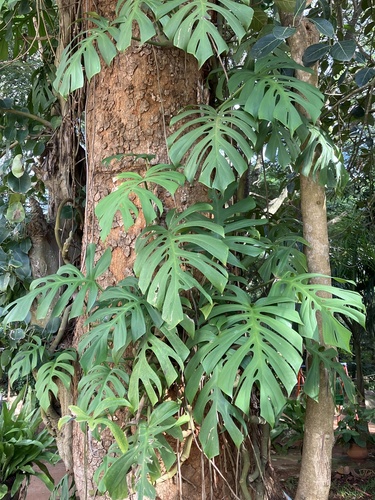

Mini monstera (Rhaphidophora tetrasperma) develops deeply divided leaves on a tropical climbing stem. Its aerial roots cling to supports; this Asian member of the Araceae is related to monsteras but belongs to a different botanical genus.
Read moreMini monstera and Dwarf monstera


© photo
(c) Vijay Anand Ismavel, some rights reserved (CC BY-NC), uploaded by Vijay Anand Ismavel · cc-by-nc
Wikimedia Commons · CC BY-SA or Public Domain
Wikipedia · CC BY-SA
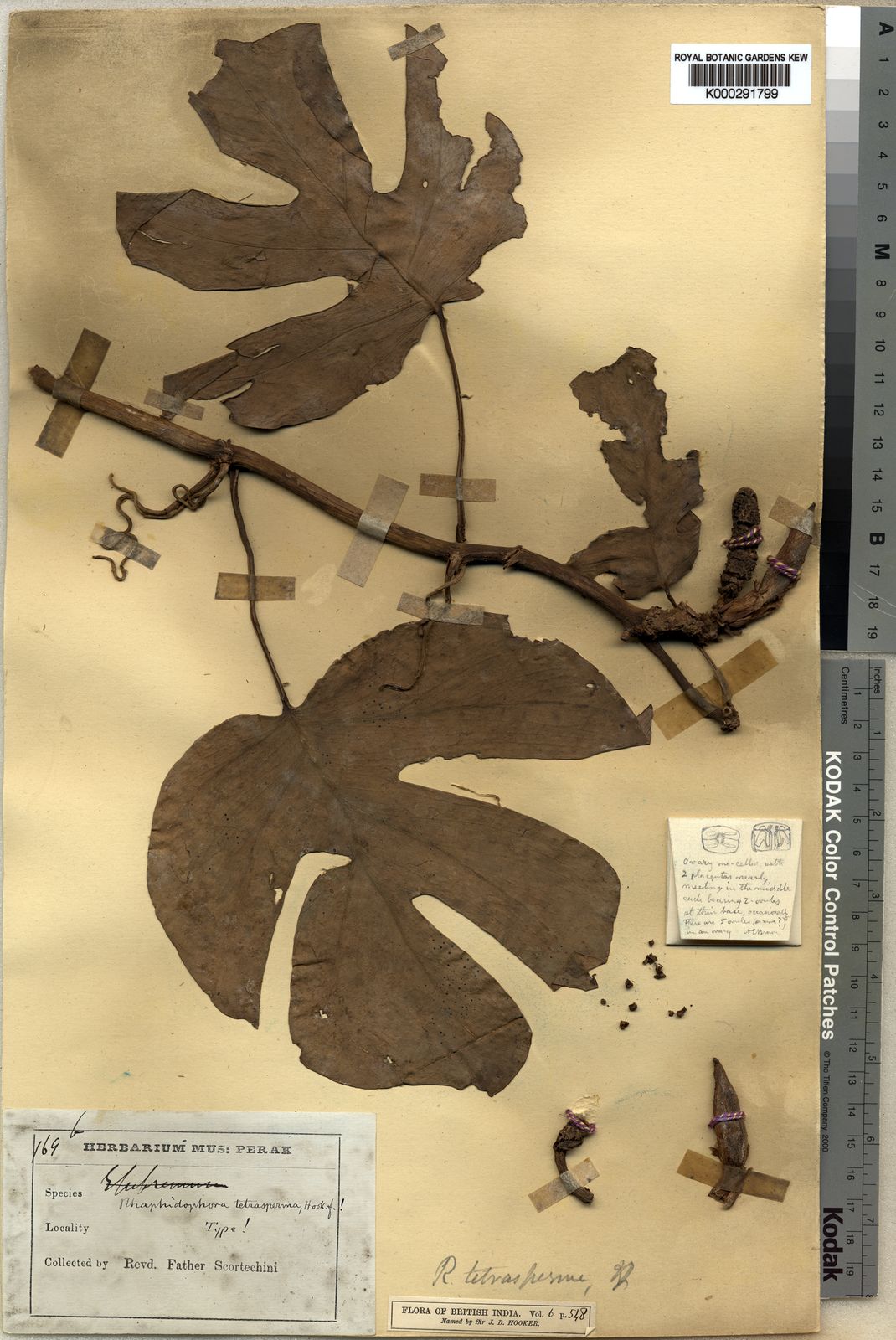
© copyright of the Board of Trustees of the Royal Botanic Gardens, Kew.




Global distribution
Native range described in Peninsular Malaysia and southern Thailand.
- Native2
- Peninsular Malaysia
- Southern Thailand
Hexagons: regions where the plant occurs. Green dots: native range.↗
Identity
Mini monstera (Rhaphidophora tetrasperma Hook.f., 1893) develops divided leaves earlier than Swiss cheese plant, Monstera deliciosa, and its leaves are generally smaller. This Asian climber belongs to the genus Rhaphidophora in the Araceae family. The resemblance to a monstera does not change its botanical placement. 1 9
"Mini monstera" also appears in French-language nursery use. The word "mini" does not mean that the plant is a dwarf: the botanical description records stems reaching 5 m (16 ft) in the wild. Sizes quoted for plants grown in pots therefore do not describe the species' maximum length in its natural habitat. 6 5
Recognition
Mini monstera's deeply divided leaves have cuts extending inward from the blade's edge. Perforations near the midrib may also develop. The blade is broadly oval to ovate-lanceolate and thinly leathery. Juvenile and mature leaves do not necessarily have the same shape, so leaf development needs to be considered when comparing specimens. 5
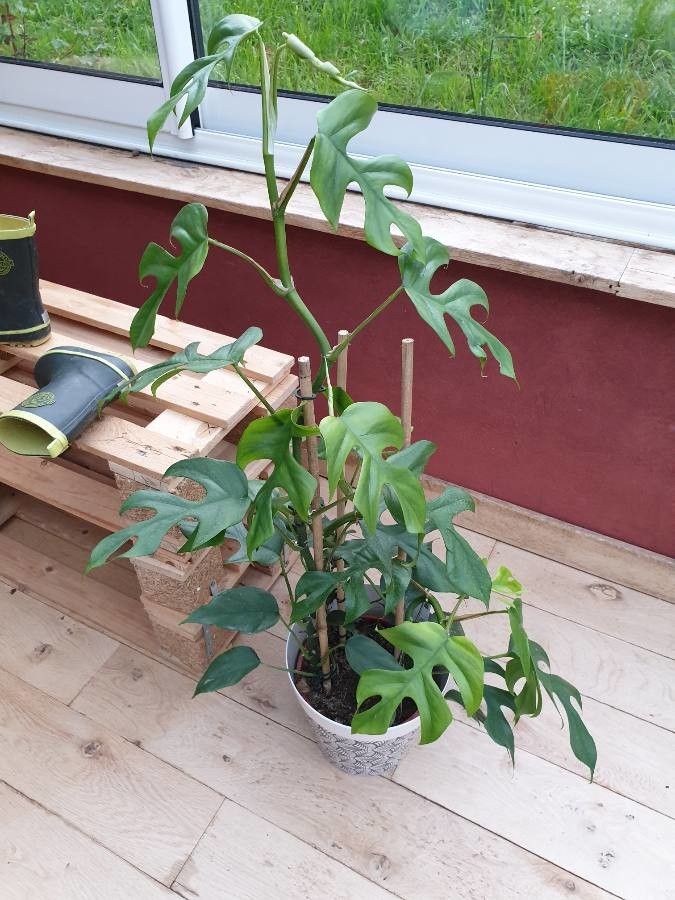
Relatively slender green stems produce clinging aerial roots that anchor the vine to supports. A trellis or moss pole accommodates mini monstera's climbing habit indoors. A hanging container allows the stems to trail instead. Mini monstera retains its foliage and grows rapidly when growing conditions suit it; a trailing plant and a supported climber can therefore have different outlines while belonging to the same species. 1
Useful taxonomy
The accepted name is Rhaphidophora tetrasperma Hook.f.. Joseph Dalton Hooker published the name in The Flora of British India in 1893. The publication date does not establish when mini monstera was discovered. The author abbreviation Hook.f. identifies the botanist responsible for the name. 8 9
The name Monstera minima is recorded as misapplied to mini monstera; it does not represent an accepted transfer into Monstera. The trade names "Philodendron Ginny" and "Piccolo" do not make the plant a philodendron either. On a label, the binomial Rhaphidophora tetrasperma identifies the species more precisely than these horticultural names. 2 1
Habitat and range
Mini monstera is native to Peninsular Malaysia and southern Thailand. The botanical revision records it in the Malaysian states of Kelantan and Perak, among other localities. Plants sold or grown elsewhere demonstrate cultivation, which on its own does not extend the documented native range. 5
Wild mini monstera grows in disturbed tropical forests ranging from relatively dry to moist, on sandstone and granite, at 190–760 m (623–2493 ft) above sea level. Mini monstera’s range of wild habitats does not justify keeping a pot constantly waterlogged. Horticultural guidance for mini monstera instead recommends a well-drained mix and allowing the surface to dry between waterings. 5 1 3
Life cycle and reproduction
Mini monstera is an evergreen perennial that rarely flowers indoors. Its inflorescence has a white spadix and a cream spathe. Stem cuttings are a documented propagation method for the species, so flowering is not required to produce another cultivated plant. 1
A 2019 New Zealand assessment noted the lack of scientific descriptions of mini monstera's reproductive biology. It also reported that fruiting had not been observed on cultivated British specimens. The absence of observed fruit on those British specimens establishes neither general sterility nor an inability to produce seeds under every set of growing conditions. 4
The calendar uses relative editorial indices from zero to ten for water and growth, originally set for an indoor plant in France in the Northern Hemisphere. The figures are neither measured water volumes nor observed growth rates, and they are not universal recommendations. The seasonal contrast reflects reduced watering in fall and winter, with feeding associated with spring and summer growth. Unchecked repotting months prohibit no intervention: no compulsory month has been established. Readers in other climates or hemispheres should apply the seasonal advice to local growing conditions. 7 6
Uses and risks
Mini monstera grows indoors in bright indirect light; direct sun can scorch its leaves. The potting mix must drain freely. Reducing watering in winter helps avoid leaving the roots in persistently wet conditions. Yellow leaves can accompany either excess water or inadequate light, so yellowing alone does not identify one cause. 1 3
Houseplant fertilizer can support spring and summer growth. Published nursery feeding schedules differ, and no universal dose, numerical NPK formula or frequency is adopted here. The calendar marks a possible feeding season; feeding still depends on the plant's condition. 6 7
Calcium oxalate crystals make ingestion irritating to humans, cats and dogs. Chewing can cause oral irritation, drooling and difficulty swallowing; contact can also irritate the skin. Keep mini monstera out of reach of children and affected pets, and wear gloves when handling it. The risk to horses and other animals is not characterized by the information used here, which does not establish safety for those animals. 1
Varieties, look-alikes and related plants
The horticultural name ‘Variegata’ is documented for a variegated form with deeply toothed leaves. Evidence that the name is used does not establish official registration, stable variegation or commercial rarity. "Mini monstera" remains a common name for the species rather than the name of a miniature cultivar. 1 6
The leaf stalk helps distinguish mini monstera from Rhaphidophora nicolsonii. In mini monstera, the stalk's sheath reaches the base of the apical joint; in R. nicolsonii, the sheath ends farther down. Rhaphidophora nicolsonii also has larger, more leathery leaves. Rhaphidophora nicolsonii is a separate botanical species, so it should not be listed as a cultivar of mini monstera. 5
Main sources
The botanical revision describes mini monstera's morphology and native range; the horticultural references address growing it in a container. 5 1
- NC State Extension, Rhaphidophora tetrasperma
- Royal Horticultural Society, Rhaphidophora tetrasperma
- RHS Plants, mini monstera growing advice
- New Zealand EPA, assessment APP203950 (2019)
- P. C. Boyce, revision of Rhaphidophora in Peninsular Malaysia and Singapore (1999)
- Jardin Jasmin, Mini monstera
- Conservatory Archives, Rhaphidophora tetrasperma growing advice
- GBIF Backbone Taxonomy, Rhaphidophora tetrasperma
- IPNI, Rhaphidophora tetrasperma Hook.f.
Frequently asked questions
Is mini monstera a Monstera?
No. Rhaphidophora tetrasperma belongs to the genus Rhaphidophora in the Araceae family. Monstera minima is a name misapplied to this species.
Is mini monstera toxic to cats?
Yes. Eating it can cause oral irritation and digestive upset from calcium oxalate crystals. Keep the plant out of reach.
Should you water mini monstera on a fixed schedule?
Let the soil surface dry before watering and reduce water in winter. A monthly calendar cannot replace checking the pot.
Similar plants
If you are unsure about a plant’s toxicity, ask a botanist or veterinarian for advice.