
Velvetleaf (Abutilon theophrasti, )
Velvetleaf (Abutilon theophrasti Medik.) is an annual in the Malvaceae family, native to Central Asia and western China and now spread by agriculture across several continents. Each plant produces thousands of seeds that can remain viable in soil for more than fifty years, making it a persistent weed of corn and soybeans. Grown in China since antiquity for a jute-like fiber, it is now chiefly monitored as a regulated agricultural weed in parts of North America and Europe.
Read moreVelvetleaf and China jute
Place in full sun, with intense direct light all day long.


© photo
(c) Christian Gaisberger, some rights reserved (CC BY-NC), uploaded by Christian Gaisberger · cc-by-nc
Darius Regnier · cc0
Tom Norton · cc-by
Taken Aug 23, 2022 by Yüksel Hamza (cc-by-sa)
Taken Sep 18, 2022 by John Sycorax (cc-by-sa)
Taken Sep 22, 2022 by Loki Loki kenata (cc-by-sa)
Taken Aug 11, 2016 by Ash T (cc-by-sa)
Taken Aug 11, 2016 by enrico7961 (cc-by-sa)
© copyright of the Board of Trustees of the Royal Botanic Gardens, Kew.


Global distribution
POWO places the native range of Abutilon theophrasti in Central Asia and western China. Agriculture then carried it to several continents, partly for its textile fiber, before it became a monitored weed in North American and Central European field crops. Its occurrence in France remains localized.
- Native2
- Introduced3
- Invasive4
- China
- Central Asia
- Metropolitan France
- New Zealand
- Japan
- United States
- Canada
- Switzerland
- Central Europe
Hexagons: regions where the plant occurs. Green dots: native range.1
Identity
Velvetleaf (Abutilon theophrasti Medik., 1787), also known as China jute, is an accepted species of Abutilon in the mallow family, Malvaceae. POWO attributes the name to Medikus in 1787 and places its native range in Central Asia and western China. Its agricultural history has since carried it far beyond that original range. 1
French botanical records use the name abutilon de Théophraste, notably in the INPN. Tela Botanica confirms the species in France, including Aquitaine and Corsica. The epithet theophrasti honors the ancient Greek botanist Theophrastus, while China jute refers to its former importance as a textile crop. 2 3
Persistent seeds make velvetleaf an unsuitable garden recommendation in Western Europe. They can remain dormant in soil for more than fifty years, making an established population difficult to eradicate. Its interest lies chiefly in its history as a Chinese fiber plant and its present role as a monitored weed of field crops. 7
Recognition
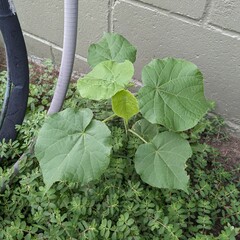
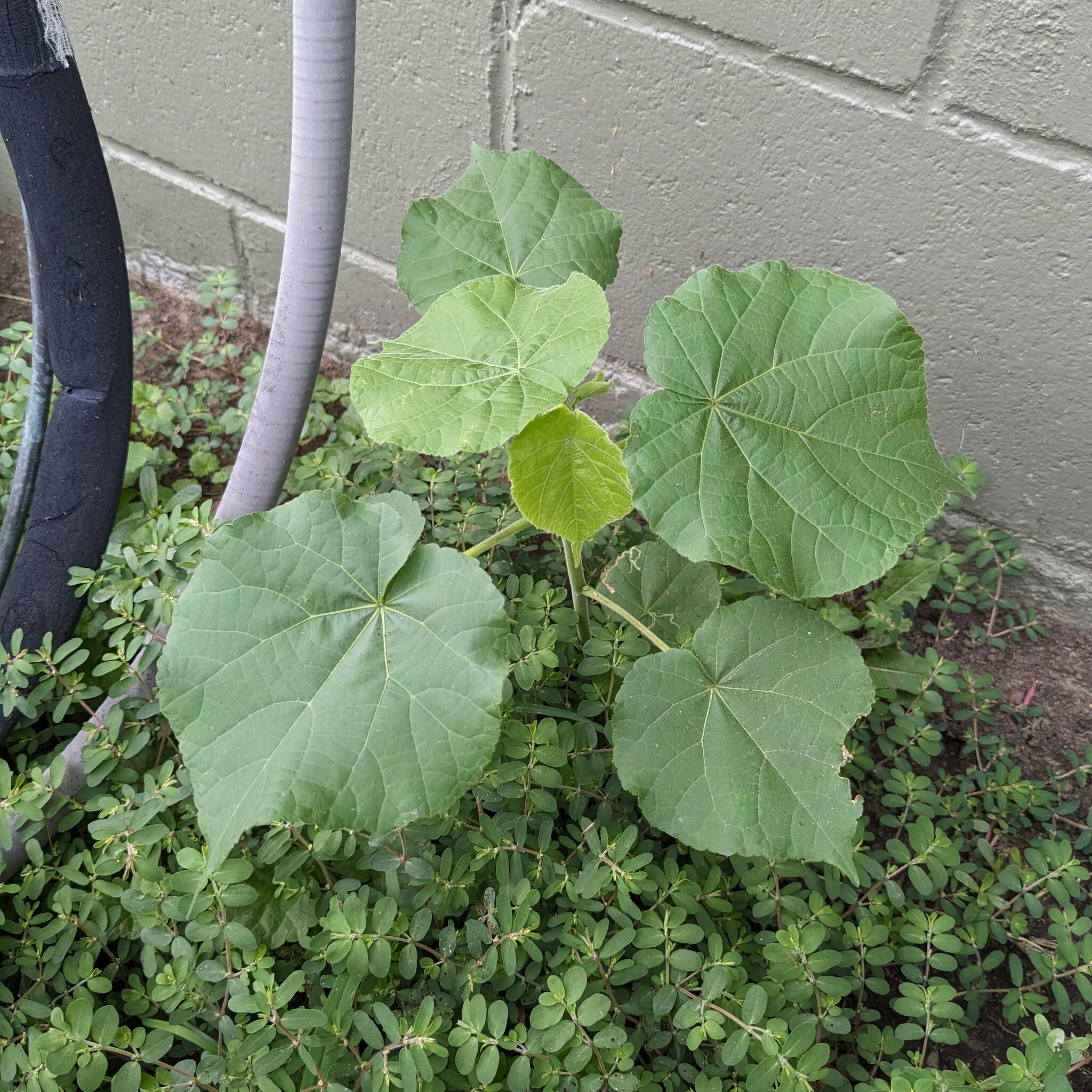
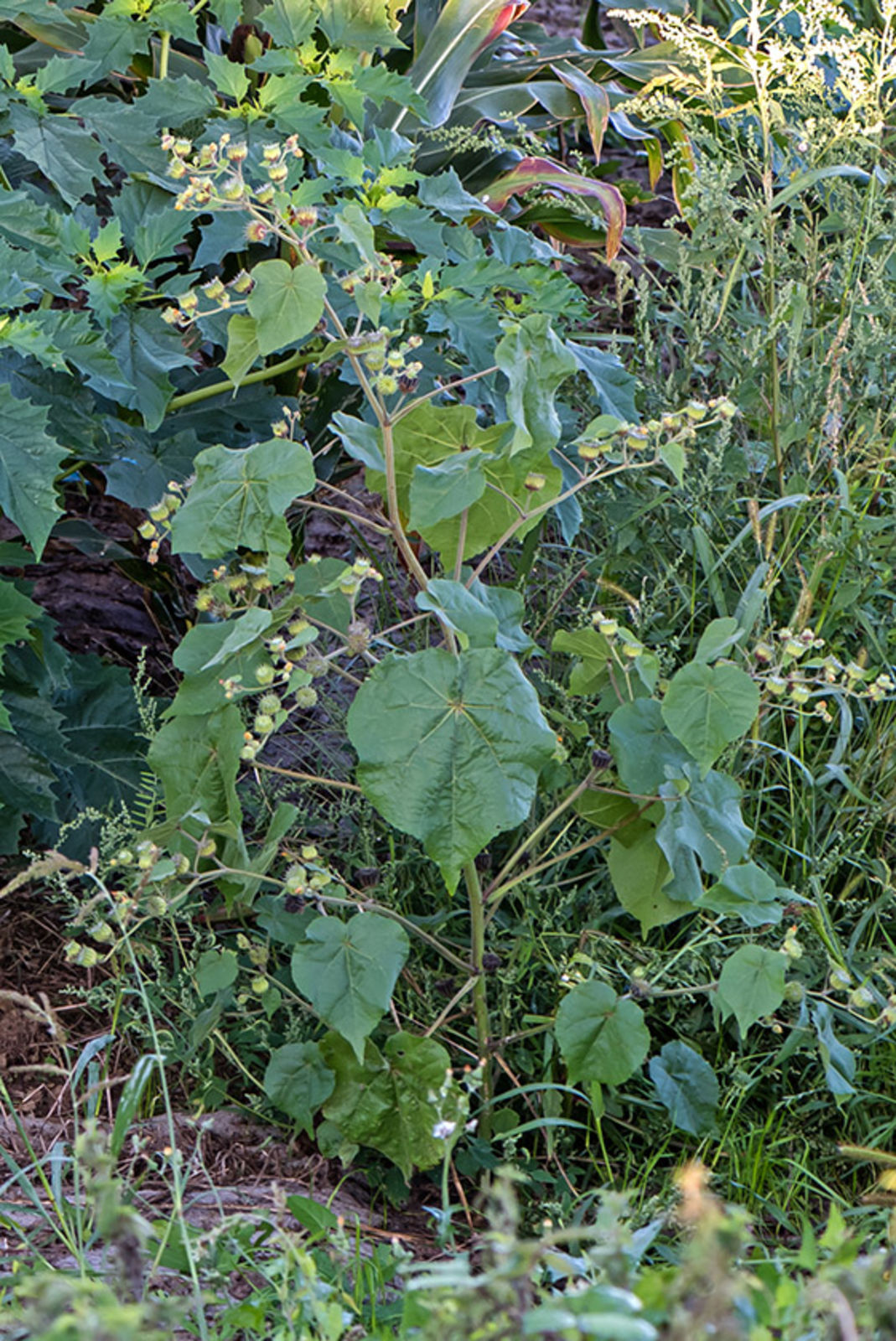
An upright, hairy, sparsely branched stem usually reaches 60 cm–1.2 m (2–4 ft), although favorable conditions can produce plants around 2.4 m (8 ft) tall. The broad, heart-shaped leaves have a soft covering of hairs, reflected in the name velvetleaf. Crushed leaves give off a strong odor, a useful additional clue when checking an identification. 4
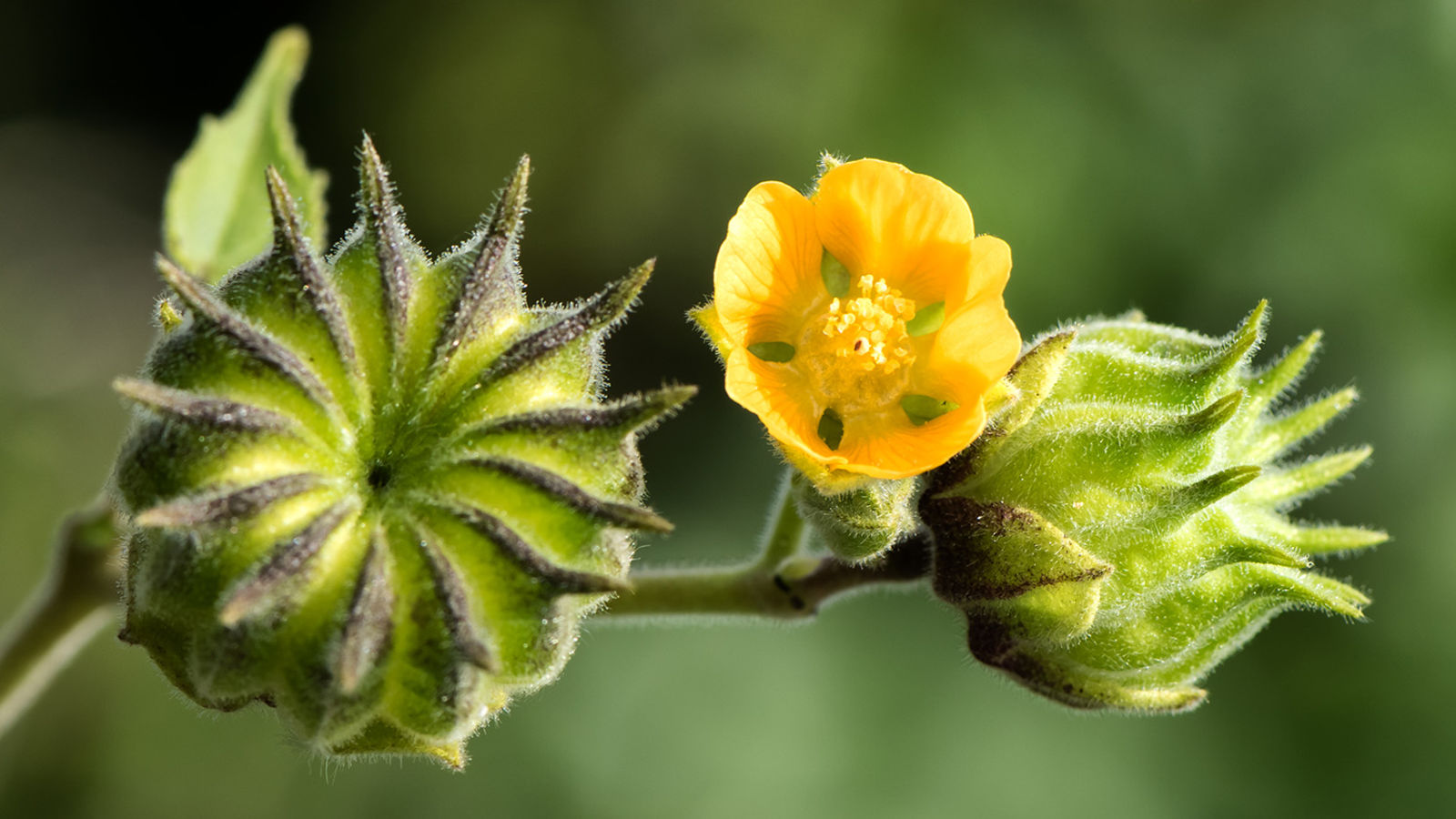
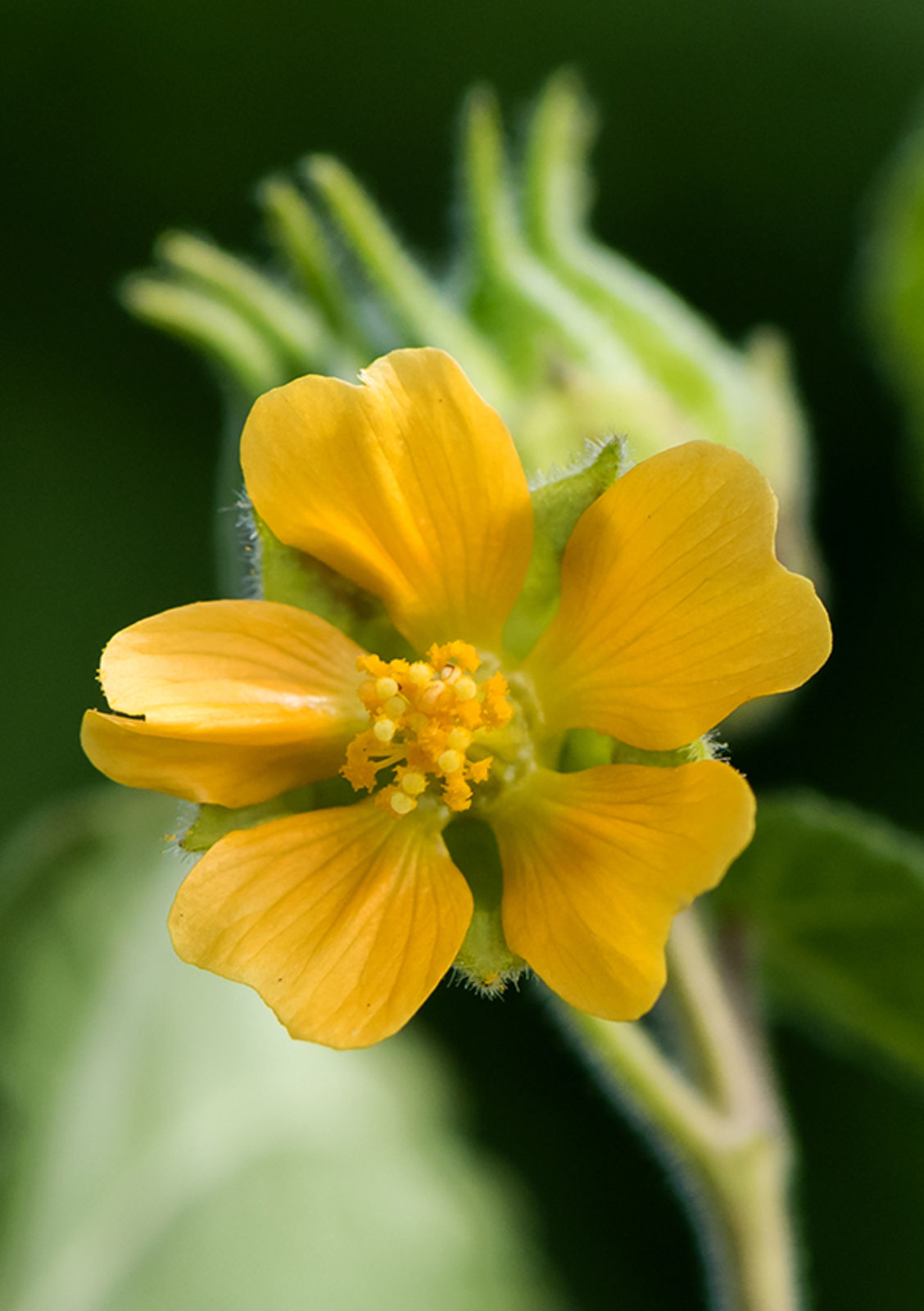
Yellow-orange flowers have five petals and measure about 1.5–2.5 cm (0.6–1 in) across. They appear singly or in small groups in the leaf axils from summer into early fall. Their small size contrasts with the broad foliage and the substantial seed capsules that follow. 4
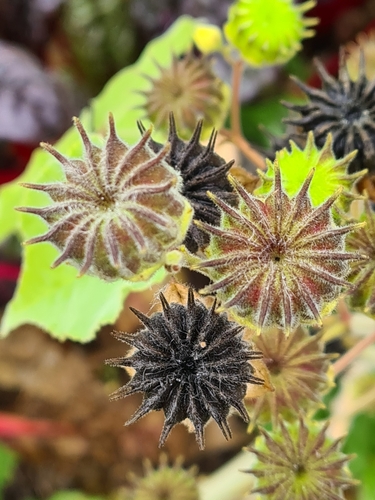
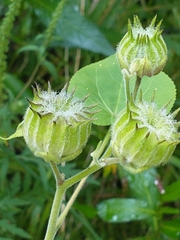
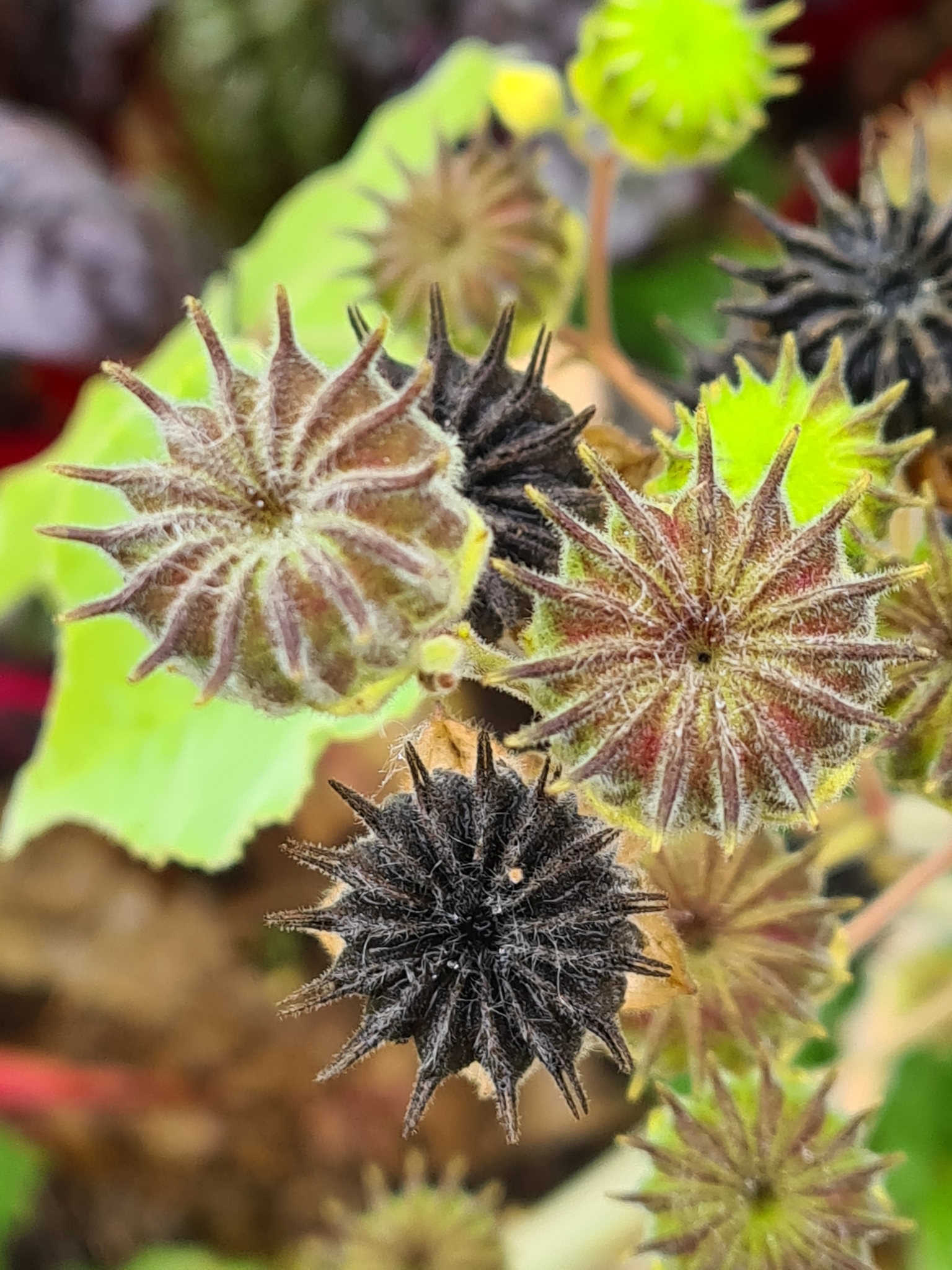
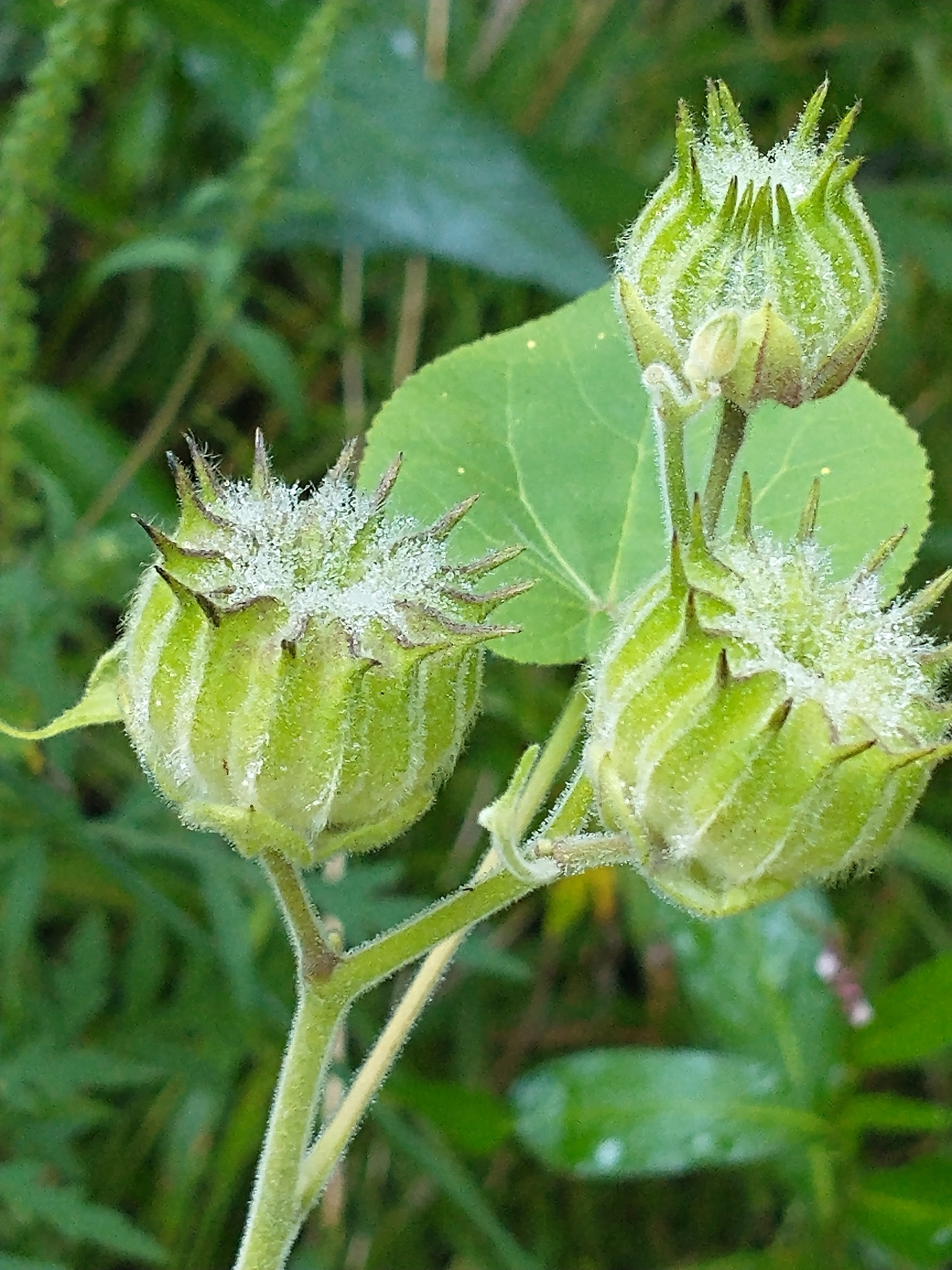
The fruit is a ribbed, crown-shaped capsule with twelve to fifteen woody chambers, each bearing points along its upper edge. It changes from green to brown and finally black as it matures. Each chamber can release several grayish, kidney-shaped seeds. The capsule's distinctive structure is more useful for identification than flower color alone. 5
Taxonomy and names
Medikus's name Abutilon theophrasti is the consistent botanical reference. POWO lists several synonyms for the same taxon: Abutilon avicennae Gaertn., Abutilon pubescens Moench, Malva abutilon (L.) E.H.L.Krause and Sida abutilon L.. The last is the earliest description in this group of names. These names refer to the same species rather than different field weeds. 1
Two botanical varieties are sometimes cited: Abutilon theophrasti var. chinense and var. nigrum. They are distinguished mainly by seed color and do not change the practical identity of the species in the field. 1
EPPO records velvetleaf under the code ABUTH in its database. This identifier is used in plant-health monitoring across Europe and provides another way to link records to the same botanical taxon. 7
Habitat and range
Central Asia and western China are the native range given for velvetleaf. Agriculture subsequently spread it across several continents, in part through deliberate cultivation for its textile fiber. Its current distribution therefore combines an original Asian range with a long history of human introduction. 1
Disturbed ground provides its characteristic habitat: waste land, construction sites, roadsides, orchards, vineyards and, especially, corn and soybean fields. In France, Tela Botanica records it in Aquitaine and Corsica without describing it as a weed widespread throughout the country. 5 3
A study published in 2014 traced its spread through Central Europe, driven by agricultural trade. The pattern resembled its expansion in North America, linking the weed's movement to exchanges associated with farming. 8
EPPO extends the native range to Mongolia. It also notes that the plant is still deliberately cultivated in some parts of the world as an ornamental or medicinal plant, contrasting with its treatment as an agricultural weed in North America. These uses and weed status describe different regional contexts. 7
Life cycle and seed production
Spring germination starts velvetleaf's annual cycle. Flowering follows in summer and early fall, and the plant dies at the first frost. In a temperate growing season, it can therefore complete its entire life cycle between spring emergence and the onset of freezing weather. 5
A single plant produces 700–17,000 viable seeds, depending on conditions. Those seeds may remain dormant and then germinate more than fifty years later, even after passing through an animal's digestive tract. Long survival explains why stopping one year's growth does not immediately exhaust the soil seed bank. 4 5
Deep plowing on its own does not solve that problem. It mainly redistributes dormant seeds toward the surface, where they can germinate once temperatures suit them. Control therefore has to account for both current plants and the seeds already present in the soil. 5
Historical uses and toxicity
Chinese cultivation for fiber dates to around 2000 BCE. Retting releases a strong, jute-like fiber that was used to make rope, coarse cloth and paper. This textile history explains why a plant now treated chiefly as a troublesome weed was once deliberately grown and transported. 4
Young leaves and seeds also served as food. The plant appears in traditional Chinese medicine for dysentery and certain eye disorders. These are historical accounts of use rather than instructions for treating those conditions. 6
No food toxicity is established for people, cats or dogs in the source account. The status for horses remains uncertain because data are lacking. That uncertainty should be retained rather than treating an absence of information as confirmation of safety. 6
Agricultural impact and regulation
Corn and soybeans face strong competition from velvetleaf for light, water and nitrogen. Yields may fall substantially if the weed is not controlled before the crop's four-leaf stage. After destruction, it also releases a compound that can slow or prevent germination of some neighboring crop seeds. 4
The cited accounts identify several US states, including Colorado, Iowa, Oregon and Washington, as listing velvetleaf as a noxious weed. In King County, Washington, they also describe a sales prohibition under the local quarantine list. These are geographically specific classifications, rather than rules applying to every English-speaking reader. 6 5
Practical management emphasizes pulling or mowing before capsules form. Deep plowing alone is insufficient: the aim is to prevent further seed production while avoiding the return of buried seeds to the surface. Seed prevention is therefore as important as removing the visible plants. 5
Look-alikes and management in France
Young velvetleaf can resemble some mallows or garden hibiscus because of its soft, heart-shaped foliage. Its ribbed, many-chambered capsule is absent in those ornamentals and remains a more reliable identification feature than flower color. That capsule structure stays consistent from one velvetleaf plant to another. 5
Within France, documented occurrences remain localized, notably in Aquitaine and Corsica. This is a different scale from Switzerland and Central Europe, where agricultural spread is better documented. The French situation should therefore not be assumed to represent the weed's importance everywhere else. 3 8
Checking the scientific name before a field diagnosis remains useful in every region. Common names can vary from place to place, whereas Abutilon theophrasti provides a consistent reference for comparing botanical and agricultural records. 2
Main sources
- Plants of the World Online / Kew, Abutilon theophrasti Medik.
- INPN, Abutilon theophrasti Medik., 1787
- Tela Botanica / BDTFX reference, Abutilon theophrasti Medik.
- University of Wisconsin Extension, Velvetleaf, Abutilon theophrasti
- King County Noxious Weeds, Velvetleaf identification and control
- Plants For A Future, Abutilon theophrasti
- EPPO Global Database, Abutilon theophrasti (ABUTH)
- Follak, Aldrian & Schwarz 2014, Spread dynamics of Abutilon theophrasti in Central Europe
Frequently asked questions
Is velvetleaf toxic?
No food toxicity is established for people, cats or dogs. Its status in horses remains uncertain because data are lacking. Young leaves and seeds have historically been eaten in China and Kashmir.
Why is velvetleaf a problem in crop fields?
It competes strongly with corn and soybeans for light, water and nitrogen, and can substantially reduce yields if not controlled before the crop reaches the four-leaf stage.
How long can velvetleaf seeds survive?
They can remain dormant in soil for more than fifty years, even after passing through an animal’s digestive tract. This makes the soil seed bank very difficult to exhaust.
Where does velvetleaf come from?
It is native to Central Asia and western China. Agriculture later spread it elsewhere, partly through cultivation for its jute-like textile fiber.
Does velvetleaf occur in France?
Its documented presence remains localized, notably in Aquitaine and Corsica, far less extensive than in Switzerland or Central Europe.
How can I tell velvetleaf from a mallow or garden hibiscus?
The soft, heart-shaped leaves can be confusing when plants are young. The ribbed capsule with twelve to fifteen chambers, absent in those ornamentals, is the most reliable distinguishing feature.
What was velvetleaf used for historically?
It has been grown in China since antiquity for a jute-like fiber. It also served as food and in traditional remedies for dysentery and certain eye disorders.
Similar plants
If you are unsure about a plant’s toxicity, ask a botanist or veterinarian for advice.