
Southern catalpa (Catalpa bignonioides, )
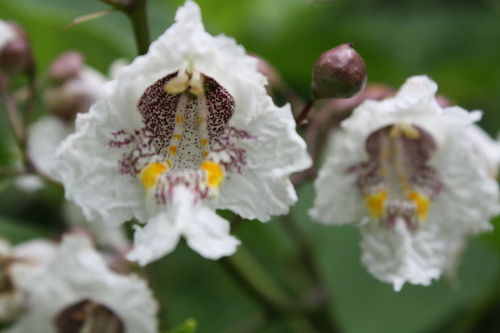

Southern catalpa (Catalpa bignonioides) is a deciduous tree in the Bignoniaceae family, native to the southeastern United States. Its large heart-shaped leaves often grow in whorls of three. White summer flowers spotted with yellow and purple are followed by long, slender pods that remain on the tree through much of winter.
Read moreSouthern catalpa, Cigartree and Indian bean tree




© photo
(c) Matthew Herron, some rights reserved (CC BY-NC), uploaded by Matthew Herron · cc-by-nc
Melissa McMasters · cc-by
Wikimedia Commons · CC BY-SA or Public Domain
Taken Nov 1, 2022 by Annemarie Ahrens-Stehle (cc-by-sa)
Taken Feb 7, 2020 by Françoise Peyrissat (cc-by-sa)
Taken Sep 10, 2020 by Dominique MALA (cc-by-sa)
Taken Aug 1, 2022 by Oğuzhan (cc-by-sa)
Taken Jul 20, 2019 by Tineke majoor (cc-by-sa)
© copyright of the Board of Trustees of the Royal Botanic Gardens, Kew.




Global distribution
Its native range is restricted to the southeastern United States, from eastern Texas to southern Georgia, with populations in Alabama, Florida, Louisiana and Mississippi. Widely introduced as an ornamental, it has spread throughout temperate Europe without a documented invasive status comparable to some other introduced North American trees.
- Native1
- Introduced1
- United States
- Metropolitan France
Hexagons: regions where the plant occurs. Green dots: native range.1
Identity
Southern catalpa (Catalpa bignonioides Walter, 1788), also called cigartree or Indian bean tree, is a deciduous member of the Bignoniaceae family. Botanist Thomas Walter described it in his Flora Caroliniana in 1788, from trees observed in the Carolinas. 1 10
The genus name Catalpa has Native American origins and was already used for this tree by early North American naturalists. The epithet bignonioides refers to flowers resembling those of Bignonia, another Bignoniaceae genus. “Indian bean tree” refers to its long hanging pods. 9 10
Recognition
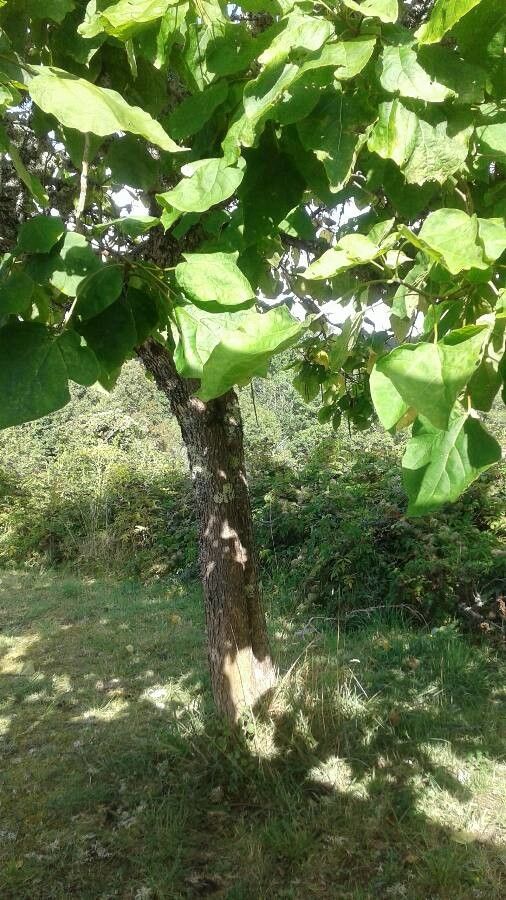
A medium-sized tree, southern catalpa usually reaches 9–12 m (30–39 ft), sometimes more in old specimens, with a 6–15 m (20–49 ft) spread. Its broad crown is irregular and rounded. Rapid growth in early years slows markedly once the main branch framework develops. 5 6
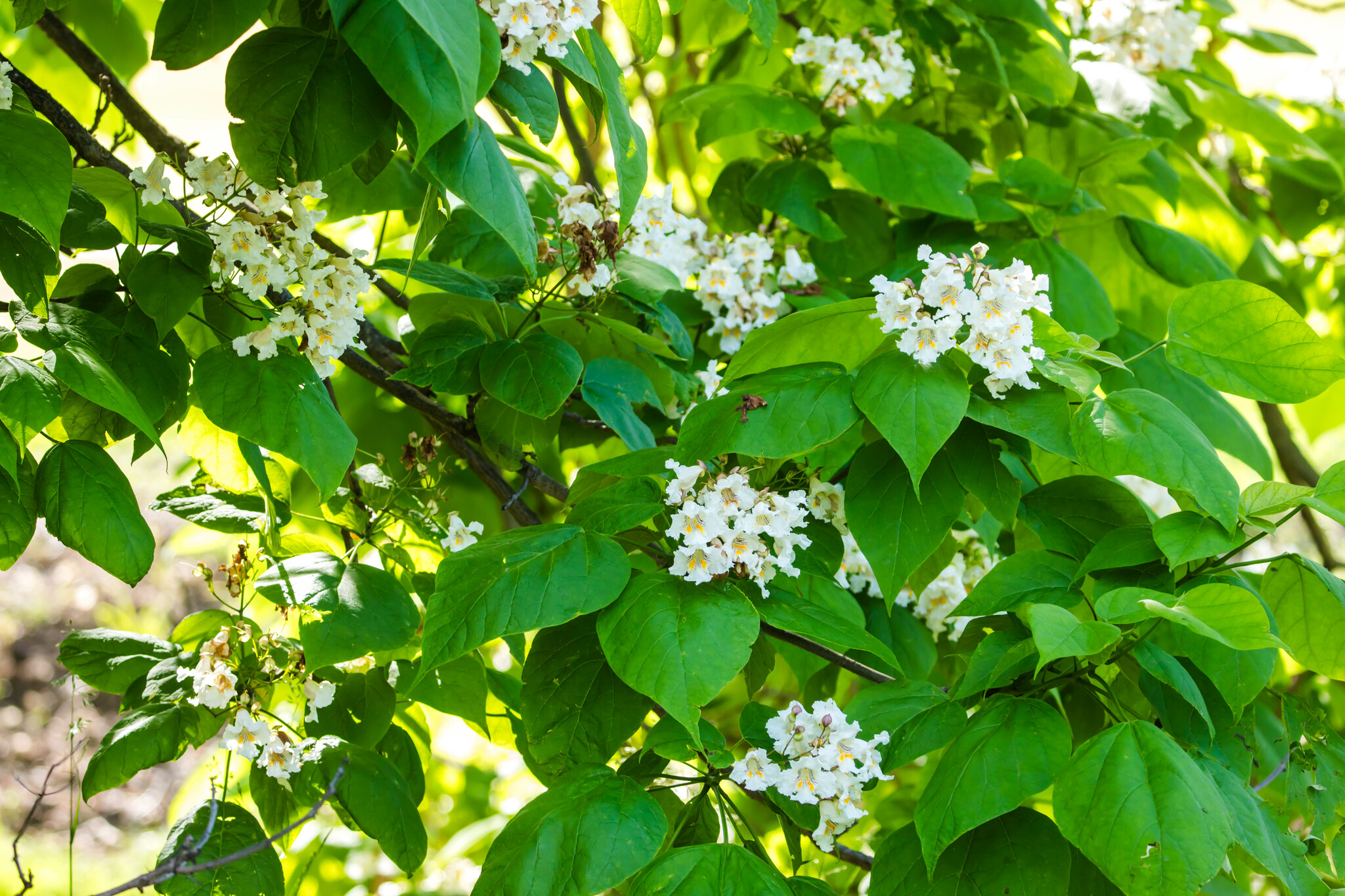
Broad leaves with heart-shaped bases and pointed tips grow opposite one another or in whorls of three on young shoots. They reach 25 cm (10 in) long and nearly 20 cm (8 in) wide. Crushed leaves release an unpleasant smell, a useful distinction from related species. 5 7
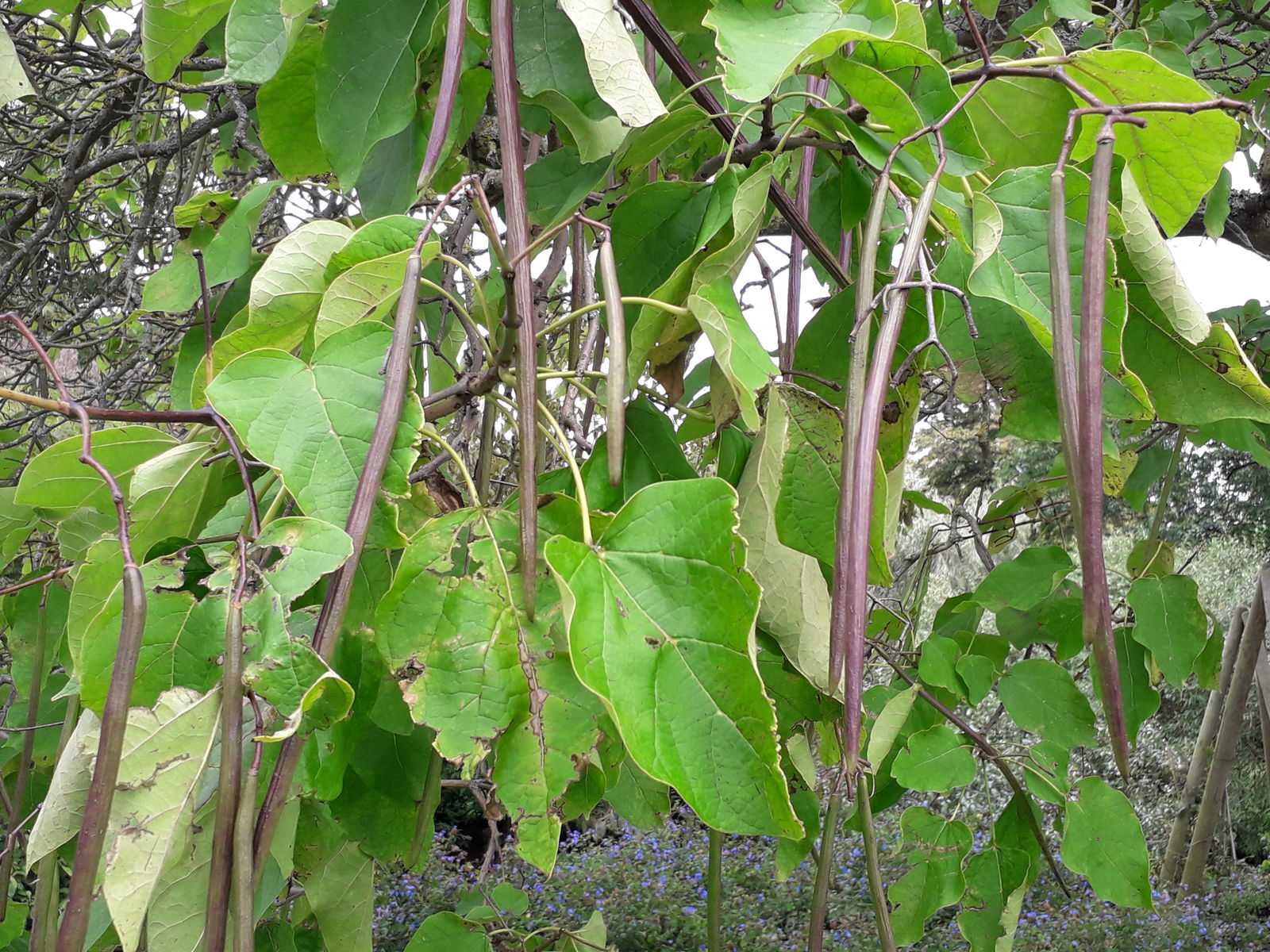
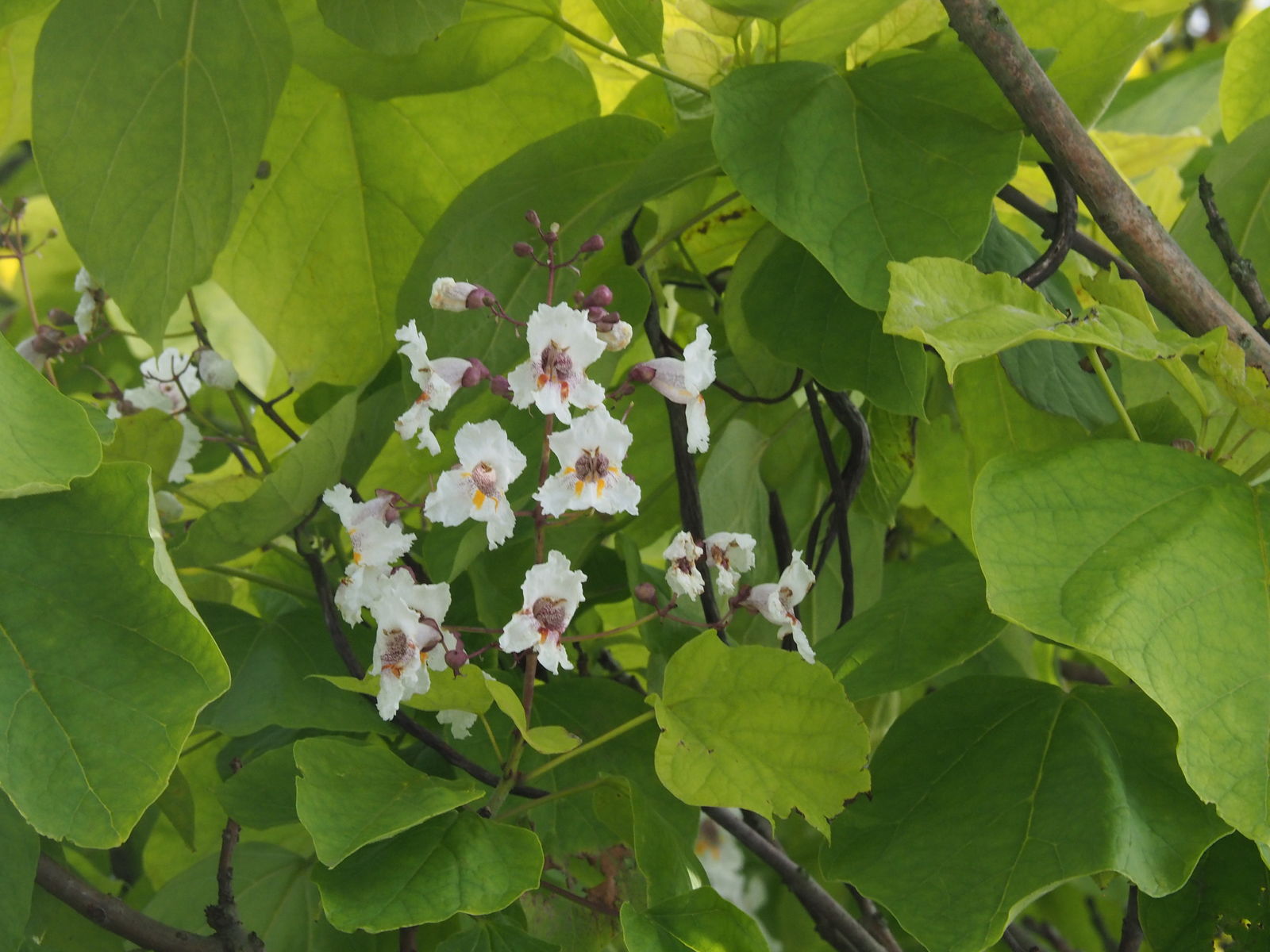
White, bell-shaped flowers have yellow and purple spots inside the tube and measure 3–4 cm (1.2–1.6 in) across. They form upright panicles 20–30 cm (8–12 in) long. The resulting slender brown pods, often 30–40 cm (12–16 in) long, stay on the tree through much of winter before splitting. 2 5
Useful taxonomy
Botanical treatment retains Catalpa bignonioides Walter as the accepted name. Historical varieties and forms now included in the species remain in synonymy, notably Catalpa bignonioides var. aurea (Mast.) Lavallée ex Bureau and Catalpa bignonioides var. variegata Bureau, rather than separate taxa. 1
The nursery name “Purpurea” creates a frequent trap. It refers to Catalpa × erubescens Carrière, a hybrid between Catalpa bignonioides and Chinese catalpa (Catalpa ovata), rather than the pure species. Young shoots offer a useful clue: purplish black in the hybrid and green in the typical species. 4
Habitat and range
Southern catalpa originates in the southeastern United States, from eastern Texas to southern Georgia, including populations in Alabama, Florida, Louisiana and Mississippi. It grows naturally in moist, rich soil along rivers and in lowland floodplain forests. 7 6
Ornamental introductions have taken this tree throughout temperate Europe, including metropolitan France, where it grows in parks, yards and street plantings. In these introduced regions it remains primarily cultivated, without a documented invasive status comparable to some other introduced North American trees. 8 9
Life cycle and reproduction
In Northern Hemisphere temperate climates, southern catalpa flowers in June and July, two to three weeks later than Catalpa speciosa, with flowers more heavily spotted in purple. This timing helps distinguish flowering trees of the two species. The nectar-bearing flowers attract bees and yield a valued honey. 2 7
Pods take several months to ripen, turning brown in fall before splitting lengthwise to release winged, round-ended seeds dispersed by wind. Cultivated trees are propagated mainly by seed, less often by root cuttings, or by grafting to preserve a cultivar such as Aurea. 5 2
Uses and risks
Planting for ornament is the main use: a street tree or specimen in a large garden or park, valued for summer flowers and strikingly large leaves. Its light wood resists decay in contact with soil and was historically used for fence posts. 6
Fallen flowers, leaves and pods require regular cleanup, particularly beside paths and patios. General veterinary sources report no known toxicity to cats or dogs. Its status remains uncertain for horses because reliable information is lacking. 7
The catalpa sphinx caterpillar (Ceratomia catalpae) is the main pest. In some years it can strip a tree within days without killing it. Verticillium wilt and late-summer powdery mildew also affect catalpa. Its relatively soft wood breaks in strong winds, especially where large branches have weak attachments. 7 6
Varieties, look-alikes and related plants
Golden foliage at budbreak, becoming yellow-green in summer, distinguishes ‘Aurea’, one of the commonly grown nursery cultivars. It holds the Royal Horticultural Society Award of Garden Merit. ‘Nana’ is a dwarf, non-flowering form, often top-grafted to make a compact urban street tree without a notable floral display. 3
Crushed foliage helps separate southern and northern catalpa: Catalpa speciosa has a scent described as “green” and a notched lower corolla lobe, whereas C. bignonioides smells unpleasant and has an entire lobe and more densely spotted flowers. Paulownia is easier to distinguish: its leaves grow in opposite pairs rather than whorls of three, and its purple flowers appear before the leaves in spring, unlike catalpa’s white summer flowers. 2 10
Main sources
- Plants of the World Online / Kew, Catalpa bignonioides Walter
- Royal Horticultural Society, Catalpa bignonioides details
- Royal Horticultural Society, Catalpa bignonioides 'Aurea'
- Royal Horticultural Society, Catalpa x erubescens 'Purpurea'
- Missouri Botanical Garden Plant Finder, Catalpa bignonioides
- University of Florida IFAS Extension, Catalpa bignonioides - Southern Catalpa
- NC State Extension Plant Toolbox, Catalpa bignonioides
- INPN / MNHN, Catalpa bignonioides
- Tela Botanica, BDTFX reference - Catalpa bignonioides
- French Wikipedia, Catalpa bignonioides
Frequently asked questions
Is southern catalpa poisonous to cats and dogs?
General veterinary sources report no known toxicity to cats and dogs for Catalpa bignonioides. Its status for horses remains uncertain because reliable information is lacking.
How can I distinguish Catalpa bignonioides from Catalpa speciosa?
Crushed Catalpa bignonioides leaves smell unpleasant, while those of Catalpa speciosa have a greener scent. Southern catalpa flowers are more densely spotted with purple and open about two to three weeks later.
Why do crushed catalpa leaves smell bad?
The unpleasant smell of crushed Catalpa bignonioides leaves is a recognized characteristic that helps distinguish it from Catalpa speciosa, whose crushed foliage has a scent described as green.
Is the cultivar Purpurea really Catalpa bignonioides?
The trade name Purpurea most often refers to Catalpa x erubescens, a hybrid between Catalpa bignonioides and Chinese catalpa, Catalpa ovata, with dark purplish-black young shoots. It is not the pure species despite sometimes being sold under that label.
Is southern catalpa invasive in France?
No invasive status is documented for Catalpa bignonioides in metropolitan France, where it remains primarily a cultivated park, yard and street tree, unlike some other introduced North American trees.
What are the long catalpa pods for?
The slender brown pods, which give the tree its name cigartree, ripen in fall and remain on the branches through much of winter. They then split lengthwise to release winged seeds carried by the wind.
How do I propagate southern catalpa?
Seed is the simplest method for the species, using moist, warm soil. Root cuttings can also reproduce the parent tree faithfully, while grafting preserves cultivars such as Aurea or Nana.
Similar plants

If you are unsure about a plant’s toxicity, ask a botanist or veterinarian for advice.