
Never Never Plant (Ctenanthe setosa, )


Never Never Plant (Ctenanthe setosa) has long, silver leaves striped with dark green, purple undersides and downy leaf stalks. This Brazilian perennial needs filtered light and a moist potting mix that lets excess water drain away.
Read moreNever Never Plant
Phrynium setosum, Maranta setosa, Myrosma setosa, Stromanthe setosa, Thalia setosa, Phrynium hirsutum and Phrynium thyrsiflorum
Give plenty of ambient light without direct sun on the leaves.
Bright, filtered light; protect from direct summer sun.


© photo
(c) laasen_germany, some rights reserved (CC BY-NC) · cc-by-nc
Wikimedia Commons · CC BY-SA or Public Domain
Taken Aug 7, 2022 by Dave Flack (cc-by-sa)
© copyright of the Board of Trustees of the Royal Botanic Gardens, Kew.


Global distribution
Native to eastern and southern Brazil, in the wet tropical biome.
Identity
Never Never Plant (Ctenanthe setosa (Roscoe) Eichler, 1884) is recognizable by its elongated silver leaves striped with dark green, carried on long, downy leaf stalks. Purple undersides complete the combination of traits that distinguishes it from other Marantaceae grown for their foliage. The species belongs to the family Marantaceae and the order Zingiberales. 4 1
Never Never Plant is a rhizomatous evergreen perennial grown in pots in temperate regions. A bright room or shaded conservatory suits it better than a window in direct sun. “Ctenanthe” is used as a French common name; “never never plant” is an English name. 5 2
Recognition
In Ctenanthe setosa, the oblong to lance-shaped leaf blade tilts at the end of an upright leaf stalk. The upper surface has dark green veins and bands on a pale, silvery-green background; the underside is purple. Examining both surfaces avoids relying on the silver pattern alone, which several related plants share. 4 3
Height depends on growing conditions. Binette & Jardin gives 60–70 cm (24–28 in) in homes, whereas NParks describes a horticultural clump 1–2 m (3.3–6.6 ft) tall in tropical conditions. The RHS also describes a vigorous plant that can approach the latter height. A small potted specimen therefore does not represent the species' maximum size. 5 3 2
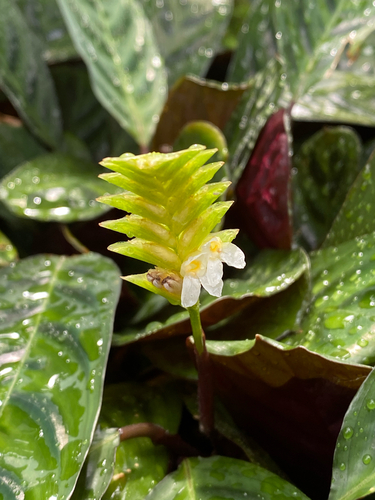
The small, pale yellow flowers are inconspicuous and may appear at different times of year. Their modest appearance explains why the leaves attract most attention; assigning a single flowering season does not accurately describe this species. 2
Useful taxonomy
Ctenanthe setosa is an accepted species name in POWO. The current combination was published in 1884. The earlier name Phrynium setosum Roscoe, published in 1828, is the basionym: the same taxon has changed genus. The parentheses around Roscoe in the botanical authority record that nomenclatural history. 1
Synonyms include Maranta setosa (Roscoe) A.Dietr., Myrosma setosa (Roscoe) Benth. and Stromanthe setosa (Roscoe) Gris. These older names refer to the species rather than to separate cultivars. POWO also provisionally includes Maranta secunda Graham in the synonymy; that placement remains tentative. 1
Habitat and distribution
The native range of Ctenanthe setosa lies in eastern and southern Brazil. POWO records native occurrences in Brazil's Northeast, Southeast and South regions. The associated biome is wet tropical; horticultural descriptions identify a terrestrial plant of the forest understory. 1 3 4
Ornamental cultivation extends beyond that native range. In Singapore, NParks suggests Never Never Plant for parks and gardens, including as a planting screen. This tropical outdoor use differs from the protected cultivation the RHS recommends in the British climate, where the species is considered cold-sensitive. Outdoor suitability therefore depends on the local climate. 3 2
Life cycle and propagation
Dividing clumps in spring is a documented way to propagate Ctenanthe setosa. Each division needs to retain leaves and roots; keep the new plants warm and humid until established. Spring sowing is also possible, at 19–24 °C (66–75 °F) according to the RHS. 4 2
The calendar retains a metropolitan French indoor-growing reference, translating seasonal care into relative indices. Its water and growth values are not measured volumes. In other climates or hemispheres, interpret care through local seasons and the plant's actual growth. The RHS species entry advises repotting in late spring or early summer; Binette & Jardin gives the broader season of spring. 2 5
The RHS recommends liquid fertilizer monthly in spring and summer. Its shared guide for Ctenanthe, Goeppertia and Stromanthe extends this period from April to September in its Northern Hemisphere context. That group-level advice explains September feeding in the calendar; it does not describe flowering or the wild life cycle of C. setosa. 2 6
Uses and risks
Never Never Plant is grown as an ornamental foliage plant. Gerbeaud gives an ideal growing temperature of 18–24 °C (64–75 °F). Filtered light protects the leaves: direct sun can cause curling and scorching. A humus-rich, free-draining potting mix retains moisture while allowing excess irrigation water to escape. 3 4
Where winter brings slower growth, water less often without allowing the root ball to dry out completely. The RHS group guide recommends emptying water that collects in the decorative outer pot, because submerged roots can rot. Mealybugs are another problem to watch for on this species. 6 2
The species-specific toxicity status remains unknown for every audience: cats, dogs, horses, children, adults and other animals. No toxic substance or symptoms specific to the species have been established. A botanical relationship to a plant classified as non-toxic is insufficient to establish the safety of Ctenanthe setosa.
Varieties, look-alikes and related plants
“Greystar” remains an unresolved name in the RHS entry, which places it under Ctenanthe without a species name. This entry does not establish it as a confirmed cultivar of C. setosa or justify assigning traits of a horticultural selection or hybrid to the species. 7
Among look-alikes, Ctenanthe burle-marxii has a compact habit and reaches 40–60 cm (16–24 in) in Binette & Jardin's horticultural description. Ctenanthe lubbersiana has irregular yellow blotches and pale green leaf undersides, contrasting with the purple undersides of C. setosa. In Ctenanthe oppenheimiana, the silvery markings form V-shaped patterns. The trade name “calathea” is therefore insufficient to identify the species. 5 3 6
Main sources
POWO documents the accepted name and native range of Ctenanthe setosa. The horticultural references distinguish the species' characteristics and cultivation from advice shared with related plants.
- Kew, Plants of the World Online, Ctenanthe setosa
- Royal Horticultural Society, Ctenanthe setosa
- NParks, Flora & Fauna Web, Ctenanthe setosa
- Gerbeaud, Ctenanthe setosa: cultivation and care
- Binette & Jardin, Ctenanthe (Ctenanthe setosa), a relative of Calathea
- Royal Horticultural Society, How to grow calatheas
- Royal Horticultural Society, Ctenanthe 'Greystar'
Frequently asked questions
How do I identify Never Never Plant?
Look for long, downy leaf stalks, elongated leaves patterned in dark green on a silver background, and purple undersides.
How tall does Never Never Plant grow indoors?
Binette & Jardin gives a usual indoor height of 60–70 cm (24–28 in). Tropical horticultural dimensions are larger and refer to different growing conditions.
When should I propagate Never Never Plant?
Divide the clump in spring, keeping leaves and roots on each section. Keep the divisions warm and humid.
Is Never Never Plant safe for cats?
Its species-specific status for cats remains unknown here, as it does for dogs, horses and humans. Being related to a plant classified as non-toxic does not establish safety.
Similar plants
If you are unsure about a plant’s toxicity, ask a botanist or veterinarian for advice.