
Snake Ragwort (Curio repens, )
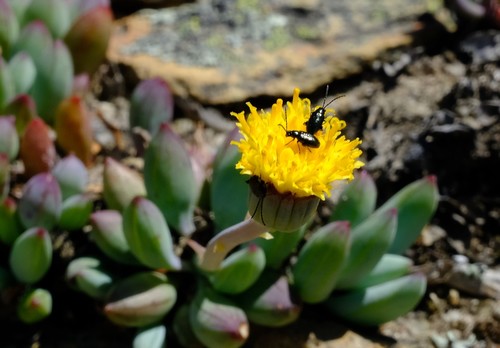

Snake Ragwort (Curio repens) is a creeping succulent with cylindrical blue-gray leaves. Its stems root on contact with the ground; in pots, light and a growing medium that dries between waterings preserve its compact shape.
Read moreSnake Ragwort, Blue Chalksticks and Blue Toes
Cacalia repens, Kleinia repens, Senecio serpens, Senecio succulentus, Cacalia glauca and Notonia glauca
Allow a few hours of direct sun per day, preferably morning or evening.
Sun to partial shade; favor partial shade in intense heat.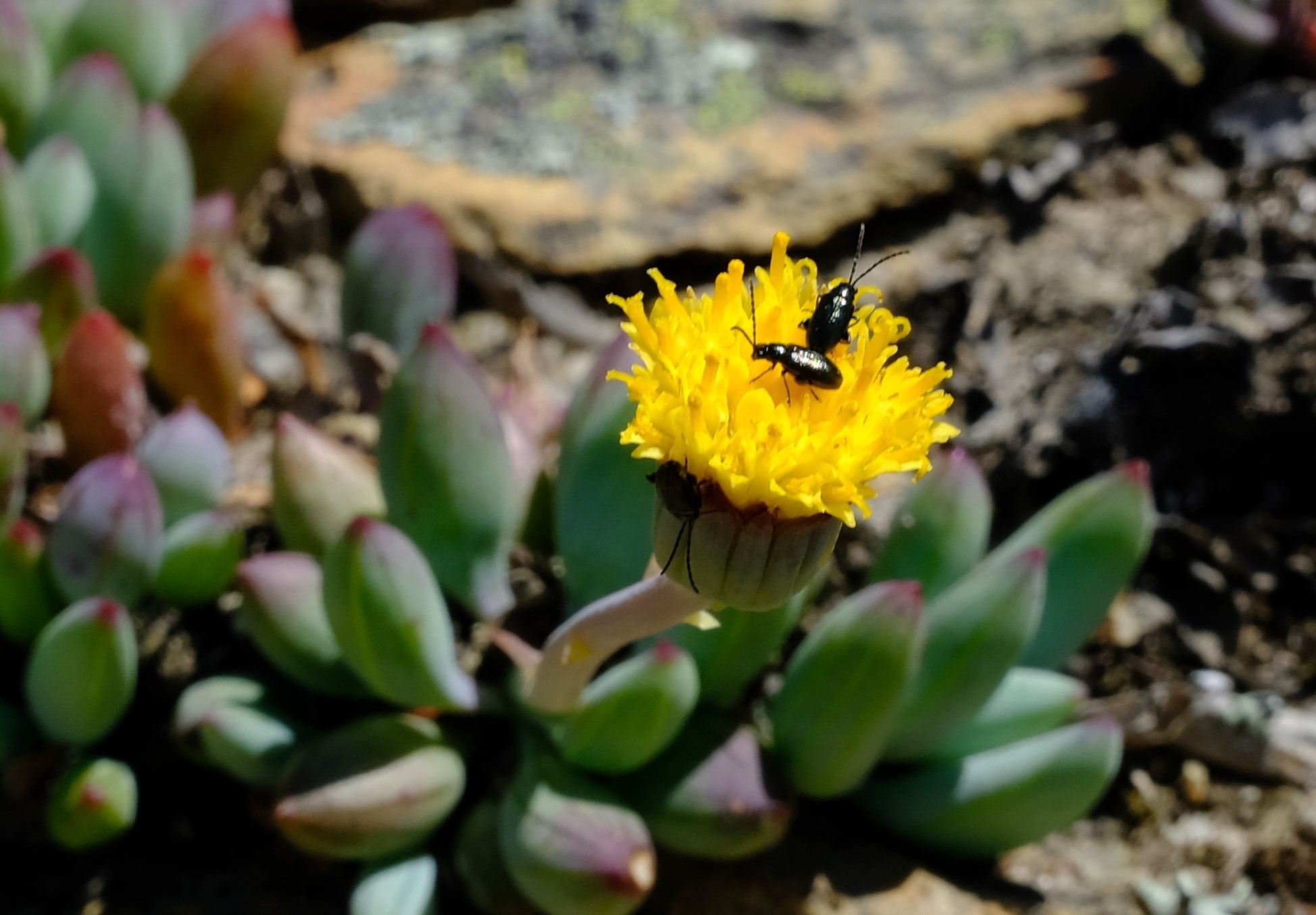


© photo
(c) Nick Helme, some rights reserved (CC BY-NC), uploaded by Nick Helme · cc-by-nc
Wikimedia Commons · CC BY-SA or Public Domain
Wikipedia · CC BY-SA
© copyright of the Board of Trustees of the Royal Botanic Gardens, Kew.
Global distribution
Native to the Cape Provinces; introductions reported in Angola, the Azores and New Zealand's South Island.
- Native1
- Introduced3
- South Africa
- Angola
- Azores, Portugal
- South Island, New Zealand
Hexagons: regions where the plant occurs. Green dots: native range.1
Identity
Snake Ragwort (Curio repens (L.) P.V.Heath, 1997) is a creeping succulent with cylindrical blue-gray leaves. This small subshrub belongs to the Asteraceae, the daisy family. The French name “séneçon serpent” appears in the botanical inventory of Castle Hill in Nice, under the older scientific name Senecio serpens G.D.Rowley. 1 5
The Latin epithet repens means “creeping”: the stems spread and root on contact with the ground. This growth habit explains the use of Snake Ragwort as ground cover and its tendency to spill over container edges. The evergreen foliage provides most of its decorative appeal. 2 3
Recognition
Snake Ragwort forms a low mat about 15 to 20 cm (6 to 8 in) tall. NC State gives a spread of around 0.6 to 0.9 m (2.0 to 3.0 ft) in cultivation; the space occupied therefore depends more on stem extension than height. Overall growth is slow. 2
The fleshy leaves, held upright on prostrate shoots, measure approximately 2 to 3 cm (0.75 to 1.25 in) long. Their color combines blue with silvery green. Young stems are green, later turning gray; older parts retain scars from fallen leaves. To recognize the plant, consider its cylindrical leaves and creeping habit together, rather than blue coloring alone. 2
Taxonomy and similar plants
The accepted name is Curio repens (L.) P.V.Heath, a combination published in 1997. Its basionym, Cacalia repens L., dates from 1767. The names Kleinia repens Haw. and Senecio serpens G.D.Rowley denote the same species in Kew's synonymy. The transfer of Snake Ragwort to the genus Curio explains the coexistence of several scientific names. 1
A label bearing Curio talinoides or “mandraliscae” calls for separate identification: these names do not appear in the synonymy of Curio repens used by Kew. The dimensions or features of another blue succulent therefore do not automatically describe Snake Ragwort. 1
Habitat and distribution
Snake Ragwort is native to the Cape Provinces of South Africa. The sandy cliffs and rock crevices of its habitat anchor the roots without keeping the soil constantly wet. Kew places this species mainly in the subtropical biome. 2 1
Introductions are reported in Angola, the Azores and New Zealand's South Island. In Nice, the inventory published in 2013 lists it among the exotic plants of the site studied. This presence on a landscaped hill does not establish an invasive status across France. 1 5
Life cycle and propagation
The small white flower heads form corymbs. NC State describes summer flowering that can continue into fall; Auckland Botanic Gardens mentions late-summer flowering. The dry fruits bear a feathery pappus that helps them travel on the wind. 2 7
Stem cuttings are the recommended propagation method, although seed sowing is possible. Pruning to contain the plant or take cuttings is best done in spring. 2 3
In his gardens near Christchurch, W. R. Sykes observed brittle stems whose fragments rooted readily and could cover less vigorous plants. Collecting pieces after pruning therefore helps control spread. The author specified, however, that his observations showed no regeneration beyond the gardens concerned. 6
Care through the seasons
Snake Ragwort needs sun and effective drainage. Partial shade is suitable when heat becomes intense. In pots, use a succulent mix that lets water drain away, and wait for it to dry before watering again. The plant does not tolerate frost. 2
In winter, water less often when soil remains moist for longer. The Californian Waterwise guide adjusts watering to the season and observed moisture. Its outdoor frequencies concern established plantings in Southern California; a pot in France requires observation of its own growing medium. The seasonal calendar provides relative guidance to be adjusted to those conditions. 3
Stretched stems can indicate insufficient light. A wilted, wrinkled plant may lack water, while persistently wet growing medium encourages root rot: check the mix before changing watering. Watch for mealybugs and mites too. 2
Uses and toxicity
Snake Ragwort is used in well-drained rock gardens or containers. In Auckland, it is among the plants that performed well in a green-roof trial. That trial combined a roofing substrate with supplementary irrigation; the observed performance cannot be generalized to every roof. 3 4
Ingestion exposes people and animals to pyrrolizidine alkaloids. NC State lists loss of appetite, nausea and vomiting in humans, pets and livestock, with possible irreversible liver damage after substantial ingestion. Its low-severity indicator must not obscure this documented risk. 2
Keep the plant and fragments out of reach of children, cats and dogs, as well as horses. The warning applies to all plant parts. Effects in other animal groups are not individually characterized; safety for them cannot be inferred. 2
Main sources
Botanical synonymy connects references published under Senecio serpens with Curio repens. Garden observations remain tied to their geographical settings.
- Plants of the World Online, Curio repens (L.) P.V.Heath
- NC State Extension, Curio repens
- Chino Basin Water Conservation District, Blue chalksticks: Senecio serpens
- Bodley, Simcock and Stanley, Plant evaluations for living roofs in Auckland, 2022
- Sant and Alziar, The vascular flora of Castle Hill in Nice, 2013
- W. R. Sykes, Succulents misbehaving in my gardens, 2004
- Auckland Botanic Gardens, Best succulents for Auckland, 2019
Frequently asked questions
Can Snake Ragwort stay outdoors in winter?
Curio repens does not tolerate frost. Growing it in a pot allows it to be moved under cover when below-freezing temperatures are possible.
Why are the stems of Snake Ragwort growing longer?
Insufficient sunlight can cause etiolation, with stretched stems. Reconsider its position while retaining partial shade when heat is intense.
Is Snake Ragwort toxic to cats and dogs?
NC State reports ingestion toxicity for pets, including cats and dogs. Keep the plant and its fragments out of their reach.
Similar plants
If you are unsure about a plant’s toxicity, ask a botanist or veterinarian for advice.