
Sea squill (Drimia maritima, )
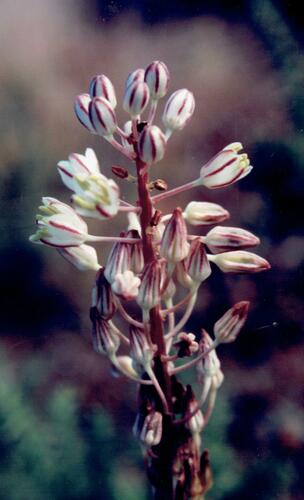
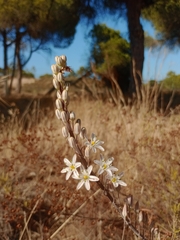
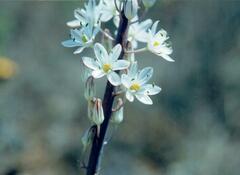
Sea squill (Drimia maritima), also called sea onion, is a perennial bulb in the Asparagaceae, subfamily Scilloideae, native to the western Mediterranean. Its large bulb often protrudes above the soil and produces a tall, bare flower stalk in late summer before the leaves appear.
Read moreSea squill, Squill, Sea onion, Maritime squill, Red squill and Urginea maritima
Allow a few hours of direct sun per day, preferably morning or evening.
Full sun; tolerates light shade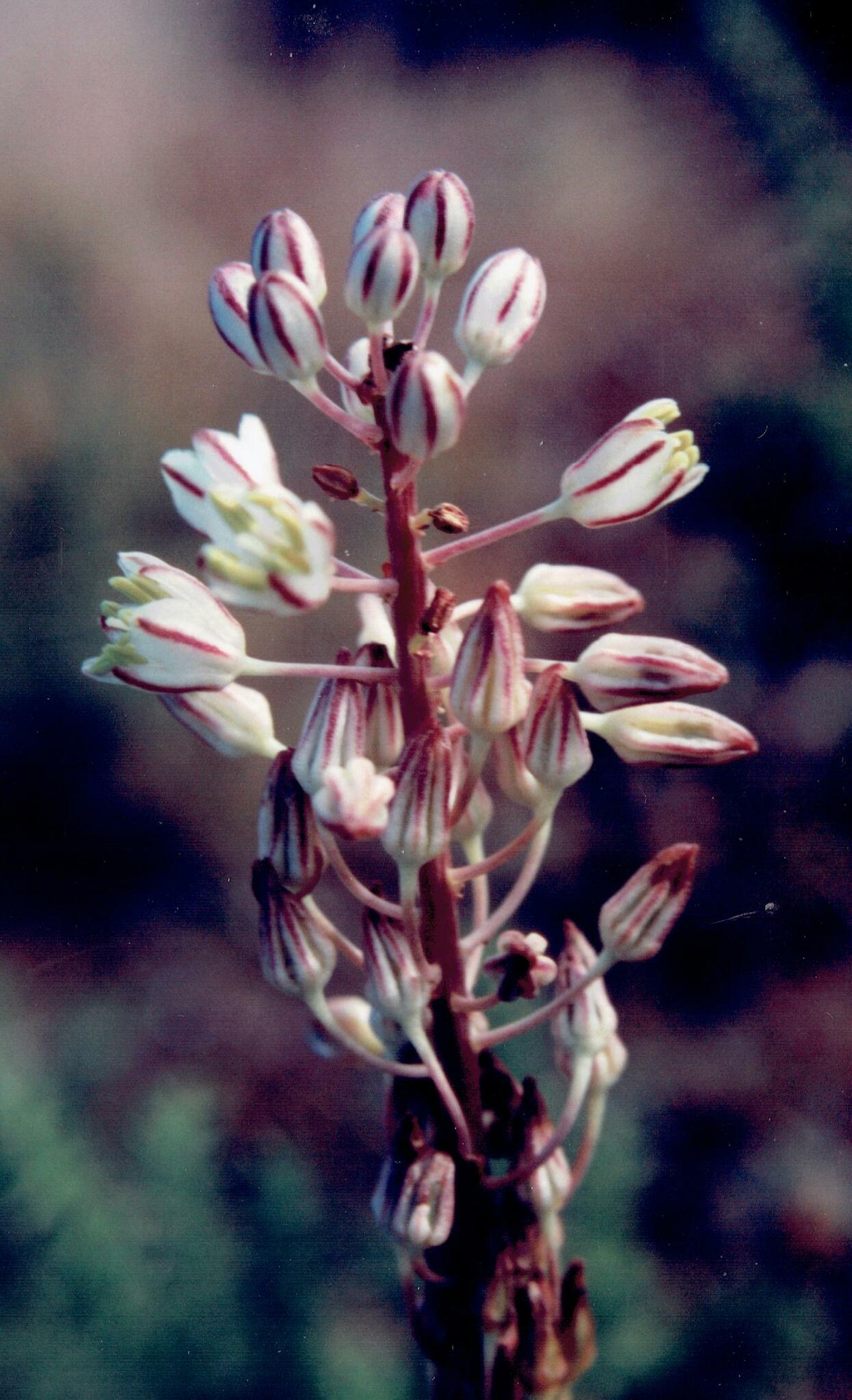



© photo
zebedeugalinha · cc-by
Duarte Frade · cc-by
Taken Sep 24, 2020 by Paco Paco (cc-by-sa)
Taken Sep 4, 2021 by laia (cc-by-sa)
Taken Sep 27, 2021 by Jean-Marc Wiederrecht (cc-by-sa)
Taken Sep 18, 2021 by Dieter Albrecht (cc-by-sa)
© copyright of the Board of Trustees of the Royal Botanic Gardens, Kew.




Global distribution
The native range of Drimia maritima in the strict sense covers the western Mediterranean, from Iberia and the Balearic Islands to southern France, Italy, Morocco and Algeria. The broader Drimia maritima complex, difficult to separate by morphology alone, is sometimes extended across the Mediterranean and the Near East, where several populations actually belong to related species.
- Native8
- Introduced2
- Spain
- Portugal
- France
- Italy
- Morocco
- Algeria
- Greece
- Israel
- United States
- India
Hexagons: regions where the plant occurs. Green dots: native range.1
Identity
Sea squill (Drimia maritima (L.) Stearn, 1978), also called sea onion, is a perennial bulb in the genus Drimia, family Asparagaceae, subfamily Scilloideae. Older classifications placed it in the Hyacinthaceae or Liliaceae. 1 8
Originally described by Carl Linnaeus in 1753 as Scilla maritima L., the species received its current combination only in 1978, from botanist William Thomas Stearn. 1 2
Medical and pharmacological writing often uses squill alongside scientific synonyms such as Urginea maritima (L.) Baker, still common in pharmacognosy. Maritime squill is another name for this same bulbous plant. 7 4
Recognition
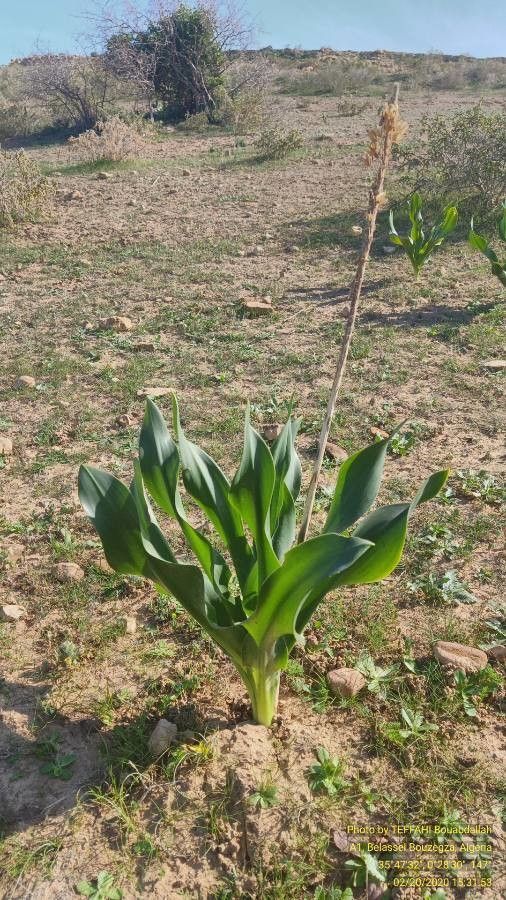
Unlike most Mediterranean bulbs, which remain buried throughout the year, the bulb of Drimia maritima protrudes well above the soil. This makes it recognizable even out of flower. It reaches 20 cm (8 in) across and 1 kg (2.2 lb) in weight, often growing in clumps on rocky coastal slopes. 2 4
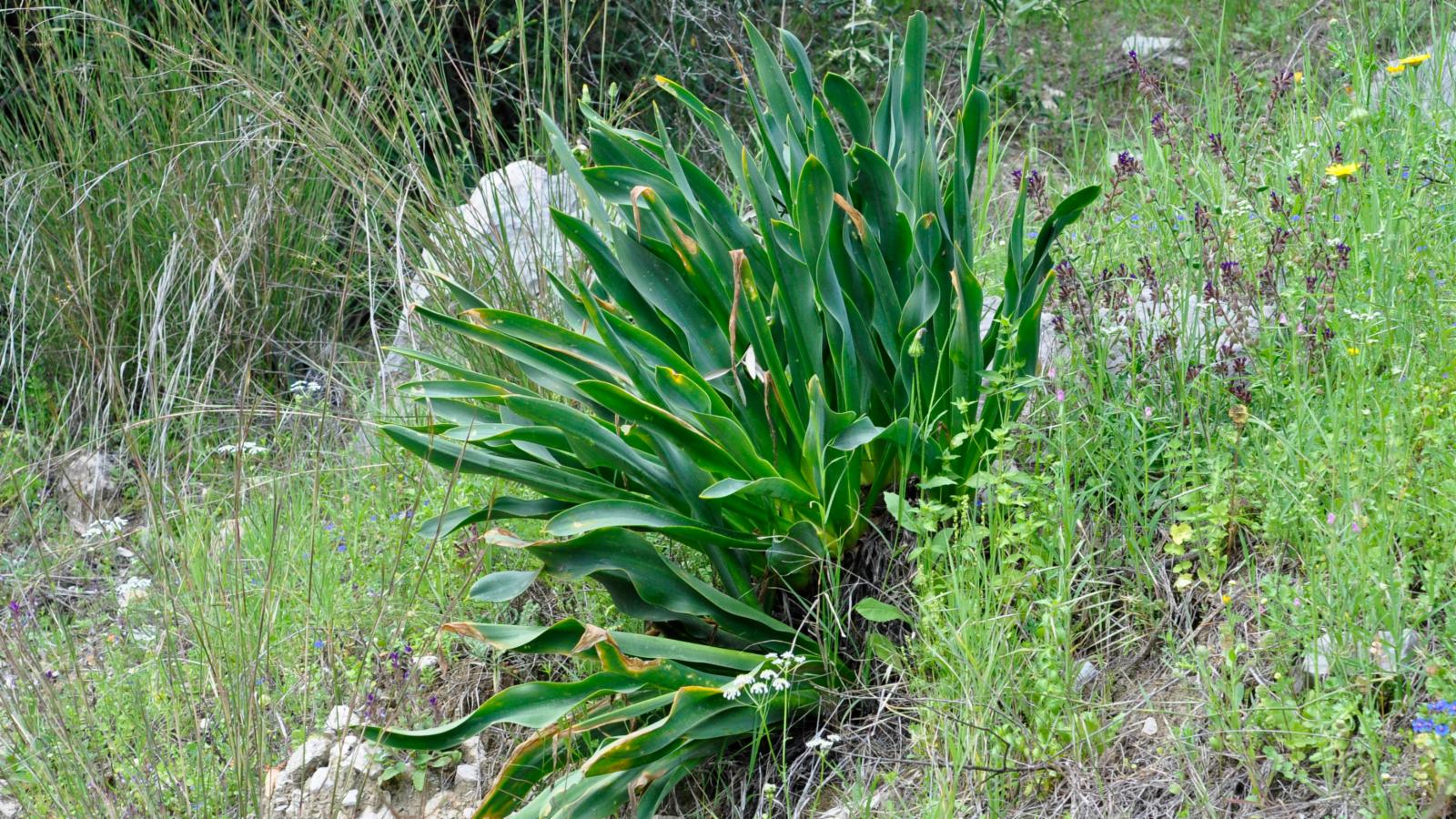
Spring brings about ten large, leathery, lance-shaped leaves per bulb, approaching 1 m (3.3 ft) long, far exceeding the bulb's diameter. They yellow and dry before summer. This marks the start of the annual summer dormancy and does not indicate disease. 2
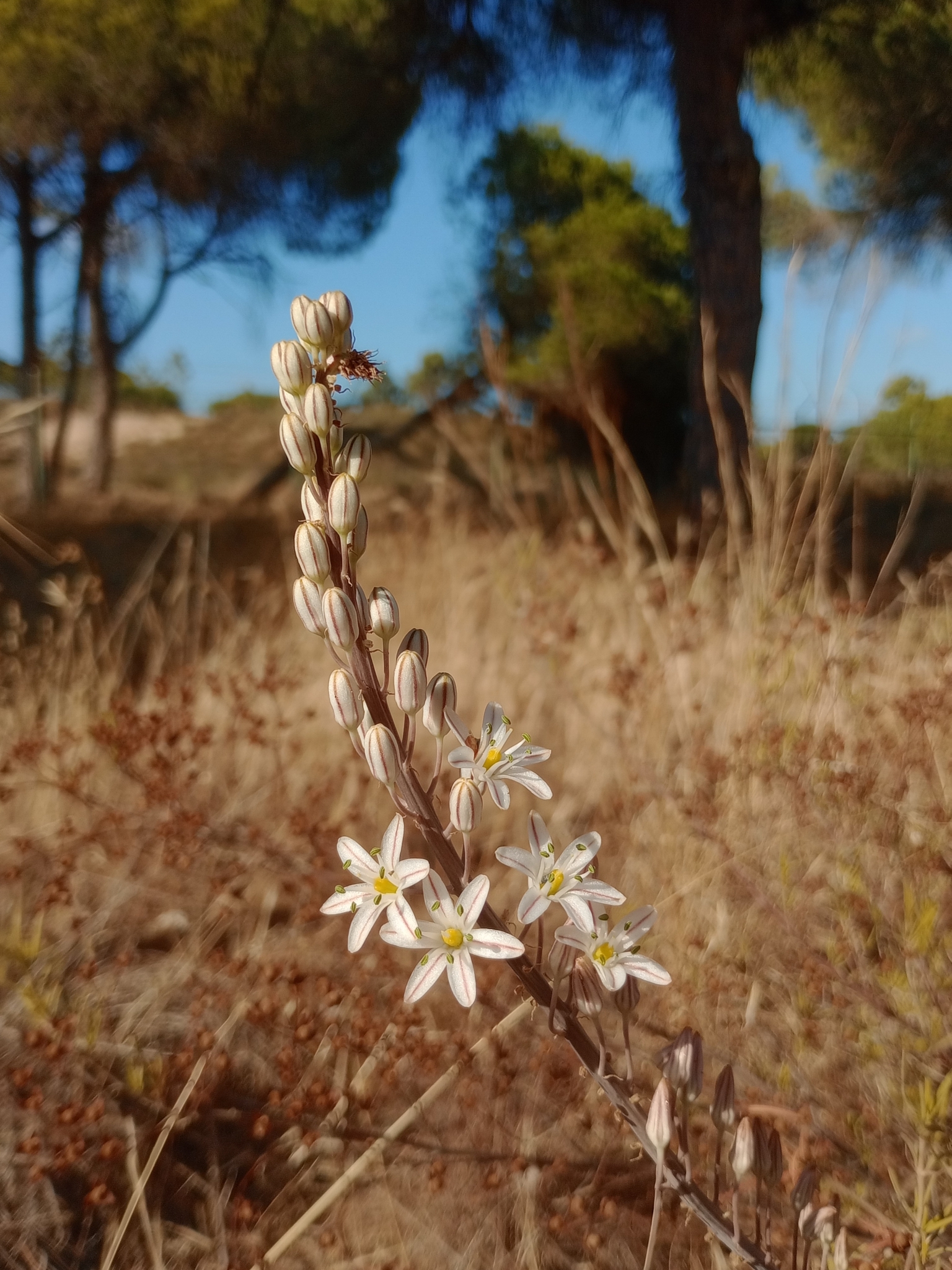
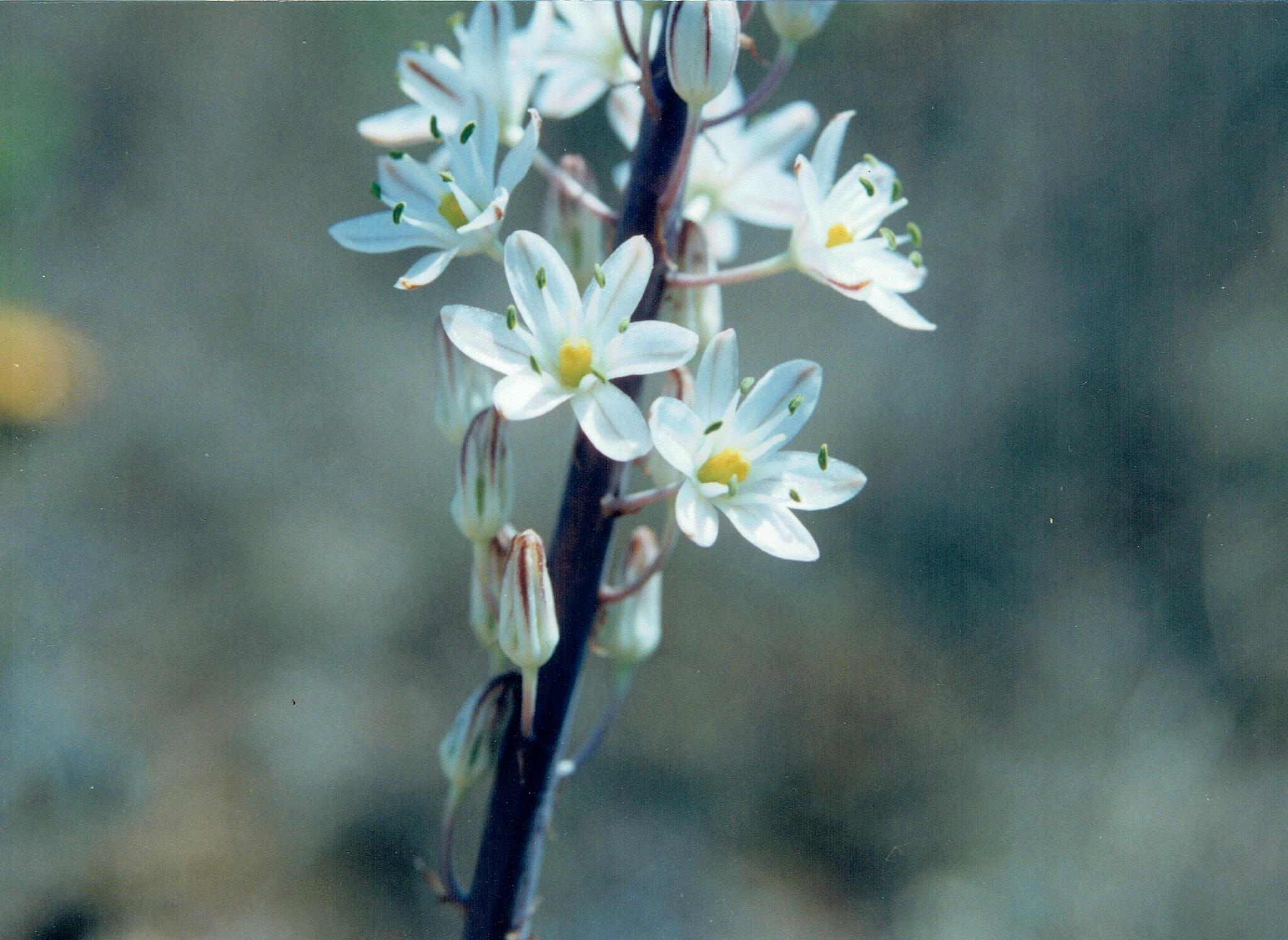
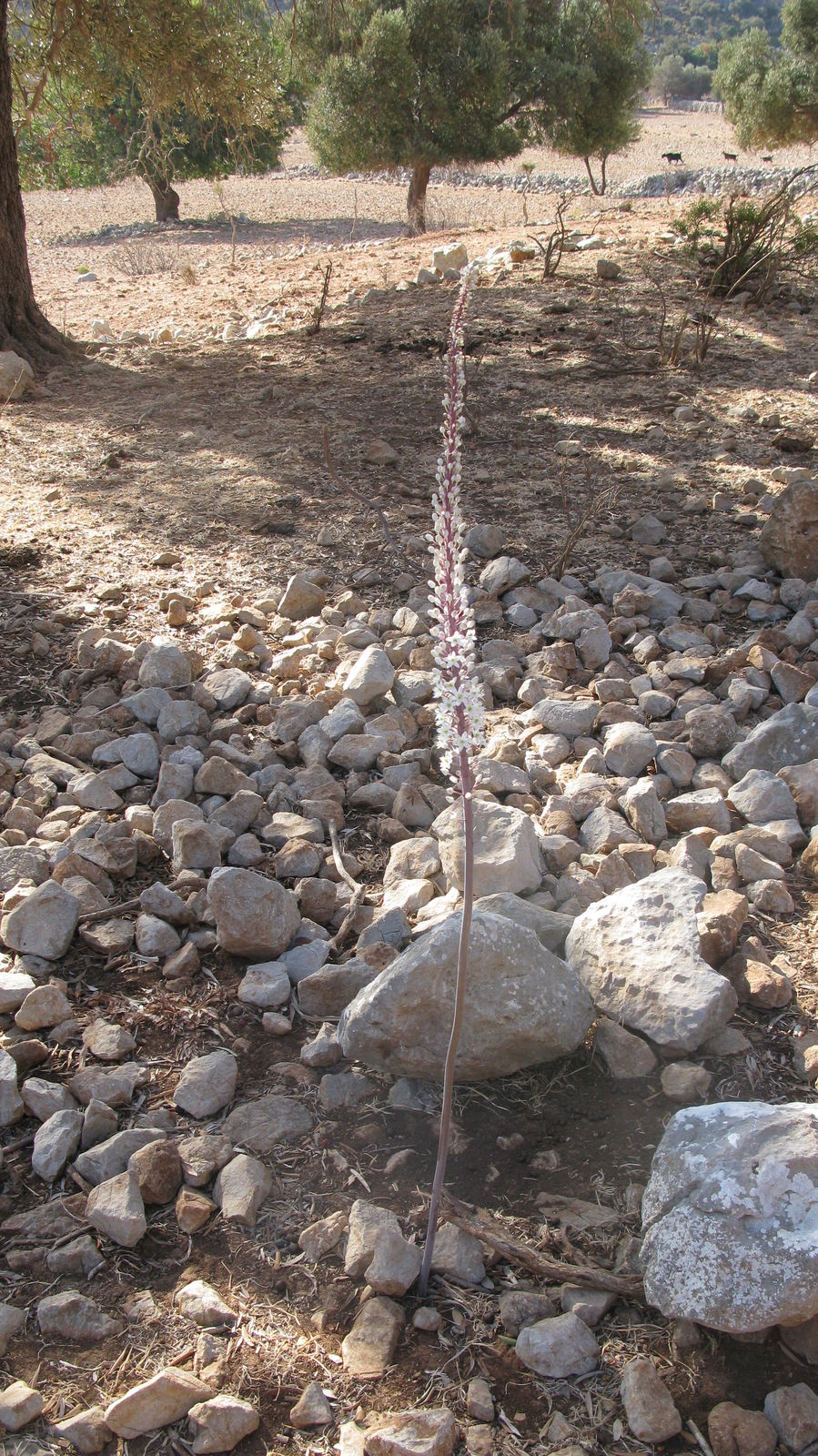
Late summer flowering follows without any visible leaves. An upright stalk 1.5–2 m (5–6.6 ft) tall carries a dense raceme of small white flowers about 1.5 cm (0.6 in) across. Each has six tepals with a darker central stripe. A dry capsule about 1.2 cm (0.5 in) long releases flattened, wind-dispersed seeds. 2
Useful taxonomy
Several synonyms help readers navigate older botanical and pharmaceutical literature.
- Scilla maritima L., the basionym published in 1753
- Urginea maritima (L.) Baker, widely used in pharmacognosy
- Charybdis maritima (L.) Speta, used by the French natural heritage inventory
- Squilla maritima (L.) Steinh., another scientific synonym
- Ornithogalum maritimum (L.) Lam., also a scientific synonym
France's Inventaire National du Patrimoine Naturel uses Charybdis maritima as its reference name, while Kew retains Drimia maritima. Both refer to the same plant; the accepted genus depends on the taxonomic treatment, explaining why the names still appear side by side in catalogs. 1 5
Closely related Mediterranean plants form a group that is difficult to separate using morphology alone, with chromosome numbers providing the main distinctions. The scientific name is therefore a more reliable reference than general appearance when identifying a particular plant. 1 8
Habitat and range
Western Mediterranean populations of Drimia maritima extend from Iberia and the Balearic Islands to southern France, Italy, Morocco and Algeria. The plant grows in garrigue scrub, rocky grasslands and sandy soils, often close to the shore, but also tolerates shadier inland sites. 1 2
Related populations occupy the rest of the Mediterranean and part of western Asia beyond this strict range. During the twentieth century, sea squill was also introduced as an agricultural crop to the United States, India and Pakistan, specifically to develop toxin-rich forms for rodent control. 2 3
Life cycle and reproduction
Mediterranean seasonality governs the cycle of Drimia maritima. Leaves grow during winter and spring, the wettest part of the year, then disappear before the summer drought. The leafless bulb passes the whole summer in complete dormancy, without visible aerial growth. 2
Flowers emerge in late summer and autumn before any new leaves. This leafless flowering, out of step with most other Mediterranean plants, is pollinated both by insects, including honey bees and certain wasps, and by wind. 9 2
Dividing the offset bulbs formed around the parent produces flowering plants sooner than sowing seed, which often takes several years to yield a first flower. 4
Uses and risks
Ancient Egypt's Ebers Papyrus already mentions Drimia maritima, documenting medicinal use stretching back millennia. Its traditional use against edema rests on the diuretic properties of its cardiac glycosides. 6
These compounds, known as bufadienolides, can account for up to 3% of the plant's weight. Scilliroside, present in all organs, is more active than scillaren A. The red-bulbed form concentrates more scilliroside; the white form mainly contains the less active scillaren A. Some purified constituents retain strictly supervised medical uses and must never be used for self-medication. 4 2
A traditional rodenticide, Drimia maritima is eaten by rats despite its bitterness, leading to scilliroside poisoning, while most other animals avoid or reject it. This selectivity renewed agricultural interest when rat populations became resistant to warfarin. 2 4
Fresh bulb sap is caustic, even without any deliberate use of the plant. Contact can irritate or blister skin. Accidental ingestion by a child or pet requires immediate medical or veterinary advice. 4
Varieties, look-alikes and related plants
Stable horticultural cultivars are absent in Drimia maritima, unlike many familiar ornamentals. Two forms are distinguished in practice: white squill, dominant in European pharmacopoeias and used for its high scillaren A content, and red squill, richer in scilliroside and named for its reddish bulb. 2 4
Before buying or collecting a plant, check its accepted scientific name and stated range. Distinguish Drimia maritima in the strict sense from the broader complex of related Mediterranean species, often confused without chromosome examination. 1 8
Cut flower stalks are also used in floristry. This ornamental role is separate from medicinal uses or the plant's use as a poison. 2
Main sources
- Plants of the World Online / Kew, Drimia maritima (L.) Stearn
- Royal Botanic Gardens Kew, Drimia maritima (maritime squill), original species profile archived 29 October 2013
- IUCN Red List, Lansdown 2018, Drimia maritima assessment
- Plants For A Future, Urginea maritima
- INPN / MNHN–OFB, Charybdis maritima (L.) Speta, CD_NOM 161772 — original notice, Internet Archive 2024-05-03 (reference for Drimia maritima)
- Stannard 1974, Squill in ancient and medieval materia medica
- Tela Botanica, eFlore BDTFX: Drimia maritima (L.) Stearn, name record 23097, synonym of retained Squilla maritima
- GBIF, Drimia maritima species profile
- Dafni & Dukas 1986, Insect and wind pollination in Urginea maritima
Frequently asked questions
Is sea squill the same plant as Urginea maritima?
Yes. Urginea maritima is a historical synonym of Drimia maritima, still widely used in medical and pharmacological literature. Drimia maritima remains the accepted name.
Is Drimia maritima poisonous to cats and dogs?
Yes. It contains cardiotonic bufadienolides, including scilliroside, in the bulb, leaves and sap. Ingestion can cause digestive problems and heart damage.
Why does sea squill flower without leaves?
Its cycle follows the Mediterranean climate. Leaves grow in winter and spring, then dry before summer. The flower stalk appears alone in late summer after the foliage has disappeared.
Has sea squill really been used as rat poison?
Yes. Rats eat the bulb despite its bitterness and succumb to scilliroside, while most other animals instinctively avoid it. This traditional rodenticide use is still studied.
Is it safe to touch a Drimia maritima bulb?
Bare-handed handling is not recommended. Fresh bulb sap is caustic and may irritate or blister skin; wear gloves when dividing or replanting it.
Does sea squill still have medicinal uses?
Historically used for edema and mild heart failure because of its cardiac glycosides, it has largely given way to purified compounds used under strict medical supervision.
How do white and red squill differ?
The two forms differ in bulb color, white or reddish-purple, and dominant chemical constituents. White squill is richer in scillaren A, red squill in scilliroside.
Similar plants
If you are unsure about a plant’s toxicity, ask a botanist or veterinarian for advice.