
Bredasdorp gasteria (Gasteria carinata, )


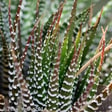
Bredasdorp gasteria (Gasteria carinata) forms low clumps of fleshy leaves, spotted with white and keeled underneath. This Western Cape succulent is grown in filtered light, with little water during winter rest.
Read moreBredasdorp gasteria and Keeled ox-tongue
Aloe carinata
Give plenty of ambient light without direct sun on the leaves.
Bright, filtered light; avoid scorching sun.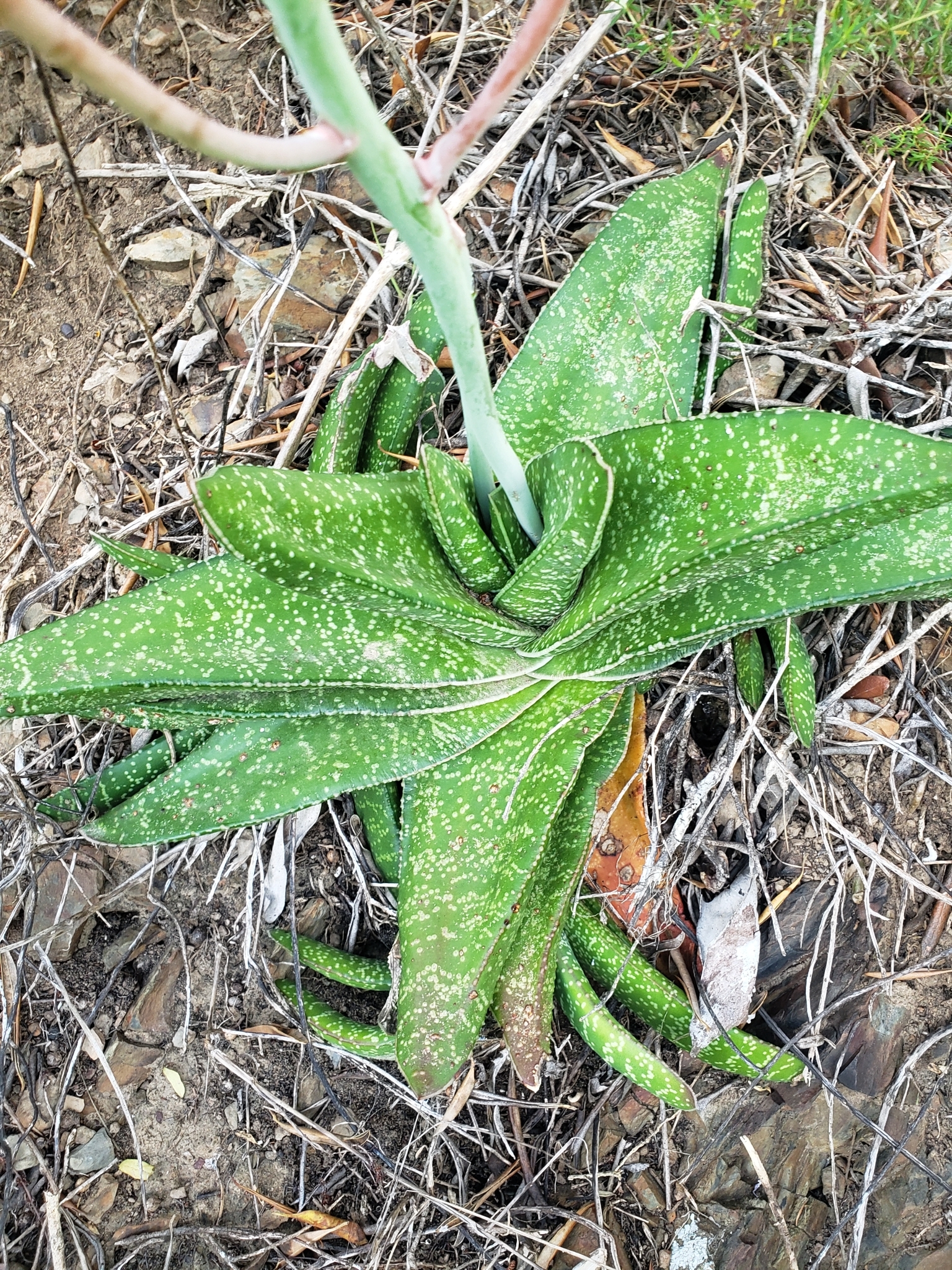


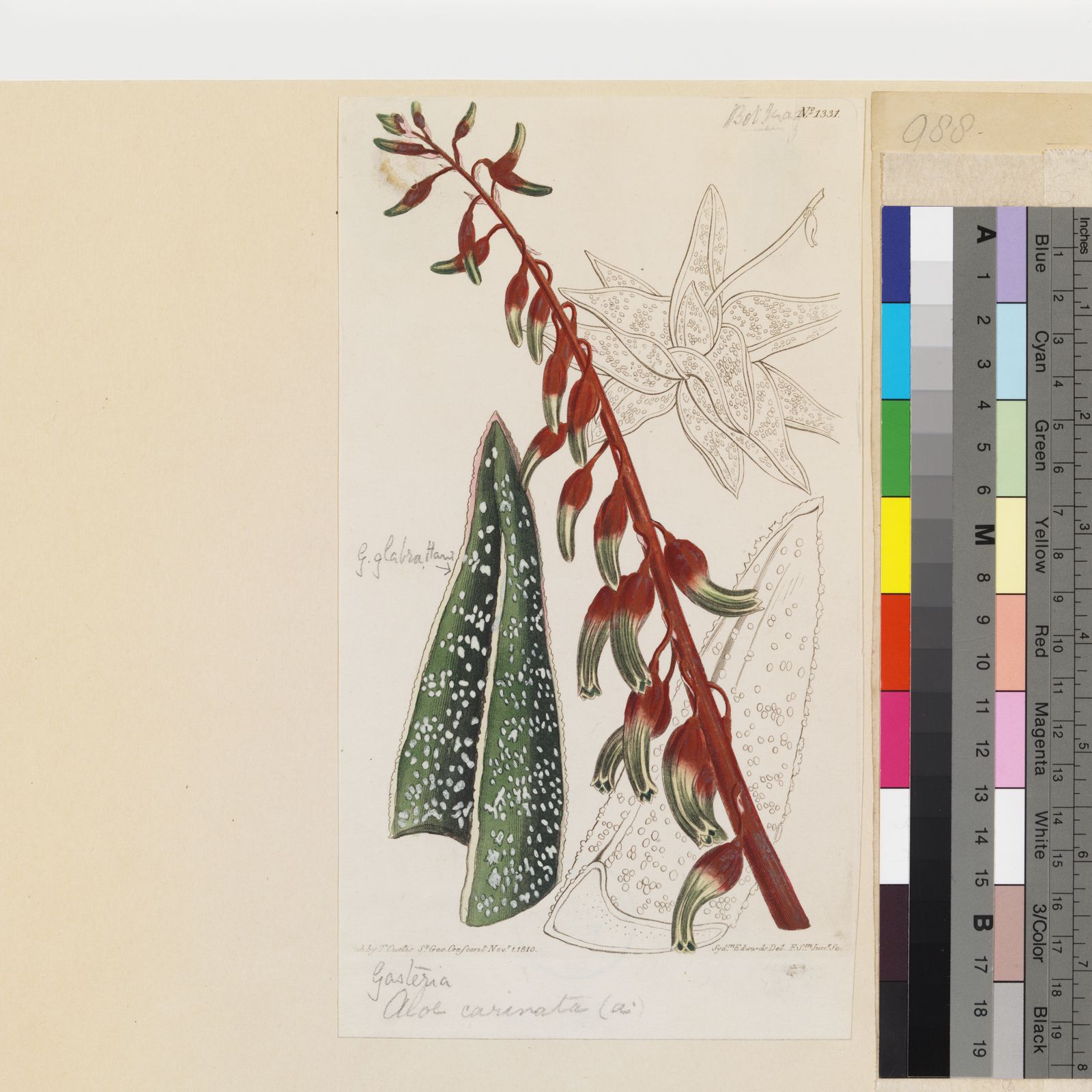
© photo
(c) Mish, some rights reserved (CC BY-NC), uploaded by Mish · cc-by-nc
Wikimedia Commons · CC BY-SA or Public Domain
Wikipedia · CC BY-SA
© copyright of the Board of Trustees of the Royal Botanic Gardens, Kew.




Global distribution
Native to the Western Cape, South Africa.
- Native1
- South Africa, Western Cape
Hexagons: regions where the plant occurs. Green dots: native range.1
Identity
Bredasdorp gasteria (Gasteria carinata (Mill.) Duval, 1809) has a ridge underneath its thick, dark green leaves, which are spotted with white. This keel helps identify the plant, whose stem remains very short or hidden. The French name “gastéria carénée” is documented for this South African species. 6 2 1
This perennial succulent belongs to the Asphodelaceae family, in the order Asparagales. Its subfamily is Asphodeloideae. A resemblance to an aloe does not change its identity: the accepted genus is Gasteria. The fleshy foliage and tubular flowers provide a starting point for identification before examining differences between varieties. 1 5 6 2
Recognition
The foliage of Bredasdorp gasteria reaches 3–18 cm (1.2–7.1 in) in height in the botanical description; clumps usually measure 15–60 cm (6–24 in) across. Young leaves are arranged in two ranks and may later form a rosette. The surface can be smooth or tuberculate: a leaf without warty bumps therefore does not rule out the species. 2
The leaves are mainly triangular to triangular-lanceolate, sometimes tongue-shaped; their undersides are keeled and they bear white spots. The pink flowers have a swollen base, followed by a narrow tube with a greenish tip; the fruits are capsules. To identify a plant, examine the relief of the underside together with the leaf markings and flower, rather than relying on green foliage alone. 6 2
Useful taxonomy
The accepted name is Gasteria carinata; the homotypic synonym Aloe carinata Mill. corresponds to the name published in 1768. The combination in Gasteria was published in 1809, in Plantae succulentae in horto Alenconio. The parentheses around Mill. in the botanical authority accompany this change of genus. 1 5
The limits of the varieties differ between treatments. The botanical classification of Gasteria carinata lists var. carinata, var. retusa, var. thunbergii and var. verrucosa. Another catalog also includes var. glabra in the group. A label carrying one of these names should therefore be kept with its provenance; the names are not all interchangeable in every classification. 1 5
A name beginning with var. denotes a botanical rank below species here. Horticultural names in quotation marks, such as “Melkbos,” belong to a different category and should not replace the binomial in an identification. 1 2
Habitat and distribution
Bredasdorp gasteria is native to the Western Cape, South Africa. Its general botanical range lies in the south-southwestern Cape provinces; its presence in collections in other countries does not add to that native range. A subtropical distribution alone is insufficient to infer frost tolerance in a reader's local climate. 5 1 6 2
In the wild, the plant occupies rocky outcrops in renosterveld and fynbos between Hermanus and Mossel Bay. Clumps often grow under the protection of shrubs: cultivation in partial shade therefore reflects conditions actually encountered in its habitat. 2
Life cycle and propagation
For container cultivation in metropolitan France, the calendar translates seasonal advice for indoor succulents in temperate climates. The water and growth indices are relative; they measure neither an irrigation volume nor a biological growth rate. In spring and summer, check that the surface has dried before watering, then let excess water drain away. Greatly reduce watering of Bredasdorp gasteria during winter rest. In other climates and hemispheres, interpret this reference through local conditions and the plant's growth. 3
Spring repotting mainly concerns a plant whose roots have filled its container. An excessively large pot retains moisture for too long and increases the risk of rot. During growth, liquid cactus fertilizer can be applied once a month, from April to September in this Northern Hemisphere reference. These general horticultural guidelines should be adjusted to drying of the mix and the plant's activity. 3
Gasteria carinata is propagated by division, sowing or leaf cuttings; spring is suitable for cuttings. Natural flowering extends from Southern Hemisphere winter to late spring. Those seasons should not be transferred directly to a French or other Northern Hemisphere calendar. 2
Uses and risks
Bredasdorp gasteria is grown as an ornamental plant, indoors or in rock gardens in mild climates. Bright, filtered light and a very free-draining cactus potting mix suit this use. Protection from scorching sun remains necessary despite its drought tolerance. 6 2
The general statement “non-toxic plant” does not specify the groups concerned or the conditions of evaluation. Safety after ingestion of Gasteria carinata therefore remains unestablished separately for cats, dogs, horses, children, adults and other animals. No toxic compound or symptoms specific to these groups are given; this uncertainty does not indicate that the plant is suitable for food. 6 2
Varieties, look-alikes and related plants
“Melkbos” and “Kykoedie” are documented cultivar names: the first is a large form with tuberculate leaves, the second a small form with short, broad, triangular leaves. These traits concern the named selections and do not describe every plant of the species or a hybrid of unknown provenance. 2
The look-alike Gasteria nitida has smooth, glossy adult leaves, also keeled and spotted in bands. Its young leaves may be tuberculate, so comparing only juvenile plants would be misleading. In G. nitida, the adult inflorescence forms a loose panicle, whereas that of G. carinata is described as a raceme. The appearance of a mature flowering plant therefore helps distinguish the species; an isolated photograph of a leaf is not always sufficient. 4 2
Main sources
The botanical references clarify the identity of Bredasdorp gasteria; the general horticultural guide provides seasonal guidance for container cultivation.
Frequently asked questions
Where should I place Bredasdorp gasteria?
In bright, filtered light, with a free-draining growing medium. Avoid scorching sun, especially in hot climates.
When should I repot Bredasdorp gasteria?
In spring, if the roots have filled the pot. Repotting every year is not automatically necessary.
How do I propagate Bredasdorp gasteria?
By division, sowing or leaf cuttings. Leaf cuttings are best prepared in spring.
Similar plants
If you are unsure about a plant’s toxicity, ask a botanist or veterinarian for advice.