
Goeppertia lietzei
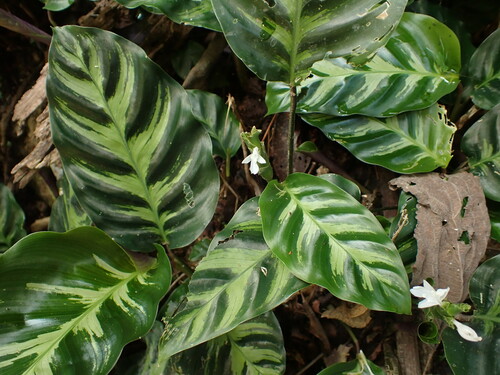

Goeppertia lietzei is a tropical perennial from eastern Brazil, with dark green leaves crossed by light green bands. This member of the Marantaceae family forms clumps and raises its leaves at night. The name Calathea lietzei remains in books and horticultural catalogs.
Read moreCalathea lietzei, Maranta lietzei, Phyllodes lietzei and Calathea glaziovii
Give plenty of ambient light without direct sun on the leaves.
Bright indirect light, protected from direct sun.


© photo
iNaturalist User · cc0
Wikimedia Commons · CC BY-SA or Public Domain
Wikipedia · CC BY-SA
© copyright of the Board of Trustees of the Royal Botanic Gardens, Kew.
Global distribution
Native to eastern Brazil; introductions documented in El Salvador, Honduras, and Mexico; cultivation recorded in Colombia.
- Native1
- Introduced3
- Eastern Brazil
- El Salvador
- Honduras
- Mexico
Hexagons: regions where the plant occurs. Green dots: native range.1
Identity
Goeppertia lietzei bears dark green leaves striped with light green, a pattern distinct from the white marbling of horticultural selections. The evergreen perennial forms clumps and belongs to the Marantaceae family, within the order Zingiberales. Green bands, rather than extensive white patches, are the foliage pattern described for the species. 2 6
The accepted name is Goeppertia lietzei (É.Morren) Saka; Calathea lietzei is an earlier botanical name for the same species. The native range lies in eastern Brazil, within the wet tropical biome. The species' identity and origins remain distinct from cultivar names added to horticultural labels. 1
Identification
The foliage of Goeppertia lietzei has light green bands against a dark background. Bands run from the midrib toward the edges of the blade. The leaves are thick and oblong, with wavy margins and long, slender stalks; the plant also has a rhizome. Leaf pattern and structure together provide identification features. 2
Contrast between two greens does not identify a white selection. In comparison with its horticultural parent, the patent for ‘Fusion White’ describes strong white variegation alongside several shades of green. The document also states that each leaf of the selection has a different pattern. A photograph of ‘Fusion White’ therefore does not, on its own, describe the foliage of the species. 9
Useful taxonomy
The basionym Calathea lietzei É.Morren dates to 1875. The combination Goeppertia lietzei (É.Morren) Saka was published in Phytotaxa in 2017. The recent date records a change in botanical combination, rather than a recent discovery of the plant. Both dates concern the history of its scientific name. 3
The paper by Saka and colleagues reexamines Marantaceae described by Édouard Morren and explicitly proposes transferring Calathea lietzei to Goeppertia. The work concerns the application of botanical names widely used in horticulture. A revised combination changes how the plant is named without making it a new horticultural selection. 4
Synonyms also include Phyllodes lietzei (É.Morren) Kuntze and Maranta lietzei (É.Morren) C.H.Nelson, Sutherl. & Fern.Casas. Searching older botanical names helps locate records in books without assuming that each name represents a distinct species. The names need to be read in their taxonomic context. 1
Habitat and distribution
Eastern Brazil is the native range of Goeppertia lietzei. The range includes the botanical regions of northeastern and southeastern Brazil; Espírito Santo state is specifically documented under the name Calathea lietzei. The state record establishes a native occurrence without limiting the whole species' range to that one territory. 1 5
Outside Brazil, introductions are reported in El Salvador and Honduras, as well as Mexico. Geographic introduction alone does not demonstrate invasive behavior. An introduced population and an invasive population describe different situations, so the introduction records should retain their own scope. 1 6
Colombia represents another setting: a flora record reports cultivation in Cundinamarca, in the Andean region. A cultivated occurrence does not automatically extend the native range. Distinguishing planted specimens from native populations prevents every country where Goeppertia lietzei grows from being treated as a country of origin. 7
Growth cycle and propagation
The leaves of Goeppertia lietzei rise at night and unfold at sunrise. Its small tubular flowers are greenish white, and flowering remains rare in a home. The daily leaf movements and occasional flowers are separate features of the plant's growth. 2
Clump division is the recommended propagation method for Goeppertia lietzei. For the horticultural calathea group, which includes Goeppertia, divide in spring. Each portion retains several leaves and stays warm, with consistent humidity and moisture, until growth resumes. The seasonal advice concerns this broader horticultural group. 2 8
Preserving the variegation of ‘Fusion White’ involves a separate observation: its patent reports vegetative reproduction and stability trials. The reported stability concerns the selection tested. The trials do not demonstrate that the entire species has the same variegation, so the selection's foliage pattern should remain attached to its name. 9
Growing through the seasons
The calendar describes indoor cultivation in metropolitan France. Water and growth indices are relative guides, adjusted to the seasons described for the horticultural calathea group. The indices prescribe neither an irrigation volume nor a measured rate of development. Actual plant activity still matters when interpreting the seasonal schedule. 8
In spring and summer, keep the growing medium consistently moist. In fall and winter, let the surface dry before watering, without allowing the entire root ball to dry out. Empty water collected in a decorative outer pot so the roots do not remain immersed. The distinction concerns moist growing medium versus roots left standing in water. 8
For the calathea group, horticultural recommendations call for balanced liquid fertilizer from April through September, once a month during growth, followed by a pause in feeding. Repot in spring or summer when the clump fills its container. The instructions apply to the horticultural group that includes Goeppertia, with adjustments for the plant's actual condition. 8
Uses, risks, and horticultural forms
Goeppertia lietzei is cultivated chiefly for ornamental foliage. Horticultural nomenclature and the patent associate ‘Fusion White’ with Calathea or Goeppertia lietzei. The patent describes a mutation found by Taiyan Yam in Malaysia; its measurements and trials concern that horticultural selection. Trials on ‘Fusion White’ do not describe all wild populations of Goeppertia lietzei. 8 9
The plant is classified as non-toxic to people and pets, with explicit mentions of cats and dogs. Sap can nevertheless irritate the skin, so gloves are recommended when handling the plant. The contact risk warrants precautions for adults and children without establishing a particular childhood sensitivity. The status of horses and other animals remains undetermined here. 2
Main sources
Taxonomic references document the accepted name, geographic range, and botanical publication of Goeppertia lietzei. Horticultural guidance supplies the seasonal instructions for the broader calathea group. 1 3 8
- Kew, Plants of the World Online, Goeppertia lietzei
- NC State Extension, Goeppertia lietzei
- International Plant Names Index, Goeppertia lietzei
- Saka et al., 2017, Nomenclatural notes on Marantaceae described by Édouard Morren
- USDA ARS, GRIN Taxonomy, Calathea lietzei
- EPPO Global Database, Goeppertia lietzei
- Kew, ColPlantA database record for Goeppertia lietzei
- RHS, How to grow calatheas, advice for the horticultural group
- Patent USPP26187P2, Calathea plant named Fusion White
Frequently asked questions
Are Calathea lietzei and Goeppertia lietzei the same species?
Calathea lietzei É.Morren is the basionym of Goeppertia lietzei (É.Morren) Saka. The combination in Goeppertia dates to 2017.
Does Goeppertia lietzei naturally have white leaves?
The foliage described for the species is dark green with light green bands. Large white marbling characterizes the horticultural selection Fusion White in particular.
Is Goeppertia lietzei toxic to cats and dogs?
The plant is classified as non-toxic to pets, with explicit mentions of cats and dogs. Its sap can nevertheless irritate human skin; the status of horses remains undetermined.
How can I propagate Goeppertia lietzei?
Division is recommended. Horticultural guidance for calatheas places division in spring and advises keeping the divisions warm and humid until growth resumes.
Similar plants
If you are unsure about a plant’s toxicity, ask a botanist or veterinarian for advice.