
Silver Ragwort (Jacobaea maritima, )

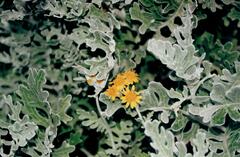
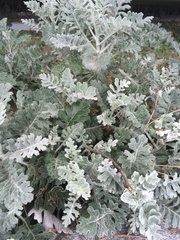
Silver Ragwort (Jacobaea maritima) owes its silver coloring to hairs covering its divided leaves. This Mediterranean subshrub in the Asteraceae is used in borders or containers, in sun and well-drained soil. All its parts are toxic if ingested.
Read moreSilver Ragwort and Dusty Miller
Othonna maritima, Cineraria maritima, Senecio cineraria, Senecio bicolor subsp. cineraria and Senecio gibbosus subsp. cineraria
Place in full sun, with intense direct light all day long.
Full sun; shade dulls the silver coloring and encourages stem elongation.



© photo
(c) Jim Evans, some rights reserved (CC BY-SA) · cc-by-sa
zebedeugalinha · cc-by
Максим Шумских · cc-by
Taken Mar 6, 2015 by Tela Botanica − Liliane Roubaudi (cc-by-sa)
© copyright of the Board of Trustees of the Royal Botanic Gardens, Kew.




Global distribution
Native to the western and central Mediterranean basin; naturally present in part of mainland France and introduced in various other territories.
- Native5
- Introduced1
- France
- Italy
- Spain
- Algeria
- Morocco
- Great Britain
Hexagons: regions where the plant occurs. Green dots: native range.1
Identity
The woolly silver foliage of Silver Ragwort (Jacobaea maritima (L.) Pelser & Meijden, 2005) forms clumps used in borders or containers. This Mediterranean Asteraceae is a woody-based perennial, frequently grown as an annual. Its ornamental appearance says nothing about safety: all its parts are toxic if ingested. 1 2
The French names cinéraire maritime, séneçon cinéraire and séneçon bicolore are attested by Floriscope. The English name “dusty miller” applies to several gray or silver plants, so a label bearing only that name is insufficient to identify the species. 4 6
Identification
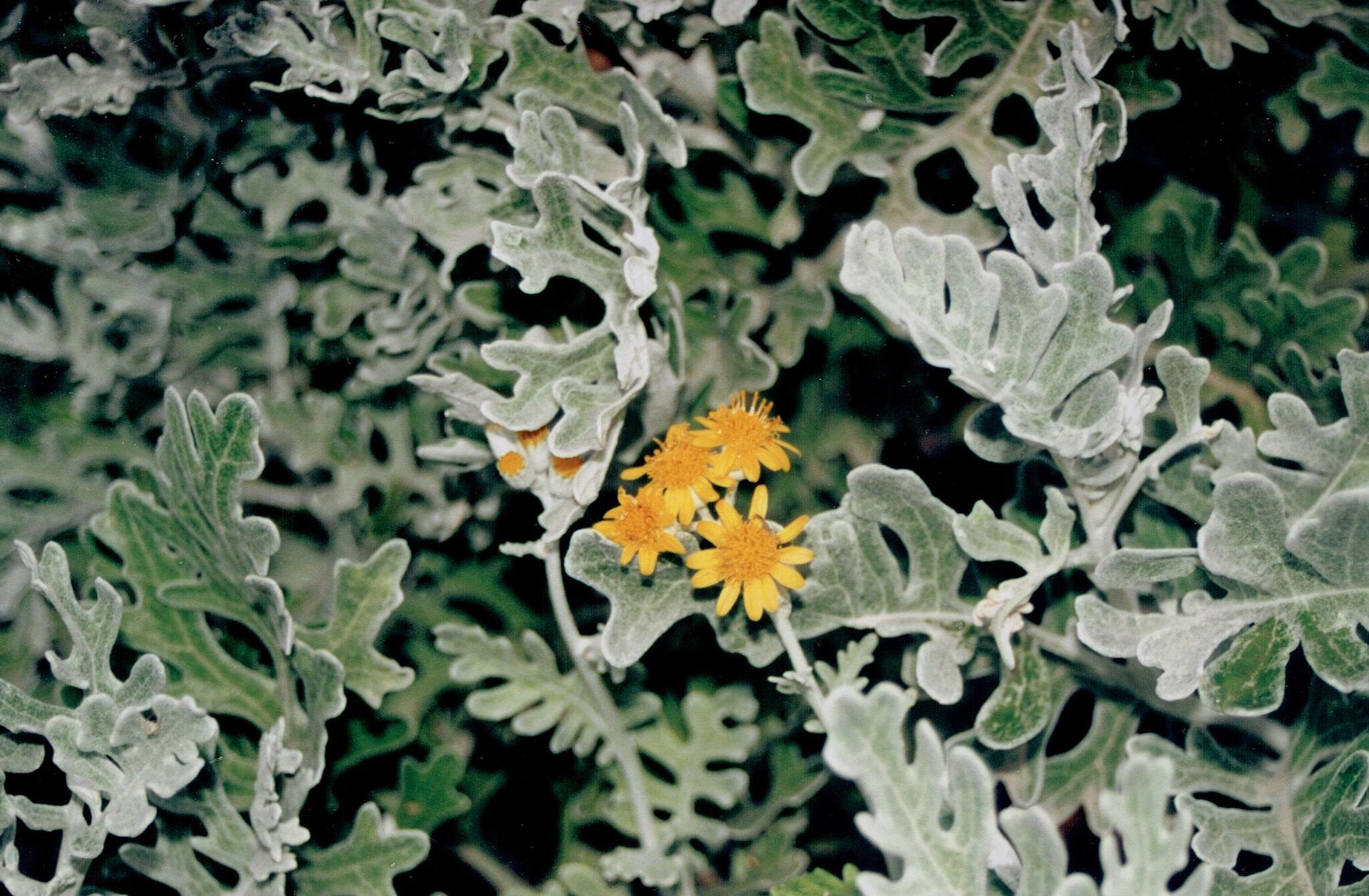
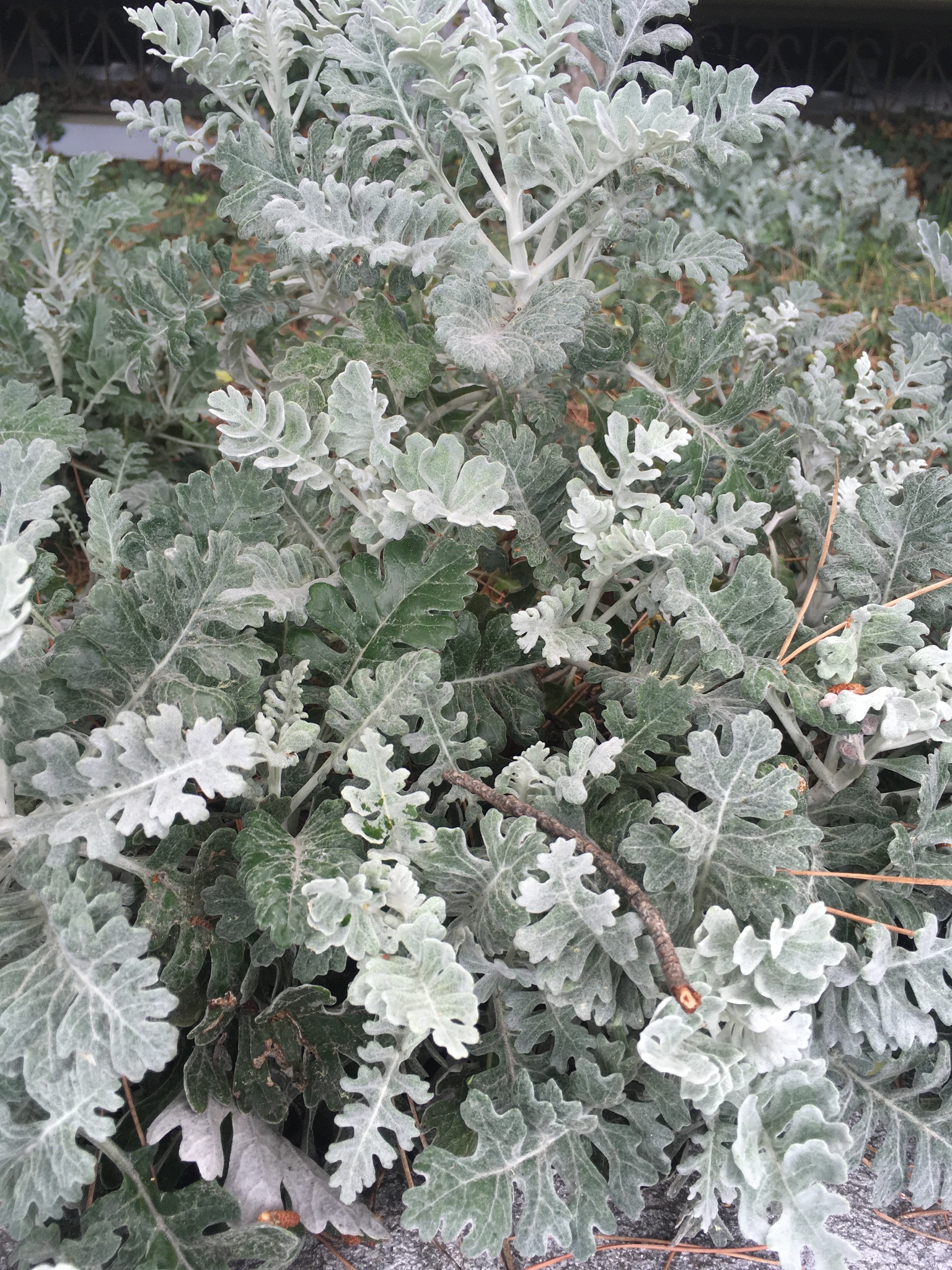
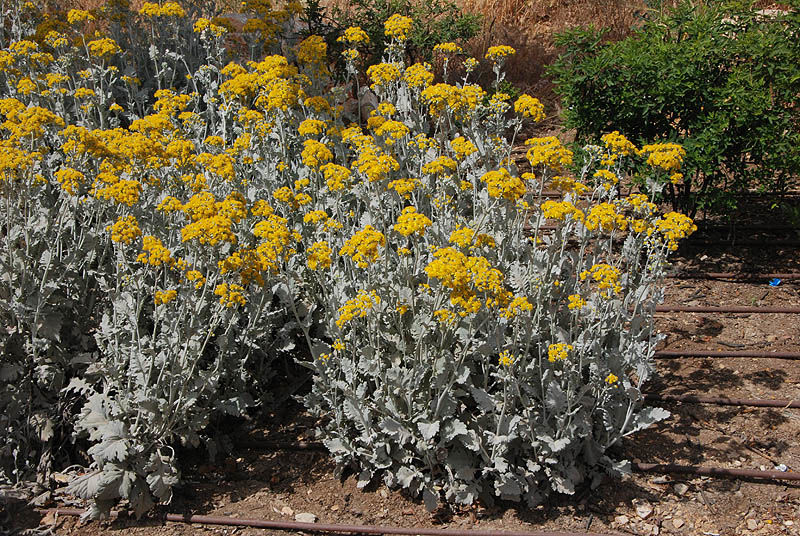
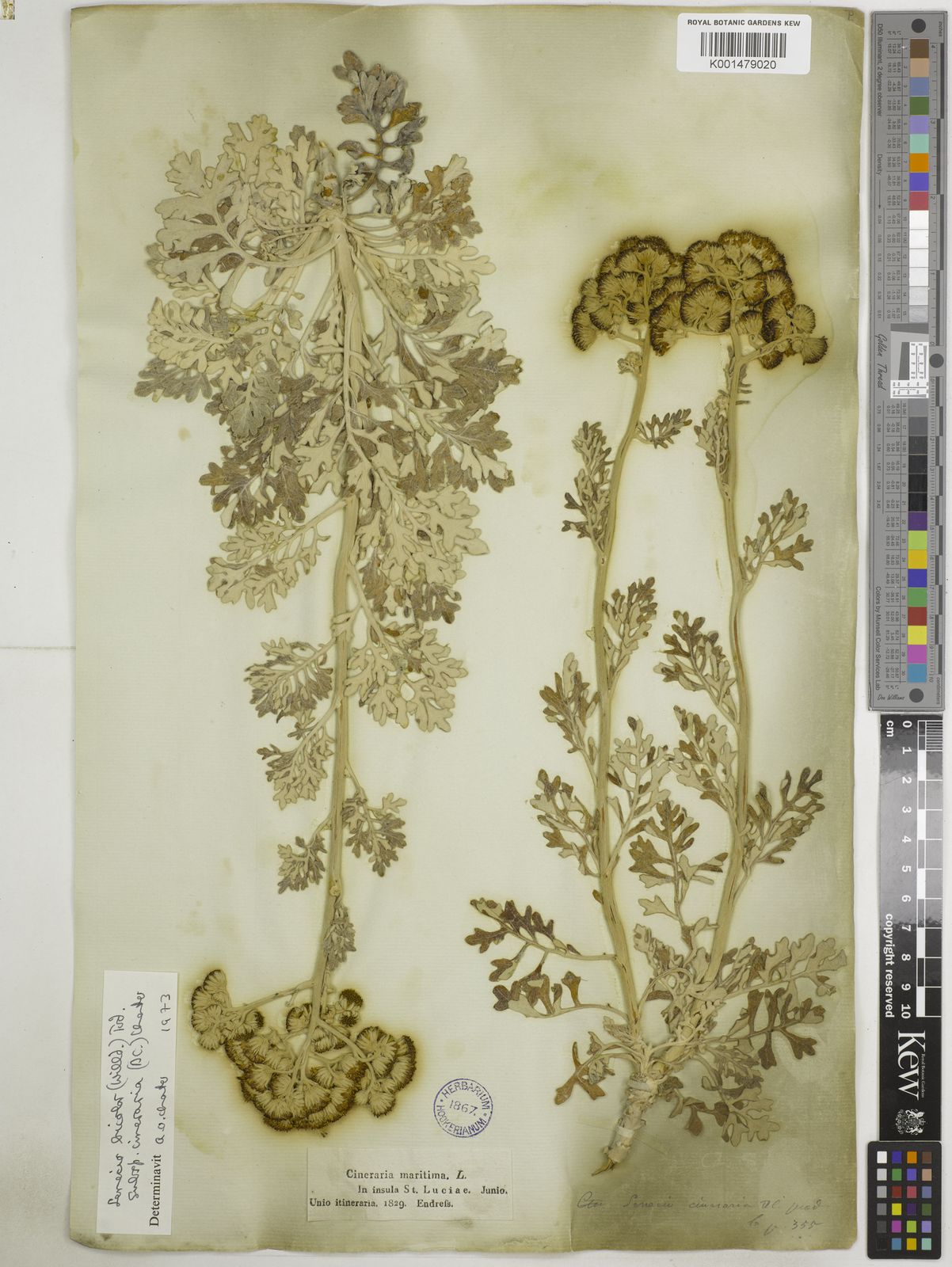
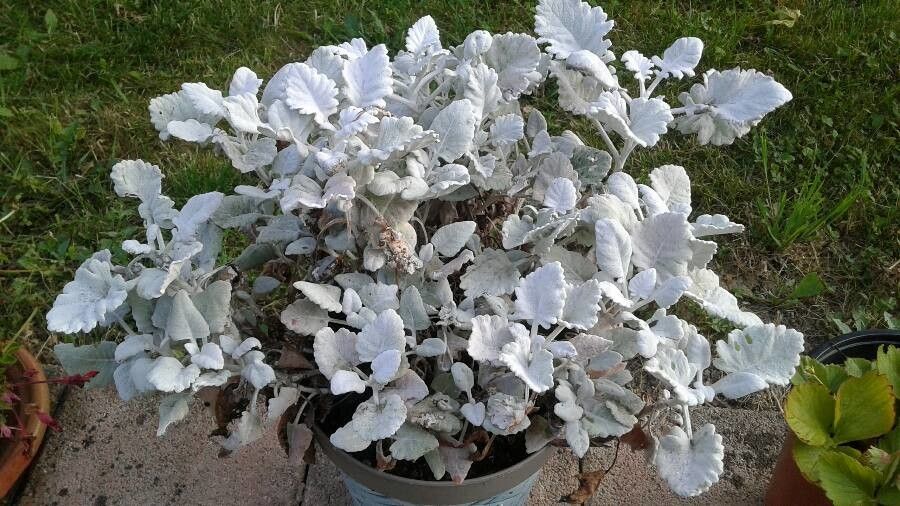
Silver Ragwort's alternate leaves have a felted covering of white hairs on both surfaces. Young blades are shallowly lobed, then become deeply divided as they mature. NParks gives a leaf length of 5 to 15 cm (2.0 to 5.9 in). When foliage is wet, the underlying green shows through; shade also dulls the silver coloring. A temporarily greener leaf therefore does not necessarily indicate a different variety. 5 6
Size depends on horticultural management. NC State describes plants about 15 to 46 cm (6 to 18 in) tall, with a spread of 15 to 30 cm (6 to 12 in); the RHS gives about 60 cm (23.6 in) in height and NParks up to 1 m (3.3 ft). These descriptions do not define a universal maximum for every container plant. 2 3 5
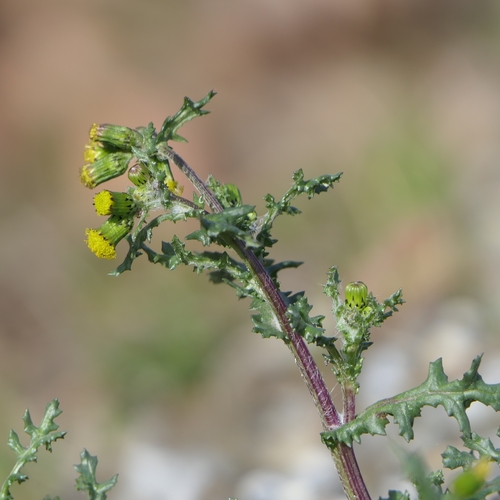
The stems are woolly, then become smooth near their woody base. Yellow flowers are grouped in heads resembling small daisies. Flower diameters given by NC State and NParks differ; foliage provides a more consistent identifying feature than a single flower-head size. 2 5
Taxonomy and names
The accepted name Jacobaea maritima was published in 2005. This date concerns the current botanical combination, not the plant's discovery: Othonna maritima L. appears in the synonymy with a publication date of 1753. 1
The older names Cineraria maritima (L.) L. and Senecio cineraria DC. also denote this taxon. Finding them in a catalog does not imply a different species. However, the RHS specifies that Senecio candicans has been misapplied to this plant; that name should not be adopted as a confirmed synonym. 1 3
Habitat and distribution
Silver Ragwort is native to the western and central Mediterranean, including France, Italy and Spain, as well as North Africa. Coasts and rocky slopes form part of the habitat described by NC State. Floriscope confirms its natural presence in part of mainland France. 1 2 4
Kew distinguishes numerous introductions, including those in Great Britain, Belgium and the Balearic Islands. Presence in a Mediterranean region is therefore not automatically native. The non-native status given by NParks concerns Singapore; it does not apply to France. 1 5
Life cycle, cultivation and propagation
Silver Ragwort prefers full sun and well-drained soil. Once established, it tolerates drought, but excess water or poor drainage causes rot. In deep shade, stems elongate. NParks notes a particular difficulty in Singapore, where the combination of heat and high outdoor humidity is unsuitable; this tropical qualification does not contradict tolerance of dry heat. 2 5
The RHS describes the foliage as evergreen, but Floriscope calls it semi-evergreen. UW Extension observes foliage deterioration under prolonged frost. Calendar indices reflect temperate outdoor cultivation, with summer activity and winter slowdown; these are relative trends, without a prescribed water volume. 3 4 6
Propagation uses seeds or summer semi-hardwood cuttings. UW Extension recommends leaving seeds on the surface and gives 20 to 25 °C (68 to 77 °F) for germination. This temperature concerns seed sowing, not the adult plant's optimum. NC State also suggests keeping cuttings under glass through winter. 6 2
Uses and risks
Silver Ragwort provides a pale contrast in garden beds and cut foliage for bouquets. Its yellow flower heads appear mainly in summer, often after the first year; the fruits are cylindrical achenes. Growing it as an annual therefore often favors foliage over flowering. 6 3
Pyrrolizidine alkaloids explain the ingestion hazard. NC State reports possible serious liver damage in humans and explicitly mentions children, cats, dogs and horses among the groups at risk. Skin irritation can also occur on contact; wearing gloves when handling the plant is recommended. Risk in other animal species remains insufficiently characterized in these references. 2
CliniTox explicitly includes Jacobaea maritima among highly toxic plants. However, the experiments and doses detailed on that page concern several other ragworts. Doses reported for those other ragworts do not establish a species-specific dose for Silver Ragwort; thresholds for each group remain unknown. 7
Varieties and lookalikes
‘Cirrus’ has a compact habit and undivided leaves; ‘Silverdust’, by contrast, has very finely divided leaves. These features belong to the cultivars described by UW Extension and NC State. Kew also recognizes the botanical subspecies bicolor, maritima and sicula, which are not horticultural cultivars. 6 1
NC State lists Centaurea cineraria and ‘Powis Castle’ artemisia as lookalikes. These plants do not appear in Silver Ragwort's accepted synonymy. To identify Silver Ragwort, combine alternate woolly leaves with yellow flower heads and check the full botanical name, rather than relying on silver coloring alone. 2 1
Main sources
Kew establishes Silver Ragwort's synonymy and distribution. Horticultural references describe different growing contexts; CliniTox supplements toxicology without providing a species-specific dose.
- Kew, Plants of the World Online, Jacobaea maritima
- NC State Extension, Jacobaea maritima
- Royal Horticultural Society, Jacobaea maritima
- Plante & Cité, Floriscope, Jacobaea maritima
- National Parks Board of Singapore, Jacobaea maritima
- University of Wisconsin Extension, Dusty Miller
- University of Zurich, CliniTox, Senecio sp., including Jacobaea maritima
Frequently asked questions
Why does Silver Ragwort look silvery?
Numerous fine hairs cover its leaves. According to UW Extension, water makes the underlying green more visible, and shade dulls the white coloring.
Is Silver Ragwort annual or perennial?
It is a perennial often grown as an annual. Leaf persistence varies: Floriscope calls it semi-evergreen, and UW Extension describes foliage deterioration under prolonged frost.
Is it toxic to cats and dogs?
Yes. NC State reports ingestion toxicity in domestic animals, explicitly mentioning cats and dogs, without giving a dose for each species.
How can I propagate Silver Ragwort?
Seed sowing and stem cuttings are documented. UW Extension recommends semi-hardwood tip cuttings in summer and seeds left on the growing medium's surface.
Similar plants
If you are unsure about a plant’s toxicity, ask a botanist or veterinarian for advice.