
Panda plant (Kalanchoe tomentosa, )
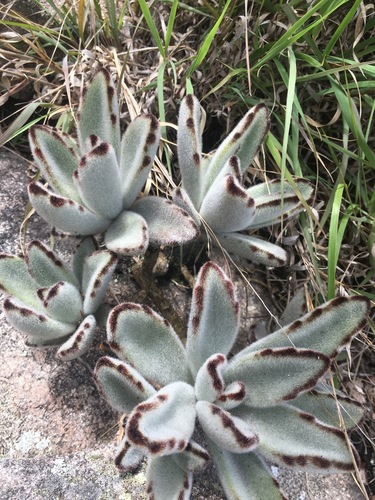


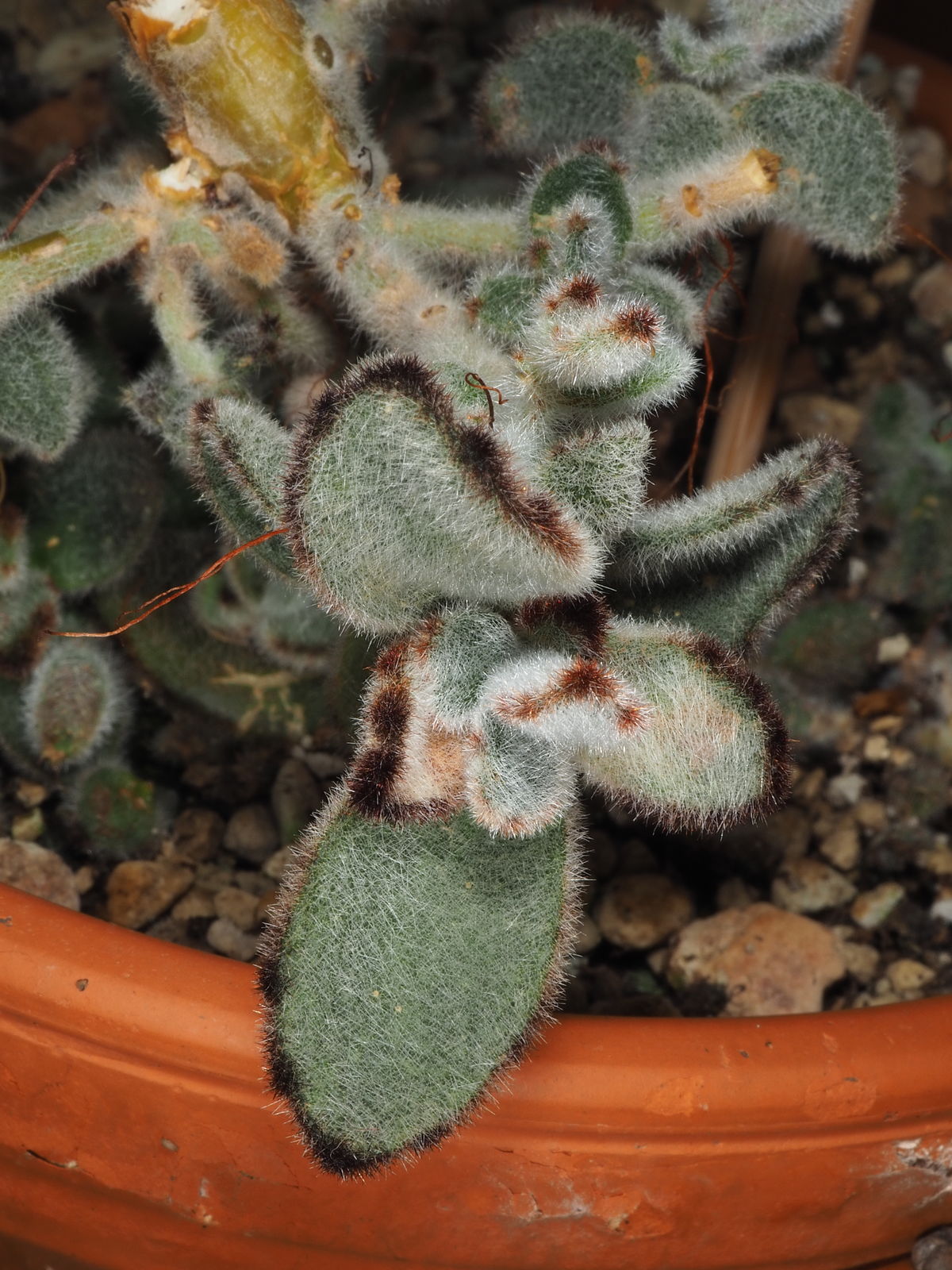
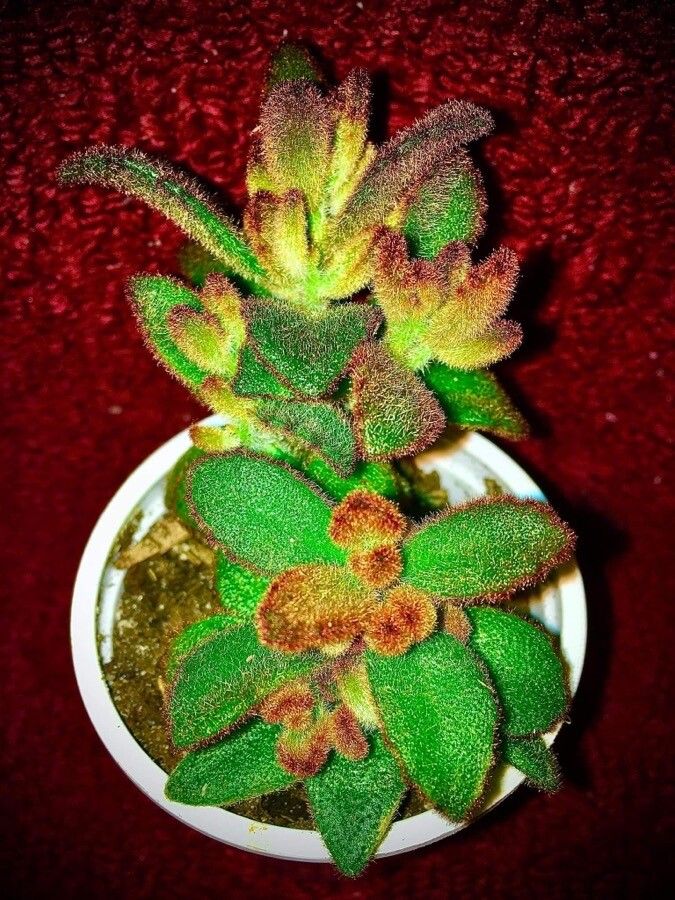
Panda plant has fleshy leaves covered in silvery hairs, with brown markings along the edges. This Madagascan succulent is grown mainly for its foliage and needs a well-drained growing medium.
Read morePanda plant
Bryophyllum triangulare
Allow a few hours of direct sun per day, preferably morning or evening.
Bright light; protect from scorching sun in very hot climates.


© photo
(c) kenbehrens, some rights reserved (CC BY-NC) · cc-by-nc
Rosario · cc-by-nc
Wikimedia Commons · CC BY-SA or Public Domain
Taken Apr 17, 2018 by Daniel Barthelemy (cc-by-nc)
Taken Jul 15, 2022 by Gualtiero (cc-by-sa)
Taken Feb 16, 2022 by Chase Hammack (cc-by-sa)
Taken Nov 9, 2022 by Pl@ntNet (cc-by-sa)
© copyright of the Board of Trustees of the Royal Botanic Gardens, Kew.




Global distribution
A species native to east-central Madagascar, cultivated elsewhere as an ornamental plant.
Identity
Panda plant (Kalanchoe tomentosa Baker, 1882) is recognizable by its fleshy leaves covered in silvery felt with brown edges. This succulent perennial belongs to the Crassulaceae family. Its evergreen foliage explains its use as a houseplant even when it does not flower. The French name “Kalankoe tomenteux” is documented in horticulture. 1 3 5
The epithet tomentosa refers to the fine hairs covering the plant. The English names panda plant and pussy ears describe the same species; they do not denote distinct botanical species. The apparent softness of the leaves says nothing about their safety if ingested. 3 4
Identification
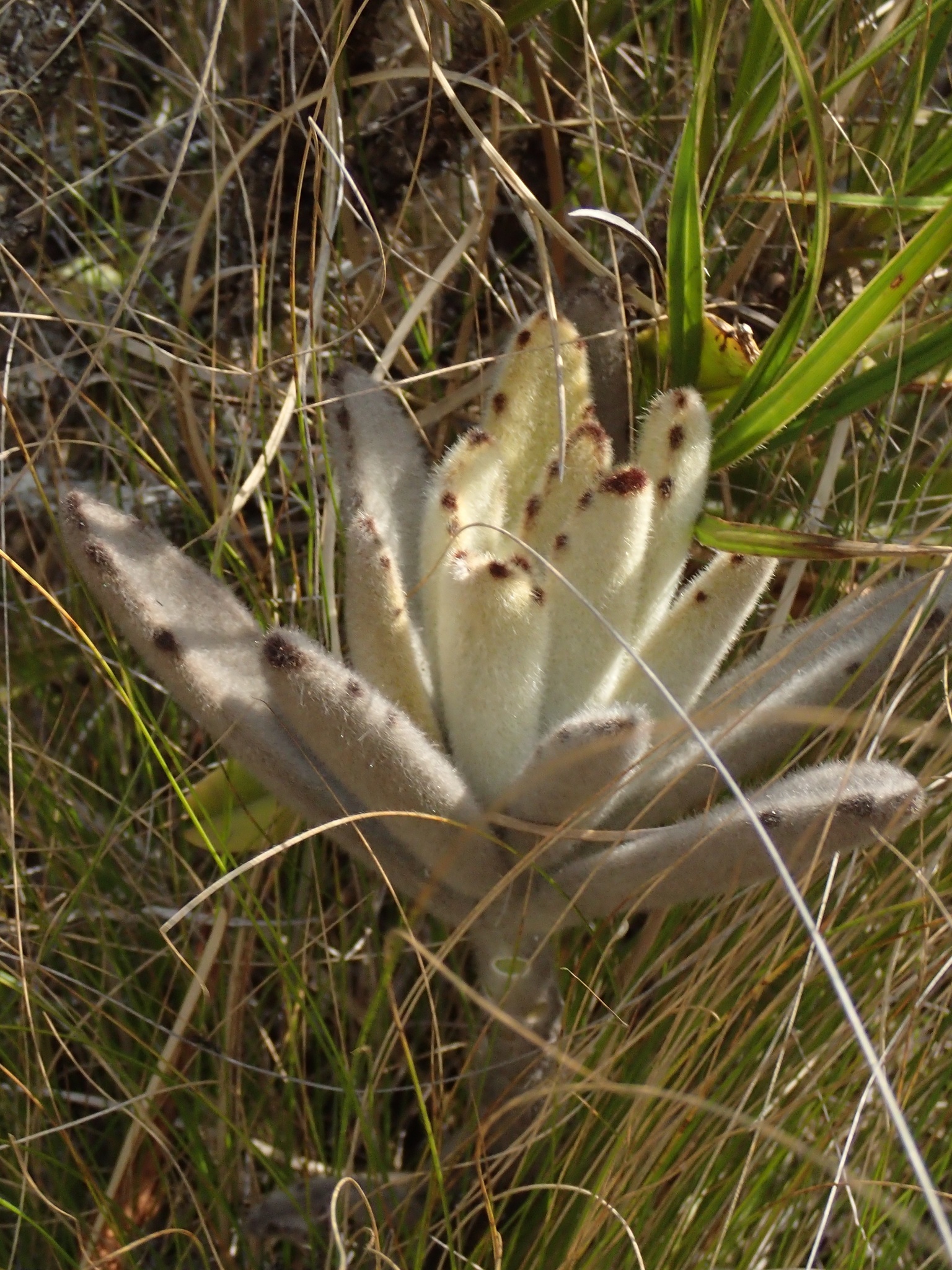
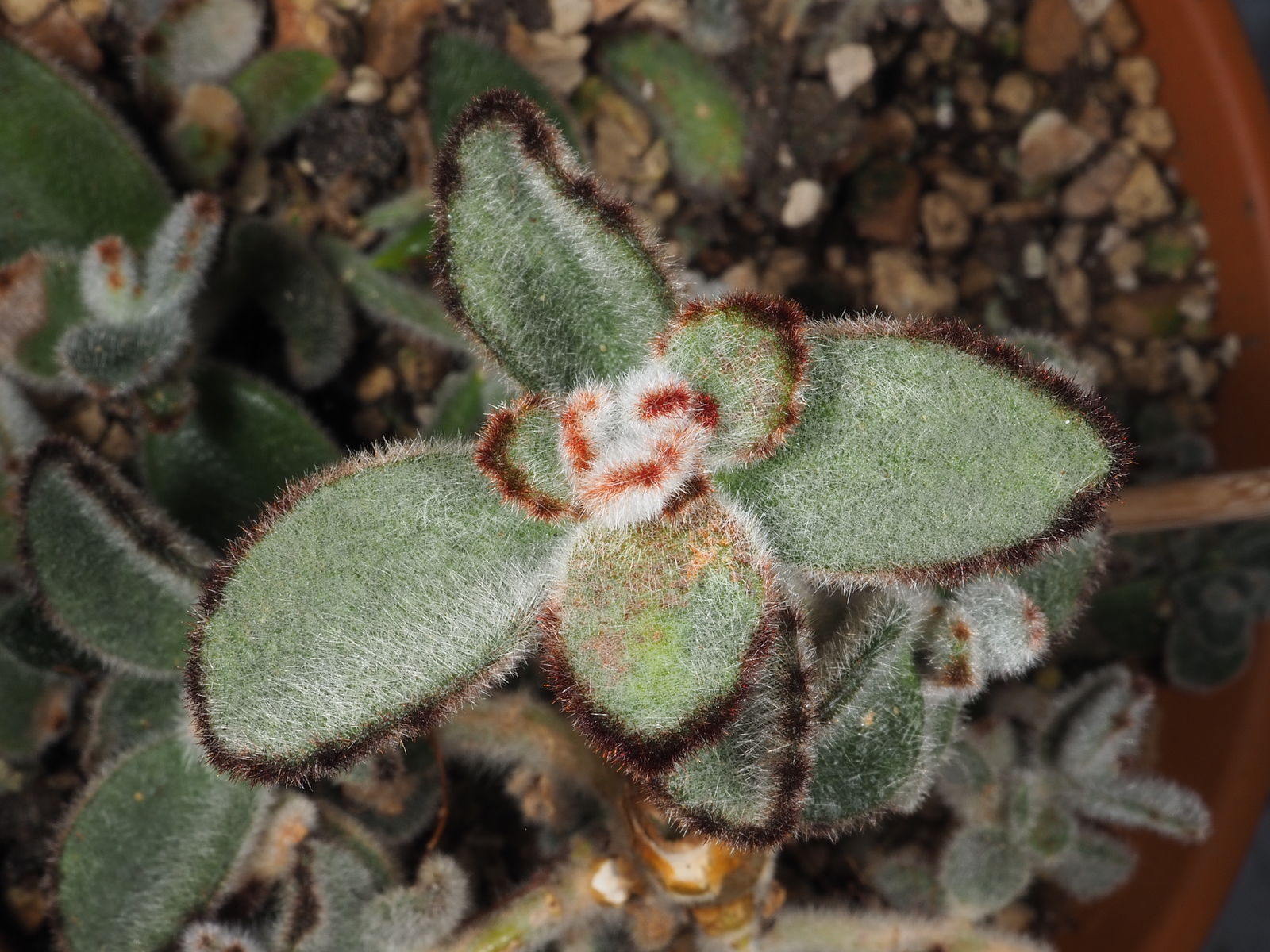
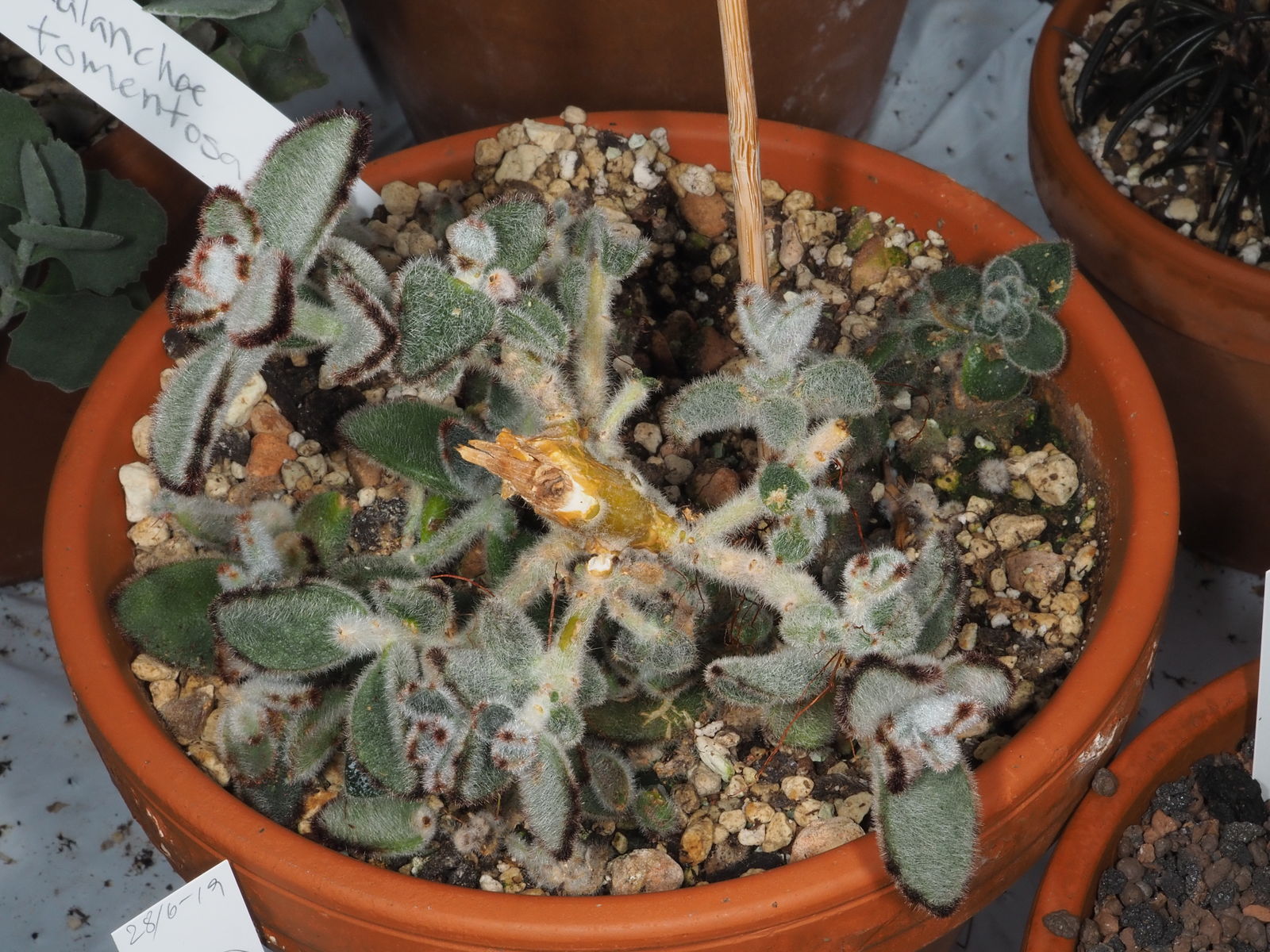
Panda plant leaves are thick, oblong to oval, with rounded teeth near the tip. The dark brown spots along the edge contrast with the whitish hairs on the leaf blade. One horticultural description gives leaves reaching 9 cm (3.5 in). The stems are also downy; their bases become woody with age. 2 3
On a mature plant, young leaves are whiter and upright; older leaves become greener, less hairy and more horizontal. These age differences can therefore alter the appearance of a single plant. Young roots are red with white tips. 4
In horticultural cultivation, the stated mature height is 0.5–1 m (1.6–3.3 ft), with a spread of 0.1–0.5 m (0.3–1.6 ft). These dimensions describe mature development rather than a fixed size for every specimen kept in a small pot. 2
Useful taxonomy
The accepted name is Kalanchoe tomentosa, published in the Journal of Botany in 1882. The synonym Bryophyllum triangulare Blanco appears in the synonymy as a rejected name. Its presence on an old label is therefore no reason to replace the accepted name. 1
Botanical names and trade names need to be read differently. In this variable species, some forms have been selected as cultivars, while others circulate under commercial names whose establishment under the cultivated plant code remains uncertain. A different color is not enough to establish a distinct species. 6
Habitat and distribution
Panda plant is native to east-central Madagascar, in the seasonally dry tropical biome. This botanical range is more precise than an origin attributed to the entire island without further detail. The species is a succulent subshrub. 1
Its presence in Singapore reflects horticultural cultivation rather than an additional native range. In gardening, the species is used in containers or rock gardens in warm climates. Growing it in the ground in those regions does not demonstrate frost resistance: in temperate climates, bring the plant indoors before the first frosts. 4 3
Life cycle, propagation and seasonal care
Panda plant flowers rarely indoors. The tubular flowers, grouped in panicles, are described as appearing from early spring in a British horticultural setting, but in summer in a North American description. Timing therefore varies with conditions. The yellow-green flowers measure about 1 cm (0.4 in) in the British description. 2 3
The plant can be propagated from leaf or stem cuttings, or from offsets. Sow under cover in early spring at 19–21 °C (66–70 °F). Propagating hairy leaves can be less straightforward than propagating other succulents; successful establishment should not be taken for granted. 2 4 3
In containers, Panda plant needs bright light and a well-drained cactus mix. Scorching sun can damage the leaves in very hot climates; insufficient light makes the stems elongate. Letting the growing medium dry between waterings limits the risk of root rot. 3
For indoor cultivation in metropolitan France, the seasonal reference reflects reduced watering in winter and feeding during growth. A balanced liquid fertilizer can be applied two or three times during that season. Adapt this Northern Hemisphere reference to local conditions. Timing depends on how quickly the pot dries and how actively the plant grows; the monthly indices remain relative guidelines, with no prescribed water volume. 2
Uses and risks
Panda plant is grown for its ornamental foliage, in succulent collections or in containers on a warm patio. Its low maintenance requirements do not remove the need to watch for mealybugs and mites. Yellow or soft leaves can indicate excess water. 3
Ingesting Panda plant exposes humans and animals to bufadienolides. Reported effects include nausea, vomiting, diarrhea, lethargy and heart rhythm disturbances. Keep the plant out of reach of children, cats and dogs. The risk to horses and other animal species is not specified, so it cannot be declared safe for them. 3
A claim of non-toxicity in a horticultural catalog contradicts the ingestion risk described for the species; that claim should not guide placement near children or animals. 5 3
Selections, hybrids and lookalikes
The selection ‘Chocolate Soldier’ has thinner, longer leaves with reddish-brown edges; its growth is described as faster than that of the typical form. ‘Teddy Bear’ has rounded, chocolate-brown leaves with almost black tips. These selection traits do not describe every Panda plant. 3
Plants sold as ‘Fang’ or ‘Roseleaf’ require a further distinction: these cultivars belong to Kalanchoe ×edwardii, a hybrid with K. tomentosa as one parent. Sharing a parent and hairy foliage does not make a hybrid a representative of the pure species. Checking the full name avoids transferring its traits to K. tomentosa. 6
Main sources
Botanical references establish identity; horticultural descriptions distinguish the species' traits, its growing conditions and its selections.
- Plants of the World Online, Kalanchoe tomentosa Baker
- Royal Horticultural Society, Kalanchoe tomentosa
- NC State Extension, Kalanchoe tomentosa
- National Parks Board of Singapore, Kalanchoe tomentosa
- Le Jardin du Pic Vert, Panda plant
- Gideon F. Smith, Kalanchoe tomentosa and its horticultural derivatives, Phytotaxa, 2024
Frequently asked questions
How can you identify Panda plant?
The thick, oblong leaves have a whitish felted coating and dark brown markings along their edges, especially near the tips.
Why isn't my Panda plant flowering?
Flowering is rare indoors. Even without flowers, the plant can be identified by its velvety foliage with brown edges.
Does Panda plant need much water?
The growing medium should dry between waterings. Water less often in winter; excess water can cause root rot.
Is Panda plant toxic?
Yes. Ingestion poses a risk to humans, children, cats and dogs. Symptoms include digestive problems and arrhythmias; keep the plant out of reach.
Similar plants
If you are unsure about a plant’s toxicity, ask a botanist or veterinarian for advice.