
Red spider lily (Lycoris radiata, )
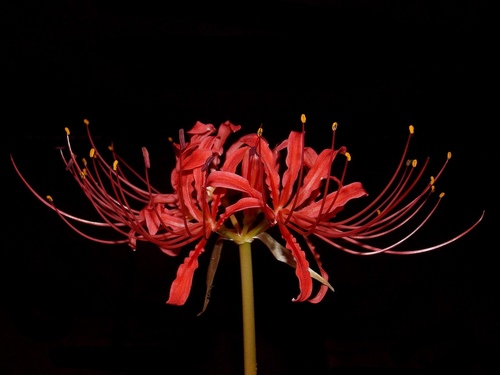
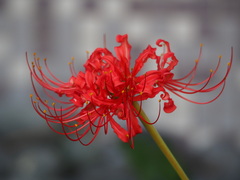
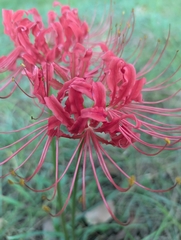
Red spider lily (Lycoris radiata) is a bulbous perennial in the Amaryllidaceae, native across a broad arc from Nepal to China, Korea and southern Japan. Its bare flower stalk, scarlet and bristling with long stamens, emerges in late summer before the leaves. This reversed sequence sets it apart from most garden bulbs.
Read moreRed spider lily, hurricane lily and higanbana
Allow a few hours of direct sun per day, preferably morning or evening.
Full sun to light partial shade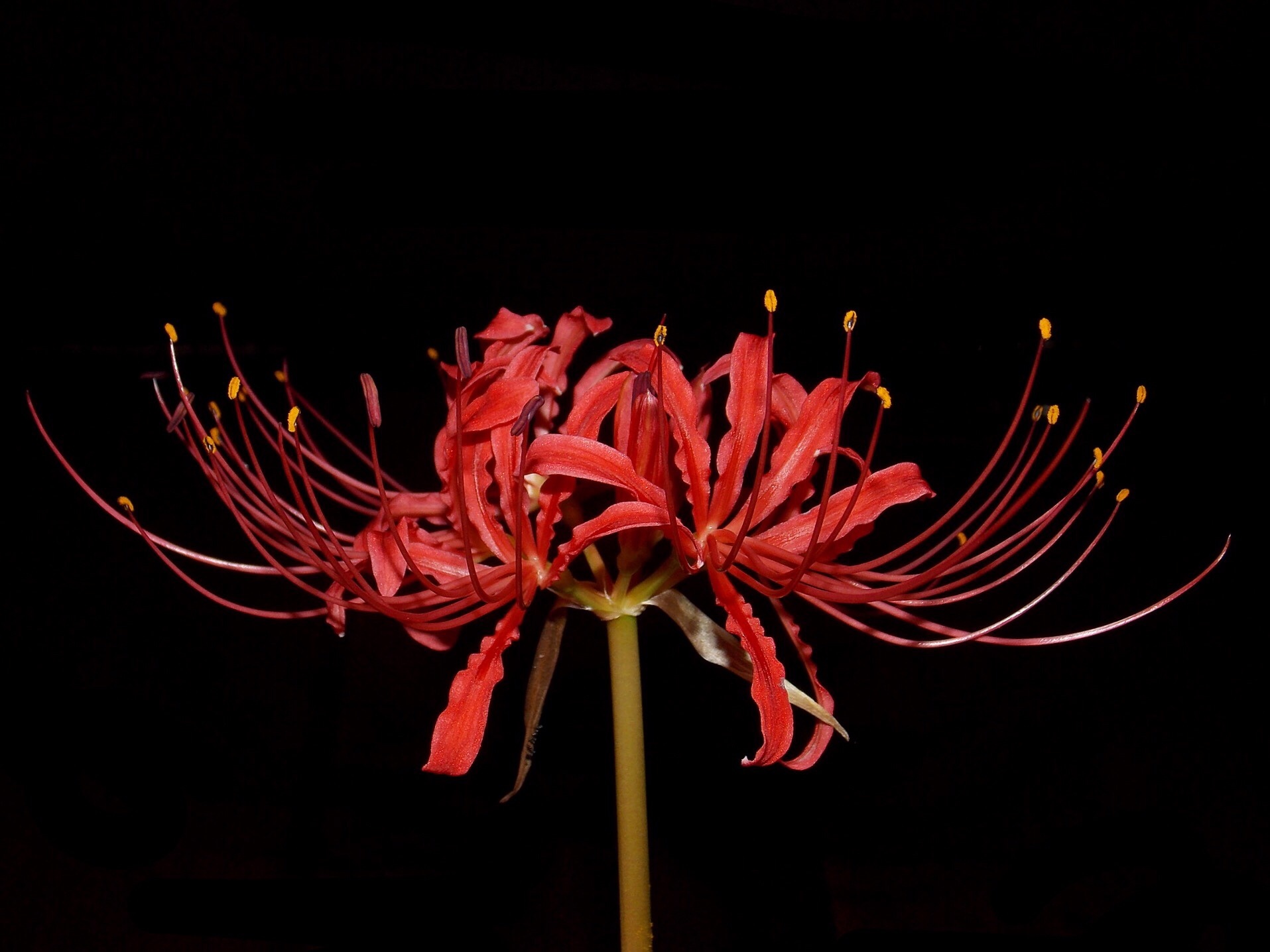



© photo
(c) Aidan Campos, some rights reserved (CC BY-NC), uploaded by Aidan Campos · cc-by-nc
葉子 · cc0
Kevin Jones · cc-by
Taken Aug 23, 2020 by Gene Anderson (cc-by-sa)
Taken Sep 15, 2020 by Denise Houchins (cc-by-sa)
© copyright of the Board of Trustees of the Royal Botanic Gardens, Kew.




Global distribution
POWO recognizes a native range from Nepal to China, Korea and southern Japan. Japanese populations, almost all sterile triploids with nearly identical genetics, may derive from an ancient introduction from China associated with the spread of rice cultivation rather than recent natural colonization. Outside Asia, the species has naturalized in the southeastern United States and Seychelles. Elsewhere, including France, it remains an ornamental without documented invasive status.
- Native4
- Introduced2
- China
- Japan
- South Korea
- Nepal
- United States
- Seychelles
Hexagons: regions where the plant occurs. Green dots: native range.1
Identity
red spider lily (Lycoris radiata (L'Hér.) Herb., 1819) is a bulbous perennial in the Amaryllidaceae. French names include lycoris rouge, lis araignée rouge and amaryllis du Japon. According to POWO, the current botanical name reflects Herbert’s 1819 transfer from Amaryllis, the genus in which L’Héritier first described the plant in 1789. 1 8
The English name hurricane lily reflects a particular trait: flowering begins within days of heavy late-summer rain, with no leaves to announce it. In Japan, where the plant traditionally lines rice fields and cemeteries, it is called higanbana, literally flower of the autumn equinox, because flowering coincides with the Buddhist observance of higan. 5
Recognition
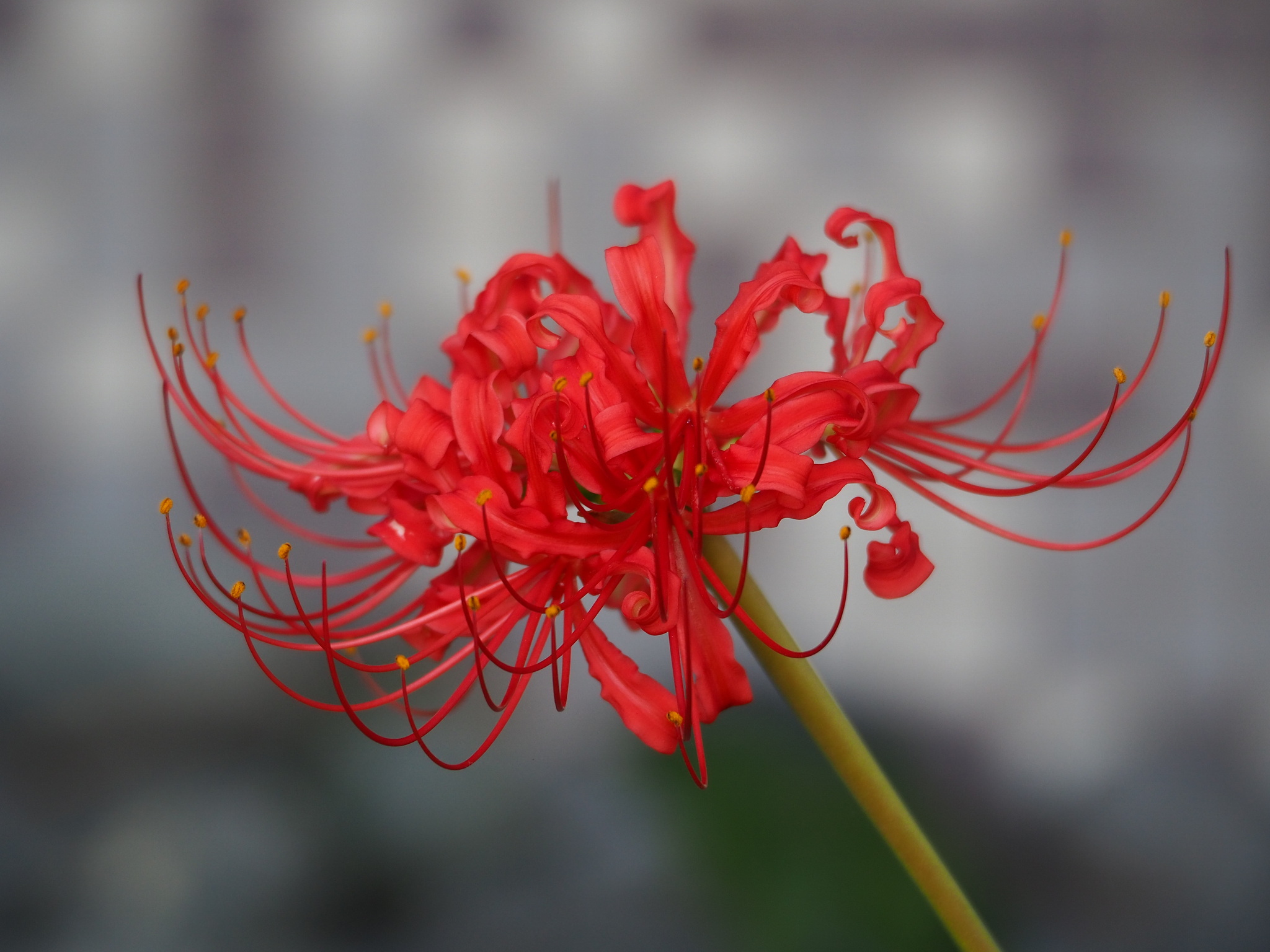
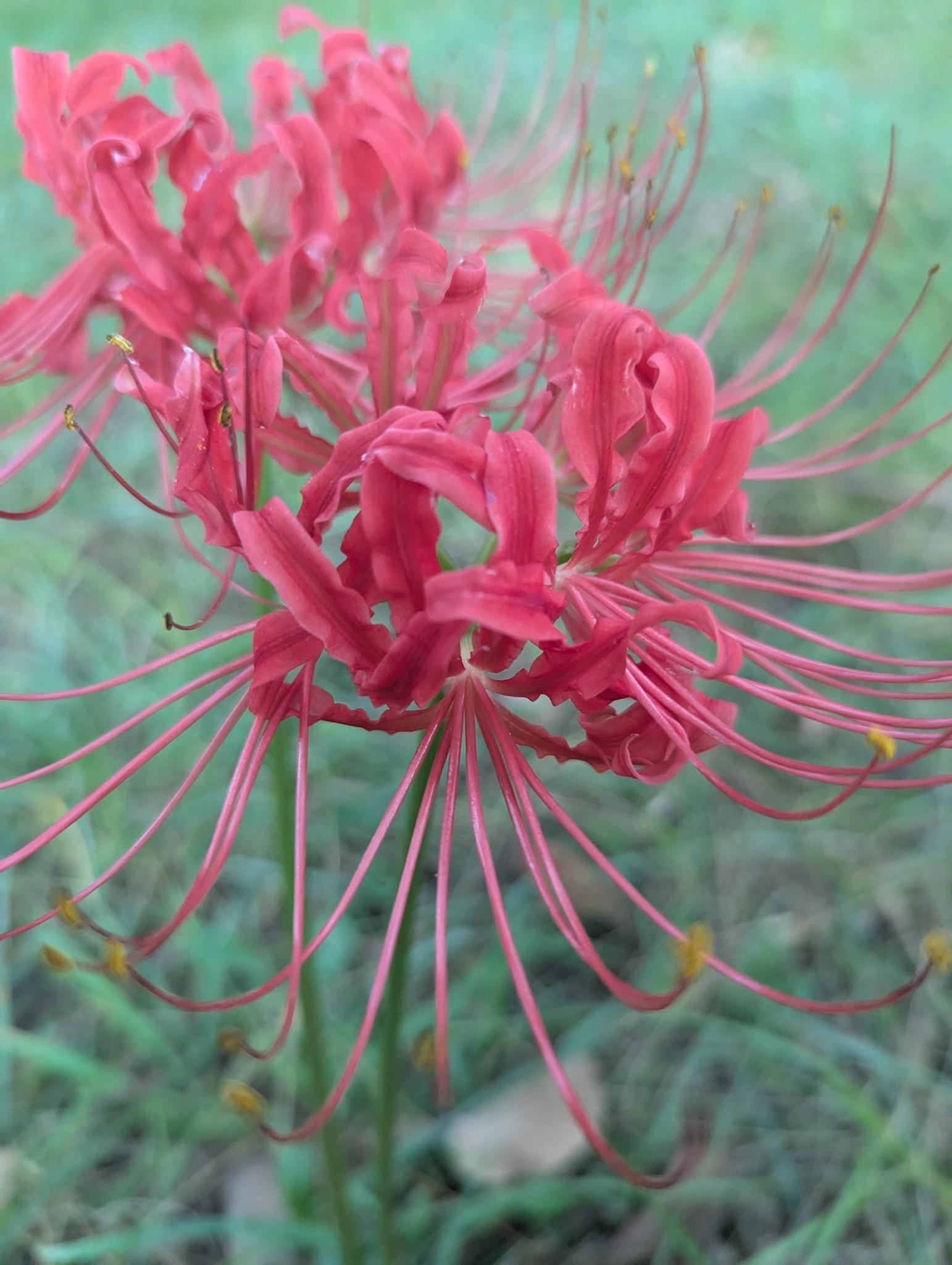
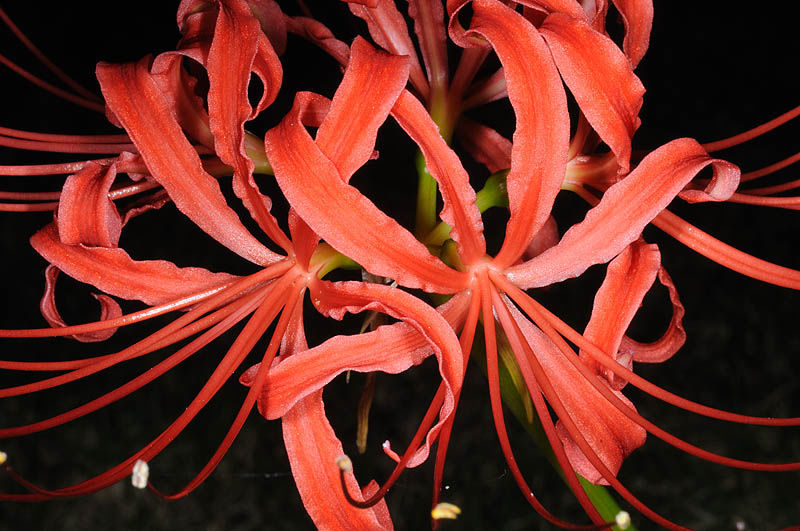
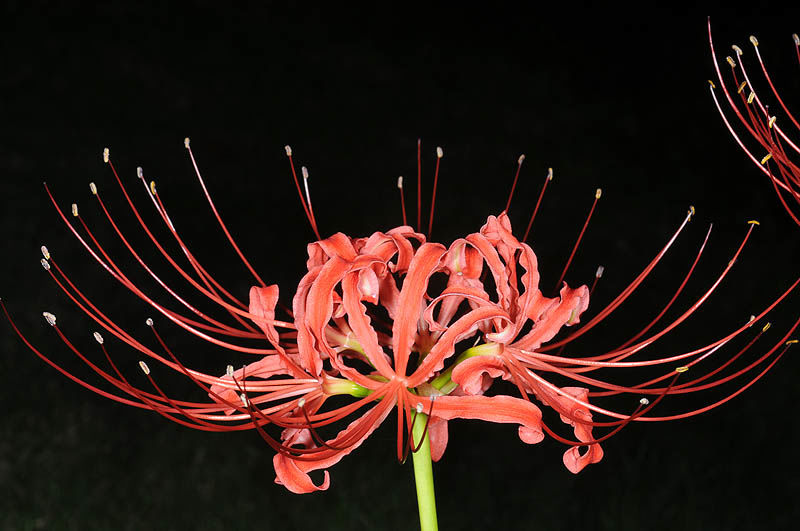
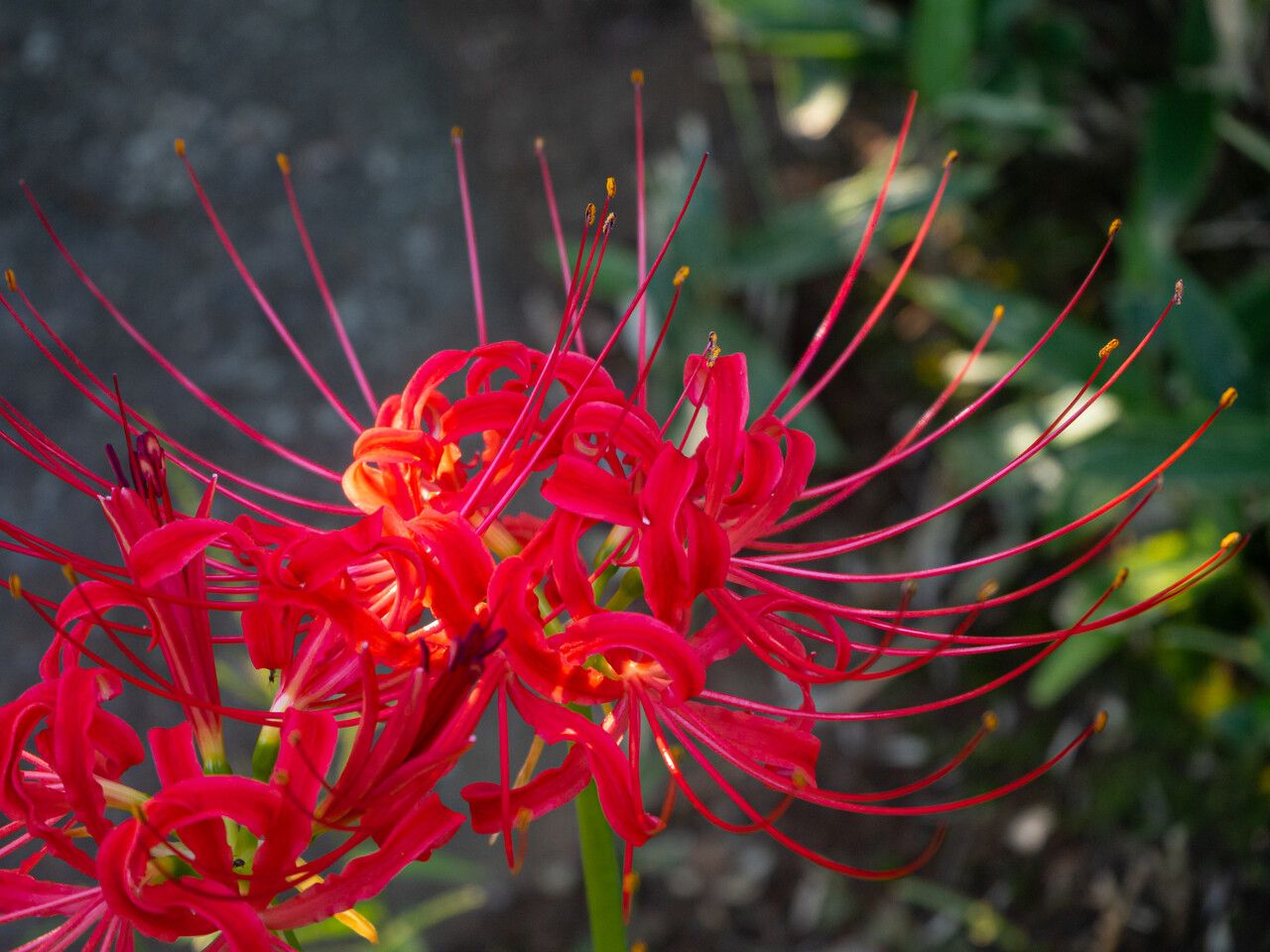
Bare flower stalks are the clearest first clue to Lycoris radiata: its leafless flowering begins directly from the ground in late summer, before foliage appears. Each stalk reaches 30–60 cm (12–24 in) and carries an umbel of 4–6 scarlet flowers opening together. 2 3
The flowers have wavy petals that curve strongly backward and long projecting stamens extending well beyond the perianth. Those stamens account for the English name spider lily. 2
Narrow, gray-green, strap-shaped leaves follow flowering in fall, typically October–November in the Northern Hemisphere. They protect the bulb throughout the cold season before disappearing in late spring; the bulb then remains bare and dormant through summer. A clump of leaves without flowers in midsummer therefore cannot be Lycoris radiata in its normal resting phase: during that phase, neither flowers nor leaves are visible. 3
Useful taxonomy
Herbert’s combination Lycoris radiata (L'Hér.) Herb., published in 1819, is the accepted name, based on Amaryllis radiata, described by L’Héritier in 1789. Several other combinations circulated before the genus Lycoris became established:
- Amaryllis radiata L'Hér., 1789, basionym
- Nerine radiata (L'Hér.) Sweet
- Nerine japonica Miq.
- Orexis radiata (L'Hér.) Salisb.
The varietal name Lycoris radiata var. pumila Grey deserves attention. POWO treats it as a synonym, but in Chinese populations it corresponds to a real biological entity that supports seed reproduction, unlike the sterile cytotype dominant elsewhere. 1
Habitat and range
Nepal, China, Korea and southern Japan form the native range recognized by POWO. The species favors shaded banks, woodland edges and streambanks rich in organic matter, conditions that favor spontaneous bulb establishment. 1 3
Genetic analyses show that Japanese populations, almost all sterile triploids, form a nearly identical clonal group from island to island. This uniformity suggests an ancient introduction from China, probably linked to the spread of rice cultivation, rather than recent natural colonization. 6
Outside Asia, the species has naturalized in the southeastern United States and Seychelles, whose subtropical climates resemble those of its original range. In Europe, including France, Lycoris radiata remains chiefly an ornamental, with no documented invasive status. 5
Life cycle and reproduction
Summer is the dormant period for Lycoris radiata, reversing the sequence of most garden bulbs. Flowering starts abruptly in late summer or early fall, typically late August or September in the Northern Hemisphere, when the season’s first heavy rains soak the ground. In other hemispheres, the seasonal sequence matters more than those calendar months. 5 2
Reproduction sharply separates two populations. In the Chinese diploid form, var. pumila (2n = 22), viable seeds allow natural spread through seedlings. The form overwhelmingly dominant elsewhere is a sterile triploid cytotype (2n = 33), which cannot reproduce sexually and multiplies only through vegetative bulb division. This accounts for the near-total genetic uniformity observed in Japan and Korea. 6
For an established garden plant, the only reliable propagation method is therefore division of bulb offsets in late summer, after flowering. Sowing has real value only for fertile diploid populations, and only where the climate allows their dry summer rest. 2 4
After separation, young offsets often need several seasons to reach flowering size. A clump that fails to thicken in the year after division has therefore not necessarily failed in cultivation. 2
Uses and risks
The bulb contains lycorine, a toxic alkaloid concentrated mainly in underground tissues. Animals that ingest it can develop abdominal pain, salivation, tremors, nausea and vomiting. NC State Extension places the plant among poisons of low severity; the RHS advises against any ingestion and recommends gloves when handling bulbs. 3 2
In Japan, the toxic bulb repels rats, mice and moles attracted to crops or burials, explaining traditional planting along rice-field margins and beside graves. The intense red flowers also carry strong symbolic associations with the autumn equinox and, in some folk accounts, separation or a final farewell. 5
Bulbs also contain galantamine, an alkaloid used as a drug for Alzheimer’s disease, at a higher concentration than in other plant organs. Chinese cultivation exploits Lycoris radiata directly for extraction as well as ornament: the same toxic chemistry that makes the bulb dangerous to ingest also makes it a documented pharmaceutical source. 7
Varieties, look-alikes and related plants
Few stable cultivars circulate; the species is grown mainly in its botanical form rather than under elaborate commercial names. Var. pumila, the fertile diploid form endemic to China, produces seeds, unlike the triploid cytotype dominant elsewhere. Plants sold as ‘Alba’, with white or cream flowers, often belong to hybrids within Lycoris rather than the pure species. Before buying, the complete scientific name is more reliable than a trade name alone. 1 6
Pink, fragrant Lycoris squamigera and Nerine bowdenii, another bulb with bare fall flower stalks but less strongly recurved petals, are the most frequent look-alikes. Against these two related plants, the scarlet color and long projecting stamens identify Lycoris radiata more reliably than flower shape alone. 2 4
Main sources
- Plants of the World Online / Kew, Lycoris radiata (L'Hér.) Herb.
- Royal Horticultural Society, Lycoris radiata - red spider lily
- NC State Extension Gardener Plant Toolbox, Lycoris radiata
- Plants For A Future, Lycoris radiata
- Wikipedia EN, Lycoris radiata
- Cytogeography and chromosomal variation of the endemic East Asian herb Lycoris radiata, PMC6662380
- Transcriptome analysis and metabolic profiling of Lycoris radiata, PMC6784096
- Wikidata, Lycoris radiata
Frequently asked questions
Why does Lycoris radiata flower without leaves?
Its cycle reverses the sequence of most garden bulbs. The bare flower stalk emerges in late summer, often after heavy rain; leaves appear only after flowering and remain through winter.
Is red spider lily toxic?
Yes. The bulb contains lycorine, an alkaloid that causes abdominal pain, salivation and vomiting if ingested. NC State Extension rates its toxicity as low, but caution is still needed around children and animals.
Can Lycoris radiata be grown from seed?
Rarely outside China. The form widespread in Japan and elsewhere is a sterile triploid cytotype that reproduces only by dividing bulb offsets; only the Chinese diploid form, var. pumila, produces viable seeds.
When should red spider lily bulbs be planted and divided?
Plant in summer, before late-season flowering. Divide established clumps in late summer, just after the flowers fade, following the local seasonal cycle rather than a fixed calendar month.
Which plants look like Lycoris radiata?
The most frequent look-alikes are Lycoris squamigera, with fragrant pink flowers, and Nerine bowdenii, another bulb with bare fall flower stalks but less strongly recurved petals.
What does higanbana mean?
This Japanese name means flower of the autumn equinox. Flowering traditionally coincides with higan, a period in the Japanese Buddhist calendar.
Similar plants
If you are unsure about a plant’s toxicity, ask a botanist or veterinarian for advice.