
Surprise lily (Lycoris squamigera, )
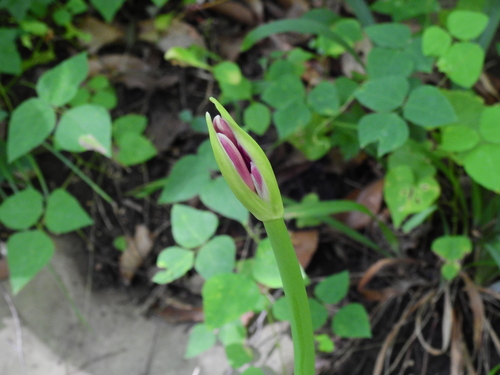
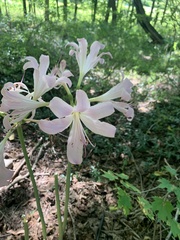

Surprise lily (Lycoris squamigera) is a bulbous perennial in the Amaryllidaceae, native to southeastern China and Korea. Its strap-shaped leaves appear in spring, then vanish completely before summer; bare flower stalks emerge within days later in the season, explaining its name. The species is thought to be an ancient hybrid with sterile flowers, spread almost entirely by bulb division.
Read moreSurprise lily and resurrection lily
Allow a few hours of direct sun per day, preferably morning or evening.
Full sun is ideal; tolerates light partial shade.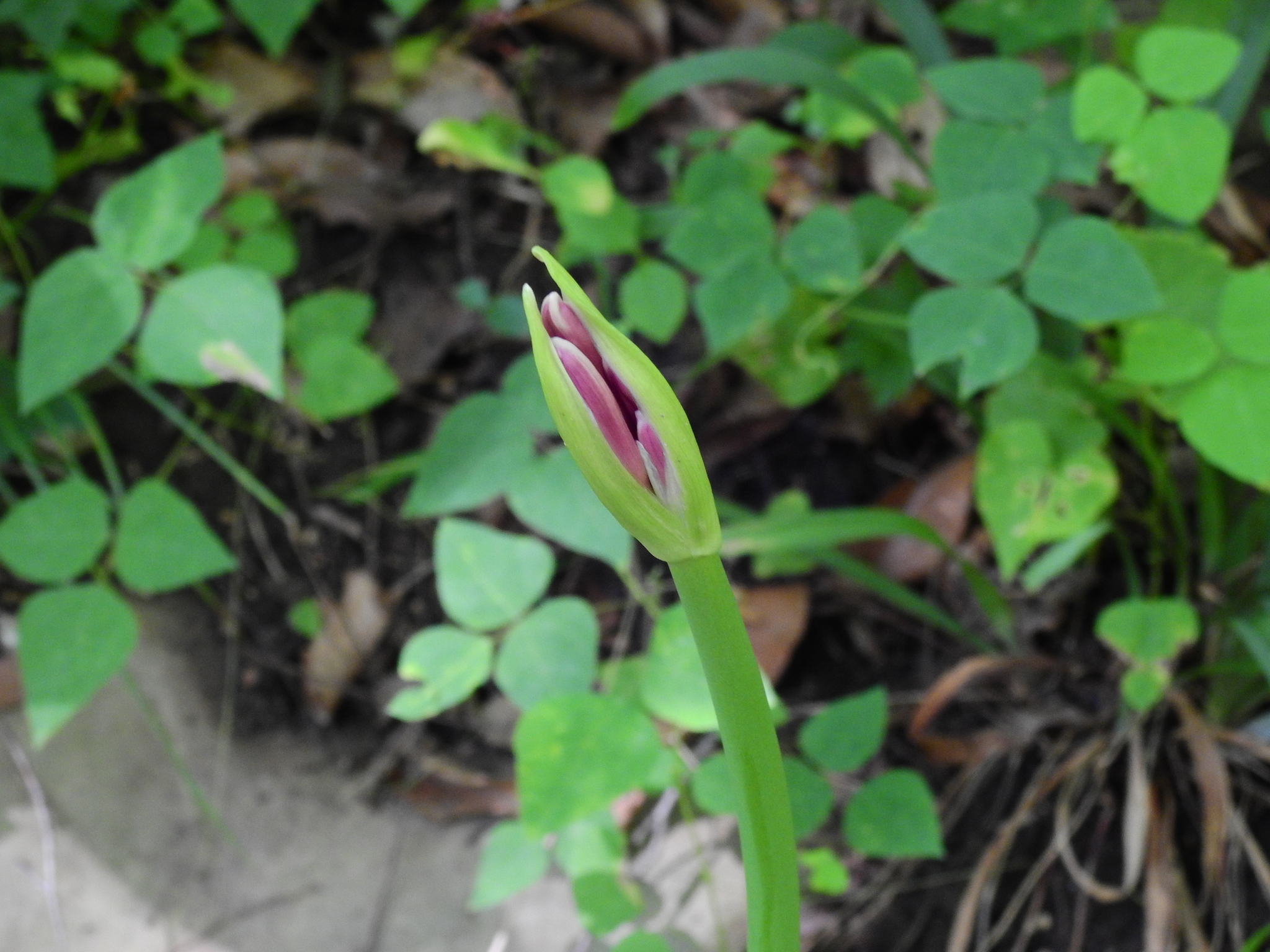

© photo
Yann Kemper · cc0
Elizabeth Axley · cc-by
Wikimedia Commons · CC BY-SA or Public Domain
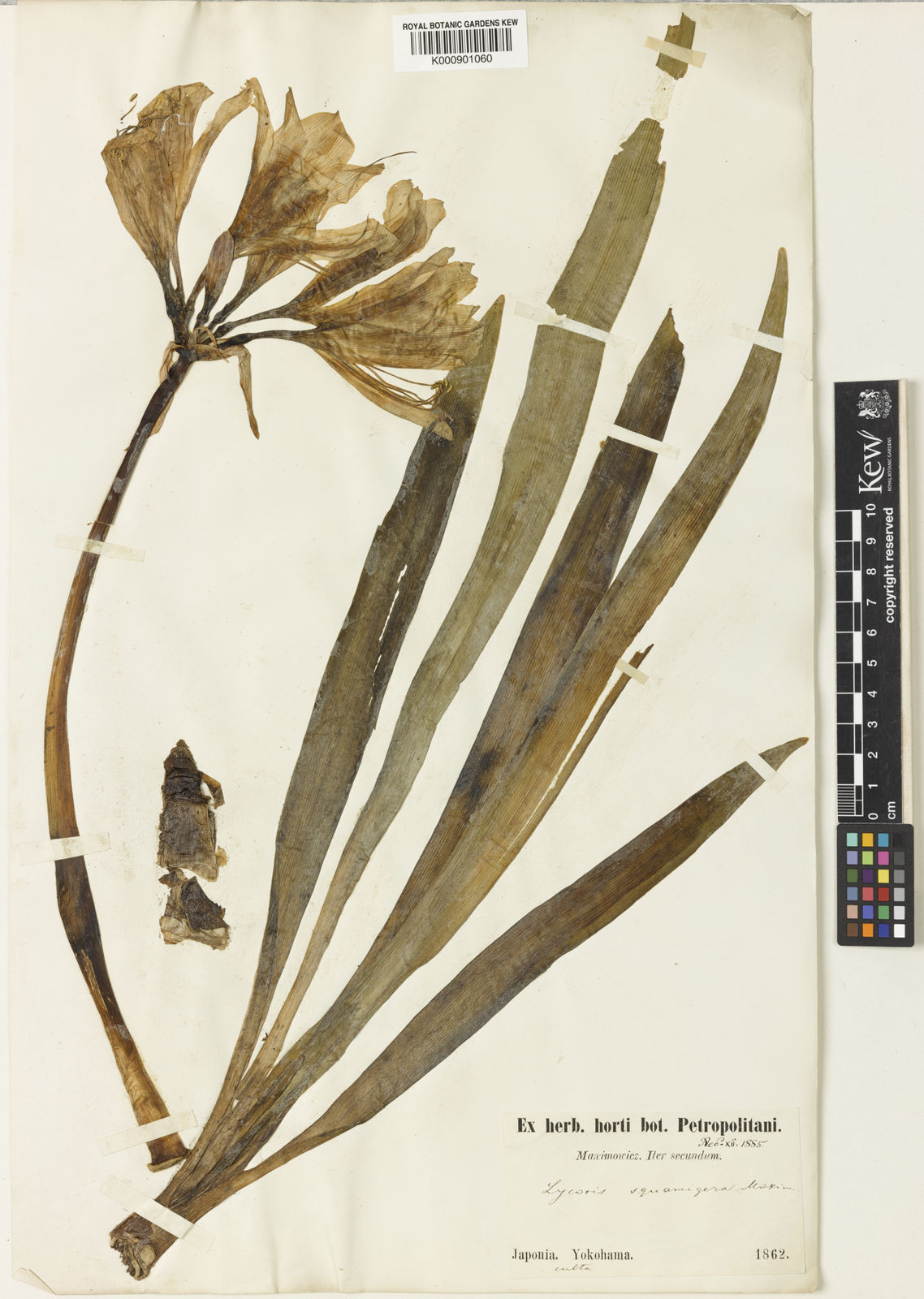
© copyright of the Board of Trustees of the Royal Botanic Gardens, Kew.


Global distribution
The recognized native range of Lycoris squamigera lies in southeastern China and Korea. It has been cultivated for a very long time in Japan, where it has widely naturalized without being regarded as truly native. In North America and Europe it remains a garden plant, sometimes found growing spontaneously near abandoned homesites.
- Native2
- Introduced2
- China
- Korea
- Japan
- United States
Hexagons: regions where the plant occurs. Green dots: native range.1
Identity
surprise lily (Lycoris squamigera Maxim., 1884), also called resurrection lily, is a bulbous perennial in the genus Lycoris, family Amaryllidaceae. POWO and USDA GRIN accept this name, with the homotypic synonyms Hippeastrum squamigerum (Maxim.) H.Lév. and Amaryllis hallii Baker. 1 6
The name resurrection lily, also used in French, describes a precise event: a flower stalk suddenly rises from ground where the foliage vanished weeks earlier. The English name naked ladies, shared with Amaryllis belladonna, points to the same absence of leaves when the flowers open. 2 8
Recognition
Foliage and flowers occupy separate phases in the cycle of Lycoris squamigera. Its gray-green, strap-shaped leaves, 15–60 cm (6–24 in) long, emerge in spring, then yellow and disappear completely in early summer, before flowering begins. 2 4
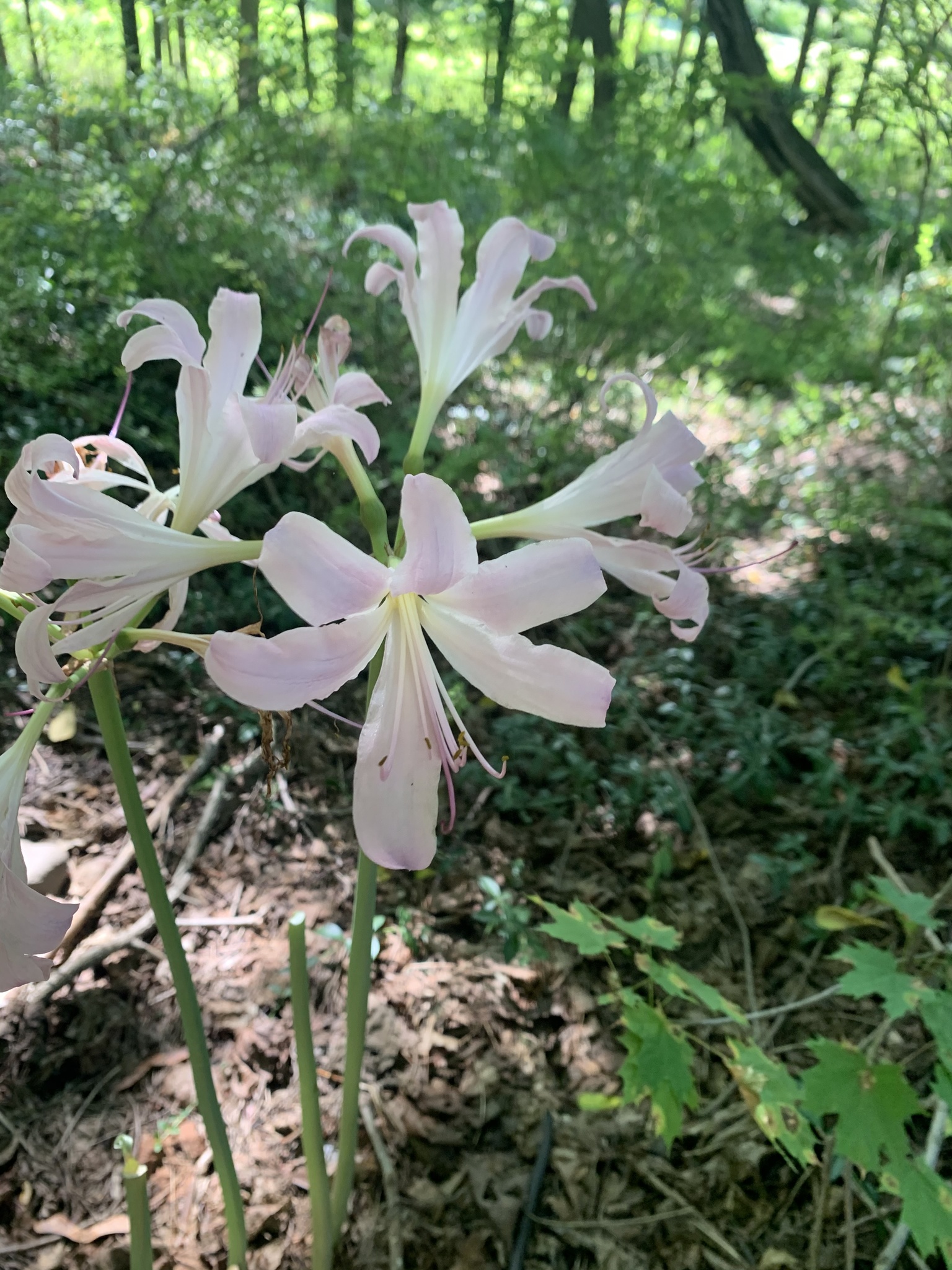
In late summer to early fall, August–September in the Northern Hemisphere, bare, rigid stalks 40–70 cm (16–28 in) tall rise from the ground in just four to five days. Each bears 4–8 flowers about 7 cm (2.8 in) across, fragrant and lilac-pink, with wavy-edged tepals sometimes tinged with blue. With no foliage alongside, the flowers seem to appear from nowhere, explaining the resurrection name. An isolated stalk bends in strong wind, while a group of stalks protects its members from breakage. 3 2
Useful taxonomy
Carl Maximowicz, the Russian botanist, published Lycoris squamigera Maxim. in 1884; POWO and USDA GRIN retain that scientific name. The synonyms Hippeastrum squamigerum (Maxim.) H.Lév. and Amaryllis hallii Baker still appear in old horticultural catalogs. 1 7
Aujardin.info and Wikipedia describe the species as an ancient hybrid, perhaps arising from Lycoris sprengeri crossed with Lycoris longituba or Lycoris chinensis. This hybrid origin explains a consistent observation in cultivation: the flowers produce few viable seeds, and the plant spreads almost entirely by bulb division. 3 8
Habitat and range
Southeastern China, particularly Jiangsu, Zhejiang and Shandong, together with Korea, forms the recognized native range. There it grows beside cultivated fields and on damp banks rather than in closed forest. 1 5
Long cultivation in Japan has led to widespread naturalization, without Lycoris squamigera being considered truly indigenous there: a long history in cultivation does not establish a wild origin. Introduced to North America as a garden plant in the 19th century, it sometimes persists beside abandoned homesites long after the surrounding garden has disappeared. 5 2
Winter hardiness down to USDA zone 5 substantially exceeds that of most other cultivated Lycoris, which are often restricted to zones 7 and warmer. For readers comparing winter climates, this difference explains why Lycoris squamigera is usually the only species of the genus offered in temperate bulb catalogs outside mild regions. 2 3
Life cycle and reproduction
For much of the year, the bulb is the plant’s only active part. After the leaves senesce in early summer, it passes through apparent dormancy before sending up its bare late-summer flower stalk within a few days. Nothing visible announces this restart: neither a bud nor a change at the soil surface. Soil that remains waterlogged throughout the season encourages bulb rot during dormancy, the main cause of losses in cultivation. 2 4
With too few viable seeds, propagation in cultivation relies almost entirely on bulb division, carried out in summer once the leaves have disappeared. A recently planted or divided bulb often needs 1–2 years before its first flowers, whereas an undisturbed clump flowers annually without interruption. The moved bulb needs that time to rebuild its reserves. 3 4
This slow return to flowering follows directly from the species’ cycle: moving the bulb interrupts an internal timetable spanning several seasons. Experienced gardeners therefore almost always advise against repotting or moving an already flowering clump. 4
Uses and risks
Beds of perennials provide the main ornamental setting, with broad-leaved neighbors concealing the summer disappearance of Lycoris foliage. The late, fragrant display adds interest to a garden already well into summer, when many spring bulbs have nothing left to show. 2 3
The bulb is toxic, as in most Amaryllidaceae. It contains alkaloids related to lycorine, which cause digestive disturbances if people or pets ingest it. Some sources report a historical food use after prolonged leaching of the bulb. That practice remains inadvisable without precise knowledge of preparation and the soaking time needed to remove irritating compounds. 4 8
In a family garden, labeling is a particular precaution. Once the leaves vanish, nothing above ground marks the toxic bulb until late-summer flowering, which may surprise a child or an animal digging in an apparently empty bed. 2
Varieties, look-alikes and related plants
Lycoris squamigera has no widely differentiated ornamental cultivars: most bulbs sold represent the same hybrid clone, propagated by division for decades. Catalogs sometimes use the spelling Lycoris × squamigera to emphasize its hybrid origin. 8
Amaryllis belladonna is the likeliest source of confusion, with similarly fragrant flowers on bare stems, but a South African origin and lower winter hardiness. Within the genus, Lycoris radiata, with narrow red flowers, differs markedly in color from Lycoris squamigera. Both nevertheless share the sequence of foliage followed by flowers that can puzzle gardeners unfamiliar with the cycle. 2 7
Main sources
- Plants of the World Online / Kew, Lycoris squamigera Maxim.
- Missouri Botanical Garden Plant Finder, Lycoris squamigera
- Aujardin.info, Lycoris squamigera - Lis de la résurrection
- Plants For A Future, Lycoris squamigera - Resurrection Lily
- USDA PLANTS Database, Lycoris squamigera (LYSQ)
- USDA GRIN Taxonomy, Lycoris squamigera
- ITIS, Lycoris squamigera Maxim.
- Wikipedia EN, Lycoris squamigera
Frequently asked questions
Is surprise lily toxic?
Yes. The bulb contains alkaloids related to lycorine, common in the Amaryllidaceae, and can cause digestive disturbances if ingested by people or pets.
Why do the leaves disappear before flowering?
The life cycle of Lycoris squamigera separates foliage and flowers in time. Leaves grow in spring, then yellow in summer; bare flower stalks appear only several weeks later, without any accompanying leaves.
Can surprise lily be grown from seed?
Rarely with success. The species is regarded as an ancient hybrid with poorly fertile flowers; propagation is almost always by bulb division rather than seed.
Where should surprise lily be planted in a garden?
In a sunny bed with rich, well-drained soil, alongside broad-leaved perennials that conceal the summer disappearance of its own foliage.
How long does it take to flower for the first time?
A newly planted or divided bulb often takes 1–2 years to flower. It first needs to settle back in without being moved again.
How does it differ from Amaryllis belladonna?
Both have fragrant flowers on bare stems, but Amaryllis belladonna is native to South Africa and less hardy, while the East Asian Lycoris squamigera tolerates much colder winters.
Similar plants
If you are unsure about a plant’s toxicity, ask a botanist or veterinarian for advice.