
Heavenly bamboo (Nandina domestica, )
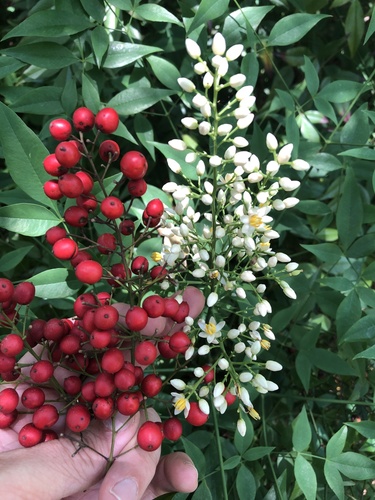
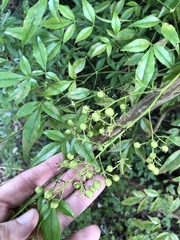
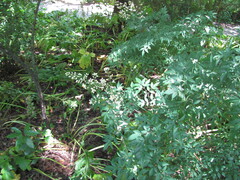
Heavenly bamboo (Nandina domestica) is an evergreen shrub in the Berberidaceae family, native to central and southern China, Japan and India. It is the sole species of Nandina, despite its resemblance to bamboo. Fine, colorful leaves, white flower panicles and red berry clusters make it a common ornamental shrub, now invasive in several temperate regions.
Read moreHeavenly bamboo, Sacred bamboo and Nandina
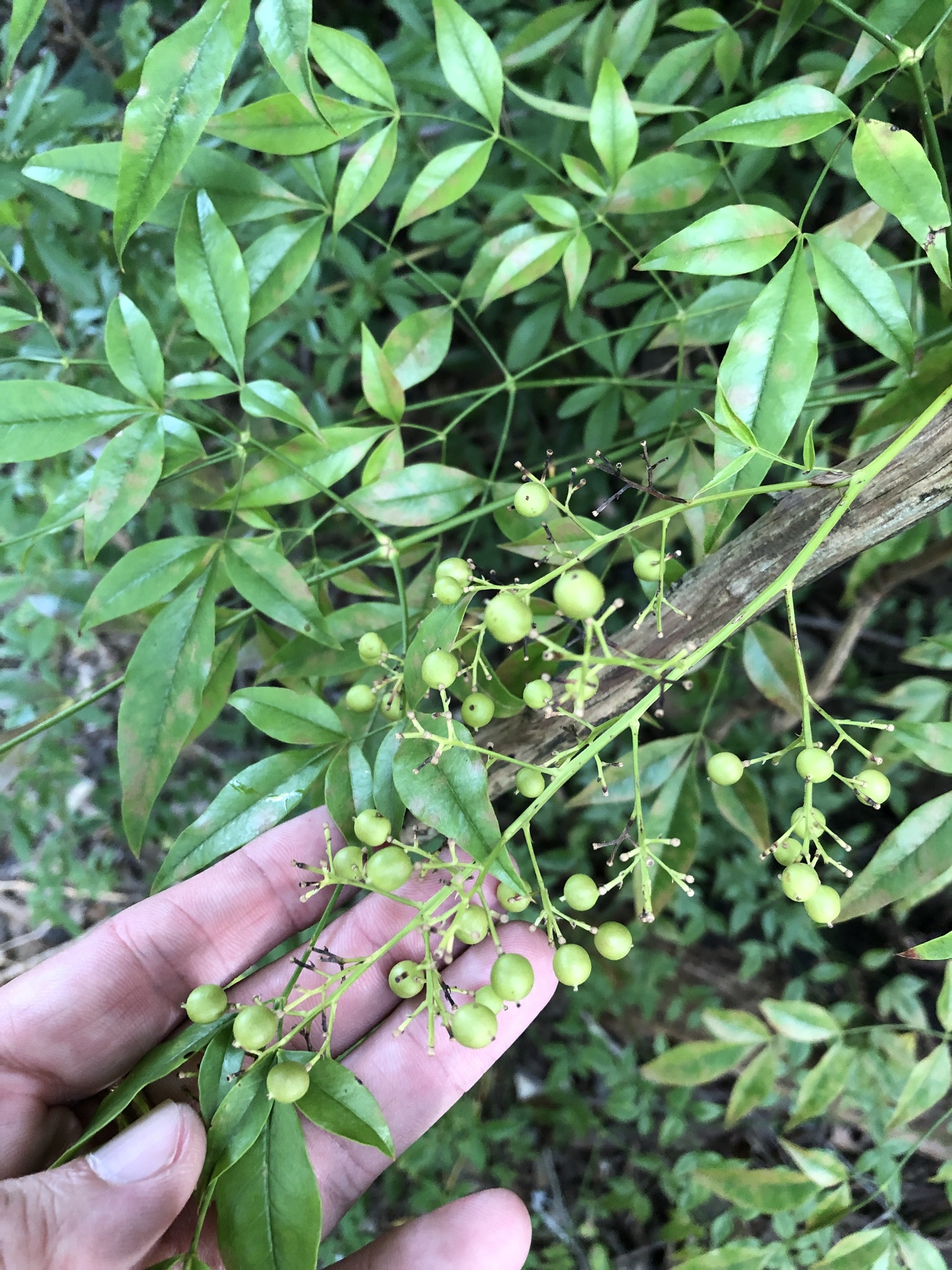
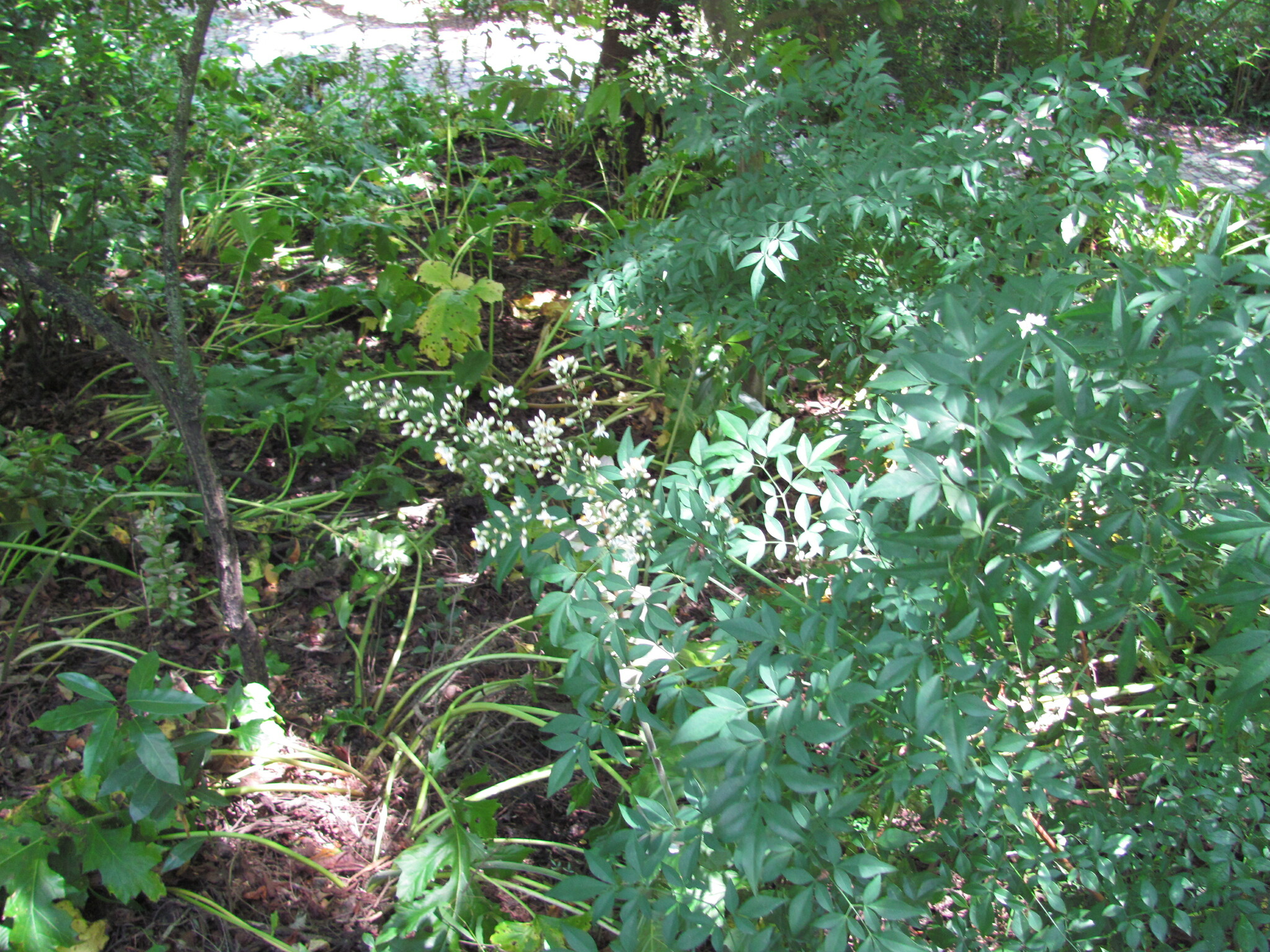


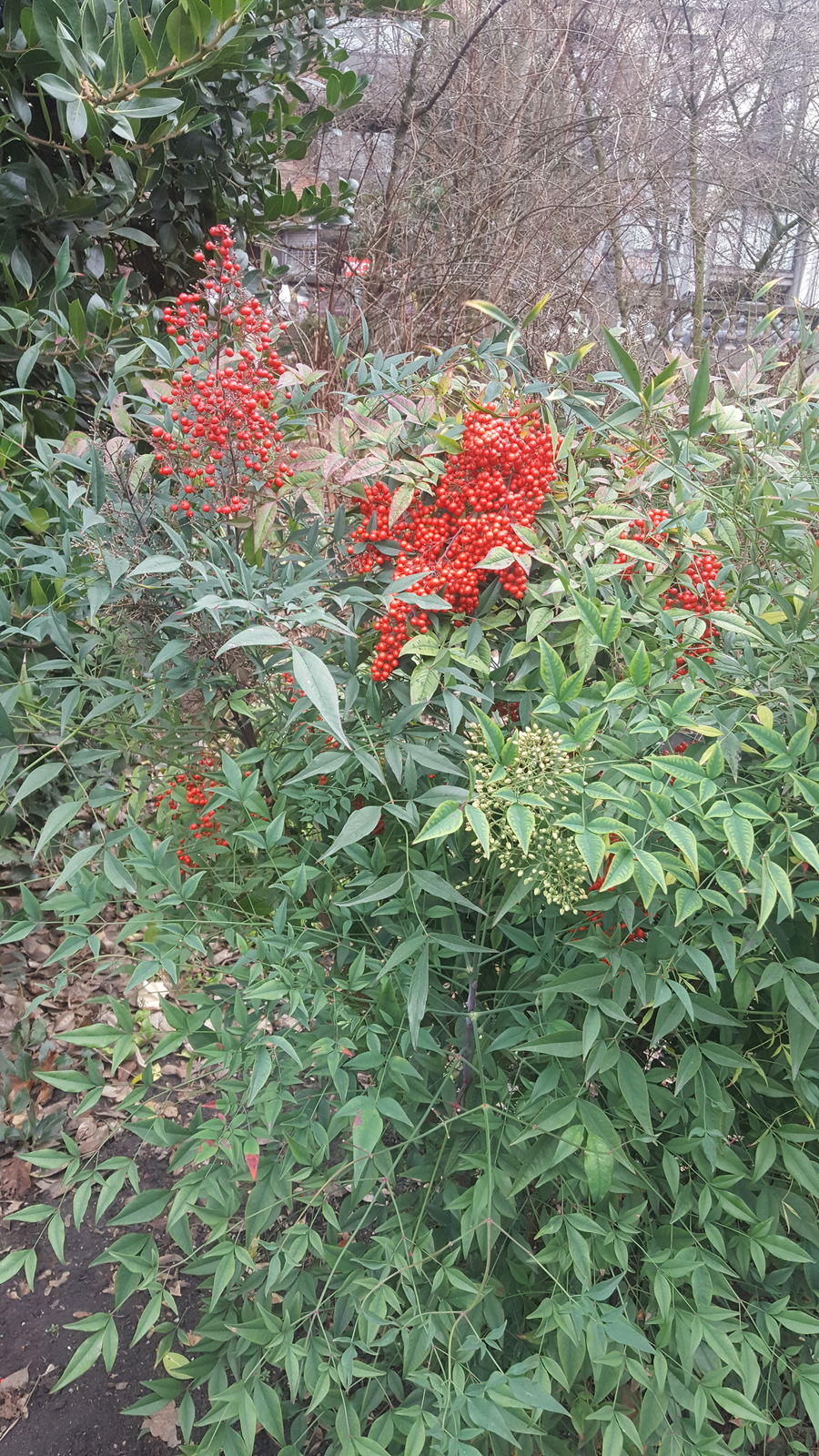
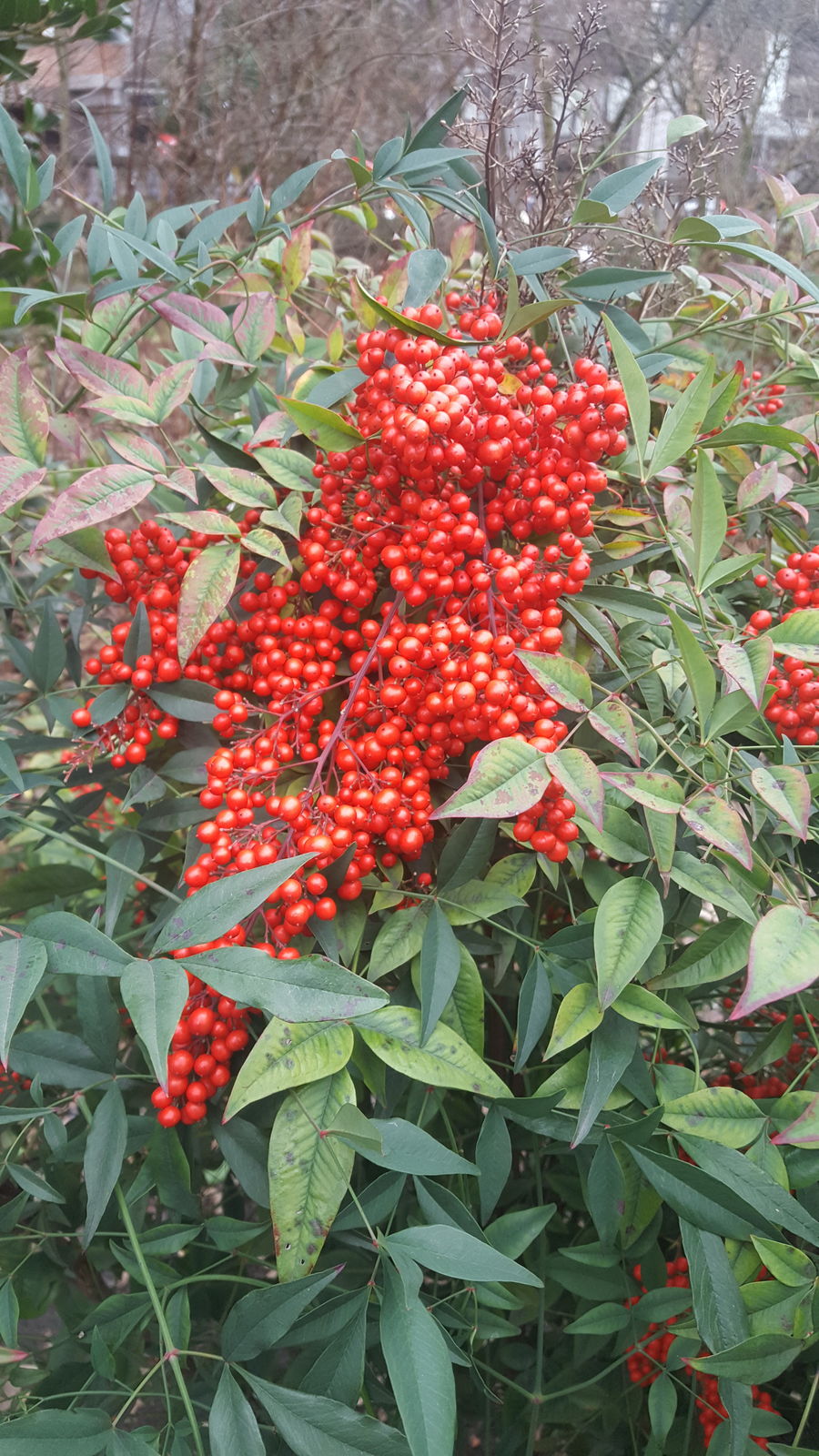
© photo
(c) Sam Kieschnick, some rights reserved (CC BY), uploaded by Sam Kieschnick · cc-by
Sam Kieschnick · cc-by
zebedeugalinha · cc-by
Taken May 27, 2020 by Carson Yunk (cc-by-sa)
Taken Nov 28, 2015 by EOL − Erika Leydig (cc-by-nc)
Taken Jan 15, 2022 by Manuëlle (cc-by-sa)
Taken Feb 15, 2020 by Pierre Sosson (cc-by-sa)
Taken Jun 25, 2014 by Tela Botanica − Yoan MARTIN (cc-by-sa)
© copyright of the Board of Trustees of the Royal Botanic Gardens, Kew.


Global distribution
Nandina domestica is native to central and southern China, Japan and India, growing in ravines and forest valleys in warm temperate climates. Widely planted as an ornamental shrub, it has naturalized and becomes locally invasive in the southeastern United States. In France it remains mainly cultivated, with no recognized invasive status.
- Native3
- Invasive1
- China
- Japan
- India
- United States (southeast)
Hexagons: regions where the plant occurs. Green dots: native range.1
Identity
Heavenly bamboo (Nandina domestica Thunb., 1781) is an evergreen shrub in the Berberidaceae family and the only currently accepted species of Nandina. Its common name can mislead beginners: it is unrelated to true bamboos, members of Poaceae. Solid rather than hollow stems distinguish it at first glance from a true bamboo’s hollow culms. 1 2
Latinized from the Japanese nanten, the genus name Nandina recalls its Asian history. The epithet domestica means “of gardens,” describing its traditional cultivation near homes in China and Japan long before Carl Peter Thunberg described it botanically in 1781. 1 5
Recognition
Upright clumps reach 1–2.5 m (3–8 ft) tall and 1–1.5 m (3–5 ft) wide at maturity. Slender, sparsely branched stems multiply from the base. Evergreen, twice- to three-times-compound leaves carry narrow lance-shaped leaflets, giving a fine, airy texture very different from true bamboo. 2 3
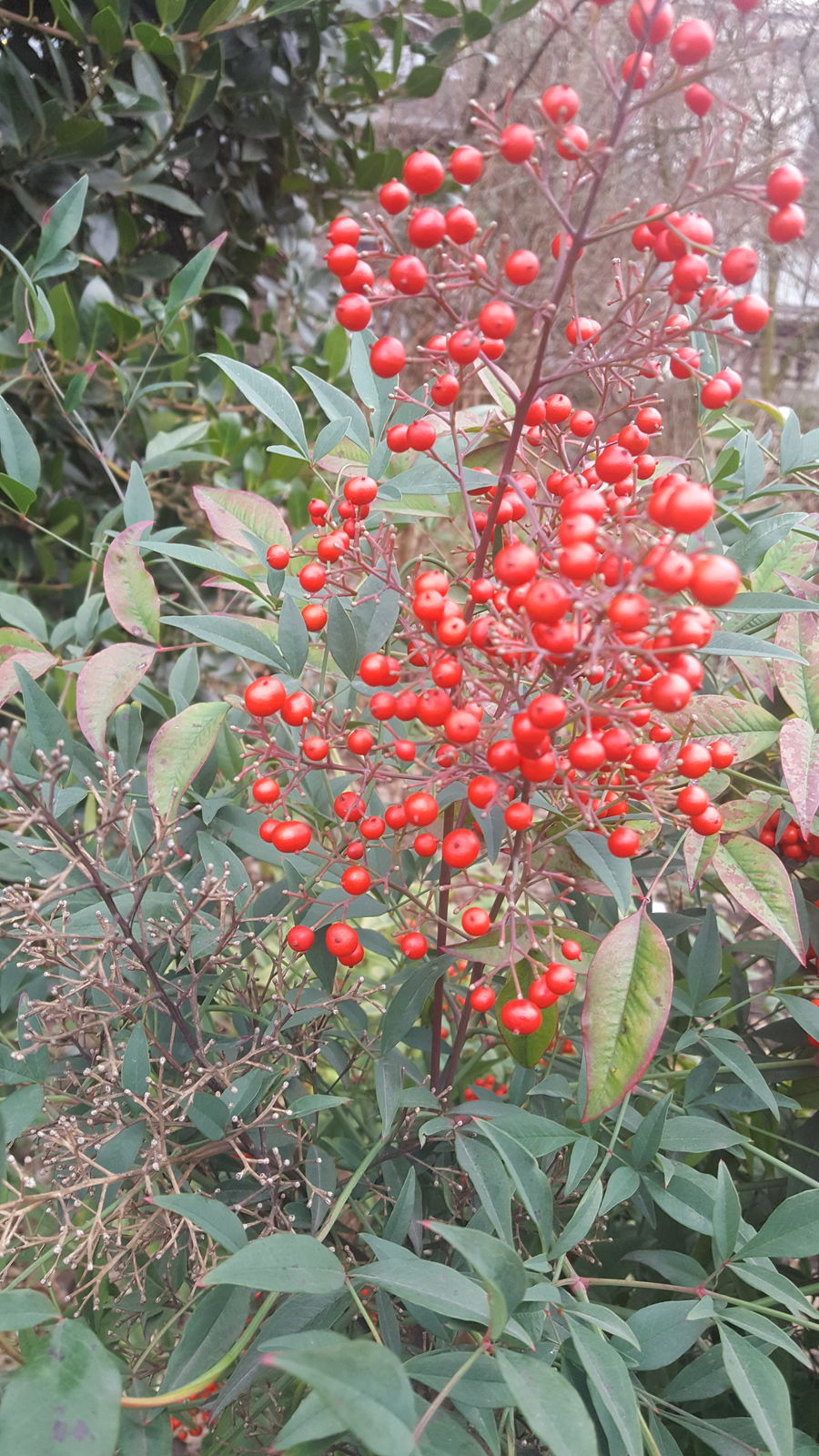
Three seasonal color changes mark the foliage: young spring shoots are often coppery red, turning green in summer and red again in fall and winter, especially in sun. This pattern helps identify a plant without flowers or fruit when leaf shape alone does not clearly distinguish it from young dwarf bamboo. 4 2
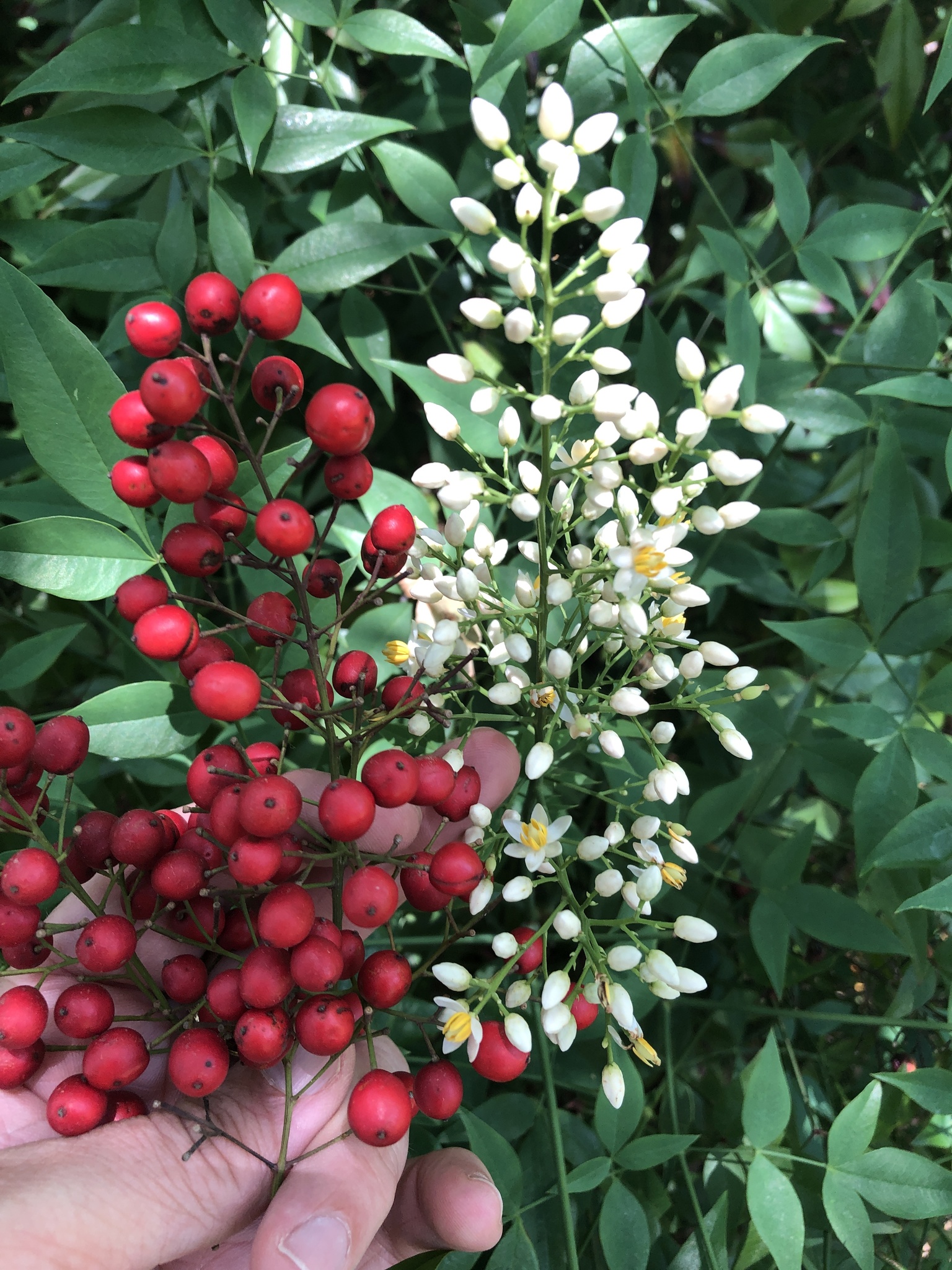
Small white flowers with yellow stamens open in broad upright panicles at the stem tips in summer. On fruiting plants, these develop into drooping clusters of round, bright red berries in fall that often remain throughout winter. 3 2
Useful taxonomy
Within Berberidaceae, Nandina domestica occupies an isolated position in the subfamily Nandinoideae. It is the only species of Nandina, so once the family has been identified there is no sister species within the genus to cause confusion. 1
Historical names circulated as synonyms or varieties now included under the accepted name:
- Nandina domestica f. alba Rehder (historical synonym)
- Nandina domestica var. longifolia Dippel (historical synonym)
- Nandina denudata Lavallée (historical synonym)
- Nandina tsermonanten Hassk. (historical synonym)
These forms mainly reflect differences in leaf or berry color rather than distinct botanical species. The reliable reference remains Nandina domestica Thunb. 1
Habitat and range
Central and southern China, Japan and India make up the native range. There the shrub grows in wooded ravines and forest valleys in warm temperate climates, often in filtered light beneath open woodland. 5 4
Introduced to Europe and then North America as an ornamental shrub, the species tolerates a wide range of soils and climates down to USDA zone 6, helping it spread far beyond its origin. In France it remains mainly a garden plant, without invasive status documented by INPN. 7 4
Across the southeastern United States, however, bird-dispersed seeds have enabled Nandina domestica to establish on woodland edges and compete with native flora. Several states classify it as invasive. 4
Life cycle and reproduction
Abundant berries follow the summer white flower panicles only when several plants grow nearby: cross-pollination markedly improves fruit set compared with an isolated plant. 2 3
Outside its native range, underground rhizomes provide vegetative spread alongside seed dispersal by fruit-eating birds. Together, rhizomes and seeds explain rapid colonization in the southeastern United States: without isolation and monitoring, the clump expands at its base while birds carry seeds farther away. 4
Garden propagation mainly uses semi-ripe stem cuttings in late summer or clump division in spring. Seed propagation is possible but slow, with often erratic germination. 5
Uses and risks
Fine, colorful foliage and decorative winter red berries make heavenly bamboo useful as a specimen, in low beds or informal hedges. Dwarf cultivars such as Firepower and Gulf Stream produce very little fruit, reducing both spread and toxicity risks while retaining ornamental value. 4
Every part, especially the berries, contains cyanogenic glycosides. The ASPCA classifies Nandina domestica as toxic to dogs, cats and horses, with signs ranging from digestive upset to neurological injury after substantial ingestion. 6
Some fruit-eating birds face the most serious documented risk. In Georgia, necropsies established that a group of cedar waxwings died after rapidly eating large quantities of berries. Digestion gradually released a dose of cyanide the birds could not detoxify. 8 9
Varieties, look-alikes and related plants
Garden cultivars chiefly vary in size and foliage color. Firepower, Gulf Stream, Harbour Dwarf and Nana remain compact, at 30 cm–1 m (1–3 ft), with strong red winter color and reduced fruiting. The typical form, by contrast, can exceed 2 m (6.5 ft) and fruit abundantly. 4
Before buying, check the expected mature size and fruiting level of the chosen cultivar, especially where pets live or wintering birds visit the garden.
Young dwarf bamboo is the commonest look-alike before flowering because of the upright cane-like habit. Examine a leaf to resolve it: true bamboos have simple, parallel-veined leaves carried on a sheath, while Nandina domestica has compound leaves with lance-shaped leaflets and no bamboo sheath. This separates even young plants without flowers or berries.
Main sources
- Plants of the World Online / Kew, Nandina domestica Thunb.
- Royal Horticultural Society, Nandina domestica
- Missouri Botanical Garden Plant Finder, Nandina domestica
- NC State Extension Gardener Plant Toolbox, Nandina domestica
- Plants For A Future, Nandina domestica
- ASPCA, Nandina toxic plant entry
- INPN / MNHN, Nandina domestica Thunb., 1781
- University of Georgia College of Veterinary Medicine, toxicity due to Nandina domestica in cedar waxwings
- PMC, feeding behavior-related toxicity due to Nandina domestica in cedar waxwings
Frequently asked questions
Is heavenly bamboo a real bamboo?
No. Despite its common name and upright canes, Nandina domestica belongs to Berberidaceae and is unrelated to bamboos, which belong to Poaceae. The similarity is limited to the overall stem silhouette.
Is heavenly bamboo toxic to animals?
Yes. All parts, especially the berries, contain cyanogenic glycosides. The ASPCA classifies Nandina domestica as toxic to dogs, cats and horses; its berries have also been documented as fatal to some fruit-eating birds.
Why do waxwings die after eating nandina berries?
Cedar waxwings consume large quantities of berries in a short time during winter stopovers. Digestion gradually releases cyanide in amounts the birds cannot detoxify, causing documented deaths in Georgia.
Is heavenly bamboo invasive?
It is classified as invasive in several southeastern US states, where birds disperse seeds into natural habitats. In France it currently remains mainly cultivated, without an invasive status recognized by INPN.
How can I get more berries on my nandina?
Fruiting improves when several plants grow together because cross-pollination increases fruit set. Pruning too early or too hard before summer also reduces the number of flowers and therefore berries.
Are there nandina varieties without toxic berries?
Yes. Dwarf cultivars such as Firepower and Gulf Stream were selected for colorful foliage and bear very little fruit, reducing risks to animals and birds while retaining ornamental value.
Similar plants

If you are unsure about a plant’s toxicity, ask a botanist or veterinarian for advice.