
Madagascar jasmine (Stephanotis floribunda, )
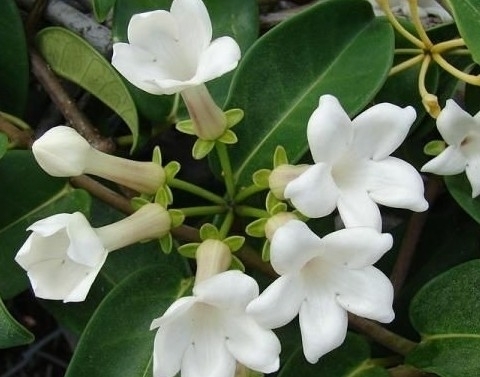

Madagascar jasmine (Stephanotis floribunda) bears clusters of waxy, fragrant white flowers on an evergreen vine in the Apocynaceae family. Native to Madagascar, this tropical climber needs a support and a bright, sheltered growing space.
Read moreMadagascar jasmine, Bridal wreath and Chaplet flower
Marsdenia floribunda and Stephanotis isaura
Allow a few hours of direct sun per day, preferably morning or evening.
Full light, with protection from scorching sun under cover.


© photo
(c) mariajose_pm21, some rights reserved (CC BY-NC), uploaded by mariajose_pm21 · cc-by-nc
Wikimedia Commons · CC BY-SA or Public Domain
Wikipedia · CC BY-SA
(c) Kevin Faccenda, some rights reserved (CC BY) · cc-by

Global distribution
Native to Madagascar; introduced in several tropical regions of Asia and the Caribbean.
- Native1
- Introduced2
- Madagascar
- India
- Cuba
Hexagons: regions where the plant occurs. Green dots: native range.1
Identity
Madagascar jasmine (Stephanotis floribunda Jacques, 1834) combines waxy, intensely fragrant white flowers with stems that twine around a support. This woody vine keeps its leaves throughout the year. The common name identifies a particular species native to Madagascar, rather than all the plants sold as jasmines. 1 2 3
The plant is also referred to by its genus name, Stephanotis. Its scent and pale flowers explain the comparison with jasmines, but true jasmines belong to the genus Jasminum. Similar-looking flowers do not establish that the plants belong to the same genus. 7 9
Recognition
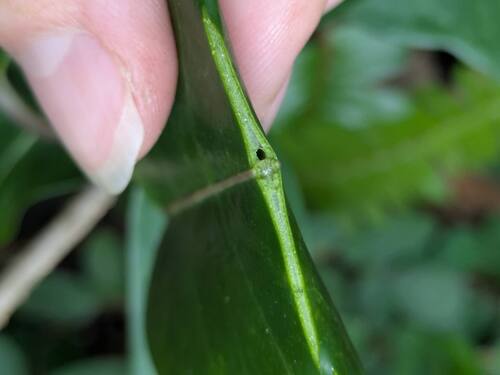
Madagascar jasmine has opposite leaves that are simple, thick and glossy, with entire margins. Their elliptical blades measure 5 to 9 cm (2 to 3.5 in) long in a horticultural description. Pairs of leaves occur along twining stems, so the climbing habit is visible even when the plant is not in flower. 4
Flowers form clusters in the leaf axils. Each corolla has a narrow tube ending in five spreading lobes and reaches 3 to 4 cm (1.2 to 1.6 in) long in the same description. The waxy appearance belongs to the flowers, while the foliage has a leathery texture. Taken together, these features are more useful for recognition than scent alone. 4
Useful taxonomy
Madagascar jasmine belongs to the Apocynaceae family, in the order Gentianales. The accepted name is Stephanotis floribunda Jacques, published in 1834. Attribution to Jacques concerns the botanical publication of the name; it does not establish a date of discovery in the wild. 1
The synonym Marsdenia floribunda (Jacques) Schltr. records the transfer of the same species to another genus. Stephanotis isaura Decne. also appears in its synonymy. These names do not identify cultivars. Asclepiadaceae, a family name still found in horticultural descriptions, differs from the Apocynaceae used in the current classification. 1 5
Habitat and range
Madagascar jasmine is native to Madagascar and is associated with seasonally dry tropical habitats. Its present distribution also includes introductions in Asia, notably India and Bangladesh, and in the Caribbean, including Cuba and Haiti. An introduced occurrence should not be presented as a natural origin. 1
In temperate climates, Madagascar jasmine is grown mainly indoors or in a greenhouse. A developed plant can reach a stated horticultural height of 4 to 8 m (13 to 26 ft), while another cultivation account gives 2 to 3 m (6.6 to 9.8 ft). These dimensions depend on how and where the plant is grown. A small flowering pot does not show the full potential extent of its stems. 3 4
Life cycle and reproduction
In cultivation, flowering is described from spring to fall. Commercial growers can maintain year-round flower production with controlled light, water and climate. Continuous flowering therefore depends on conditions that are not available in every home. Growth slows when conditions become cool. 5
Propagate Madagascar jasmine by seed in spring at 18 to 21 °C (64 to 70 °F), or by semi-ripe cuttings in summer with bottom heat. The fruit contains seeds equipped with a tuft of hairs. Seeds provide sexual reproduction, while cuttings use a section of stem to produce another plant. 3 2
Uses and risks
Madagascar jasmine flowers are used in bouquets, particularly for weddings. The plant is also grown in pots for its fragrance. Its climbing growth requires a support such as a trellis, even when the plant offered for sale is still compact. Allowing for that growth matters when choosing how to display it. 5
Madagascar jasmine is classified as non-toxic to cats, dogs and horses. This classification does not make the plant food or fodder. The status of other animals cannot be inferred from the assessment of these groups. 6 8
In humans, the latex irritates the skin and mucous membranes; itchy eyes and respiratory reactions are also reported. The irritating substance has not been identified. Wearing gloves during work that releases sap limits contact, and children should be kept away from the sap. These contact precautions remain relevant alongside the veterinary classification. 7
Cultivation and look-alikes
Madagascar jasmine needs abundant light, with protection from scorching sun when grown under cover. Sudden exposure to full sun can burn the leaves. A humus-rich, well-drained growing medium allows regular watering during growth; excess water exposes the roots to rot. Drainage and adequate moisture during active growth must be managed together. 3 5
For indoor cultivation in mainland France, the seasonal guidelines reflect this alternation: reduced watering in winter and more during growth. Apply a balanced liquid fertilizer every two to three weeks while the plant is growing. The monthly indices are relative guidelines, rather than measured volumes of water. 3
Jasminum officinale differs in having compound leaves with seven to nine leaflets, compared with the simple leaves of Madagascar jasmine. Jasminum officinale belongs to the Oleaceae family. Examining the foliage helps distinguish these fragrant climbers beyond the shared sales name "jasmine." 10 4
Main sources
Botanical references establish the identity and native range of Madagascar jasmine; horticultural descriptions document its identifying features and growing seasons.
- Plants of the World Online, Stephanotis floribunda Jacques
- Office québécois de la langue française, Madagascar jasmine
- Royal Horticultural Society, Stephanotis floribunda
- Kwantlen Polytechnic University, Stephanotis floribunda
- NC State Extension, Stephanotis floribunda
- ASPCA, Madagascar Jasmine
- Klorane Institute, Irritant and allergenic plants, Stephanotis, page 21
- University of Zurich, CliniTox, Stephanotis floribunda
- Royal Horticultural Society, Jasmine, Jasminum
- Royal Horticultural Society, Jasminum officinale
Frequently asked questions
Is Madagascar jasmine a true jasmine?
Madagascar jasmine belongs to the genus Stephanotis, in the Apocynaceae family. True jasmines belong to Jasminum, in the Oleaceae family.
Is Madagascar jasmine toxic to cats?
Stephanotis floribunda is classified as non-toxic to cats, dogs and horses. This veterinary status does not mean that its sap cannot irritate humans.
Does Madagascar jasmine need a support?
Yes. Its twining stems are trained onto a trellis or another support suited to their growth.
Why should watering be reduced in winter?
When conditions become cooler and growth slows, water less. Overwatering the potting mix exposes the roots to rot.
Similar plants
If you are unsure about a plant’s toxicity, ask a botanist or veterinarian for advice.