
Marsh mallow (Althaea officinalis, )
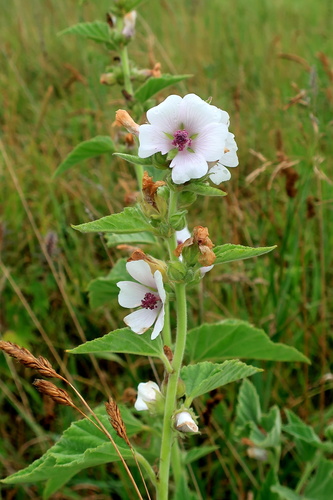
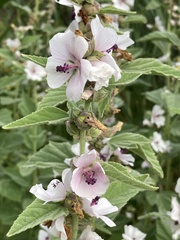
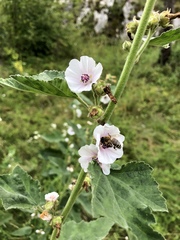
Marsh mallow (Althaea officinalis) is an herbaceous perennial in the Malvaceae, native to Europe, western Asia and North Africa. Its downy gray-white leaves and preference for moist, sometimes salty soils distinguish it from other garden mallows.
Read moreMarsh mallow, Marshmallow and Common marshmallow
Allow a few hours of direct sun per day, preferably morning or evening.
Full sun to light partial shade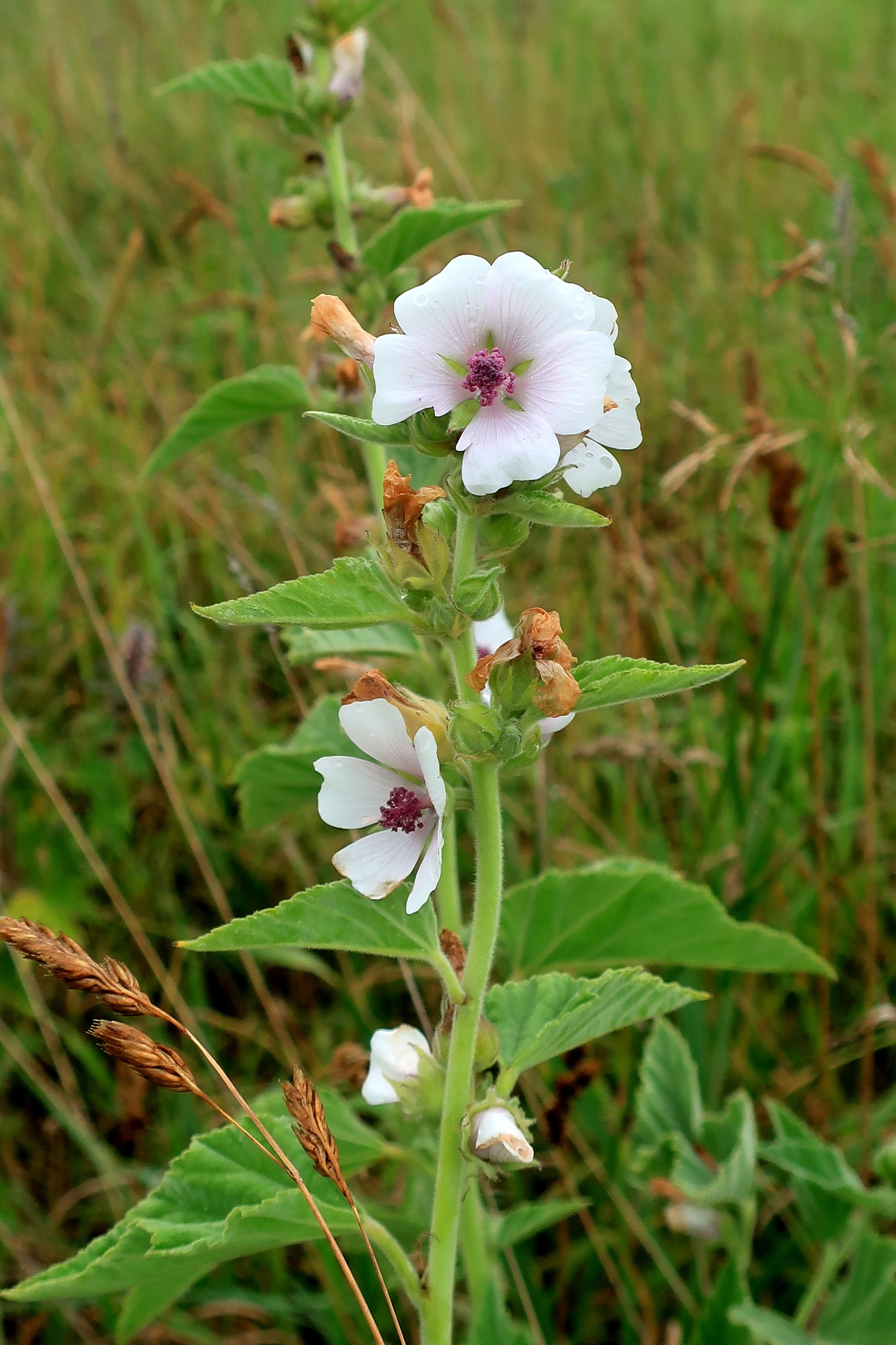


© photo
(c) Maxim Sharapov, some rights reserved (CC BY-NC), uploaded by Maxim Sharapov · cc-by-nc
John Kenrick Gibson · cc0
Conrad Altmann · cc-by
Taken Nov 2, 2016 by Yoan MARTIN (cc-by-sa)
Taken Oct 20, 2022 by Loïc Tulasne (cc-by-sa)
Taken Jul 15, 2014 by Tela Botanica − Jean-Jacques HOUDRÉ (cc-by-sa)
© copyright of the Board of Trustees of the Royal Botanic Gardens, Kew.


Global distribution
The native range of Althaea officinalis covers Europe, from Denmark to Spain and the United Kingdom to Russia and Ukraine, temperate Asia from Turkey to Xinjiang in China, and North Africa. Introduced in North America and the Baltic countries, it has often naturalized beside waterways and on damp disturbed ground.
- Native7
- Introduced2
- France
- United Kingdom
- Denmark
- Russia
- Turkey
- Algeria
- China
- Latvia
- United States
Hexagons: regions where the plant occurs. Green dots: native range.1
Identity
Marsh mallow (Althaea officinalis L., 1753), also written marshmallow or common marshmallow, is an herbaceous perennial in the genus Althaea, family Malvaceae. Its generic name comes from the ancient Greek althaía, meaning marsh mallow. Theophrastus and Dioscorides already used that name for the same medicinal plant centuries before Linnaeus described it under the modern binomial. 7 1
The French name guimauve combines an old Frankish word for “white” with the late Latin malva, “mallow.” This description refers to the pale leaves rather than the flowers, which are light pink. The epithet officinalis points to another historical association: it derives from officina, the workshop where an apothecary prepared remedies and ointments from medicinal plants. 6
Recognition
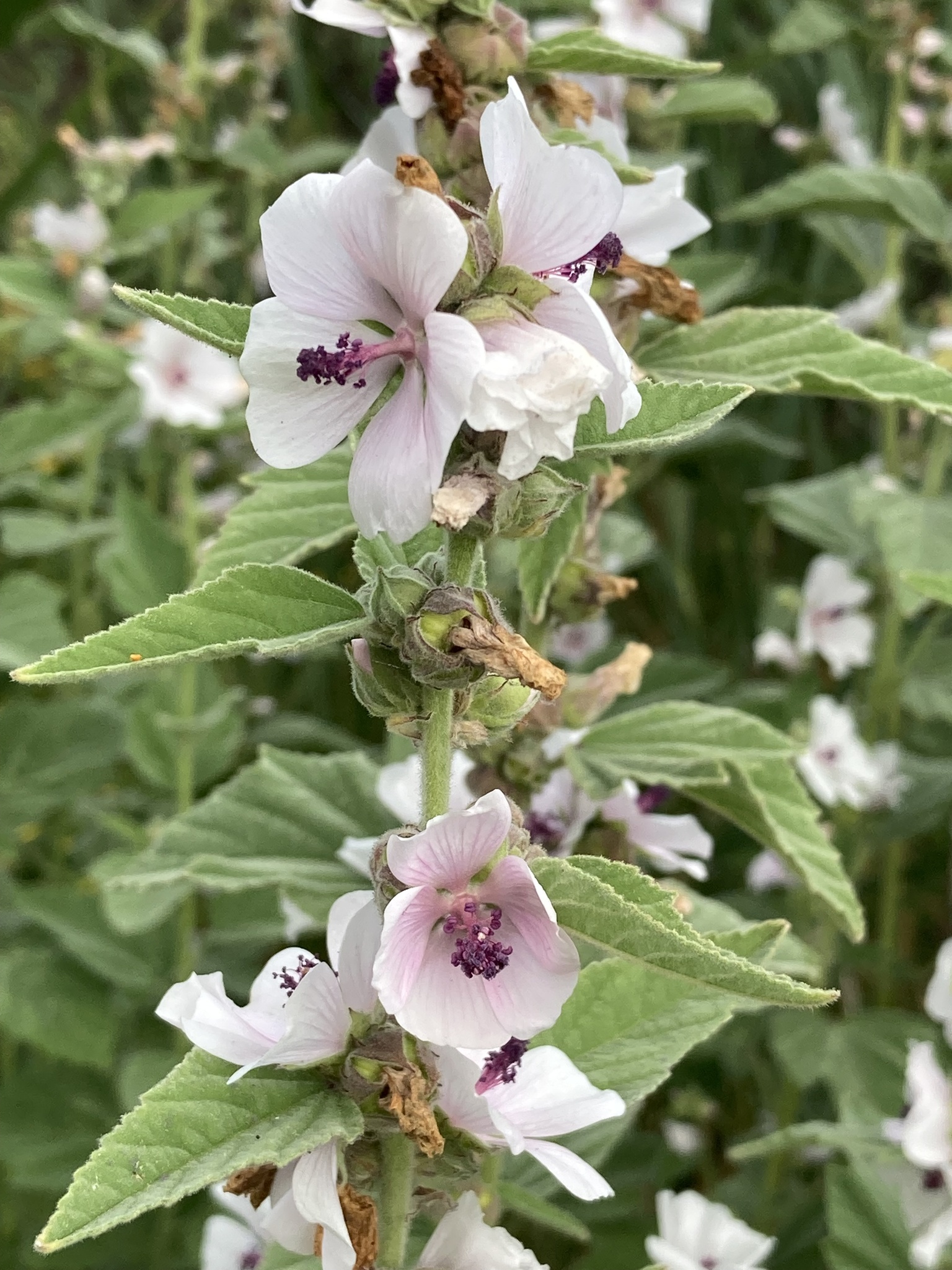
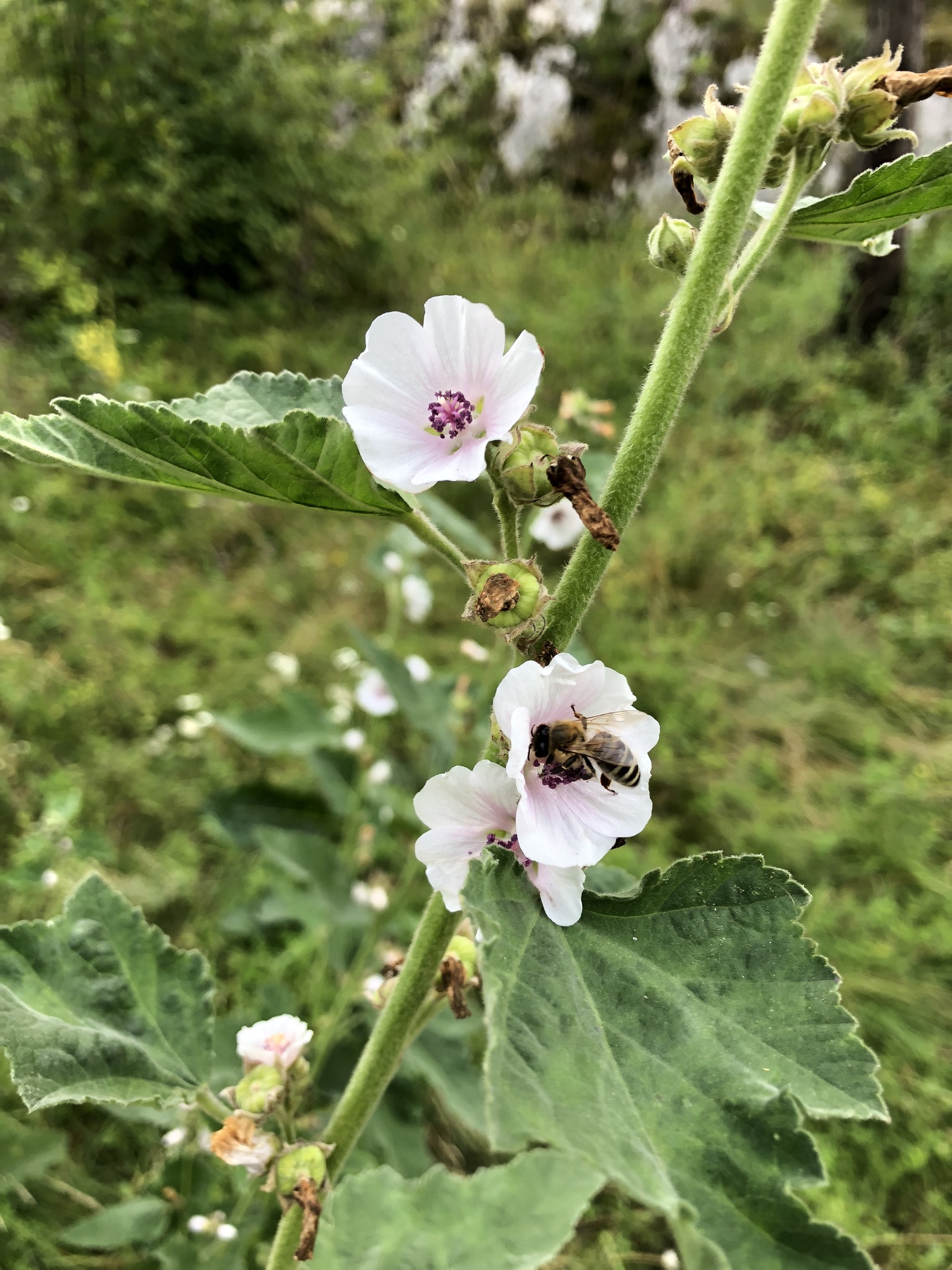
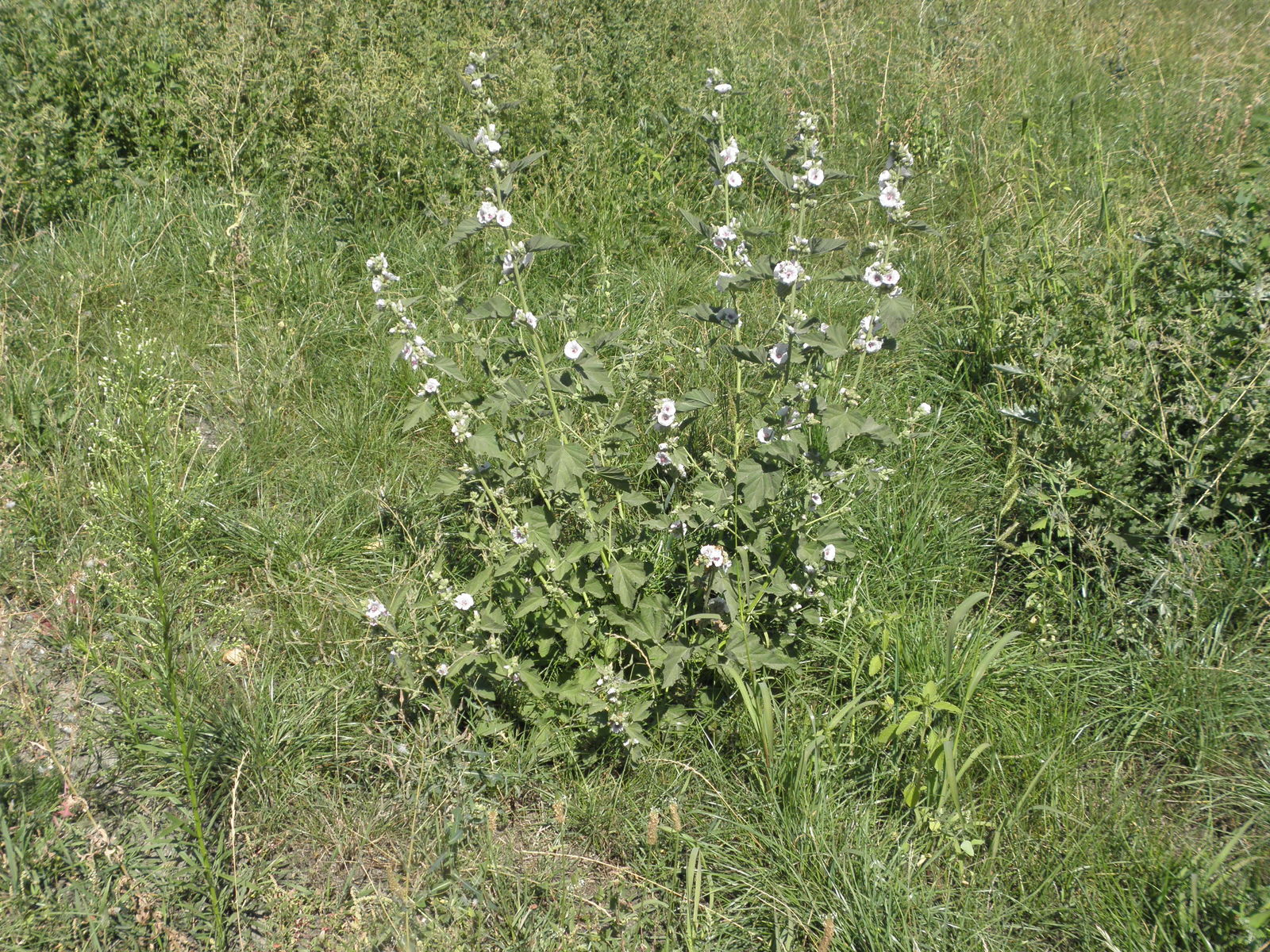
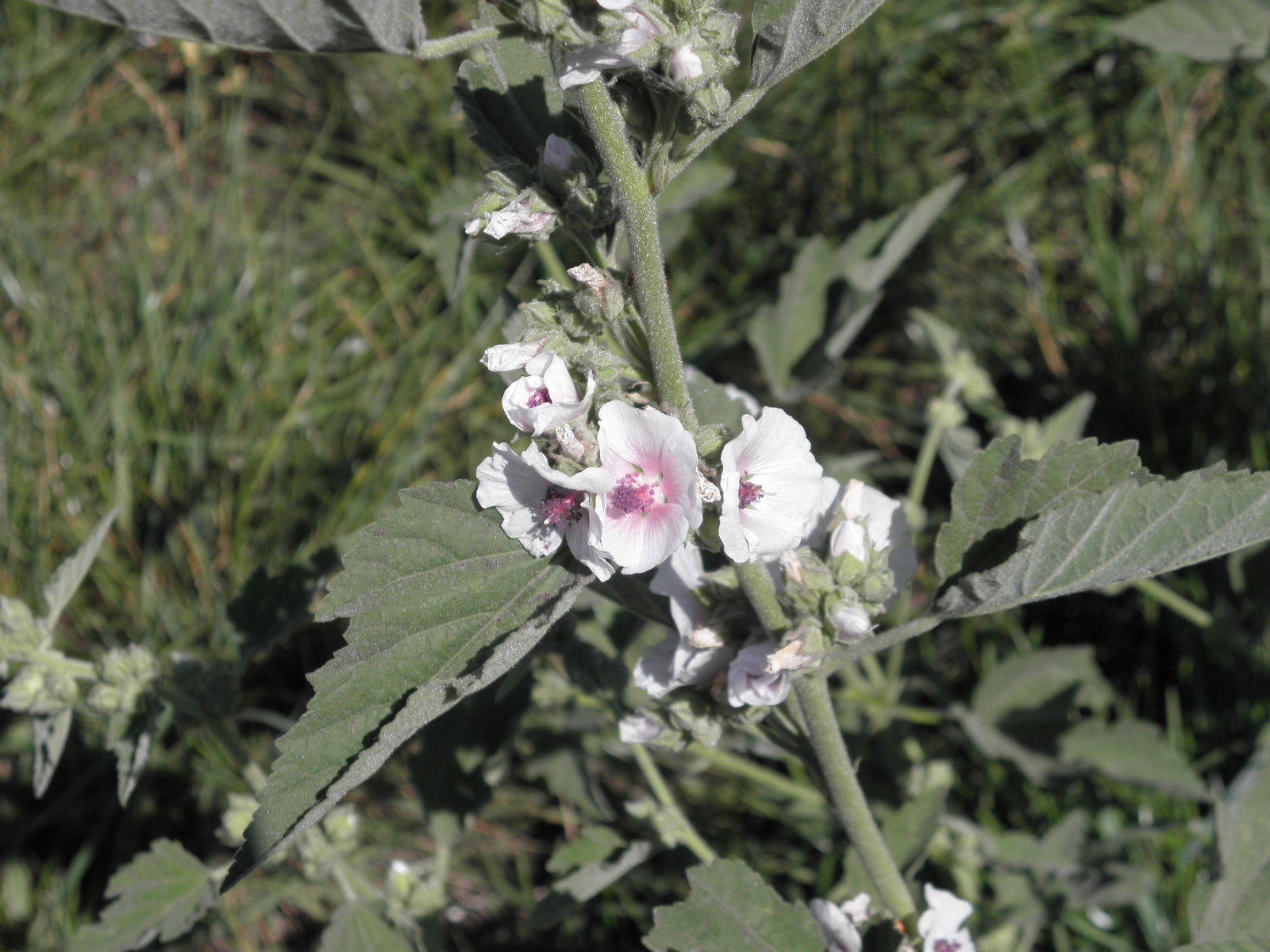
An upright clump rises 60 cm–1.5 m (2–5 ft) from a perennial rootstock with a deep taproot. Fine down covers the alternate leaves, giving them a gray-green, almost whitish appearance. Common mallow (Malva sylvestris) has distinctly greener, much less downy foliage. This contrast is the clearest field distinction between the two species, even before either plant flowers. 3 2
Flowers appear singly or in groups of two to four in the leaf axils. Each pale pinkish-white flower measures 2.5–4 cm (1–1.5 in) across and has a conspicuous central staminal column with dark purple anthers. In the Northern Hemisphere summer, flowers begin opening in July, later and less conspicuously than the bright pink blossoms of common mallow. 2
The overall habit is upright but flexible. Stems lean readily in wind without snapping, consistent with the exposed shores and riverbanks where the plant grows. Combined with the gray-white down, this flexibility helps identify a clump at a distance before the flower details can be examined closely. The foliage remains the more immediately visible feature. 3
Useful taxonomy
Althaea officinalis L. is the accepted name, published in 1753 within Althaea. It belongs to one of the few Malvaceae genera adapted to Europe's moist, saline soils. The scientific name connects this wetland plant to its botanical records and distinguishes it from other mallows that share overlapping common names. 1
POWO records roughly fifteen synonyms, including two well-documented names based on the same nomenclatural type: Malva althaea E.H.L.Krause and Malva officinalis (L.) K.F.Schimp. & Spenn. Such homotypic synonyms refer to the same type specimen and are brought under the accepted name in modern taxonomic treatments. 1 8
Old catalogs still mention var. rotundifolia Gray and var. pallida Regel & Herder. Neither has current commercial standing as a garden selection. When buying plants or citing a botanical record, Althaea officinalis remains the stable reference rather than a historical variety name whose use may be inconsistent. 1
Habitat and range
Europe, temperate Asia and North Africa form the native range of marsh mallow. Its European distribution extends from Denmark to Spain and from the United Kingdom to Russia and Ukraine; eastward, it reaches from Turkey to Xinjiang in China. Introductions in North America and the Baltic countries have often naturalized beside waterways. 1
In France it occurs especially in the Atlantic west, in tall, herbaceous wetland vegetation on rich, moist ground. Typical settings include seashores, salt meadows, riverbanks and marshes. Salt tolerance is unusual among Malvaceae and helps explain its presence on both coastal sites and inland river margins, habitats that many related mallows avoid. 6
Wetland loss has led to regional protection in Nord-Pas-de-Calais, Lorraine and Picardy in France. That regional picture differs from the global assessment: marsh mallow remains classified as Least Concern worldwide, with no demonstrated threat affecting the whole of its extensive range. Protection in these French regions should therefore be understood at that geographical scale. 6
Life cycle and reproduction
Seeds germinate in 14–21 days at 18–20 °C (64–68 °F) if the soil stays moist. During the first year, the plant forms only a basal rosette of downy leaves, without upright stems. Flowering begins in the second season, once the deep-rooted perennial base is established, so a young rosette is a normal early stage. 4
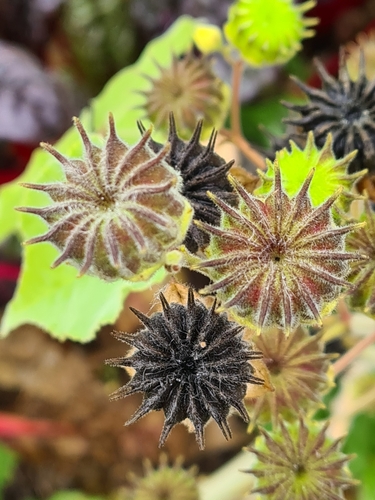
Summer flowers produce a schizocarp, a dry fruit that splits at maturity into separate units. Here it forms a disk about 8 mm (0.3 in) across, with 15–20 yellowish carpels arranged in a circle. Spring sowing and division remain the most dependable propagation methods. Root cuttings also work, but require plants that are already well established. 3 4
Uses and risks
The original marshmallow confection was made from root mucilage, a viscous plant substance that swells in water and forms a protective gel over mucous membranes. Gelatin later replaced the root extract while the candy retained its name. Young, relatively slender roots have also been eaten after scalding, and tender leaves can be cooked like spinach. 4 5
All parts contain mucilaginous polysaccharides, but roots have the highest proportion, reaching 25–35% of dry weight. This concentration explains their traditional herbal use to soothe irritated mucous membranes. The relevant feature is the water-swelling material in the root, rather than any connection with the texture or ingredients of modern commercial marshmallows. 9
Flower infusions have traditionally been used for coughs, alone or combined with leaves. Soaking the root in lukewarm water produces a less thick liquid than a decoction and one considered more pleasant to drink. These traditional practices do not have the status of a validated medical treatment, a distinction that matters when describing the plant's historical uses. 4
According to the USDA reference, marsh mallow causes no documented toxic symptoms in humans, cats or dogs. Its status remains uncertain for horses because species-specific published data are lacking. That uncertainty should remain explicit rather than being converted into a general statement that all animals can safely consume the plant. 5
Varieties, look-alikes and related plants
A developed range of horticultural cultivars is absent from marsh mallow, unlike more ornamental Malvaceae such as hollyhock. Rare names in older catalogs, including the paler-flowered var. pallida, represent botanical forms rather than established garden selections. A variety name in an old source therefore does not necessarily indicate a distinct cultivated strain available today. 2
Three related plants commonly cause field confusion:
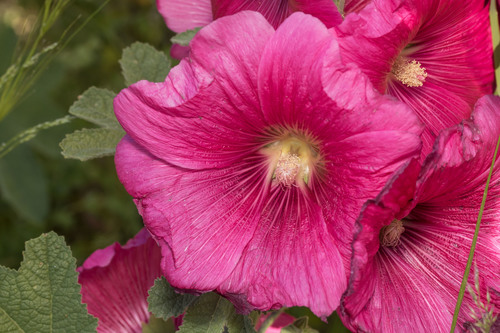
- Common mallow (Malva sylvestris) has distinctly green leaves and brighter, more conspicuous pink flowers.
- Hollyhock (Alcea rosea) grows considerably taller and lacks the same dense down on its stems.
- Annual mallow (Lavatera trimestris) has larger flowers and much less hairy foliage.
Compared with all three, the gray-white down on marsh mallow leaves provides the most dependable identifying feature. It can settle the distinction before flowering begins, when flower size and color are unavailable. Leaf texture and overall pale appearance are therefore useful observations to make together rather than waiting for a mature bloom.
Main sources
- Plants of the World Online / Kew, Althaea officinalis L.
- Royal Horticultural Society, Althaea officinalis details
- Missouri Botanical Garden Plant Finder, Althaea officinalis
- Plants For A Future, Althaea officinalis
- USDA PLANTS Database, Althaea officinalis plant profile
- INPN / MNHN, Althaea officinalis L., 1753 protection status
- Tufts University / Perseus Scaife ATLAS, LSJ entry ἀλθαία (Althaea officinalis)
- Integrated Taxonomic Information System, Althaea officinalis L.
- PubMed, Phytochemical investigation of the seeds of Althea officinalis L.
Frequently asked questions
Is marsh mallow poisonous to cats or dogs?
No. Reference sources identify no documented toxic compound in fresh or dried plants for humans, cats or dogs. Its status remains uncertain for horses because specific data are lacking.
How did marshmallow candy originate?
It was originally made with mucilage extracted from the root of Althaea officinalis. Modern recipes use gelatin instead, without a botanical connection to the plant, but retain the marshmallow name.
How can you tell marsh mallow from common mallow?
The most reliable distinction is the foliage. Marsh mallow has fine gray-white down, while Malva sylvestris has distinctly green, less hairy leaves. Marsh mallow flowers are also paler and smaller.
Is marsh mallow protected in France?
It has regional protection in Nord-Pas-de-Calais, Lorraine and Picardy because of the decline of its wetland habitats. Globally, however, the species remains classified as Least Concern.
When is marsh mallow root harvested?
Roots are harvested in autumn from the second growing year, once the rootstock is well established. Mucilage content then reaches its highest level, up to 25–35% of root weight.
Can marsh mallow grow in a container?
Yes, in a large container with rich substrate kept moist. It develops better in the ground near water, where its taproot can grow without restriction.
Similar plants
If you are unsure about a plant’s toxicity, ask a botanist or veterinarian for advice.