
Jackfruit (Artocarpus heterophyllus, )
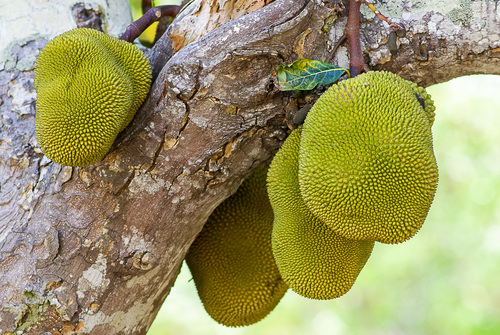
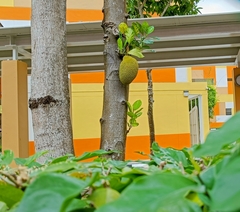
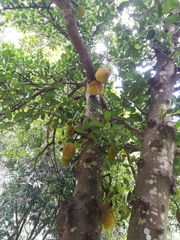
Jackfruit (Artocarpus heterophyllus) is a large tropical tree in the Moraceae, native to southwestern India, probably the Western Ghats. It produces the largest tree-borne fruit, a fleshy multiple fruit growing directly on the trunk and large branches through cauliflory. Its fibrous immature flesh is used as a meat substitute in many Asian cuisines; ripe flesh is sweet and fragrant. Vegetative parts release sticky white latex when damaged.
Read moreJackfruit, Jakfruit, Jackfruit tree and Nangka
Place in full sun, with intense direct light all day long.




© photo
(c) Brieuc Fertard, some rights reserved (CC BY-NC-ND), uploaded by Brieuc Fertard · cc-by-nc-nd
Huey · cc-by
Carolina Leal · cc-by
Taken Jan 1, 2020 by Dieter Albrecht (cc-by-sa)
Taken Sep 26, 2021 by Augustin Soulard (cc-by-sa)
Taken Apr 15, 2022 by Nuong Nguyen (cc-by-sa)
© copyright of the Board of Trustees of the Royal Botanic Gardens, Kew.


Global distribution
The precise native range of jackfruit remains debated, but it probably originated in humid forests of the Western Ghats in southwestern India. Its ancient cultivation in India spread early to Myanmar, Sri Lanka and southern China, then throughout the tropics.
- Native1
- Introduced1
- Invasive1
- India
- United States
- Brazil
Hexagons: regions where the plant occurs. Green dots: native range.1
Identity
Jackfruit (Artocarpus heterophyllus Lam., 1789), also spelled jakfruit, belongs to Artocarpus in the Moraceae, the family of figs and mulberries. Jean-Baptiste Lamarck published its scientific name from material collected by the botanist Philibert Commerson. 1 2
The English name jackfruit and the French jacquier share a linguistic route through Portuguese jaca, borrowed from Malayalam chakka. Malayalam is spoken in Kerala, where the tree is especially widely cultivated. The name reached European accounts through the naturalist Garcia de Orta in the sixteenth century. 6 2
Recognition
A dense evergreen crown rises above a relatively short trunk in Artocarpus heterophyllus, which reaches 9 to 21 m tall. The trunk measures 30 to 80 cm across and sometimes has buttress roots. Smooth reddish-brown bark releases sticky white latex at the slightest injury, a useful identification clue among large tropical trees. 2
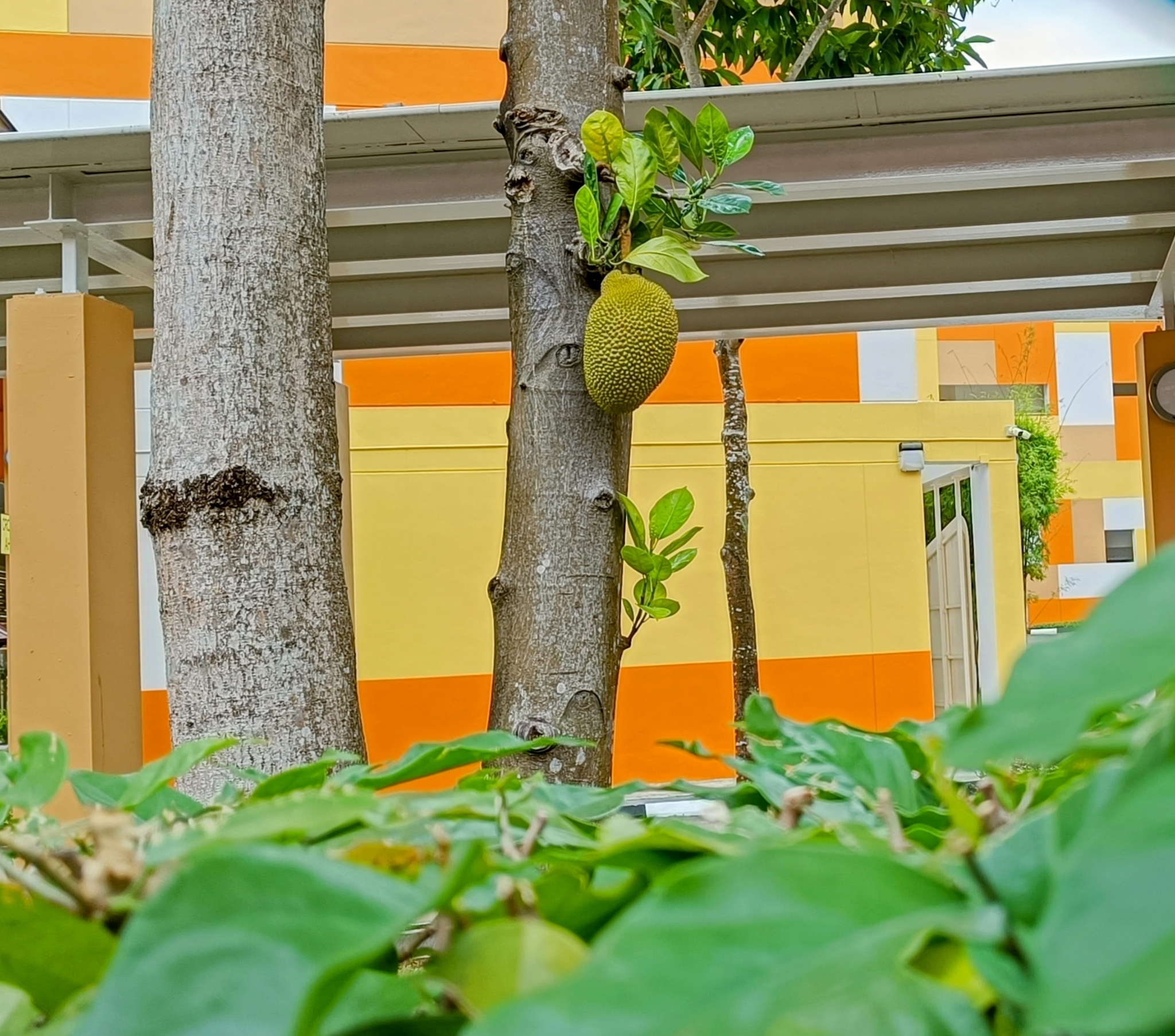
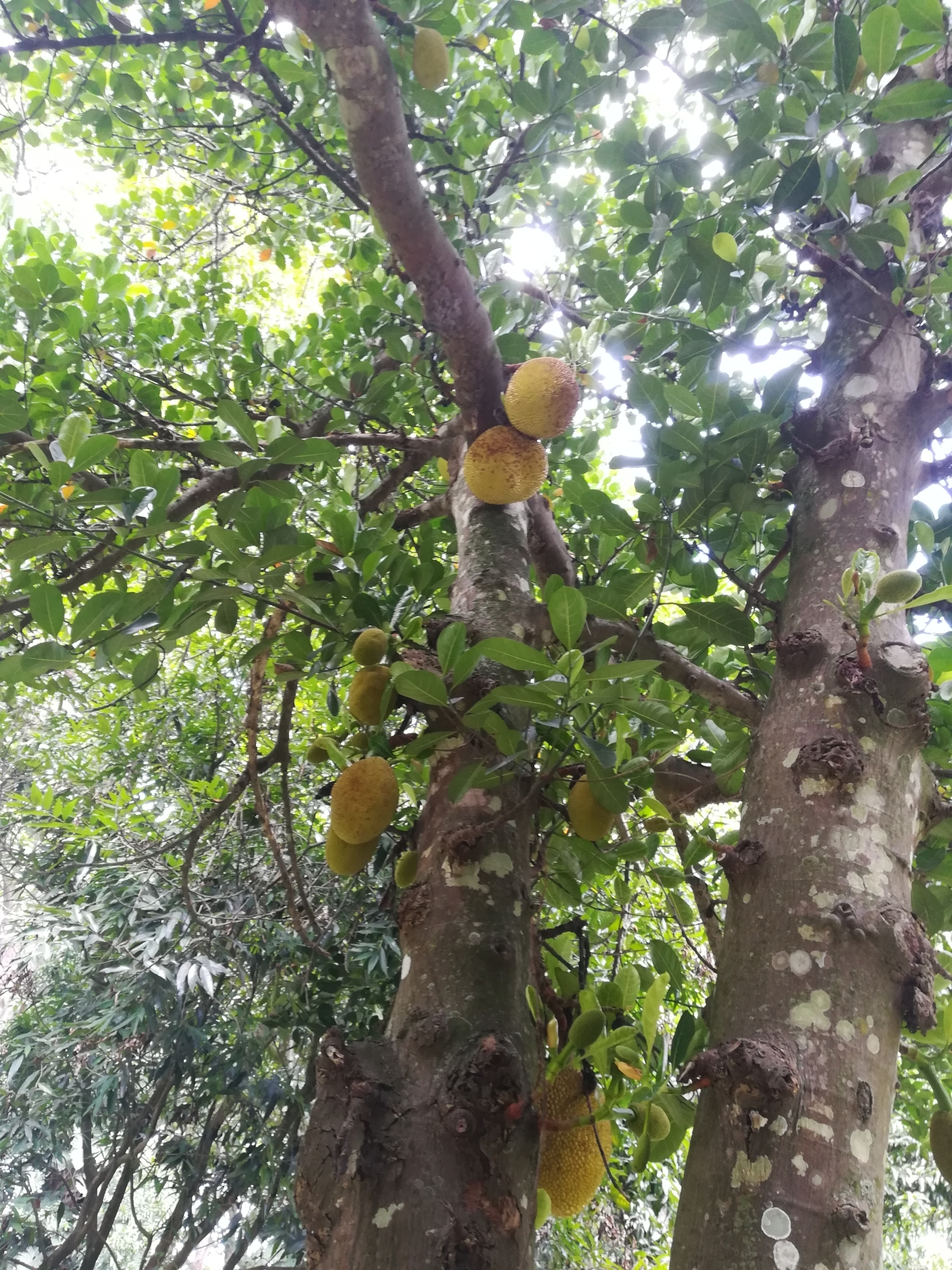
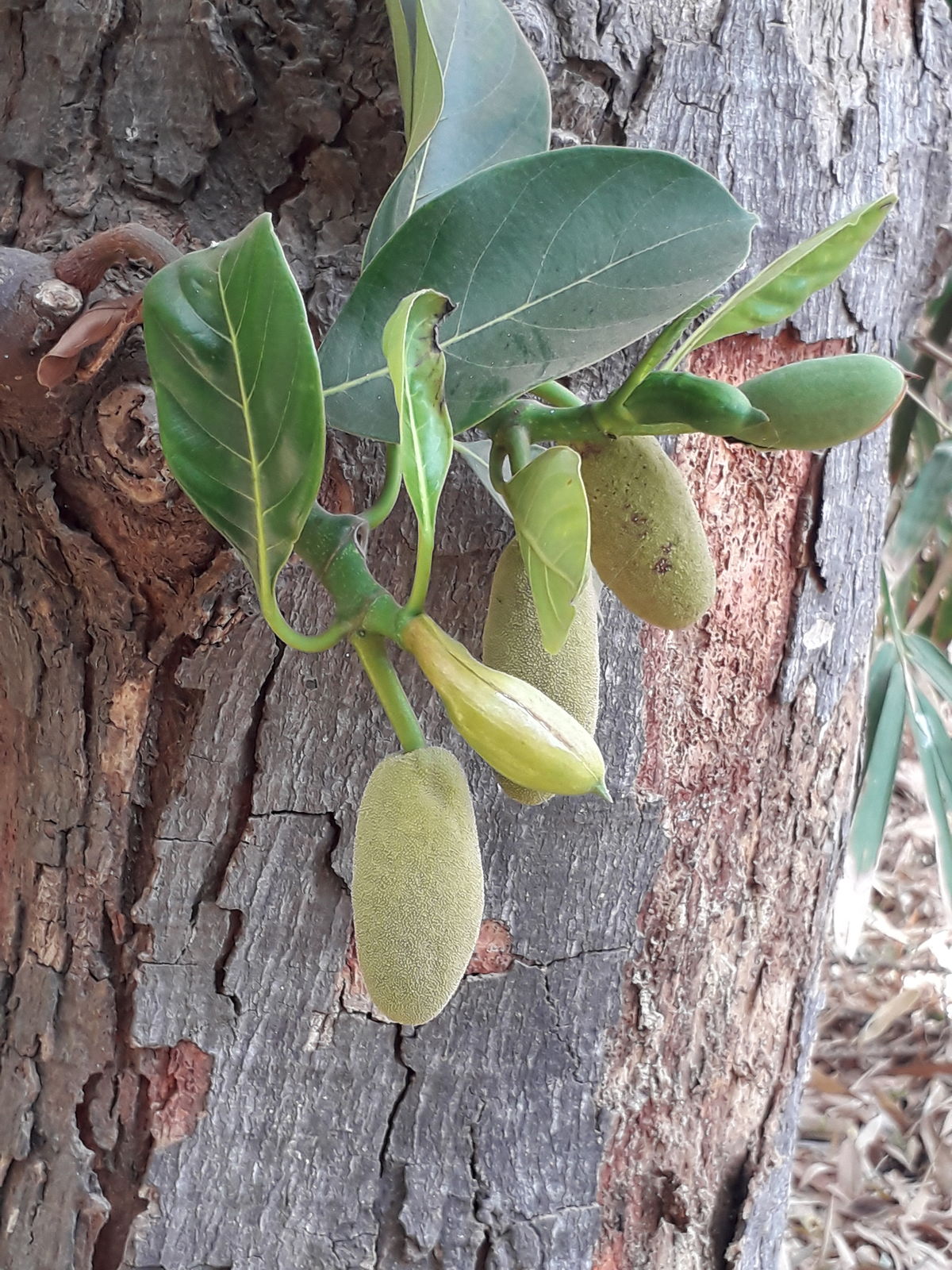
Leathery, glossy, alternate leaves are entire and rounded on adult trees but often lobed or divided on young plants. This variation explains heterophyllus, meaning different-leaved. Small flowers form clusters directly on the trunk and large branches rather than in leaf axils. This cauliflory clearly distinguishes jackfruit from fruit trees that flower at their shoot tips. 4 2 3
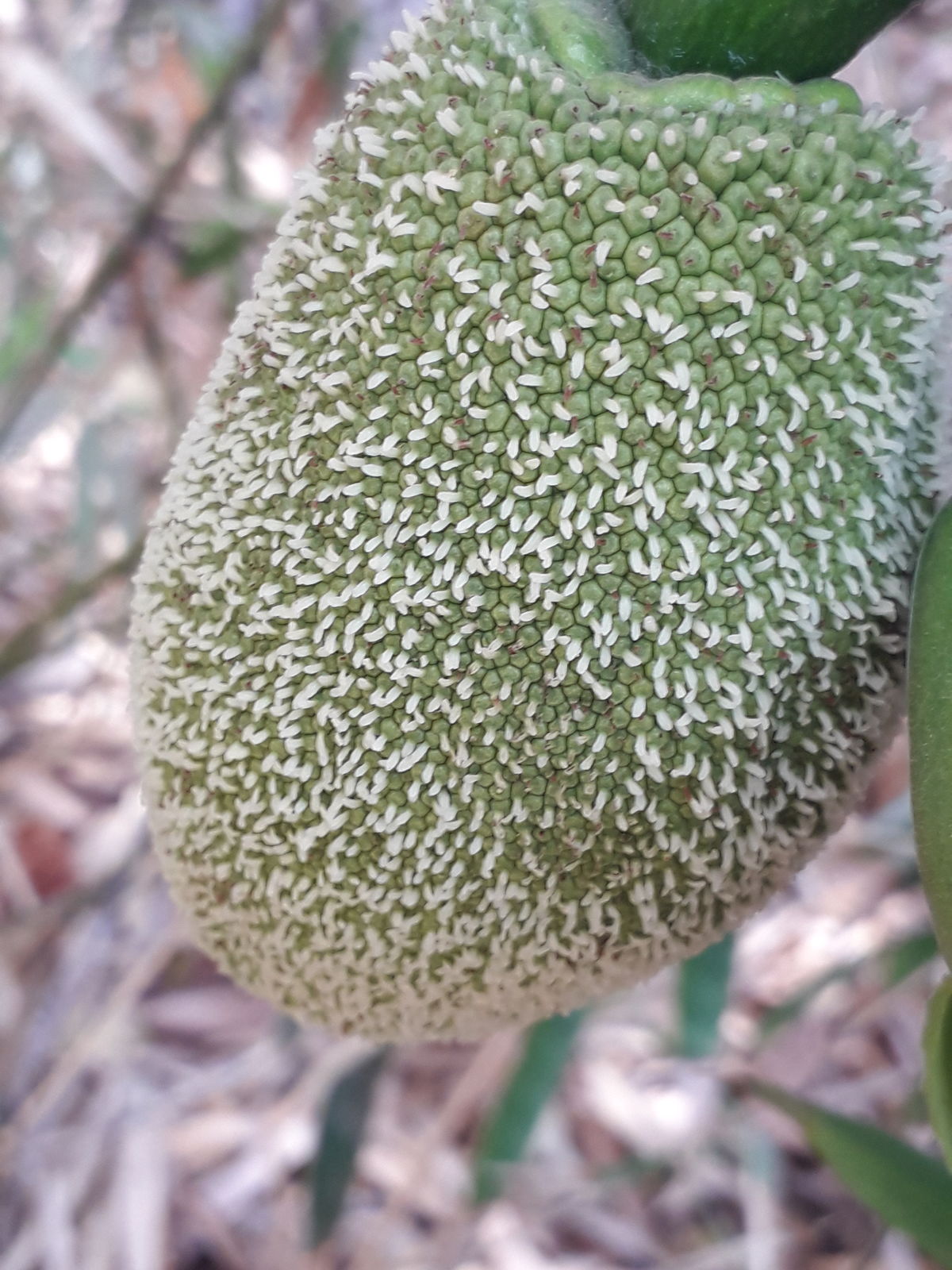
Its multiple fruit may reach 100 cm long and 50 cm across, with a reported record weight of 55 kg, making it the heaviest known tree-borne fruit. Small hexagonal bumps cover the rind, unlike the smoother surface of its relative breadfruit. The rind changes from green to yellow-brown at full ripeness. 2 3
Useful taxonomy
Several competing names were used before Artocarpus heterophyllus became the accepted name. The following historical names help interpret older references:
- Artocarpus integrifolius auct., a historical name;
- Artocarpus philippensis Lam., a historical name;
- Artocarpus maximus Blanco, a historical name;
- Artocarpus brasiliensis Gomes, a historical name;
- Saccus heterophyllus (Lam.) Kuntze, a historical combination.
Kew's accepted name, Artocarpus heterophyllus, remains the safest reference when encountering these older synonyms. It denotes a Moraceae species distinct from strangler figs, despite the botanical relationship between their two genera. 1 7
Habitat and range
Southwestern India's humid Western Ghats forests are the probable origin of jackfruit, although its precise native range remains debated. Cultivation is documented in India over several millennia and spread early to Myanmar, Sri Lanka and southern China. 2 6
Cultivation now extends throughout the tropics. Jackfruit is described as the national fruit of Bangladesh and Sri Lanka and the official fruit of Kerala state in India. In favorable conditions outside its native range it can naturalize: in Brazil's Tijuca Forest in Rio de Janeiro, fallen fruits feed marmosets and coatis, which disperse the seeds and help the trees spread at the expense of native species. 9 8
Life cycle and reproduction
Separate male and female flower clusters occur on the same jackfruit tree, making it monoecious. These inflorescences grow on the trunk. Flowering falls between December and March depending on the region, and each fruit then takes several months to ripen. 2
An adult jackfruit tree produces an average of 200 fruits a year, while an old tree may bear more than 500. Each contains 100 to 500 seeds, enclosed in thin, waxy seed coats and surrounded by edible flesh. This abundance of seeds, as much as the pulp, has long contributed to the tree's food value in poorer rural regions. 2
Fresh seed is one propagation route, but it quickly loses viability. Grafting preserves the qualities of a particular cultivar and brings earlier fruiting: a grafted tree bears after 3 to 4 years, compared with 4 to 8 years for a seedling. 2
Uses and risks
Both immature and ripe fruit are eaten, with very different results. Cooked immature flesh is mild and fibrous, resembling shredded meat in texture and serving as a meat substitute in vegetarian cooking. Ripe flesh becomes sweet and fragrant, with notes recalling pineapple, banana and mango, and is eaten raw or in desserts. 2 4
Boiled or roasted seeds have a chestnut-like flavor and are served as a side dish or ground into flour. All parts of the tree release sticky white latex. The consulted databases report no toxicity to humans, cats or dogs, while the status for horses remains poorly documented. 5 4
Golden, dense, termite-resistant wood is used for furniture and doors. In India it also supplies musical instruments, including the mridangam drum and the vina, extending the tree's usefulness well beyond its fruit. 2 4
Varieties, look-alikes and related plants
Growers traditionally distinguish two groups by ripe flesh texture: the firm, crunchy type often called varikka, and the soft, very sweet type sometimes called koozha. These are horticultural categories rather than separate botanical taxa. 2
When identification is uncertain, compare these possibilities:
- Artocarpus altilis, breadfruit, has deeply divided leaves and smoother fruit without conspicuous scales;
- Artocarpus integer, cempedak, has smaller fruit with a stronger odor and a less bumpy rind;
- young jackfruit trees have lobed leaves and may resemble other Moraceae before they develop entire adult foliage.
Taken together, the scientific name, direct observation of cauliflory and the white latex that beads from an injury provide the most reliable identification clues. They remain useful even when there is no ripe fruit on the tree.
Main sources
- Plants of the World Online / Kew, Artocarpus heterophyllus Lam.
- Morton, J.F. 1987, Jackfruit, in Fruits of Warm Climates, Purdue University NewCROP
- California Rare Fruit Growers, Jackfruit Fruit Facts
- Plants For A Future, Artocarpus heterophyllus (Jackfruit)
- ASPCA, Jackfruit toxicity entry
- INPN / MNHN, Artocarpus heterophyllus Lam., 1789 - jackfruit
- USDA ARS GRIN, Artocarpus heterophyllus taxonomy record
- ABC News, Danger or delight? Uphill battle for Brazil's huge jackfruit
- The Daily Star, A poor man's fruit — now a miracle food!
Frequently asked questions
Is jackfruit the same as breadfruit?
No. Breadfruit (Artocarpus altilis) belongs to the same genus but is a distinct species, with more deeply divided leaves and smoother fruit lacking the conspicuous scales.
Is jackfruit toxic to cats and dogs?
The veterinary databases consulted report no known toxicity to cats, dogs or humans. Its status for horses is poorly documented.
Why does jackfruit grow on the trunk?
Jackfruit flowers and fruits directly on the trunk and large branches, a pattern called cauliflory. Also seen in cacao, this may help support heavy fruit on stronger wood.
How long does a jackfruit tree take to bear fruit?
A grafted tree generally fruits after 3 to 4 years, compared with 4 to 8 years for a seed-grown tree. It reaches its adult form at around 15 to 20 years.
Can you eat jackfruit raw?
Ripe jackfruit can be eaten raw, when its flesh is sweet and fragrant. Immature fruit is bland and fibrous and is cooked before eating, particularly in curries.
How do hard and soft jackfruit types differ?
These horticultural groups, sometimes called varikka and koozha, differ in the texture of their ripe flesh. One is firmer and crunchier, the other softer and sweeter. They are not different species.
Can jackfruit grow outdoors in a frosty climate?
It needs a consistently warm tropical climate and cannot survive frost, which kills it below 0 °C. In a climate such as metropolitan France, a young tree can be kept in a container in a heated greenhouse.
Similar plants
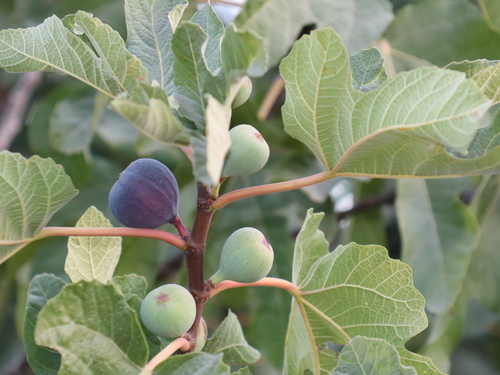
If you are unsure about a plant’s toxicity, ask a botanist or veterinarian for advice.