
Lawn daisy (Bellis perennis, )
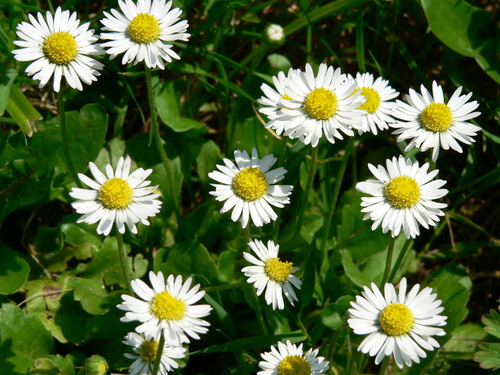
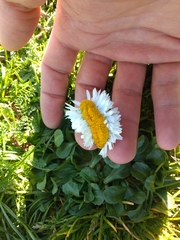
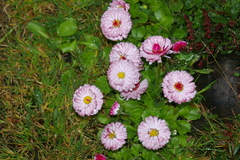
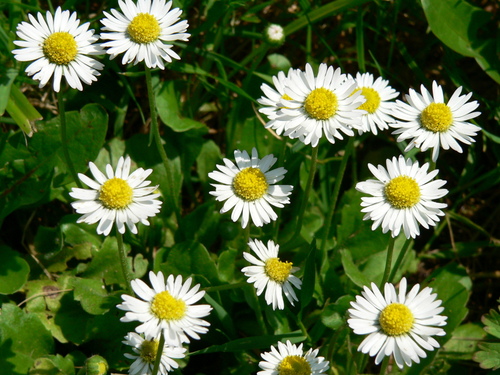
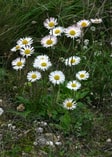
Lawn daisy (Bellis perennis L., 1753) is a herbaceous perennial in the Asteraceae, native across much of Europe and familiar in French lawns. Its spoon-shaped leaves form a basal rosette, with bare stalks 5–15 cm (2–6 in) tall bearing small white, sometimes pink-tinged heads around a yellow center.
Read moreLawn daisy, Common daisy, English daisy and Daisy

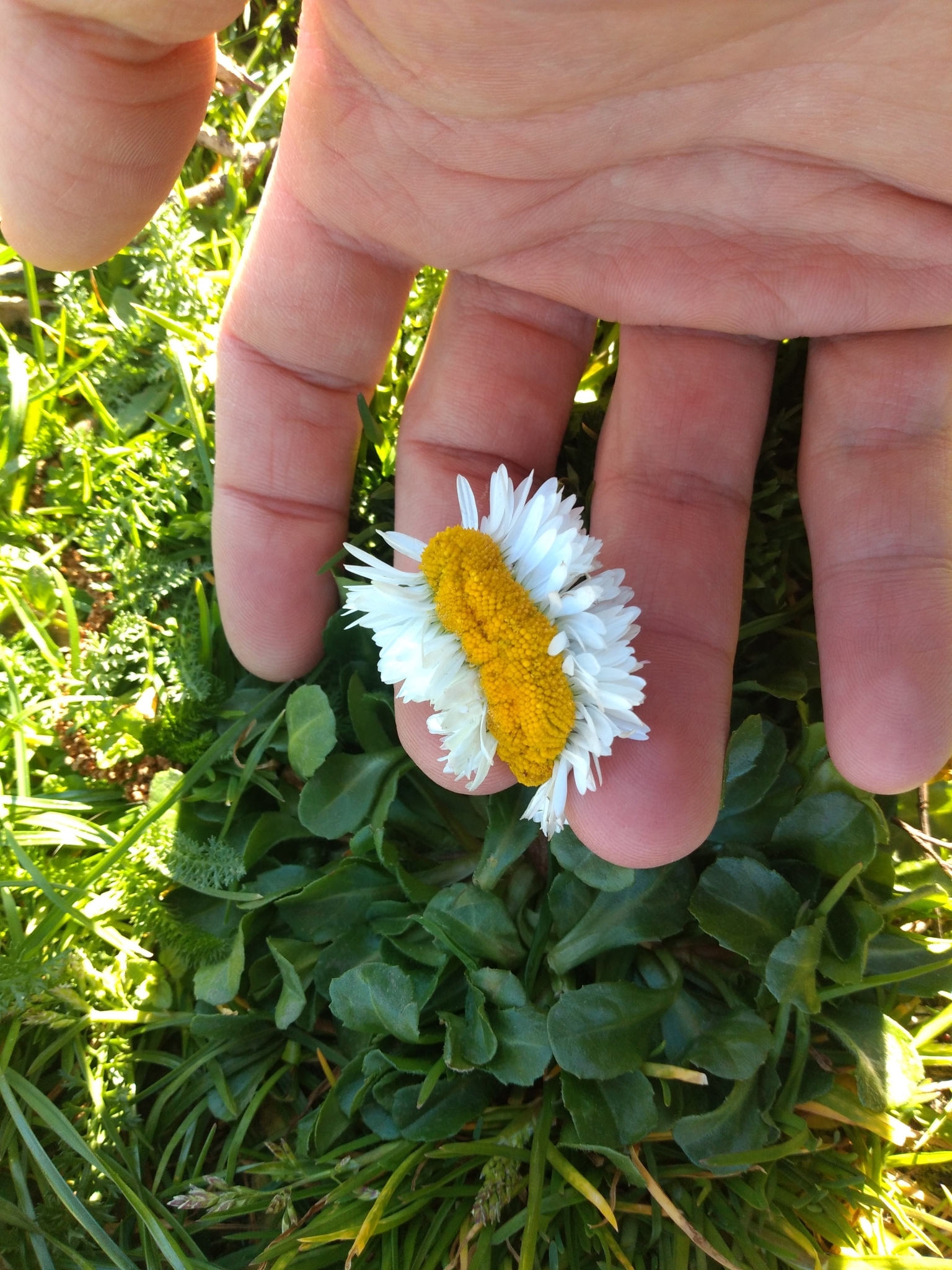
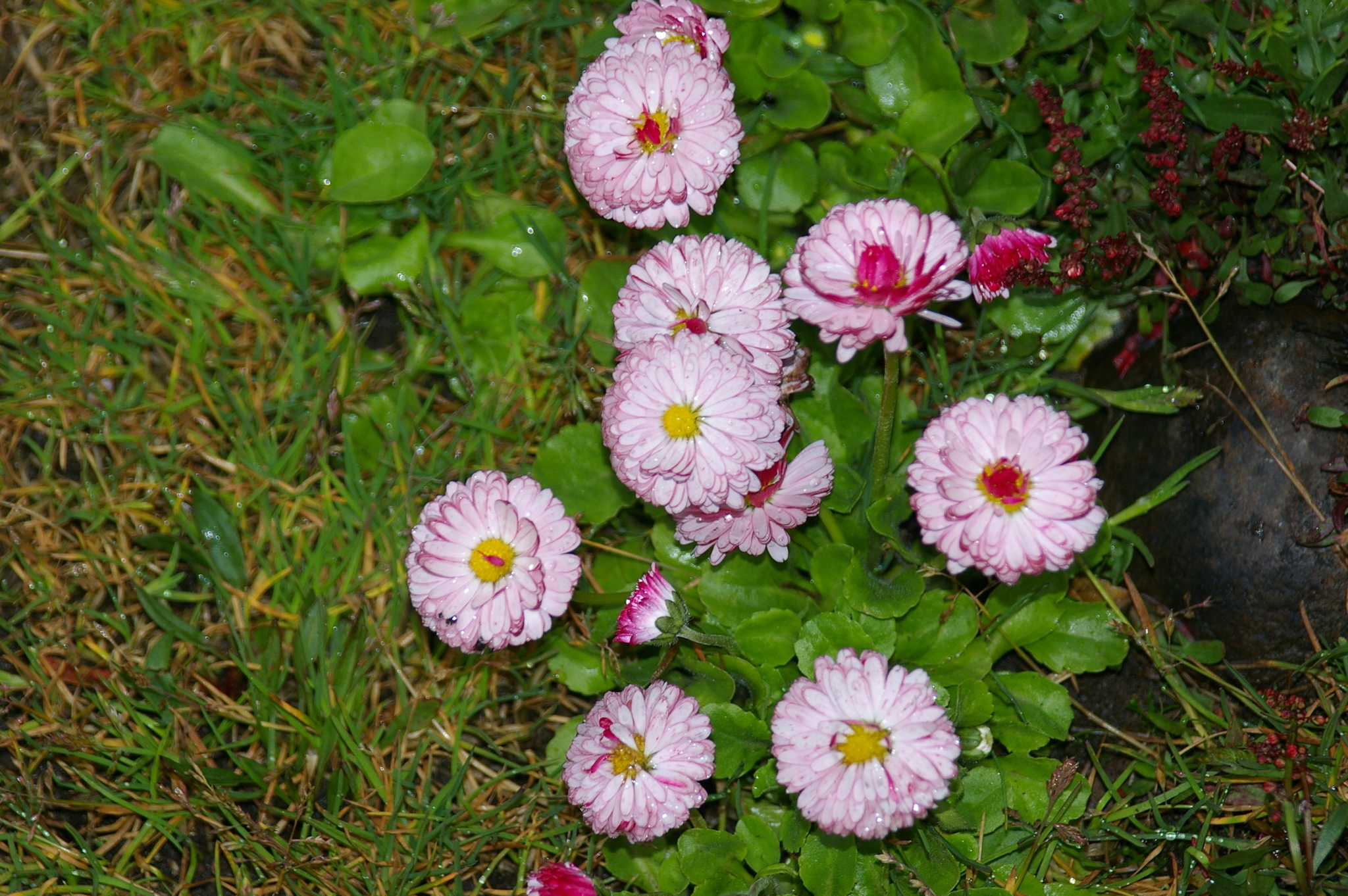
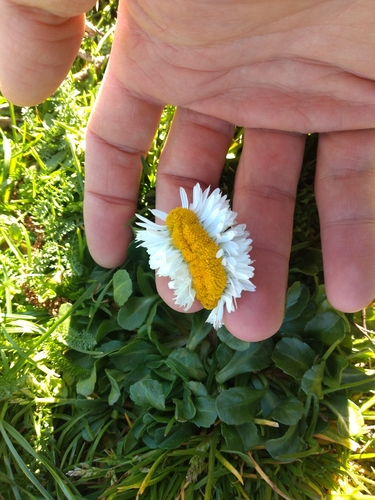
© photo
(c) m.dolores paderne sa…, some rights reserved (CC BY-SA) · cc-by-sa
Julian List · cc0
Don Johnston · cc0
no rights reserved · cc0
Global distribution
POWO/WCVP and Trefle place Bellis perennis in a native range covering Madeira, Europe, the Mediterranean and Central Asia, including France. North American and Oceanian introductions represent local situations as a naturalized plant or lawn weed.
- Native5
- Introduced3
- Mainland France
- Corsica
- Western Europe
- Madeira
- Central Asia
- United States
- California
- New Zealand
Hexagons: regions where the plant occurs. Green dots: native range.1
Identity
Lawn daisy (Bellis perennis L.) is an accepted species of Bellis in the Asteraceae. WCVP/POWO traces the name to Linnaeus’s Species Plantarum, published in 1753, and gives a native range spanning Madeira, Europe, the Mediterranean and Central Asia. 1 2
Names such as common daisy, English daisy and daisy refer to the same low-growing lawn plant. Lawn daisy describes its familiar setting: a small member of the Asteraceae able to flower in short turf. 3 4
French sources connect “pâquerette” with Easter and spring flowering, but this is no fixed calendar. They describe a long flowering season, often from late winter into fall, with a pronounced spring peak in the conditions they cover. 5 4
Recognition
Spoon-shaped to obovate leaves form the basal rosette of Bellis perennis. They widen toward the tip and often have rounded teeth. Short, bare flower stalks each carry one head. The ground-hugging foliage helps the plant withstand moderate mowing. 6 7
Each apparent flower is a head of many florets. Small tubular florets make up the yellow central disk; the white outer rays, sometimes pink beneath, are strap-shaped florets. Bedding cultivars can develop this arrangement into double or pompon heads. 6 9
Oxeye daisy, Leucanthemum vulgare, is the most useful comparison for identification. It has taller stems and larger heads. Bellis perennis remains a lawn rosette, often below 15 cm (6 in), with smaller heads. 4 7
Useful taxonomy
For botanical identification, use Bellis perennis L. WCVP records an accepted species in the Asteraceae, genus Bellis, with author L. and publication year 1753. Trefle follows the same accepted status and also links to WFO, IPNI, GBIF and POWO. 2 3
Numerous named forms, varieties and historical descriptions account for its extensive synonymy. Names assigned to the accepted species include Aster bellis, Bellis hortensis, Bellis pumila, Bellis perennis var. integrifolia, Bellis perennis var. prolifera and Bellis perennis f. discoidea. These do not represent separate currently accepted species. 1 2
Another member of Bellis is Bellis sylvestris, southern daisy, with a more Mediterranean distribution and fall flowering. Historical treatments linking it to B. perennis do not justify merging the two accounts; this one concerns Bellis perennis alone. 2 4
Habitat and range
France falls within the native range recorded for Bellis perennis by POWO/WCVP and Trefle. Tela Botanica and the LPO describe a familiar plant of lawns, meadows, pathsides, gardens and places exposed to trampling or regular mowing. 1 3 4
A low rosette gives it an advantage in moist lawns: mowing removes the heads but often spares the leafy crown. Penn State and UC IPM treat it as a turf weed in some North American settings, particularly in moist, fertile or open turf. 7 8
Within France, the cited references describe lawn daisy as common and native, with no designation as an invasive alien species. Outside its native range, its local status may differ, including occurrence as an introduced plant or lawn weed. 1 8 12
Life cycle and reproduction
Persistence depends on a low perennial crown. Lawn daisy forms small colonies through short rhizomes or adjacent rosettes and also self-seeds when heads mature. Turf references emphasize both mechanisms: a rosette protected from mowing and seed production. 7 8
Mild climates allow an extended flowering season. French sources describe spring flowering and often much more, while horticultural accounts emphasize the spring-to-summer display of Bellis. In comparable conditions, spring is the main season, with flowers possible almost year-round depending on weather and mowing. 5 9
Gardeners usually propagate wild forms by seed or division of rosettes. Double-flowered bedding cultivars are often grown as biennials or short-lived perennials, selected for decorative heads rather than long persistence in turf. 9 10
Uses and risks
Flowering lawns, short meadows, moist borders and spring containers are its main ornamental or small-scale ecological uses. Leaving some patches less closely mown preserves heads for insects, although a daisy lawn cannot replace a diverse meadow. 5 6
Edible leaves and flowers are mentioned in horticultural sources, often as garnishes or salad ingredients. Use remains cautious: correctly identified, untreated plants, collected away from pollution and eaten only in small quantities. Medicinal use and supplements are not recommended. 6 12
Safety requires more nuance than a blanket non-toxic label. NC State reports saponins, oxalates and tannins, with possible digestive upset or dermatitis, particularly after substantial ingestion or in sensitive people. The ASPCA list has no specific entry for Bellis perennis, but includes daisies from other genera, some toxic. 6 13
Pets should not be offered lawn daisy as food. Minimal exposure need not cause panic, but seek veterinary advice if an animal eats a large amount or develops vomiting, drooling, lethargy or irritation. 6 13
Varieties, look-alikes and related plants
Bedding cultivars of Bellis perennis have double or pompon heads in pink, red or white, and sometimes variegated foliage. RHS describes Bellis as rosette perennials with spoon-shaped leaves and frequently double heads in cultivars; individual listings include ‘Pink Buttons’ and ‘Aucubifolia’. The SNHF also names ‘Pomponette’ among horticultural forms. 9 10 11
Trade names including Pomponette, Bellissima Red, Pink Buttons and Aucubifolia identify horticultural selections rather than wild taxa. A white, yellow-centered lawn seedling and a red double-flowered container plant can belong to the same species while serving different purposes. 11 9 12
Common-name overlap creates a separate identification problem. Depending on country and trade usage, “daisy” can mean Bellis, Leucanthemum, Chrysanthemum, Gerbera or other Asteraceae. This matters for animal safety: chrysanthemums sold as daisies may be toxic to pets, whereas Bellis perennis belongs to a different genus. 13 6
Main sources
- Plants of the World Online / Kew, Bellis perennis L.
- WCVP / Plants of the World Online, Bellis perennis
- Trefle, species data, Bellis perennis
- Tela Botanica, Flore de Coste: Bellis perennis L., description
- LPO France, Lawn daisy
- NC State Extension Gardener Plant Toolbox, Bellis perennis
- Penn State Extension, Lawn and Turfgrass Weeds: English Daisy
- University of California IPM, English daisy
- Royal Horticultural Society, Bellis perennis (daisy)
- Royal Horticultural Society, Bellis perennis 'Pink Buttons'
- Société Nationale d'Horticulture de France, Lawn daisy
- Perenual, horticultural traits, English daisy
- ASPCA animal toxicity data
Frequently asked questions
Is lawn daisy the same as oxeye daisy?
No. Bellis perennis is the small lawn daisy; Leucanthemum vulgare is the taller meadow plant with larger heads.
Is Bellis perennis native to France?
Yes, according to the cited sources. POWO/WCVP, Trefle and Tela Botanica include France or the French flora within its native occurrence.
Can you eat lawn daisy?
Horticultural sources describe edible leaves or flowers, but use only small amounts of correctly identified, untreated plants. Avoid plants from chemically treated lawns.
Is lawn daisy poisonous to pets?
No specific ASPCA entry for Bellis perennis was found in the cited references. Prevent pets from eating large quantities and check identification, since other daisies belong to toxic genera.
Why does lawn daisy survive mowing?
Its rosette stays below cutting height and the plant can flower again quickly. Moist, short, open turf favors it.
Is Bellis perennis invasive in France?
No. It is treated as native in France. It may be a lawn weed or introduced elsewhere, but that does not amount to a French invasive designation.
Similar plants
If you are unsure about a plant’s toxicity, ask a botanist or veterinarian for advice.