
Flamboyant (Delonix regia, )
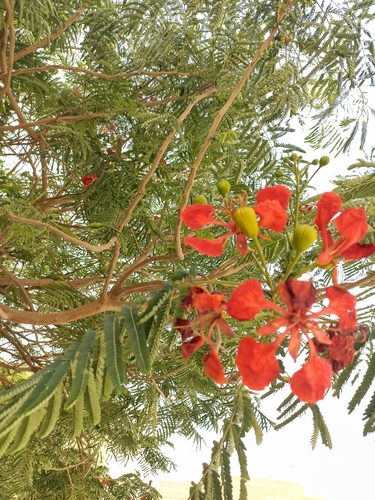

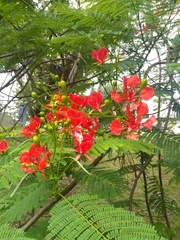
Flamboyant (Delonix regia (Bojer ex Hook.) Raf.) is an umbrella-crowned tree in the Fabaceae, native to dry forests in western and northern Madagascar. Its mass of scarlet flowers, often appearing before new leaves, has made it one of the most widely planted tropical ornamental trees. Shallow, spreading roots require careful siting.
Read moreFlamboyant, royal poinciana, Flame tree and Gulmohar


© photo
Johannes Schuster · cc-by
Robert Taylor · cc-by
Lucas Kaminski · cc-by
Taken Dec 16, 2020 by Pacheco Bruna (cc-by-sa)
Taken Nov 28, 2022 by Costa Raul (cc-by-sa)
Taken Jan 8, 2020 by Espinoza-Zevallos Marco Elías (cc-by-sa)
Taken Apr 29, 2021 by Fernando da Luz Schmidt (cc-by-sa)
© copyright of the Board of Trustees of the Royal Botanic Gardens, Kew.


Global distribution
The strict native range of Delonix regia is confined to dry deciduous forests in western and northern Madagascar. Introduced for its flowers across nearly all tropical and subtropical regions, it is now much more widespread in cultivation than in the wild.
- Native1
- Introduced6
- Invasive1
- Madagascar
- India
- Vietnam
- Florida (United States)
- Cuba
- Hong Kong
- Israel
- Christmas Island (Australia)
Hexagons: regions where the plant occurs. Green dots: native range.1
Identity
Flamboyant (Delonix regia (Bojer ex Hook.) Raf., 1837), also called royal poinciana or flame tree, is an accepted species in Delonix, family Fabaceae, subfamily Caesalpinioideae. The genus name combines Greek delos, evident, and onyx, claw, referring to the clawed petals. Latin regia means royal, alluding to the magnificent flowering. 8 3
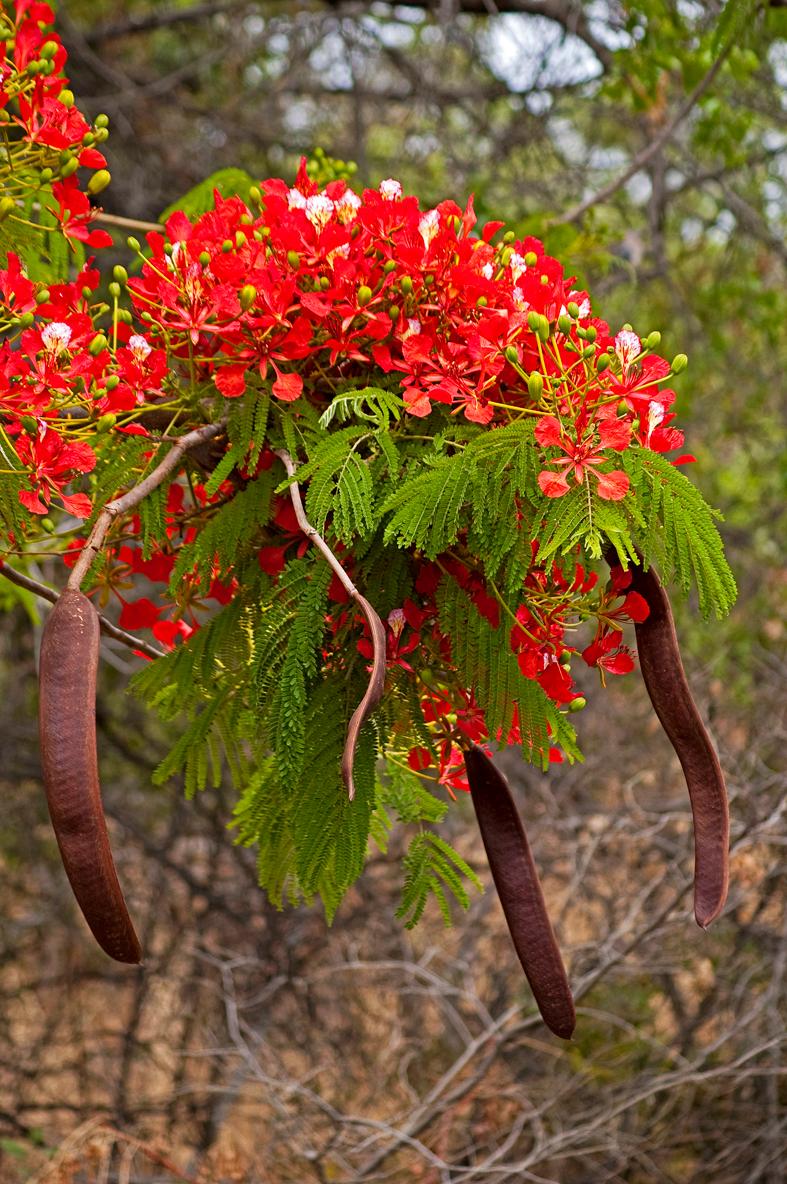
Jacaranda (Jacaranda mimosifolia) is often confused with it in photographs because both have bipinnate leaves. Flamboyant can also be recognized outside flowering season by its flat pods, 30–70 cm (12–28 in) long, a dependable distinction between the two trees.
Constantine Samuel Rafinesque published the name in 1837, based on Poinciana regia, described by William Jackson Hooker from Wenceslas Bojer’s Madagascar collections. Flamboyant describes a crown ablaze with scarlet flowers, often before new foliage appears. Gulmohar is another established name for the tree. 2 8
Recognition
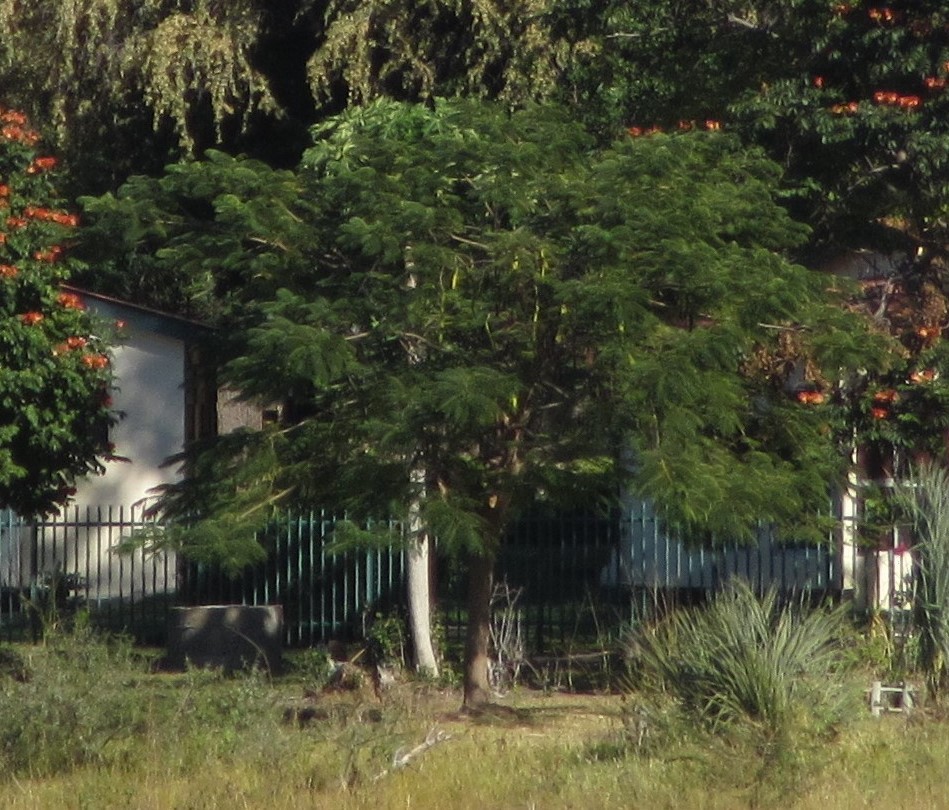
An umbrella-shaped crown is usually wider than the mature tree is tall. Typical height is 10–15 m (33–49 ft), occasionally 18 m (59 ft), while the crown often spreads beyond 20 m (66 ft). The trunk swells at its base and has smooth grayish bark marked with lenticels. Shallow, spreading roots remain visible at the surface. 8 4
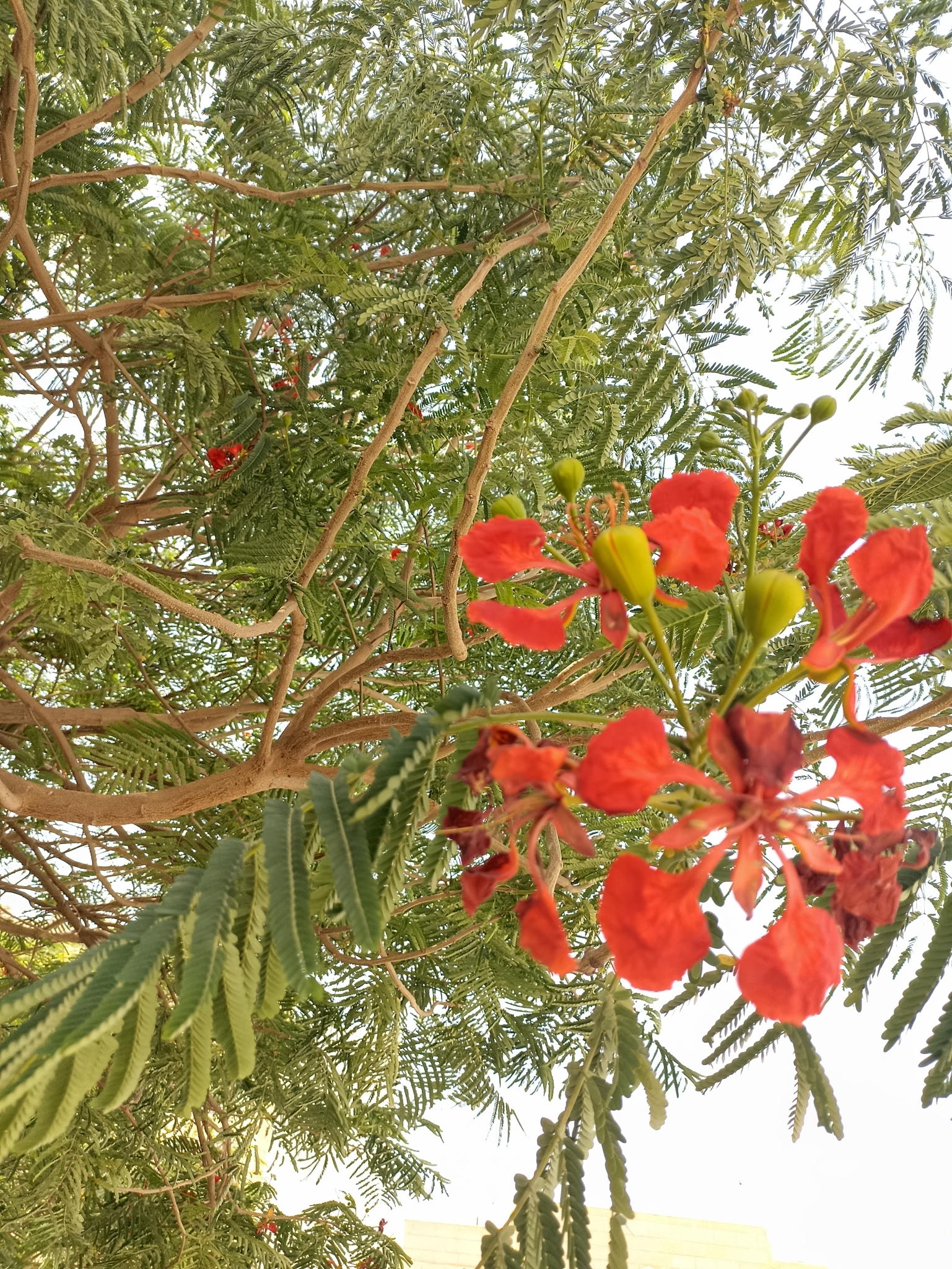
Bipinnate foliage has 8–25 pairs of pinnae, each carrying 30–60 tiny leaflets just 4–12 mm (0.16–0.47 in) long. From a distance the leaves appear almost feathery. Their fine divisions cast light, shifting shade, often compared with mimosa foliage, although the trees belong to different genera. 3
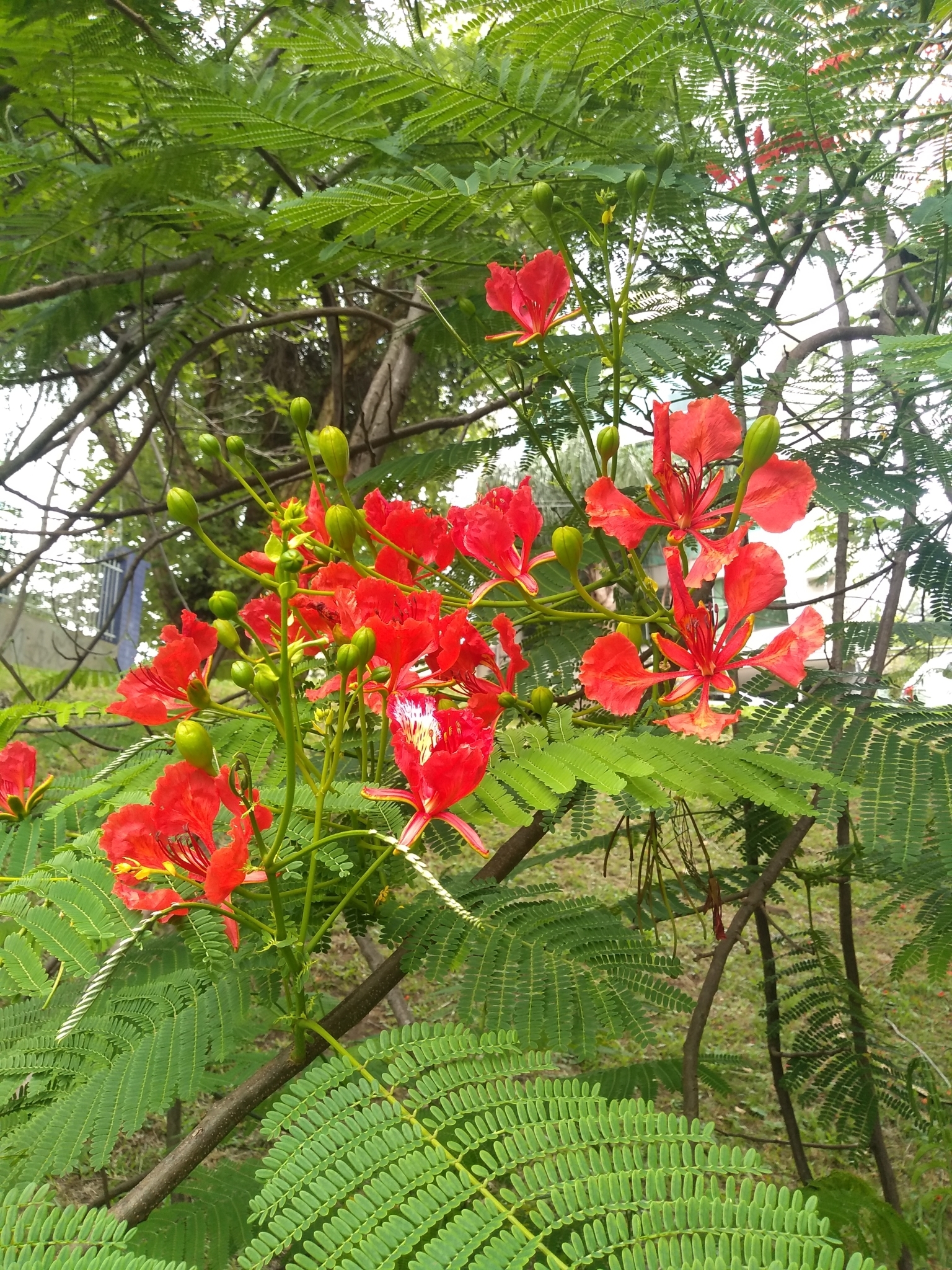
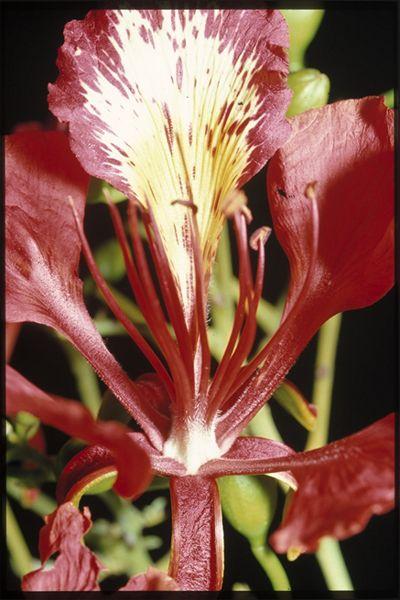
Flowers provide the clearest recognition feature, more conspicuous than foliage or pods. Blooms 8–11 cm (3–4.3 in) across have four spreading scarlet or orange petals and a fifth, larger petal veined yellow and white. This pattern helps identify the tree from a distance. A natural yellow-flowered form, variety flavida, replaces scarlet with yellow throughout the flower. 3 4
Useful taxonomy
Several synonyms remain useful when reading old catalogs:
- Poinciana regia Bojer ex Hook., the basionym
- Caesalpinia regia (Bojer ex Hook.) D.Dietr.
- Delonix regia var. genuina Stehlé
- Delonix regia var. flavida Stehlé, the yellow-flowered form
Delonix was long confused with Poinciana, explaining why “poinciana” persists in many languages despite the species’ present placement in Delonix. 1 2
Habitat and range
Its strict native range is confined to dry deciduous forests in western and northern Madagascar, on karst soils, limestone slopes and coastal sands. Long poorly documented in the wild, it was confirmed from a natural population on the west coast only in 1932. 1 3
Introduced for its flowers, flamboyant is now grown across almost all tropical and subtropical regions, including India, Vietnam, Florida, the Caribbean, East Africa, Southeast Asia and southern China. IUCN has assessed it globally as Least Concern since 2014, although charcoal production still threatens its original wild populations. 6 7
Naturalization is problematic on some tropical islands. On Christmas Island, for example, flamboyant inhibits regeneration of native vegetation. 8
Life cycle and flowering
Flowering follows local climate rather than a universal calendar. In India it occurs in April and May, often while trees are leafless. In Vietnam, May–July flowering coincides with the end of the school year, giving rise to the local name “flower of the pupil.” In Madagascar it flowers toward the end of the year, from September to January. 3 8
Flat, woody pods measure 30–70 cm (12–28 in) long and 4–6 cm (1.6–2.4 in) wide. Green and flexible when young, they harden and turn brown at maturity. Each releases 40–50 seeds, about 2 cm (0.8 in) long, capable of germinating once the hard coat is breached. Pods are collected in December and January; uncollected pods often remain on the tree into the following season. 3 8
A hard seed coat makes germination uneven. After scarification and 24 hours in warm water, seeds germinate in 5–10 days if the coat is sufficiently opened. Untreated seeds may remain dormant for months. Semi-ripe branch cuttings are possible but root more slowly than seed germinates. Seed-grown trees rarely flower before 4–5 years, often later in containers or cool conditions. 7 4
Uses and risks
Shade and ornament are the principal uses. Flamboyant lines avenues and parks in tropical cities, is the official tree of several Chinese and Taiwanese cities, and supplies the national flower of Saint Kitts and Nevis. Despite belonging to the Fabaceae, it is a non-nodulating legume and does not fix atmospheric nitrogen as many relatives do. 3 8
Shallow, spreading roots and soft, brittle wood make it risky in cramped urban avenues. Entire trees have fallen, including reported cases in South Africa. Reserve it for large spaces, away from foundations and buried utilities. Cold below 6 °C (43 °F) damages the tender wood, restricting outdoor planting to tropical or very sheltered Mediterranean conditions. 8
The cited databases classify Delonix regia as non-toxic to cats, dogs and people; its status in horses remains undocumented. Seeds contain tannins, saponins and oxalates, but at lower levels than many everyday foods. Caution about eating large quantities is presented as a mechanical precaution rather than a confirmed toxicological alert. 7
Varieties and look-alikes
Apart from yellow-flowered flavida, no distinct stabilized cultivars are offered in horticulture. Plants sold are almost always seedlings, with natural variation in flower shade and shape. 3
Several spectacular tropical flowering trees cause confusion, each with a distinguishing feature:
- Jacaranda mimosifolia has mauve, bell-shaped flowers and similarly bipinnate but broader foliage;
- Peltophorum pterocarpum, yellow poinciana, belongs to the same subfamily, Caesalpinioideae;
- Caesalpinia pulcherrima is a much smaller shrub with red and yellow flowers, sometimes sold as dwarf poinciana.
The most dependable recognition combines scarlet petals with a fifth petal marked yellow and white, very long flat pods and extremely fine bipinnate foliage, rather than relying on flower color alone. 4
Main sources
- Plants of the World Online / Kew, Delonix regia (Bojer ex Hook.) Raf.
- International Plant Names Index, Delonix regia (Bojer ex Hook.) Raf.
- Wikipedia EN, Delonix regia
- Missouri Botanical Garden Plant Finder, Delonix regia
- Royal Horticultural Society, Delonix regia
- IUCN Red List, Delonix regia (assessment 2014)
- Useful Tropical Plants, Delonix regia
- Monaco Nature Encyclopedia, Delonix regia
- Wikidata, Delonix regia
Frequently asked questions
Is flamboyant poisonous to cats and dogs?
The cited databases classify it as non-toxic to cats, dogs and people; its status in horses is undocumented. No major toxic principle is confirmed, but eating large quantities of hard seeds is discouraged as a mechanical precaution.
Can flamboyant grow outdoors in a cool climate?
In most cool regions it needs a container in a heated greenhouse or conservatory. It does not withstand cold below about 6 °C (43 °F); planting in the ground is confined to tropical or very sheltered conditions.
Why is my flamboyant not flowering?
Seed-grown trees seldom flower before 4–5 years and may take longer in containers or cool climates. Insufficient full sun also substantially delays flowering.
Is flamboyant invasive?
The climate prevents outdoor establishment in metropolitan France. On some tropical islands, such as Christmas Island, it naturalizes and locally hinders native vegetation regrowth.
How do you germinate flamboyant seeds?
Scarify the hard seed coat, then soak the seeds in warm water for 24 hours before sowing. Treated seeds germinate in 5–10 days; untreated germination is much less even.
How does flamboyant differ from jacaranda?
Flamboyant has scarlet flowers with five petals and very long, flat pods. Jacaranda (Jacaranda mimosifolia) has mauve, bell-shaped flowers and much shorter, rounded, flattened pods.
What does the name Delonix regia mean?
Delonix comes from Greek delos and onyx, referring to the clawed petals. Regia means royal in Latin, alluding to the magnificent flowering.
Similar plants

If you are unsure about a plant’s toxicity, ask a botanist or veterinarian for advice.