
Quitch grass (Elymus repens, )
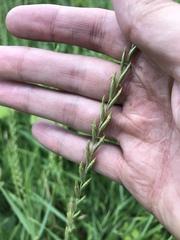
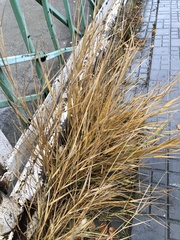
Quitch grass (Elymus repens) is a perennial in the Poaceae from temperate Eurasia, now widespread on almost every continent. Its pointed, much-branched yellowish rhizomes colonize cultivated ground, making it one of the hardest weeds to remove from gardens and fields. Dried rhizomes have also long featured in French herbal medicine as a mild diuretic.
Read moreQuitch grass, Quackgrass, Couch grass, Common couch, Twitch and Quick grass
Allow a few hours of direct sun per day, preferably morning or evening.
Full sun to light partial shade
© photo
(c) Dmitry Ivanov, some rights reserved (CC BY-NC), uploaded by Dmitry Ivanov · cc-by-nc
Chad Zirbel · cc0
Roman A. Lagazyuk (Роман А. Лагазюк) · cc-by
(c) Roman A. Lagazyuk (Роман А. Лагазюк), some rights reserved (CC BY) · cc-by
no rights reserved · cc0
Global distribution
Elymus repens is native to temperate Eurasia and northern Africa. Agriculture has introduced it widely, as forage or accidentally in seed and soil, making it one of the most widespread grass weeds across the temperate world.
- Native4
- Introduced3
- Invasive3
- Europe
- Temperate Asia
- North Africa
- Metropolitan France
- New Zealand
- South Africa
- Japan
- United States
- Canada
- Australia
Hexagons: regions where the plant occurs. Green dots: native range.1
Identity
Quitch grass (Elymus repens (L.) Gould, 1947), also called quackgrass or couch grass, is an accepted species of Elymus in the Poaceae. Linnaeus first described it as Triticum repens in 1753. Frank Walton Gould transferred it to Elymus in 1947, after its placement in Agropyron. 1 2
Claw-like auricles, 1–3 mm (0.04–0.12 in) long, immediately distinguish Elymus repens from the often-confused Elymus caninus, which entirely lacks these structures. 4
France’s INPN still uses the combination Elytrigia repens, common in European floras alongside the name accepted by POWO. Both names identify the same plant; French herbal-tea catalogs use either under the label chiendent officinal. 3
Its yellowish rhizome, creeping and brittle, accounts for the plant’s reputation. Fragments left in soil after plowing can regenerate whole plants, making partial removal ineffective. The same rhizome, dried, features in the French Pharmacopoeia as a mild diuretic. 6
Recognition
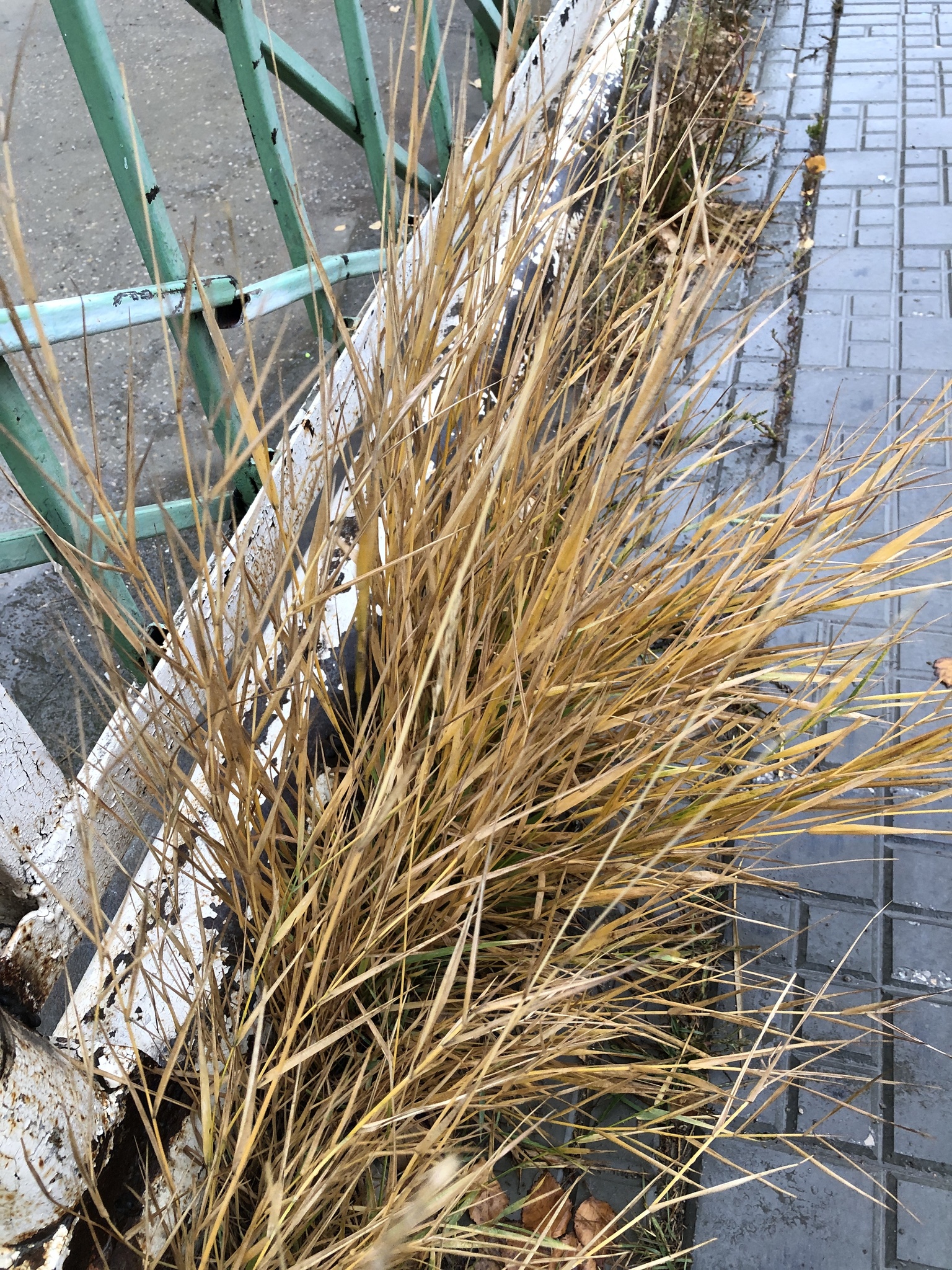
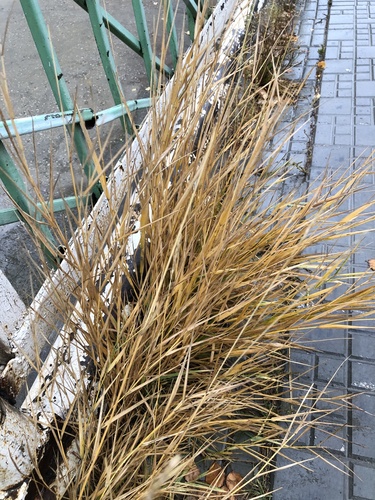
Upright quitch grass stems usually stand 30–90 cm (12–35 in) tall and may reach 1.2 m (4 ft) in rich, well-exposed soil. Narrow, flat leaves have rough upper surfaces and often taper near their tips. 5 4
Beyond the seedling stage, each leaf base carries two slender claws, 1–3 mm (0.04–0.12 in) long. These auricles can be checked with the naked eye, unlike subtler details needed to identify some related grasses. 4
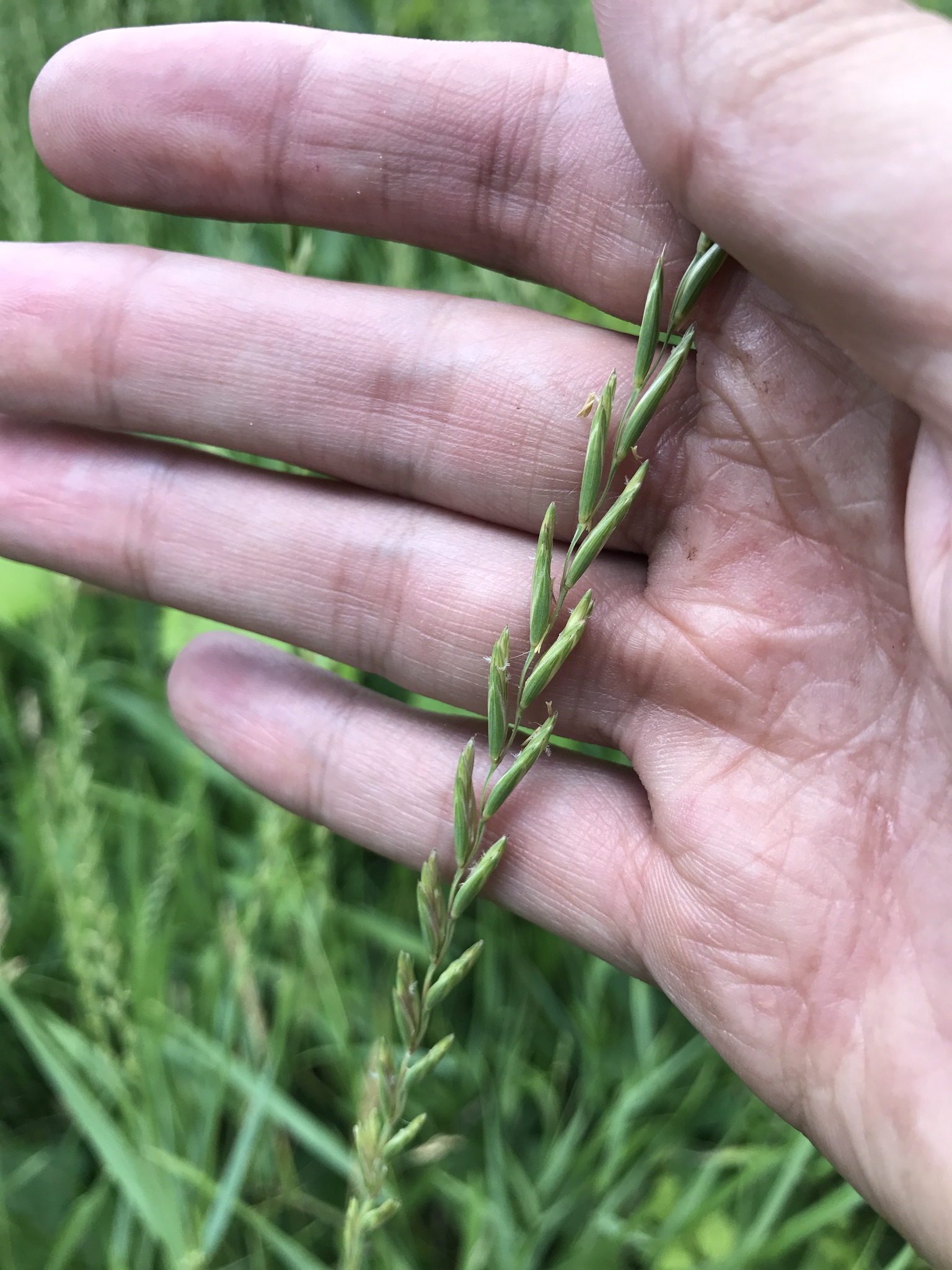
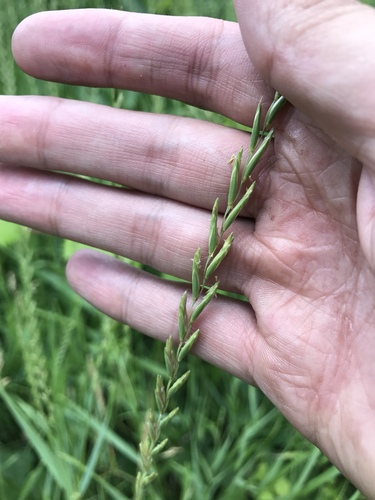
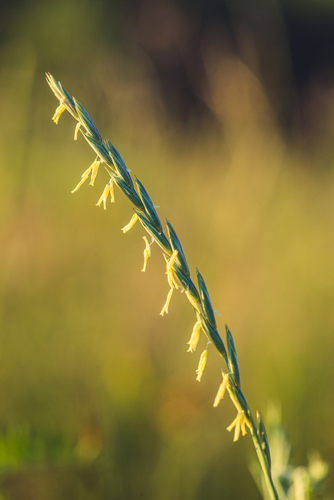
An unbranched terminal spike holds two rows of spikelets pressed against its axis; some populations have awns. Below ground, pale yellow to whitish rhizomes extend 60 cm (24 in) or more, reaching 20 cm (8 in) deep. Each node can produce an independent new shoot. 5
Taxonomy and names
For this species, the accepted botanical reference is Elymus repens (L.) Gould. POWO includes older combinations still in use, notably Agropyron repens (L.) P.Beauv., homotypic with Triticum repens L., and Elytrigia repens (L.) Desv. ex Nevski, preferred by several European floras. 1 3
The EPPO code AGRRE identifies the species for European plant-health tracking. It derives from Agropyron repens and remains in use despite the accepted change of genus. 7
A frequent field confusion involves Elymus caninus, which lacks auricles but has awned spikelets resembling those of quitch grass. A further character helps separate them: in Elymus repens, glumes stay attached to the stem when the spikelet falls; in Elymus caninus, they fall with the flower. 8
Habitat and range
Temperate Eurasia and northern Africa form the native range of Elymus repens. Agriculture later spread it through almost every temperate continent, where it is now among the most thoroughly documented grass weeds. 1 5
North America treats quitch grass as non-native and invasive. It occurs from coast to coast and north to Alaska, except in Gulf Coast states whose climate is too hot for this cool-climate grass. 5
Almost any soil suits quitch grass, across a pH range of 4.2–8.3. It favors disturbed ground: cultivated fields, waste places, roadsides, banks and gardens. This broad soil tolerance makes it a pioneer after plowing or construction, establishing before other weeds take over. 6 5
Life cycle and reproduction
Both seeds and rhizomes reproduce quitch grass, explaining its persistence. Rhizome spread dominates: every fragment with a viable node can regenerate a complete plant, even when isolated in soil after plowing. 4 5
Stem extension and heading occur in local summer. Spikelets ripen afterward and contribute seeds to the soil seed bank, where they may wait several seasons before germinating. 5
One isolated deep plowing does not destroy the plant. Instead, it mostly breaks up the rhizome network and carries viable pieces into new areas, reversing the intended effect. 4
Uses and management
Dried rhizomes appear in the French Pharmacopoeia as a recognized medicinal plant, traditionally prepared as a decoction for a mild diuretic effect in cystitis and urinary stones. Young shoots are eaten raw in spring salads, and ground rhizomes have supplemented flour during food shortages. 6
In gardens and field crops, quitch grass competes with neighbors for nitrogen and water from emergence, reducing yields when crops establish before weeding. Management favors removing whole rhizomes without breaking them, together with repeated stale seedbeds, rather than a single deep plowing. 5
Foliar systemic herbicides applied during active growth remain a common agricultural option, but repeated treatments are often needed. Dormant rhizome buds may survive the first application and resume growth the following season. 4
Look-alikes and related plants
Several different grasses share the French name chiendent. The temperate, rhizomatous Elymus repens must be distinguished from Bermuda grass (Cynodon dactylon), a different genus more frequent in warm-climate lawns. Scientific names avoid confusion between these plants. 3
Useful field characters include the following:
- Claw-like auricles, absent in Elymus caninus;
- yellowish, brittle rhizomes in Elymus repens;
- whether glumes remain when a spikelet falls, distinguishing the two Elymus species;
- the scientific name, a stable reference despite variation in regional common names.
Correct identification also affects management: Bermuda grass (Cynodon dactylon) rhizomes respond differently to removal and herbicides from those of quitch grass. 8
Main sources
- Plants of the World Online / Kew, Elymus repens (L.) Gould
- International Plant Names Index, Elymus repens (L.) Gould
- INPN / MNHN, Elytrigia repens: TAXREF 96046 accepted species record
- Washington State University Hortsense, Weeds — Quackgrass, Elymus repens
- US Forest Service FEIS, Elymus repens species review
- Plants For A Future, Elymus repens — Couch grass
- EPPO Global Database, Elymus repens (AGRRE)
- Botanical Society of Britain and Ireland, Plant Crib — Elytrigia and Elymus, Couches
Frequently asked questions
Is quitch grass toxic to cats or dogs?
No toxicity is documented. Cats and dogs often graze this grass, a behavior associated with digestive regulation rather than a poisoning risk.
Why is quitch grass so hard to remove?
Its yellowish rhizomes regrow from any fragment bearing a node, even after partial removal. A single deep plowing breaks up and spreads the network instead of destroying it.
Are quitch grass and Bermuda grass the same plant?
No. Elymus repens spreads through rhizomes in temperate climates, while Cynodon dactylon belongs to a different genus and is common in warm-climate lawns. Rhizomes and auricles help distinguish them.
How is quitch grass rhizome used in herbal medicine?
Dried rhizomes are traditionally prepared as a decoction and used as a mild diuretic for cystitis and urinary stones. This use is recorded in the French Pharmacopoeia.
How can Elymus repens be distinguished from Elymus caninus?
Elymus repens has claw-like auricles at the leaf bases; Elymus caninus lacks them. Whether the glumes remain when a spikelet falls provides a further distinction.
Where does quitch grass come from?
Its native range covers temperate Eurasia and northern Africa. Agriculture subsequently spread it to almost every continent, where it is now a widespread weed of cultivated ground.
Is quitch grass edible?
Dried and ground rhizomes have been used in bread during food shortages, and young shoots can be eaten raw in salads. The leaves soon become fibrous and unappetizing.
Similar plants
If you are unsure about a plant’s toxicity, ask a botanist or veterinarian for advice.