
Rainbow eucalyptus (Eucalyptus deglupta, )
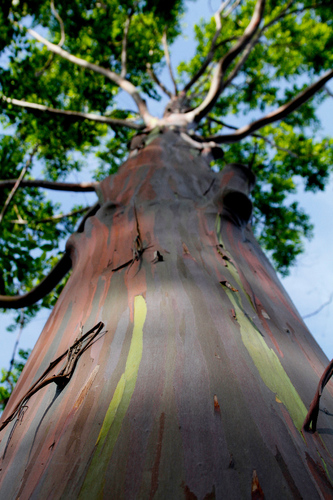
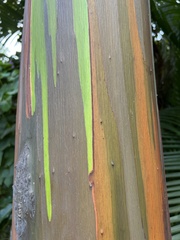
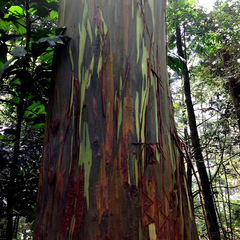
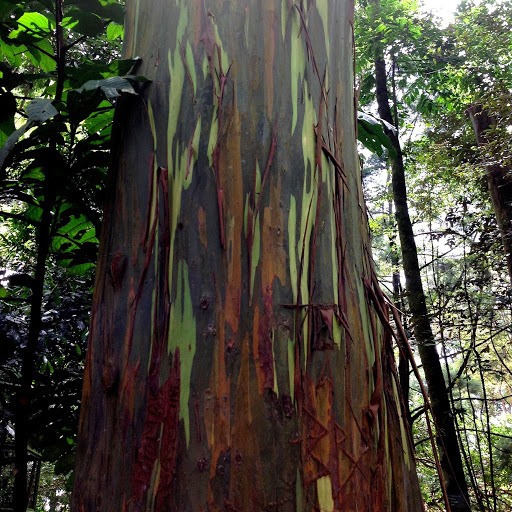
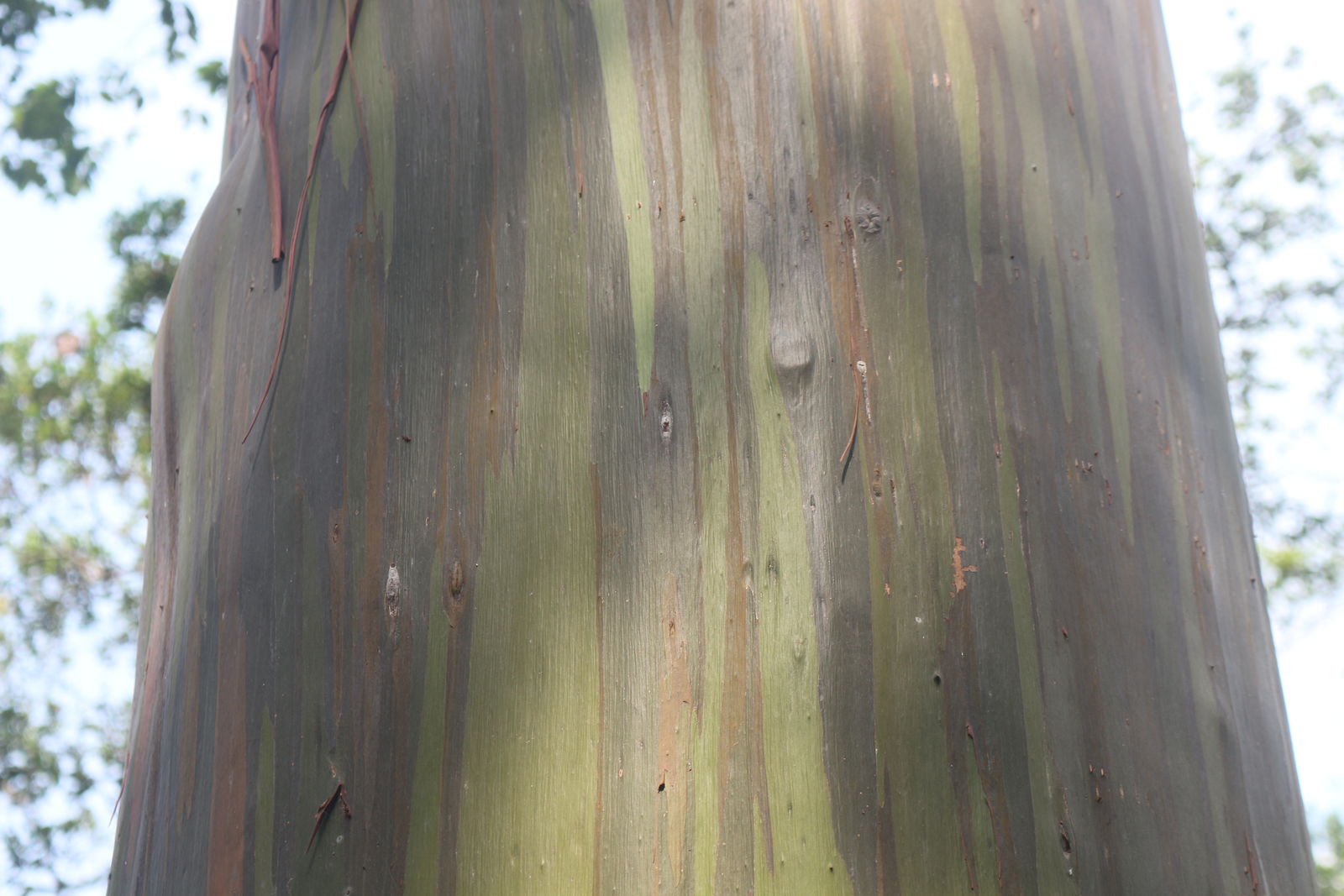
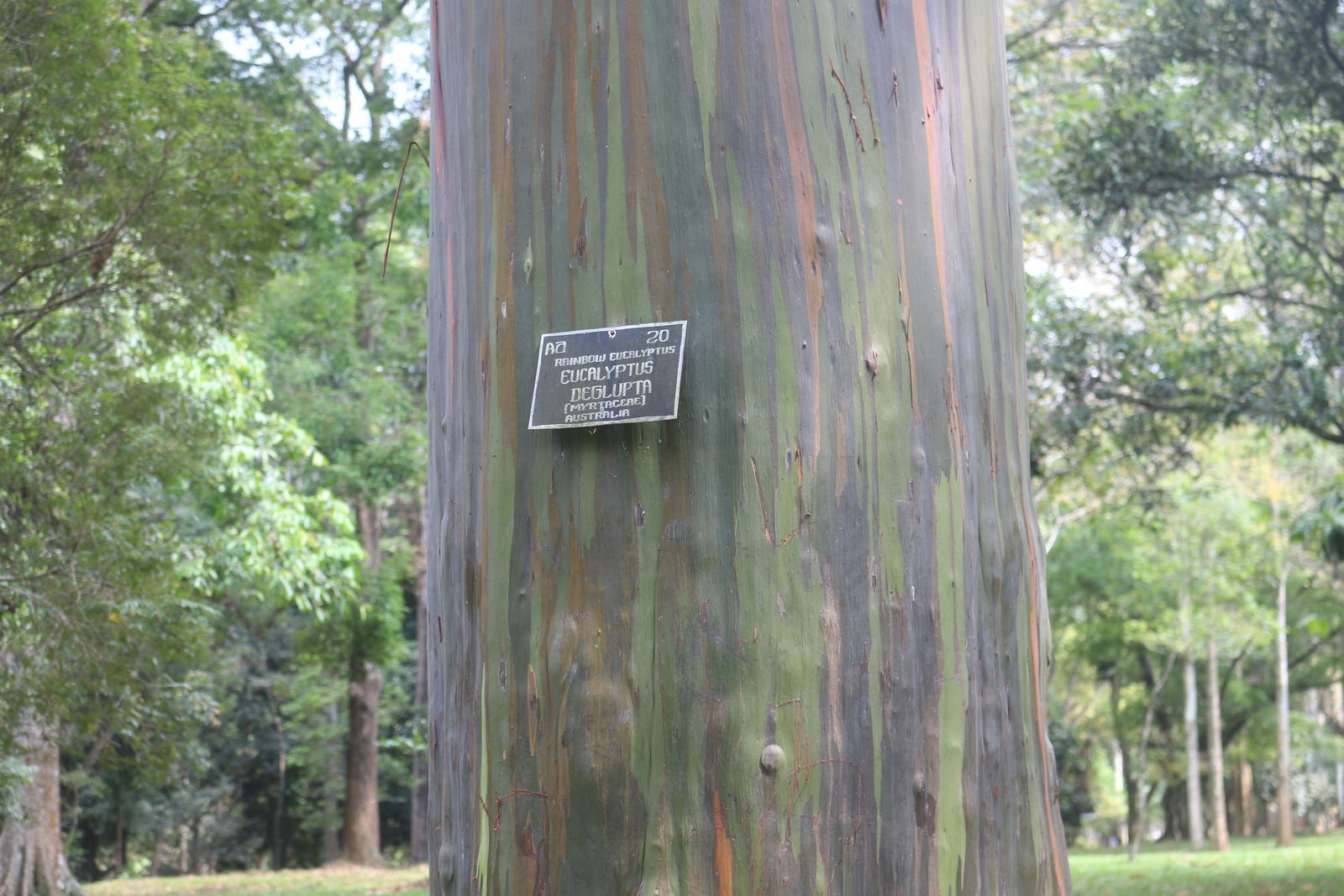
Rainbow eucalyptus (Eucalyptus deglupta) is a tree in the Myrtaceae, native to the Philippines, Indonesia and Papua New Guinea. Its name comes from bark that peels in patches, revealing green, blue, purple, orange and brown shades. It is also the only species in the genus that grows naturally in tropical rainforest.
Read moreRainbow eucalyptus, Mindanao gum and Indonesian gum




© photo
steve b · cc0
iNaturalist User · cc0
Jason Alexander · cc-by
Taken Mar 30, 2016 by OTS - Oviedo-Brenes, Federico (cc-by-nc-sa)
© copyright of the Board of Trustees of the Royal Botanic Gardens, Kew.




Global distribution
Eucalyptus deglupta is native to the Philippines (Mindanao), Indonesia (Seram and Sulawesi) and Papua New Guinea (including New Britain). It is the only Eucalyptus whose natural distribution extends into the Northern Hemisphere. Elsewhere it is grown as an ornamental or plantation tree, with no documented report of invasion.
- Native3
- Philippines
- Indonesia
- Papua New Guinea
Hexagons: regions where the plant occurs. Green dots: native range.1
Identity
Rainbow eucalyptus (Eucalyptus deglupta Blume, 1850), also known as Mindanao gum or Indonesian gum, belongs to the Myrtaceae. The Latin epithet deglupta means peeled or stripped, describing bark that comes away in patches to expose a bright green surface beneath. 1 5
Dutch botanist Carl Ludwig Blume described the species in 1850. It is the only Eucalyptus that grows naturally in tropical rainforest, with a native range extending into the Northern Hemisphere to about 9° north on the Philippine island of Mindanao. 1 6
Recognition
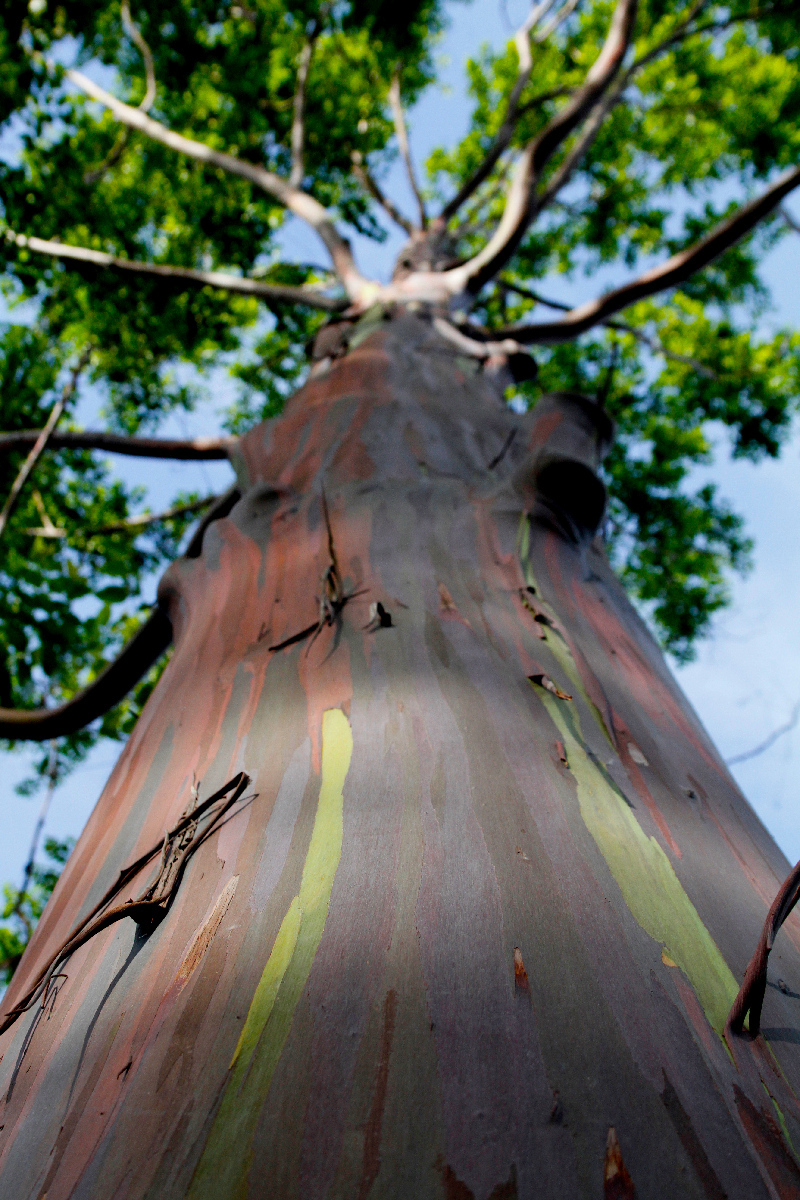
Rainbow eucalyptus sheds its bark in irregular strips. The newly exposed bright green surface darkens over several months through blue, purple and orange to brown. Peeling continues throughout the year on one trunk, rather than occurring in a single annual shedding season. 3 4
Unlike most eucalyptus, whose adult leaves become alternate, those of Eucalyptus deglupta remain opposite at every stage. Oval to lance-shaped, 7.5–15 cm (3–6 in) long and aromatic when crushed, these paired adult leaves help distinguish it from other eucalyptus. 4 3
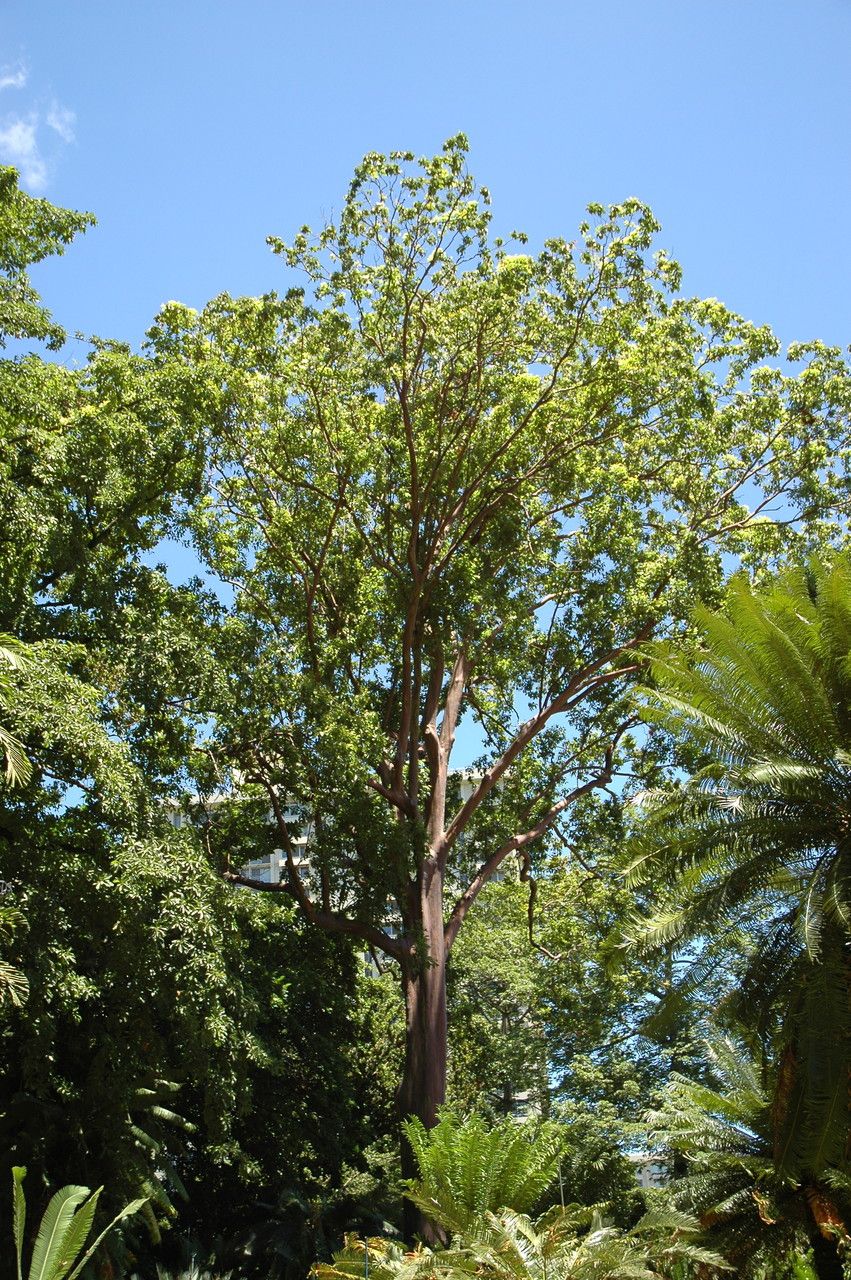
On deep volcanic soils in its native range, the tree commonly reaches 60–75 m (197–246 ft), with a trunk up to 2.4 m (8 ft) across at the base and buttress roots several meters (several yards) tall. Outside its tropical range, on less favorable soil, mature trees are smaller, often 25–40 m (82–131 ft). 3 4
Small white to cream flowers occur in groups of three to seven in umbels, carried in terminal or axillary panicles. The fruit is a woody, hemispherical capsule about 5 mm (0.2 in) across, with three or four protruding valves, each releasing several tiny winged seeds. 3
Useful taxonomy
Kew accepts Eucalyptus deglupta. A related name has long caused confusion: Eucalyptus binacag (Elmer) Elmer, 1915, described from Mindanao populations, was often treated as its synonym. Plants of the World Online now accepts E. binacag as a separate species, so the complete scientific name distinguishes the two taxa. 1 2
Another name, Eucalyptus multiflora, sometimes appears as an illegitimate synonym in older horticultural catalogs. It should not be confused with other homonymous names in the genus. 2
Habitat and range
The native range covers the Philippines, particularly Mindanao, Indonesia (Seram and Sulawesi) and Papua New Guinea (including New Britain). It grows from sea level to 1,800 m (5,900 ft) in moist, well-drained primary and secondary tropical rainforest. 1 4
IUCN listed the species as Vulnerable in 2019. The estimated population decline was about 30% over three generations, approximately 210 years, attributed to forest conversion for agriculture and logging. 6
Beyond the native range, it is widely planted in Southeast Asia, Hawaii and some frost-free tropical or subtropical locations, including Southern California, Florida and Texas. It is almost always grown as an individual ornamental tree rather than in naturalized stands. 3
Growth and reproduction
Exceptionally fast growth within Eucalyptus explains its extensive use for pulpwood plantations in the Philippines and Indonesia. Rapid growth also encourages more frequent bark shedding, allowing the trunk to develop its colors sooner. 3
Flowering occurs in warm, wet conditions. Umbels bear many small white flowers with numerous stamens, pollinated by insects. After fertilization, capsules take several months to ripen and release winged seeds, which the wind carries short distances around the parent tree. 3
Nurseries propagate it almost exclusively by seed, with germination beginning at about 20–22 °C (68–72 °F). Cuttings can be taken from juvenile wood on trees under five years old. Beyond that age, rooting becomes much less reliable when propagating a particular tree. 3
Uses and risks
The wood is used chiefly for white paper pulp. It accounts for a large share of industrial plantations in the Philippines, where fast growth shortens the interval between planting and harvest. Plywood and light construction are other uses. 3
Colorful bark, rather than foliage, drives ornamental planting. Trees line avenues or stand alone in tropical and subtropical parks. An individual at Katong Park in Singapore is listed as a Heritage Tree. 4
As in most eucalyptus, the leaves contain essential oil rich in eucalyptol. ASPCA classifies Eucalyptus species as toxic to cats, dogs and horses. Ingestion of leaves or oil causes salivation, vomiting, diarrhea and depression. 7
In warm, humid conditions, young shoots and buds are vulnerable to blight caused by Teratosphaeria destructans. First reported in Indonesia in 1996, this fungus is now present on several continents. Prolonged high humidity favors infection, with brown spots, purplish discoloration and sometimes death of young shoots. 8
Varieties, look-alikes and related plants
No stabilized horticultural cultivars are widely distributed. Differences in color intensity or speed of bark shedding chiefly reflect tree age and growing conditions, rather than deliberate cultivar selection. 3
Confusion most often involves Eucalyptus binacag (Elmer) Elmer, with similar populations and appearance, or other peeling-barked eucalyptus and corymbias. Corymbia citriodora, for example, has a pale, uniform trunk without the blue, purple and orange tones of E. deglupta. Heavily saturated online photographs often exaggerate these colors, adding to confusion with unrelated peeling-barked trees such as some plane trees and birches. 1
Main sources
- Plants of the World Online / Kew, Eucalyptus deglupta Blume
- International Plant Names Index, Eucalyptus deglupta record
- Missouri Botanical Garden PlantFinder, Eucalyptus deglupta
- NParks Singapore FloraFaunaWeb, Eucalyptus deglupta
- Integrated Taxonomic Information System, Eucalyptus deglupta
- IUCN Red List, Eucalyptus deglupta assessment 2019
- ASPCA, Eucalyptus toxicity entry
- FABI Tree Protection Co-operative Programme, Teratosphaeria destructans
Frequently asked questions
Why does rainbow eucalyptus bark change color?
Irregular patches of bark peel away throughout the year. The exposed surface is initially bright green, then darkens through blue, purple and orange to brown before the next peeling cycle, creating the multicolored effect.
Can rainbow eucalyptus grow in metropolitan France?
It seldom survives long-term in open ground there. It tolerates no frost and suffers below 5 °C (41 °F), so it is mainly grown in a container, greenhouse or conservatory, except in a few very mild coastal microclimates.
Is rainbow eucalyptus poisonous to animals?
Like most eucalyptus, its leaves contain eucalyptol, an essential oil that ASPCA classifies as toxic to cats, dogs and horses if ingested.
How do Eucalyptus deglupta and Eucalyptus binacag differ?
Long confused with one another, they are now accepted as separate species by Plants of the World Online. The latter is restricted to Mindanao populations.
Why is rainbow eucalyptus planted in Southeast Asia?
Very rapid growth makes it a major pulpwood plantation tree in the Philippines and Indonesia, alongside ornamental planting for its bark.
Does rainbow eucalyptus need much water?
Yes. Unlike many Australian eucalyptus adapted to drought, this rainforest species needs consistently moist soil and does not tolerate prolonged water shortage.
Similar plants

If you are unsure about a plant’s toxicity, ask a botanist or veterinarian for advice.