
Snow-on-the-mountain (Euphorbia marginata, )
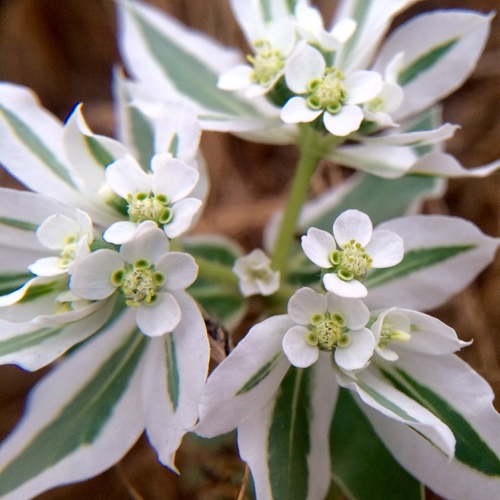
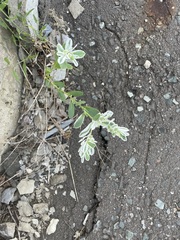
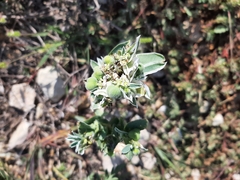
Snow-on-the-mountain (Euphorbia marginata) is an annual Euphorbiaceae native to grasslands from the central United States to northern and southeastern Mexico. A single stem carries green leaves whose margins turn pure white as flowering approaches, surrounding tiny, almost invisible flowers. Irritating milky latex occurs throughout the plant, so handling requires care.
Read moreSnow-on-the-mountain, ghost weed, smoke-on-the-prairie, variegated spurge and mountain spurge
Allow a few hours of direct sun per day, preferably morning or evening.
Full sun; tolerates light partial shade in very hot climates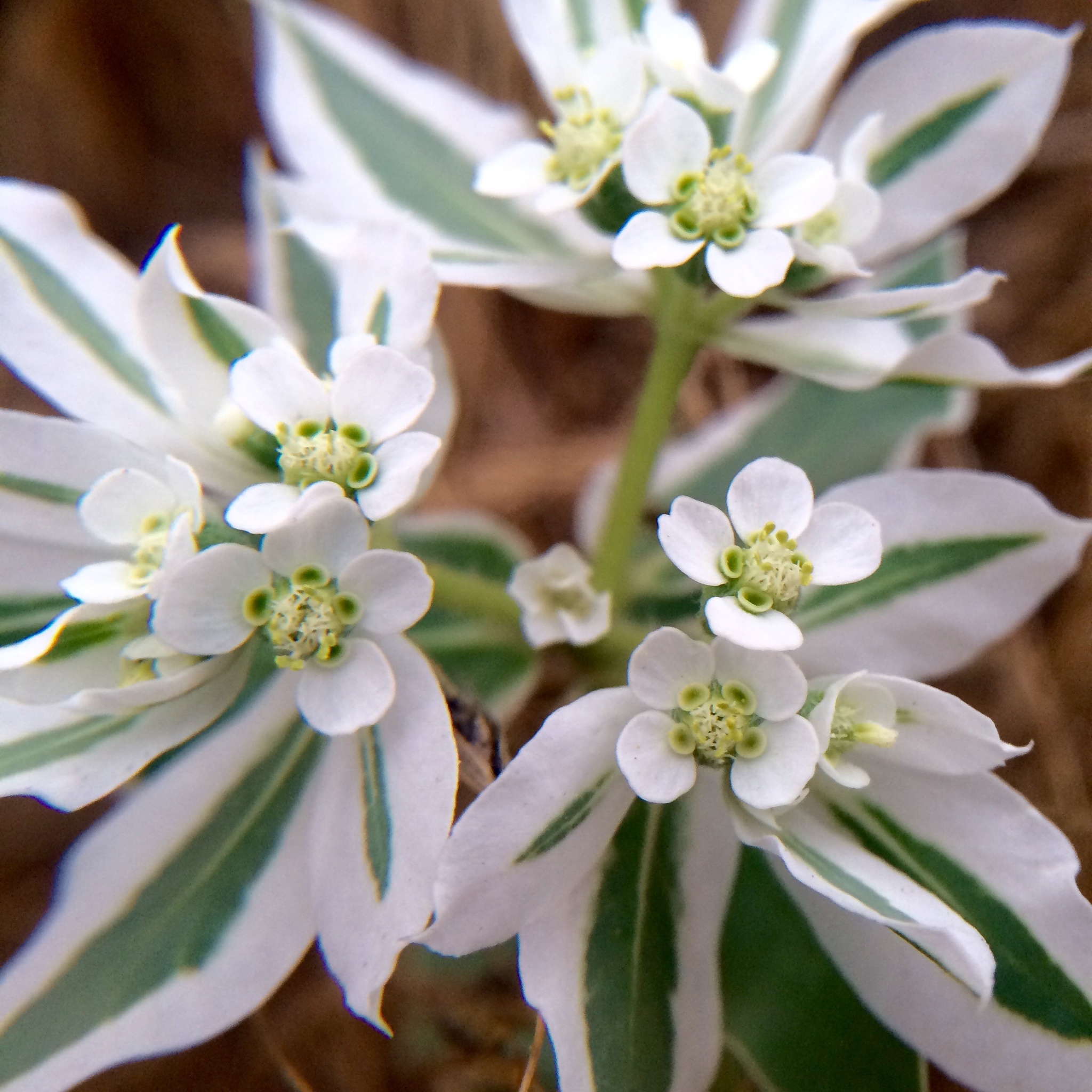


© photo
(c) Doug Grinbergs, some rights reserved (CC BY-NC), uploaded by Doug Grinbergs · cc-by-nc
Силаева Татьяна Борисовна · cc0
iNaturalist User · cc-by
Taken Aug 22, 2021 by mohammad fazel dehkordi (cc-by-sa)
Taken Sep 2, 2019 by Waldemar Zeja (cc-by-sa)
Taken Sep 30, 2021 by Manu___ (cc-by-sa)
Taken Sep 1, 2020 by Álvaro Pardo (cc-by-sa)
© copyright of the Board of Trustees of the Royal Botanic Gardens, Kew.




Global distribution
Euphorbia marginata is native to grasslands and plains of the central and west-central United States, from Minnesota and the Dakotas to Colorado and Texas, extending into northeastern and southern Mexico. It has naturalized beyond this range, notably in China and other temperate regions, often on disturbed ground.
- Native2
- Introduced1
- United States
- Mexico
- China
Hexagons: regions where the plant occurs. Green dots: native range.1
Identity
Snow-on-the-mountain (Euphorbia marginata Pursh, 1814) is an annual in the Euphorbiaceae family. Frederick Traugott Pursh described it from a specimen collected by William Clark during the Lewis and Clark expedition. Six vernacular names circulate internationally; the Latin binomial identifies the plant unambiguously across languages. 1 7
Its French name, euphorbe panachée, is used by Tela Botanica for the two-colored foliage, green below and pure white toward the stem tips. English names such as ghost weed and smoke-on-the-prairie, alongside variegated spurge and mountain spurge, evoke the same striking white-green contrast. 9 5
Stems, leaves and bracts all contain the milky latex characteristic of Euphorbia. Exposure to it can cause contact dermatitis when sowing or cutting stems for bouquets. 8 3
Recognition
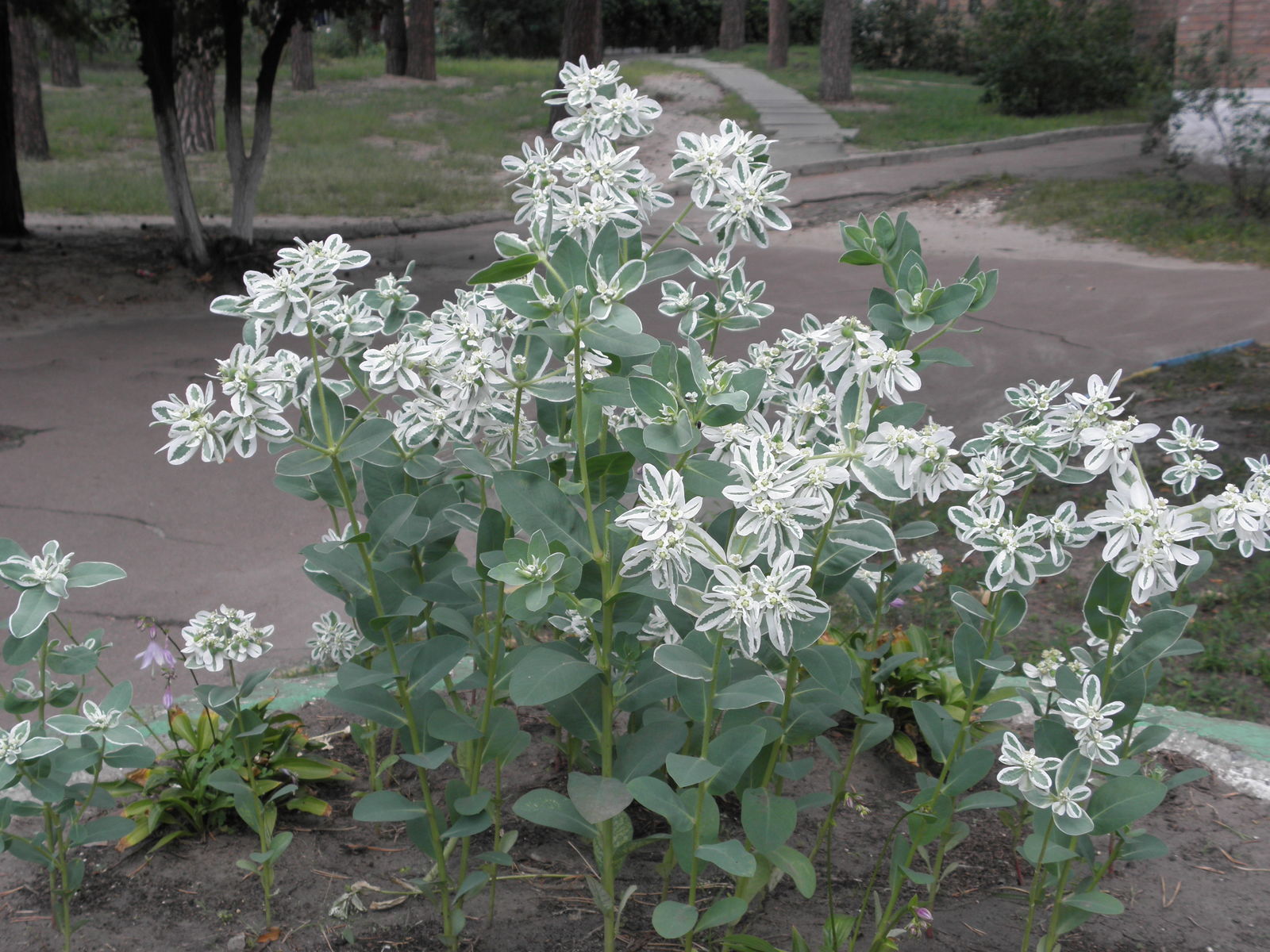
Euphorbia marginata develops a single upright stem, unbranched before flowering, 30–100 cm (1–3.3 ft) tall and 30–60 cm (1–2 ft) across. The lower leaves are oval, medium green, 2–8 cm (0.8–3 in) long and alternate along the stem. 3 6
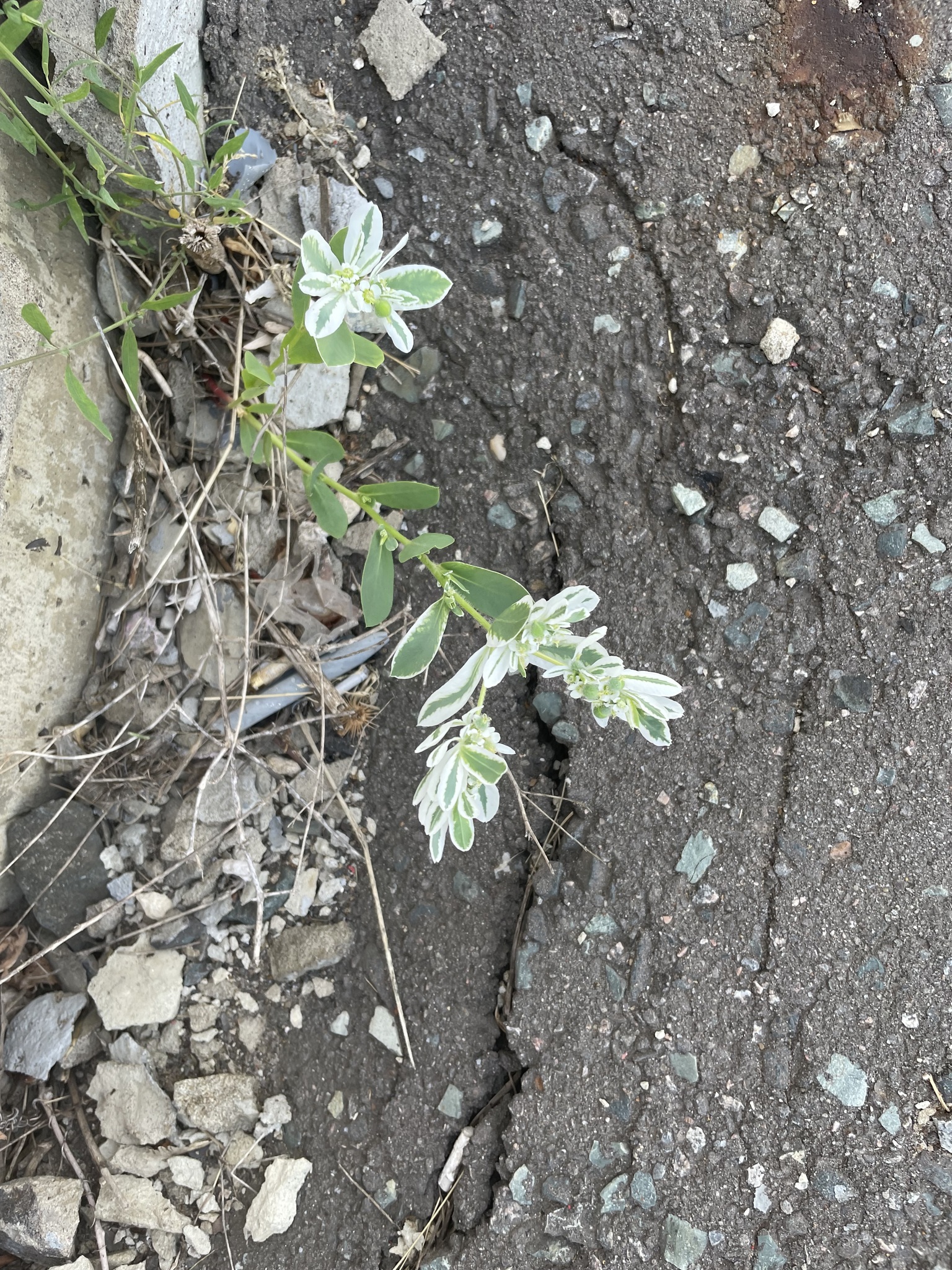
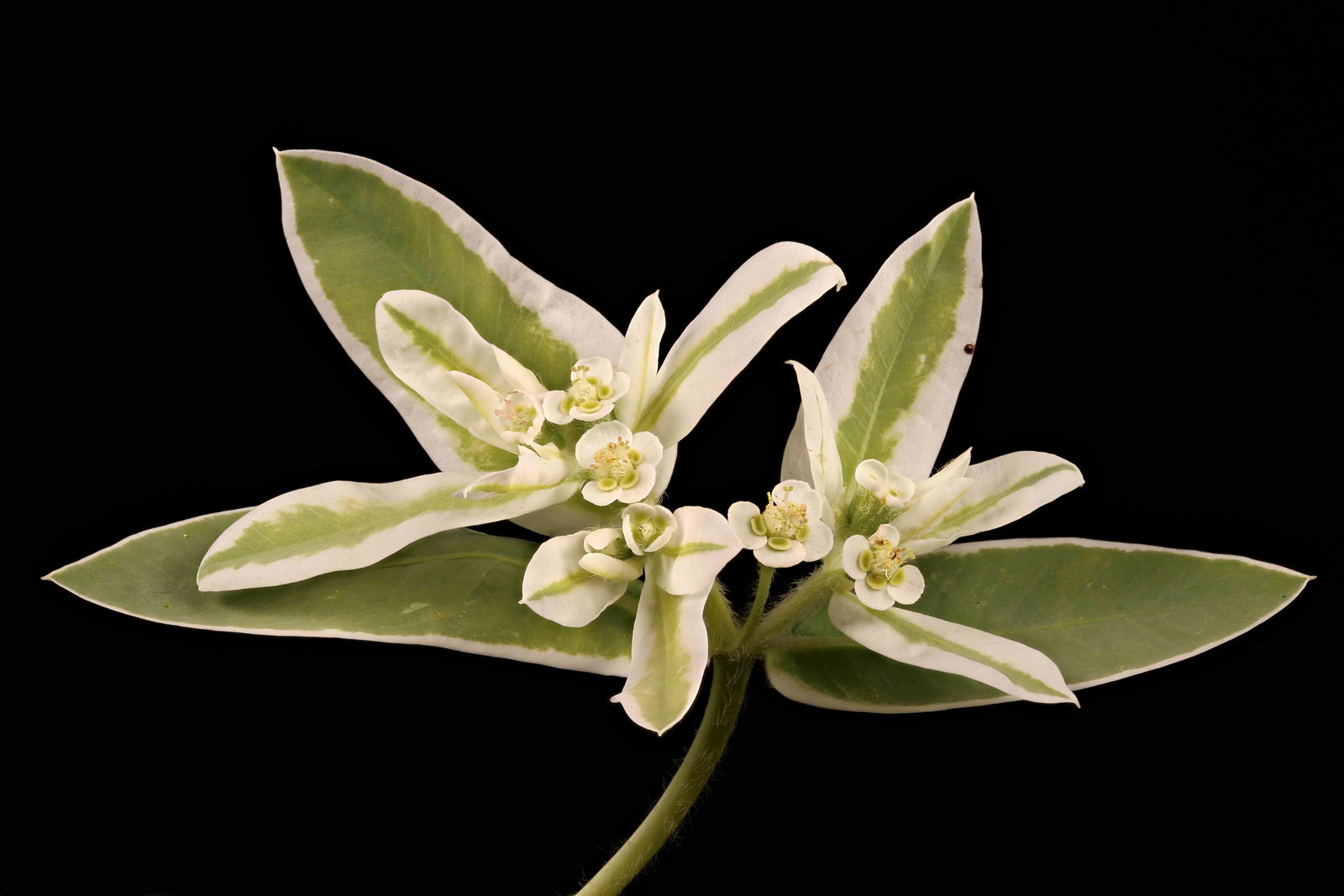
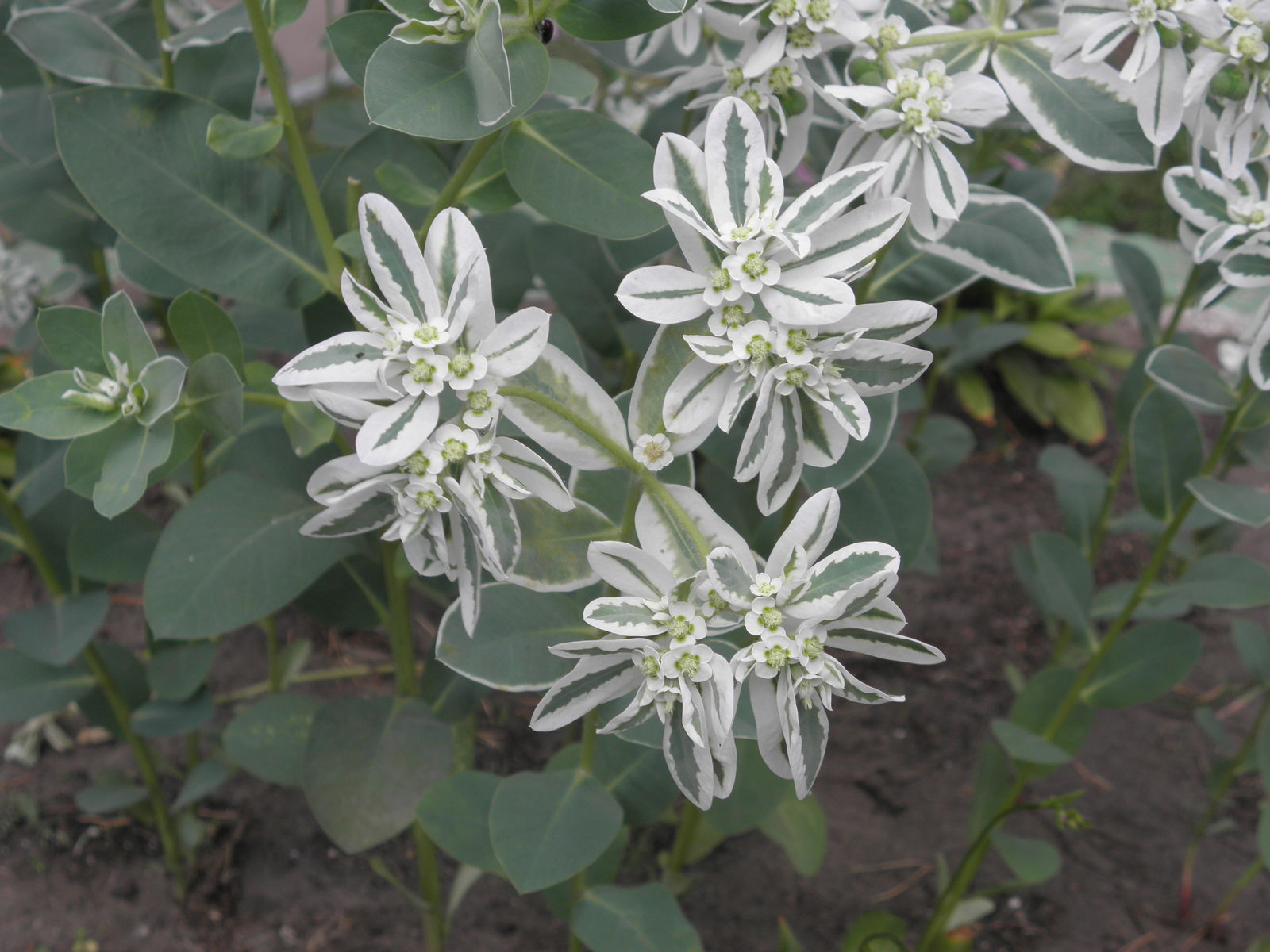
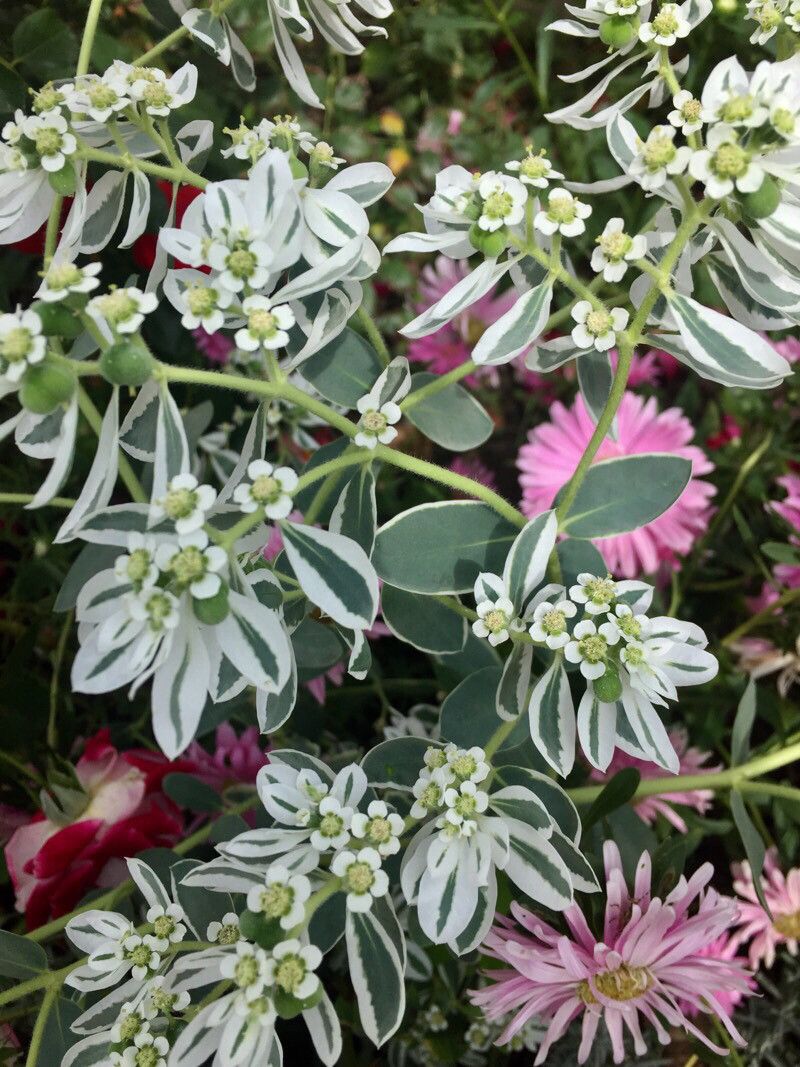
The diagnostic feature develops as summer approaches: the upper leaves acquire an increasingly broad pure white margin, becoming almost entirely white beneath the inflorescences. The true flowers, grouped in the cyathia typical of Euphorbiaceae, remain tiny and greenish-yellow. Almost all the ornamental effect comes from the surrounding white bracts. 3 5
The plant has also been reported to emit sulfur gas, mainly dimethyl sulfide. Its white-edged upper leaves remain the more readily visible identification feature. 7
Useful taxonomy
Euphorbia marginata Pursh is the accepted name within Euphorbia, one of the largest flowering-plant genera, with about 2,000 species. The nearly identical Euphorbia marginata Kunth, published in 1817, is a later illegitimate homonym and must not replace Pursh's name in references. 1 2
The variety Euphorbia marginata var. uloleuca, described by Engelmann and Gray, also appears in botanical synonymy. For field identification, the combination of white-edged foliage and a single stem matters more than these historical names and allows rapid recognition without herbarium material. 1 2
Euphorbia ranges from herbaceous annuals to cactus-like succulents, all sharing milky latex and cyathia. This varied genus is no basis for transferring the uses or risks of another garden spurge to Euphorbia marginata. 8 3
Habitat and range
The native range lies in the grasslands and plains of the central United States, from Minnesota and the Dakotas to Colorado and Texas, extending into northeastern and southern Mexico. The plant grows in full sun on poor, rocky or sandy soils, along roadsides and on waste ground. 1 3
Grown ornamentally far beyond its native range, Euphorbia marginata has naturalized in several temperate regions, notably China, where it occupies disturbed ground. Its status therefore varies by country: native in the United States and Mexico, introduced and sometimes invasive elsewhere. 8 1
In France it remains a garden annual sown each year, without a known naturalized range. Escape is a local possibility, mainly through self-seeding in beds where it has already been grown. 9 5
Life cycle and reproduction
Euphorbia marginata is a strict annual, completing the cycle from sowing to seed formation in one season. Seeds germinate in 1–2 weeks in warmed soil. Sow directly after the last frost, or under cover 6–8 weeks earlier. 3 5
Flowering extends through July–September in northern temperate conditions, from summer into early autumn. Cyathia form compound cymes at the stem tips. 'Kilimanjaro', documented by Missouri Botanical Garden, flowers earlier than the species and grows slightly taller. 4 5
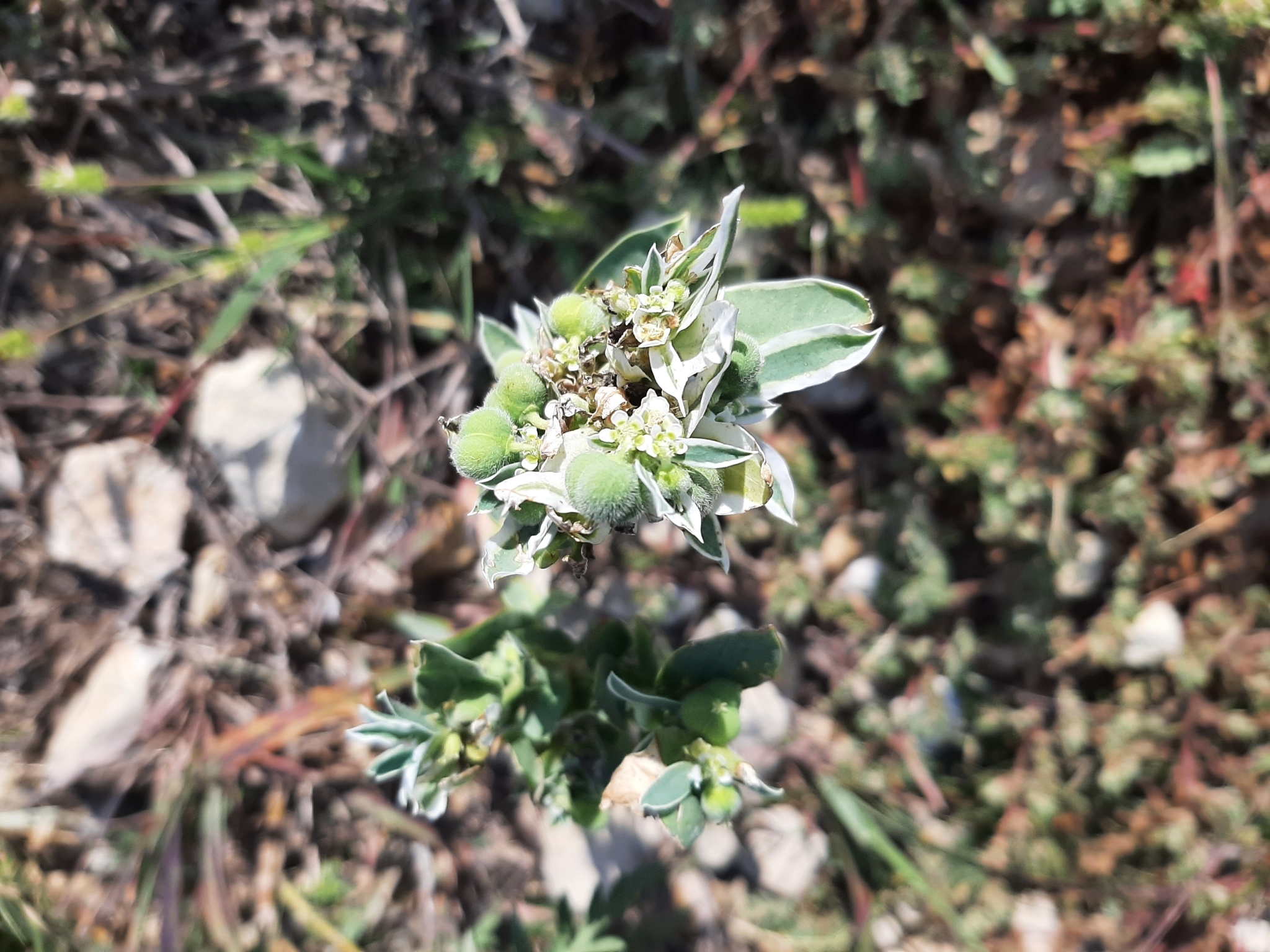
After flowering, each cyathium produces a small three-chambered capsule. Plants self-seed freely and abundantly in gardens. Removing capsules before they open remains the only reliable way to limit this spread from one season to the next. 3 6
Uses and risks
The main use is ornamental, in sunny beds, wildflower-meadow borders and cutting gardens. White-edged foliage brightens neighboring plantings of stronger colors. Despite its tiny true flowers, it attracts bees and butterflies. 3 5
The main hazard is milky latex, present throughout the plant and rich in phorbol esters. On skin it causes dermatitis; in eyes it causes pain and swelling. If ingested, it irritates the mouth and digestive tract of animals and humans. 8 5
Basic precautions prevent most exposure: wear gloves for sowing, pruning and cutting stems; avoid rubbing the eyes after contact; and keep plants away from children and animals that chew foliage. For cut flowers, briefly sear the stem bases or dip them in very hot water for a few seconds to limit latex flow. 8 3
Varieties, look-alikes and related plants
Few stable cultivars exist for this annual, chiefly sold as seed. 'Kilimanjaro' is the best documented, taller and earlier than the wild species. 'Summer Icicle' is a more compact form with earlier whitening, reported by several seed suppliers. 'Snow Top' mainly denotes seed lots intended for cut flowers. 4 6
The most confusing English name is snow in summer, shared with Cerastium tomentosum, a mat-forming Caryophyllaceae without latex or a botanical relationship to spurges. The scientific name distinguishes the two. 5 7
The German name Braut und Bräutigam, meaning bride and groom, describes the same defining contrast: green leaves below, white leaves and bracts above, two colors united on one plant. This green-white pattern is visible before the cyathia open. 8 3
Main sources
- Plants of the World Online / Kew, Euphorbia marginata Pursh
- Wikidata, Euphorbia marginata
- Missouri Botanical Garden, Plant Finder, Euphorbia marginata
- Missouri Botanical Garden, Plant Finder, Euphorbia marginata Kilimanjaro
- NC State Extension Gardener Plant Toolbox, Euphorbia marginata
- Royal Horticultural Society, Euphorbia marginata
- Wikipedia EN, Euphorbia marginata
- Wikipedia DE, Weißrand-Wolfsmilch
- Tela Botanica, eFlore, Euphorbia marginata
Frequently asked questions
Is snow-on-the-mountain toxic?
Yes. Milky latex containing phorbol esters occurs throughout the plant. It causes contact dermatitis, eye irritation and digestive problems if ingested, notably in cats, dogs and children.
How can I distinguish snow-on-the-mountain from other spurges?
Its characteristic combination is a single, sparsely branched annual stem, upper leaves with crisp white margins, and showy white bracts around almost invisible greenish-yellow cyathia.
When and how should I sow snow-on-the-mountain?
Sow outdoors after the last frost in warm, sunny soil, or under cover 6–8 weeks earlier. Germination usually takes 1–2 weeks.
Why is the name snow in summer confusing?
This English name refers both to Euphorbia marginata and to Cerastium tomentosum, a mat-forming plant in a completely different family. The scientific name resolves the ambiguity.
Is snow-on-the-mountain invasive?
It self-seeds freely and abundantly in gardens and has naturalized outside its native range, notably in China. Removing capsules before they open limits unwanted spread.
Can I cut snow-on-the-mountain for bouquets?
Yes. Its white-bracted stems are used as cut flowers and grown in cutting gardens. The cut stem bases need heat treatment to limit latex flow.
Similar plants


If you are unsure about a plant’s toxicity, ask a botanist or veterinarian for advice.