
Eastern teaberry (Gaultheria procumbens, )
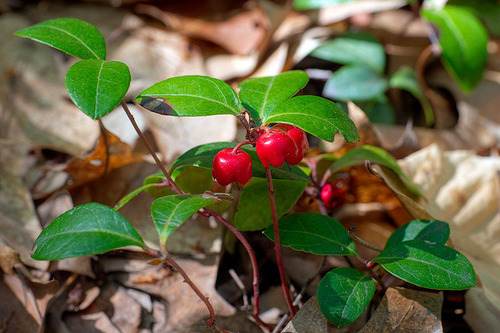
Eastern teaberry (Gaultheria procumbens L., 1753) is a creeping evergreen subshrub in the Ericaceae family, native to acidic forests of northeastern North America, from Newfoundland to Alabama. Its spreading underground stems produce short upright shoots with glossy leaves and bright red berries, long gathered for their wintergreen flavor.
Read moreEastern teaberry, American wintergreen, Creeping wintergreen, Checkerberry and Boxberry
Place in indirect light or in a shaded room.
Partial to dense shade; filtered woodland light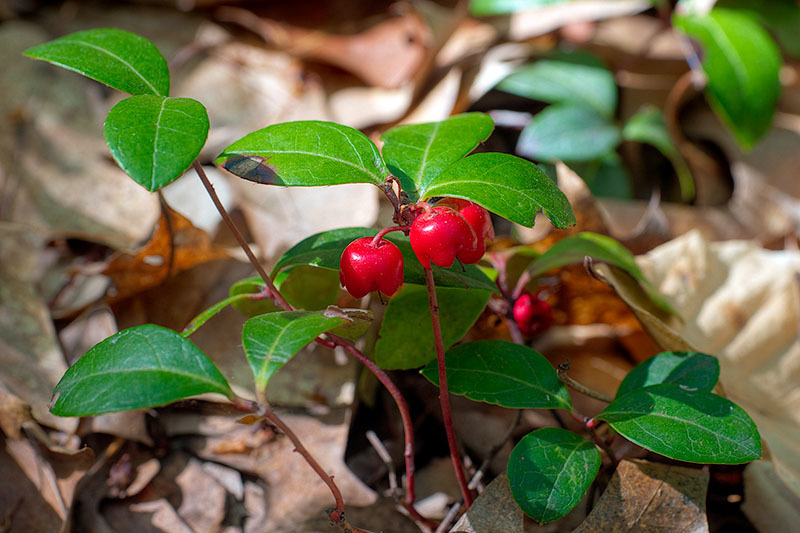


© photo
(c) Leo Papandreou, some rights reserved (CC BY-NC-SA) · cc-by-nc-sa
Dustin Mitchell · cc0
Tom Rogers · cc0
Taken Jan 16, 2020 by Didier Levassort (cc-by-sa)
Taken Feb 13, 2020 by Matthias Koch (cc-by-sa)
Taken Oct 29, 2022 by Sophie ROBIN (cc-by-sa)
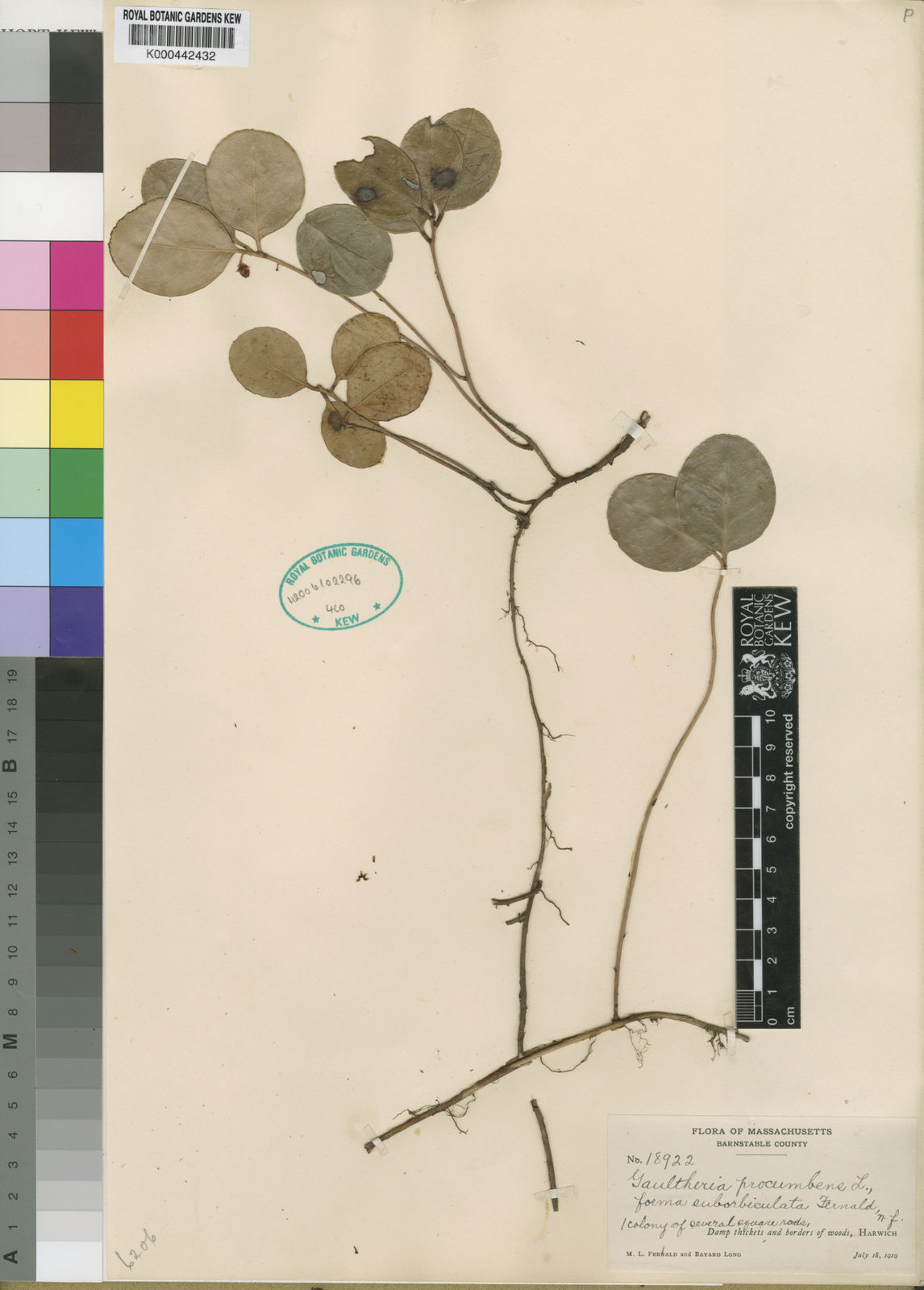
© copyright of the Board of Trustees of the Royal Botanic Gardens, Kew.




Global distribution
POWO places the native range of Gaultheria procumbens in central and eastern Canada and the north-central and eastern United States. English-language accounts describe a range from Newfoundland to southeastern Manitoba and south to Alabama. It is absent from the wild flora of mainland France but long established in Saint Pierre and Miquelon, where it is called thé rouge.
- Native3
- Introduced1
- Central and eastern Canada
- Northeastern and east-central United States
- Saint Pierre and Miquelon
- Mainland France
Hexagons: regions where the plant occurs. Green dots: native range.1
Identity
Eastern teaberry (Gaultheria procumbens L., 1753), published by Linnaeus in Species Plantarum, is an accepted species of Gaultheria in the Ericaceae family. It is a low, evergreen subshrub whose botanical name gives a stable reference across its many regional common names. 1 2
The genus honors Jean-François Gaultier, a royal physician and naturalist based in Quebec during the 18th century. Swedish botanist Pehr Kalm named it for him in 1748 after a botanical exploration they undertook together in New France. Linnaeus subsequently adopted that name in his classification. 8
English names include checkerberry, boxberry, American wintergreen and creeping wintergreen. French names thé des bois and thé rouge refer to the traditional infusion made from the leaves. The Acadian name pomme de terre instead describes its rounded berries close to the ground; these regional names all refer to the same species.
Recognition
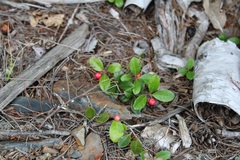
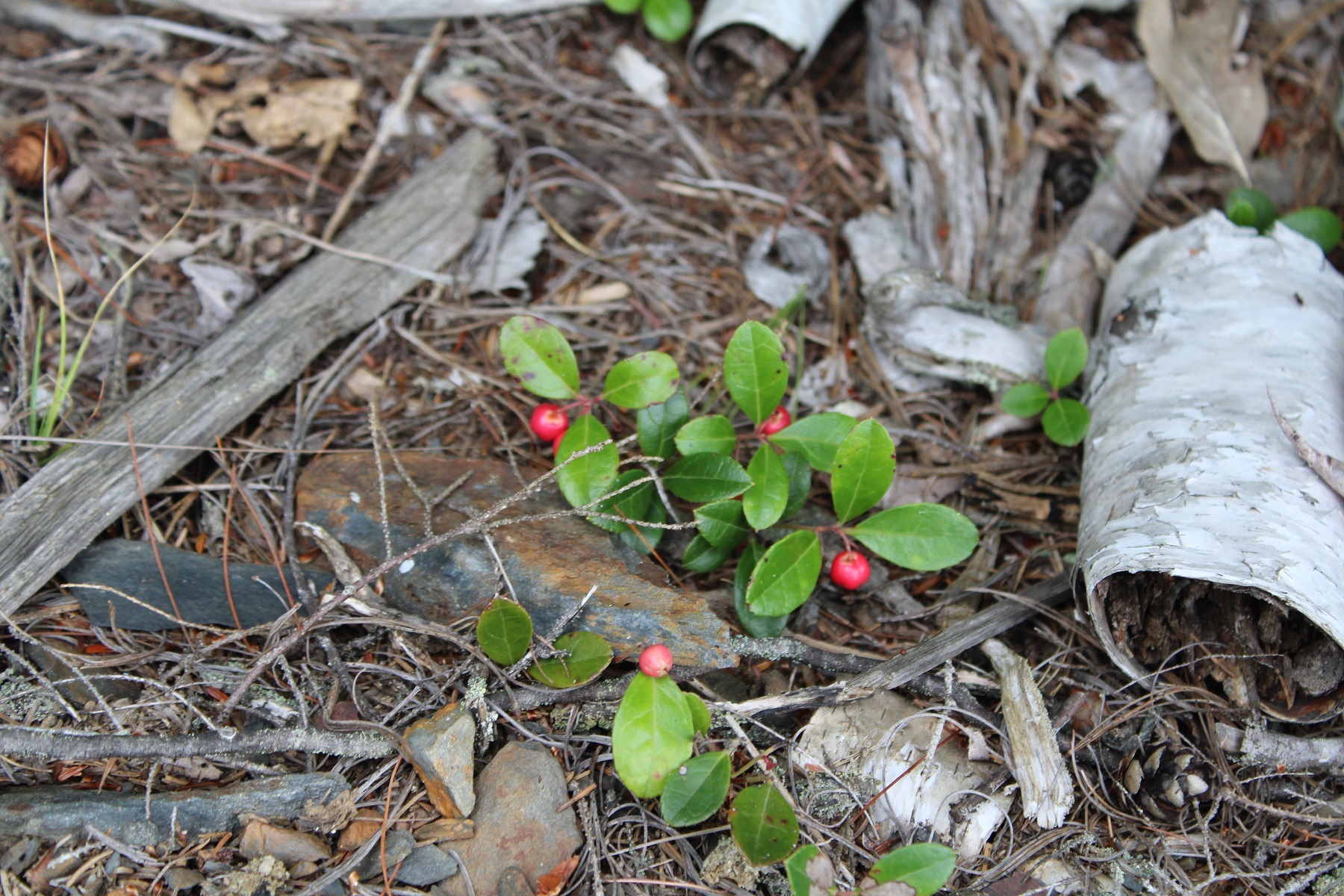
A creeping evergreen subshrub, eastern teaberry reaches 10–20 cm (4–8 in) tall and spreads by rhizomes running through the uppermost soil. Each underground stem produces short upright shoots crowned by a rosette of leaves. The resulting carpet remains low rather than developing the tall woody framework of a larger shrub. 4 6
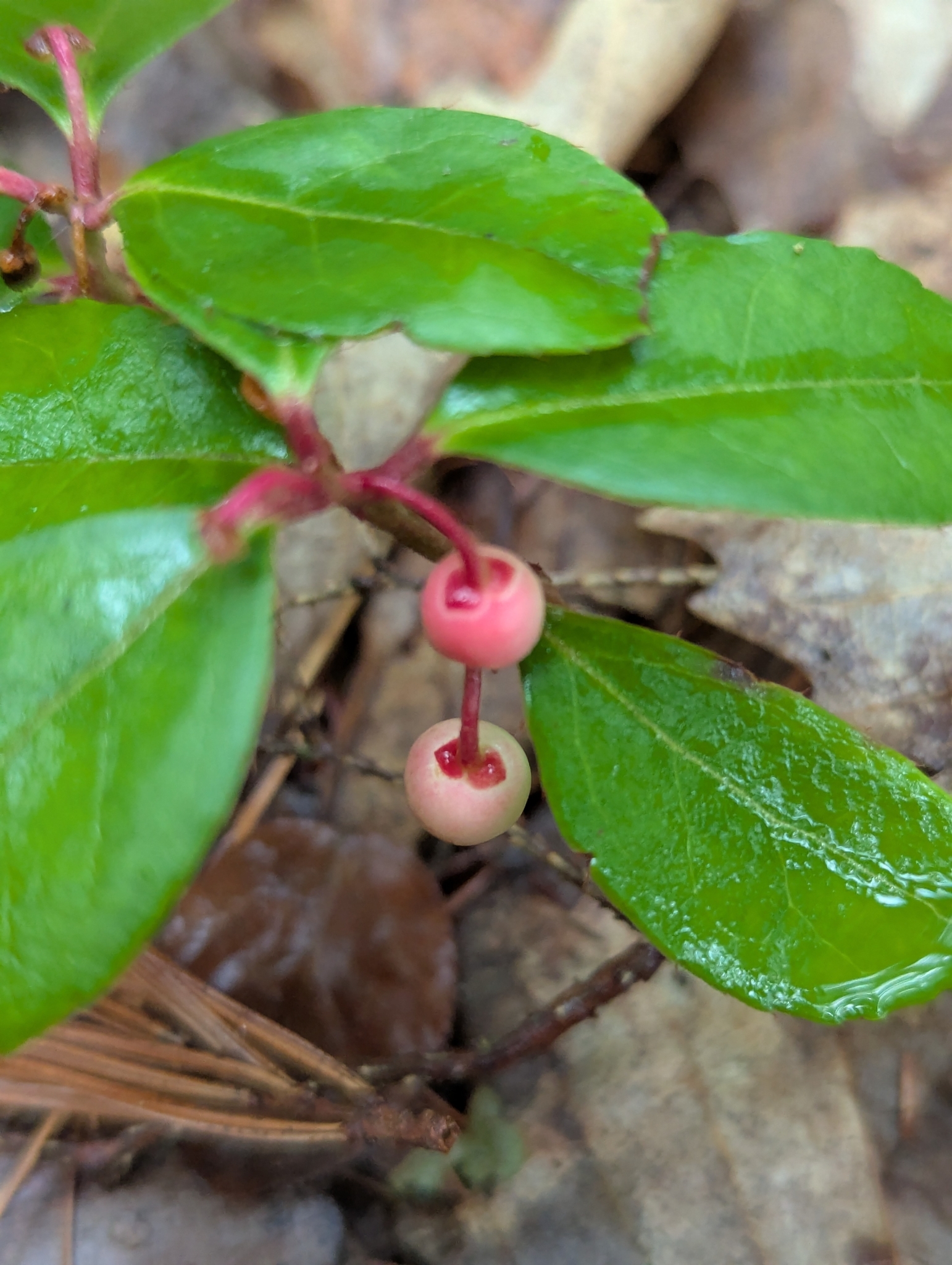
Leathery, glossy leaves are oval to elliptical and about 2–5 cm (0.8–2 in) long. Dark green during active growth, they often turn purple or bronze in winter, making the plant recognizable outside the flowering season. Crushing a leaf releases a distinct wintergreen scent, a useful field character alongside its shape and arrangement. 6 5
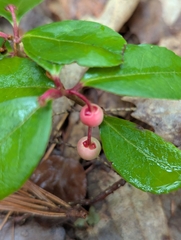
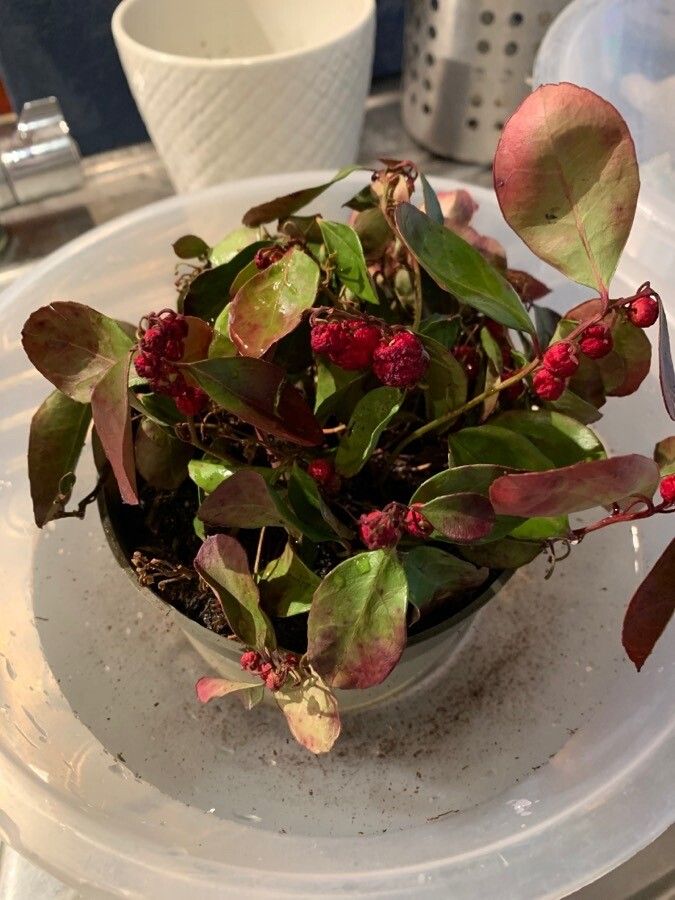
White to pale pink flowers appear singly in the leaf axils in summer. Their small, rounded bells measure 8–10 mm (0.3–0.4 in) long. The bright red, round berries that follow are 6–10 mm (0.24–0.4 in) across and remain from fall into the following spring, long after nearby deciduous Vaccinium plants have lost their leaves in the same acidic woodland. 3 4
Useful taxonomy
Within the Vaccinioideae subfamily, Gaultheria belongs to the tribe Gaultherieae, alongside genera such as Chamaedaphne and Leucothoe. Several infraspecific forms have been described for G. procumbens, including G. procumbens f. accrescens Fernald & Hodgdon and f. elongata Svenson. Differences in fruit shape are their main distinguishing characters. 1
These minor forms have no separate horticultural value. When buying or identifying a plant, the accepted name Gaultheria procumbens remains the useful reference, rather than small variations documented chiefly in botanical literature. A form name therefore adds little practical information for the gardener choosing this woodland groundcover. 2
Habitat and range
Central and eastern Canada and the north-central and eastern United States form its native range, from Newfoundland and southeastern Manitoba south to Alabama. Eastern teaberry occupies coniferous and deciduous woodland understories on poor, acidic, well-drained soils. 1 6
That broad North American range corresponds to hardiness tested to USDA zone 3, with winter temperatures below −30 °C (−22 °F) tolerated. Hot, dry summers can be more limiting in cultivation: a young carpet with few established roots dries rapidly, even where winter cold presents little difficulty.
Although absent from the wild flora of mainland France, Gaultheria procumbens has long grown in Saint Pierre and Miquelon. There it is called thé rouge and remains associated with infusion traditions brought by Breton, Norman and Basque settlers. 7
Its creeping rhizomes occupy only the top 2–3 cm (0.8–1.2 in) of soil. That shallow position leaves the colony vulnerable to woodland fire, unlike deeper-rooted shrubs capable of resprouting after a burn. The same surface growth that allows the carpet to expand provides little protection from heat reaching the soil surface. 6
Life cycle and reproduction
Establishment begins with slow germination in acidic soil or a rhizome fragment taken from an existing clump. An individual upright shoot settles in over one to two years, after which creeping rhizomes extend the carpet outward. Allow about five years for a covering colony with regular flowering rather than expecting immediate ground coverage from a single young plant. 5
Bees pollinate the summer flowers. Berries then ripen in fall and persist through winter, providing late food for birds and small mammals in northern forests. Their long persistence matters especially when few other fruits remain available in the woodland. 6
For garden propagation, division of established rhizomes or summer heel cuttings provides the most reliable approach. Seed can be used after cold stratification, but germination and subsequent establishment remain slow and irregular. Vegetative propagation starts with existing plant material rather than waiting through the seed stage. 5
Spacing fragments 25–35 cm (10–14 in) apart allows neighboring rhizomes to meet sooner. This shortens the time needed to form an even carpet across the planted area.
Uses and risks
Ripe berries are edible raw or cooked, with a sweet, lightly minty wintergreen flavor. Dried leaves, or leaves fermented for several days to release more essential oil, have traditionally been brewed as the woodland tea called thé des bois. These uses concern berries and prepared leaves rather than concentrated distilled oil. 5
Leaf oil is rich in methyl salicylate, a compound chemically related to aspirin. Historically, it was applied externally for rheumatic pain, sprains and neuralgia. Pure distilled essential oil is toxic at high doses: it must never be swallowed or applied undiluted, with particular concern for dogs and cats. The concentrated oil therefore requires a different risk assessment from the small quantities involved in traditional food uses. 5
Varieties, look-alikes and related plants
Nurseries mainly offer the typical species, sometimes alongside selections such as Variegata, with white-variegated leaves, or Very Berry, selected for heavier fruit production. These remain ornamental cultivars for acidic growing conditions and have no separate taxonomic status. 3
A common field look-alike is Mitchella repens, another evergreen carpet with red berries in the same acidic woodland. Its leaves are opposite and rounded, and lack the clear wintergreen scent released by crushed Gaultheria procumbens. Comparing leaf arrangement and scent quickly separates the two, even when both carry similar-looking red fruits. 6
Main sources
- Plants of the World Online / Kew, Gaultheria procumbens L.
- International Plant Names Index, Gaultheria procumbens L.
- Royal Horticultural Society, Gaultheria procumbens - checkerberry
- Missouri Botanical Garden Plant Finder, Gaultheria procumbens
- Plants For A Future, Gaultheria procumbens
- NC State Extension Plant Toolbox, Gaultheria procumbens
- INPN, Gaultheria procumbens L., 1753
- Dictionary of Canadian Biography, Jean-François Gaultier
Frequently asked questions
Is eastern teaberry poisonous?
Ripe berries are edible in small quantities, but its distilled essential oil, rich in methyl salicylate, is toxic at high doses, especially to dogs and cats. Never ingest or apply the undiluted oil.
Why do the leaves smell of wintergreen?
Crushed leaves release methyl salicylate, the compound responsible for wintergreen flavor in candies and some ointments. Traditionally, leaves were fermented before distillation to release the oil.
How can you tell eastern teaberry from Mitchella repens?
Both form evergreen carpets with red berries in acidic woodland. Mitchella repens has opposite, rounded leaves without a strong scent; eastern teaberry has alternate leaves with a clear wintergreen scent when crushed.
Does eastern teaberry grow in France?
It is absent from the wild flora of mainland France, but long established in Saint Pierre and Miquelon, where it is called thé rouge and traditionally gathered for herbal tea.
What soil does eastern teaberry need in a garden?
Acidic, humus-rich soil below pH 6, kept consistently moist and free of lime. Partial to dense shade under conifers most closely reproduces its natural habitat.
Where does the name Gaultheria come from?
The genus honors Jean-François Gaultier, royal physician and naturalist in Quebec. Swedish botanist Pehr Kalm named it in his honor in 1748 after exploring New France together; Linnaeus later adopted the name.
Similar plants
If you are unsure about a plant’s toxicity, ask a botanist or veterinarian for advice.