
sword lily (Gladiolus, )
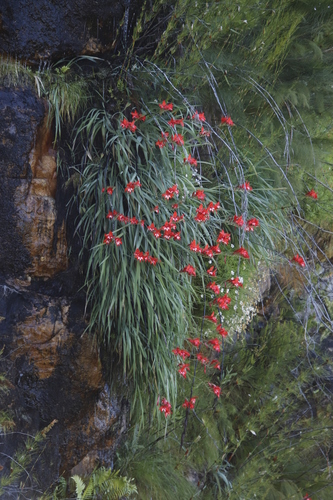
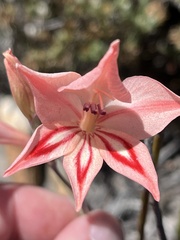

Gladiolus is a genus of cormous perennials in the iris family, Iridaceae, chiefly native to South Africa and the Mediterranean region. Tall, one-sided flower spikes and sword-shaped leaves make the plants easy to recognize. Garden gladioli are usually large-flowered hybrids, grown from corms for borders and cut flowers.
Read moresword lily


© photo
Tony Rebelo · cc-by-nc
Dave U · cc-by-sa
Seth Musker · cc-by
© copyright of the Board of Trustees of the Royal Botanic Gardens, Kew.
Global distribution
Gladiolus is chiefly African, with its center of diversity in South Africa’s Cape region. Its range also extends through tropical Africa, Madagascar, the Mediterranean and the Near East. Garden-center plants are horticultural hybrids cultivated worldwide, distinct from wild species.
- Native4
- South Africa
- Madagascar
- Italy
- Greece
Hexagons: regions where the plant occurs. Green dots: native range.1
Identity
Gladiolus (Gladiolus L., 1753), also known as sword lily, is a genus of cormous perennials in Iridaceae, the family that includes irises and crocuses. The name derives from Latin gladius, meaning sword, in reference to the genus’s distinctive blade-shaped leaves. 1 4
In gardens, the name usually refers to large-flowered hybrids grouped under Gladiolus × hortulanus. Grown from corms planted in spring, their tall, one-sided flower spikes make them classic cut flowers as well as colorful border plants. 2 5
Recognition
An upright flower stem, often 60–150 cm (24–59 in) tall depending on the cultivar, rises above a fan of foliage. The flat, pointed leaves sheath the stem at their bases and form the sword blade that gave the genus its name. 3 5
The flowers form a usually one-sided spike, facing toward one side of the stem and opening progressively from the base upward. Each flower has six tepals joined at the base. The upper tepal is often larger, making the flower conspicuously asymmetrical. 4 3
The underground storage organ is a flattened corm, not a true bulb. It is renewed each year: the planted corm becomes exhausted while a new one forms above it, surrounded by small cormlets. Cultivar colors range widely from white to deep purple. 2 5
Useful taxonomy
Linnaeus established the genus in 1753. It contains about 250–300 wild species, with its greatest diversity in southern Africa. Formerly separate genera, including Acidanthera, Homoglossum and Oenostachys, are now included within it. 1 4
The familiar ornamental plants are complex horticultural hybrids, grouped as Gladiolus × hortulanus, rather than wild species. Gardeners commonly distinguish the following practical groups:
- Gladiolus × hortulanus, the large-flowered garden hybrids;
- grandiflora gladioli, with very large spikes prized for cutting;
- nanus gladioli, shorter, earlier and somewhat hardier hybrids;
- Gladiolus communis subsp. byzantinus, the Byzantine gladiolus, a Mediterranean plant that can naturalize in gardens.
The accepted genus name, Gladiolus, is the consistent botanical reference. Series and cultivar names identify horticultural selections rather than botanical ranks. 1 2
Habitat and range
The genus is predominantly African, with its center of diversity in South Africa’s Cape region, which holds most species. Its range also includes tropical Africa, Madagascar, the Mediterranean, the Near East and Iran. 1 4
These are plants of open, sunny habitats, including grasslands, rocky slopes and seasonally dry ground. The corm rests through unfavorable periods. This ecology helps explain why cultivated hybrids need plenty of sun and are sensitive to waterlogged soil. 3 5
Outside these ranges, garden gladioli occur as cultivated plants. In France, the United States and Japan, hybrids are planted in spring and lifted in fall in cold climates. Some Mediterranean plants, including Byzantine gladiolus, can instead naturalize. 2 4
Life cycle and reproduction
A gladiolus is a geophytic perennial with a pronounced dormant period. In the familiar spring-planted garden cycle of northern temperate climates, the corm produces leaves and a flower stem in spring, blooms in summer, then rests after the foliage yellows. As the planted corm is depleted, a replacement develops immediately above it for the following year. 3 5
Pollinators vary with the species and include bees, butterflies, nectar-feeding birds and long-tongued flies. This diversity makes the genus useful in studies of pollination. After fertilization, capsules release winged seeds that travel on the wind. 4 1
Garden propagation chiefly uses cormlets, the small corms around the main one. They are detached when plants are lifted, then grown for one or two seasons to reach flowering size. Seed remains useful for botanical species and breeding, but does not reliably reproduce hybrid flower colors; the offspring are highly variable. 2 5
Uses and risks
Gladioli are grown mainly as ornamentals, in sunny borders and in rows for cut flowers. Their tall, colorful spikes last well in bouquets. Staggering spring planting extends flowering; in cold climates the corms are lifted in fall and overwintered dry and frost-free. 2 5
Handle and position these plants with care. ASPCA lists gladiolus as toxic to cats, dogs and horses. The corm is the part most concentrated in irritants, and ingestion can cause drooling, digestive upset and lethargy. Keep corms and plantings beyond the reach of animals and young children. 6 4
Gladiolus thrips distort flowers and leaves, leaving silvery streaks. Corm rots, including Fusarium and Botrytis diseases, develop in poorly drained soil or during storage. Rotating planting sites, providing good drainage and inspecting corms before winter storage help limit these problems. 5 3
Varieties, look-alikes and related plants
Commercial gladioli are sold by hybrid group rather than species. Grandiflora types give the largest cut-flower spikes; nanus types are shorter and earlier. Byzantine gladiolus (Gladiolus communis subsp. byzantinus) offers a hardy garden option. Choose firm, healthy corms of a good size. 2 3
Look-alikes include other Iridaceae with flower spikes and blade-shaped foliage:
- Crocosmia, or montbretia, has arching spikes of smaller orange flowers;
- Watsonia has a similar habit but more regular flowers;
- Freesia, another cormous Cape genus, has low, fragrant flower spikes.
A tall, one-sided flower spike, flat sword-shaped leaves and a flattened corm remain the most useful combination for confirming that a plant sold as a gladiolus belongs to Gladiolus. 3 1
Main sources
- Plants of the World Online / Kew, Gladiolus L.
- Royal Horticultural Society, Gladiolus search results
- Missouri Botanical Garden, Gladiolus communis var. byzantinus
- Encyclopaedia Britannica, Gladiolus
- North Carolina Extension Gardener Plant Toolbox, Gladiolus
- ASPCA, Gladiola (Gladiolus species) toxic plant entry
Frequently asked questions
Is gladiolus toxic to cats and dogs?
Yes. ASPCA lists Gladiolus as toxic to cats, dogs and horses. The corm is the most toxic part; ingestion can cause drooling, digestive upset and lethargy.
Does gladiolus return every year?
Gladiolus is a cormous perennial, but large garden hybrids freeze in the ground in cold climates. Their corms are lifted in fall and replanted in spring; only hardy species remain outdoors.
When should gladiolus corms be planted?
Plant them in spring once the soil has warmed, 10–15 cm (4–6 in) deep in well-drained soil in a sunny position. Staggering planting over several weeks extends summer flowering.
Why are my gladiolus flowers distorted?
Silvery streaks and damaged flowers often indicate gladiolus thrips, the genus’s main pest. Address infestations early and inspect corms before winter storage.
Where does the name gladiolus come from?
It comes from Latin gladius, meaning sword, referring to the flat, pointed, blade-shaped leaves. Gladiolus means little sword and shares its root with gladiator.
Do gladioli need staking?
Tall cultivars can fall over in wind or rain. A stake or soil drawn up around the base helps support the spikes, especially in exposed sites and rich soil.
How are gladioli propagated?
Use the small cormlets that develop around the main corm and are collected when lifting. Seed is used for botanical species because hybrids do not reproduce true to type.
Similar plants

If you are unsure about a plant’s toxicity, ask a botanist or veterinarian for advice.