
Large-flower primrose-willow (Ludwigia grandiflora, )


Large-flower primrose-willow (Ludwigia grandiflora) is an aquatic and amphibious plant in the Onagraceae. In France it is a regulated invasive alien species: the priority is to recognize and document populations and limit their spread. Its documented French status calls for management rather than cultivation; applicable rules elsewhere depend on the jurisdiction.
Read moreLarge-flower primrose-willow and Water primrose
Allow a few hours of direct sun per day, preferably morning or evening.
Sunny to partly shaded slow water; do not encourage growth


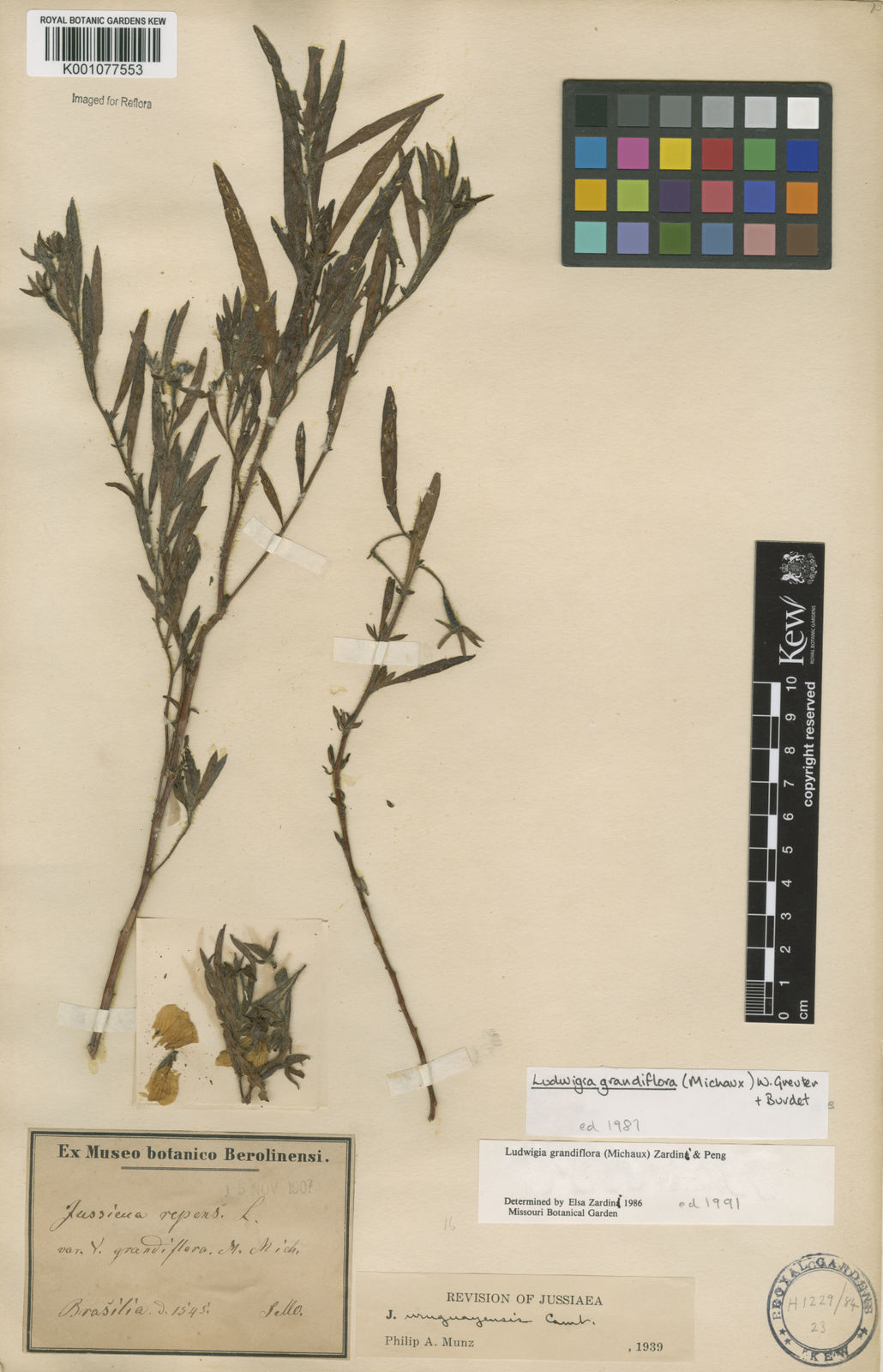
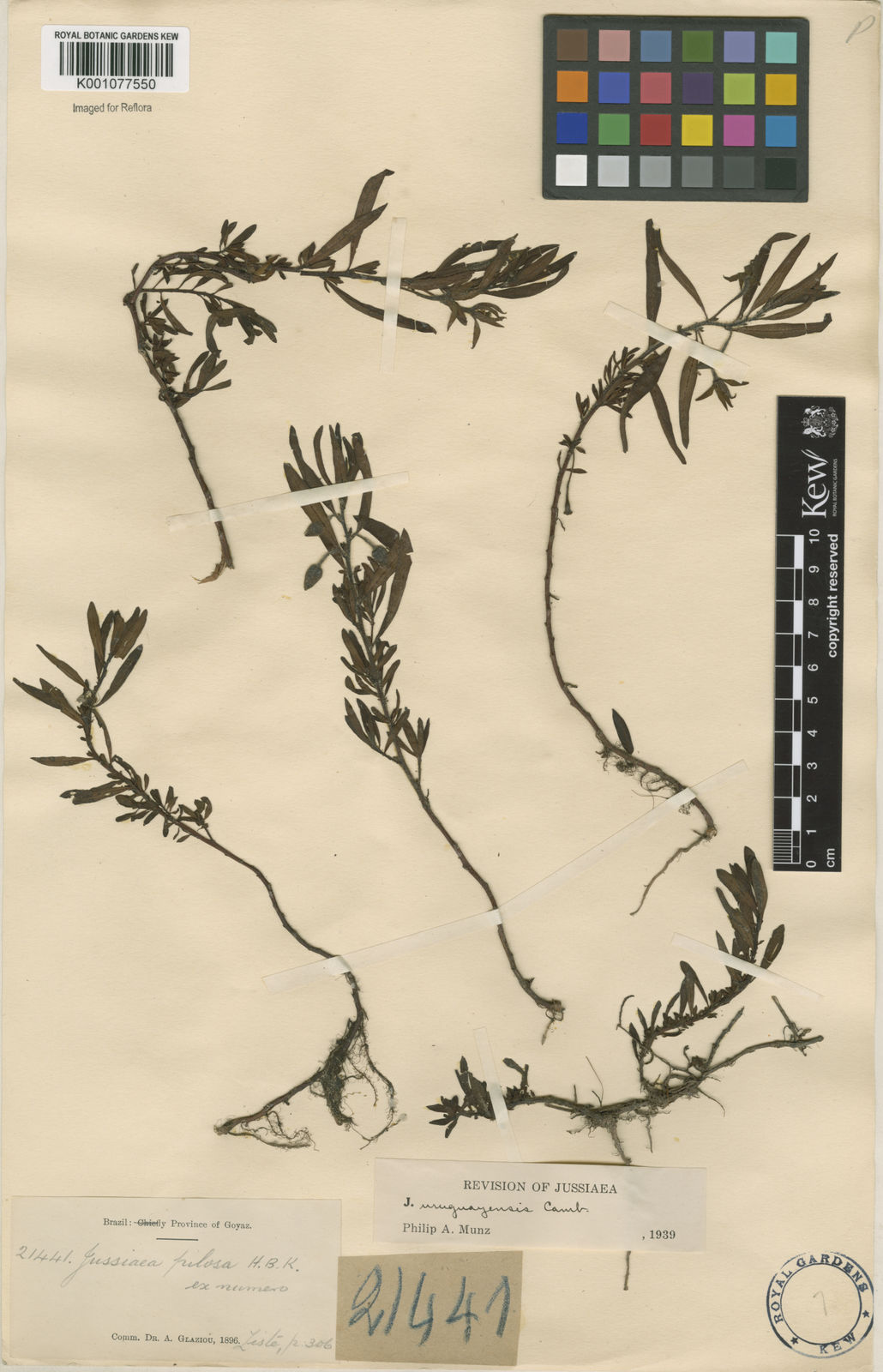
© photo
Wikimedia Commons · CC BY-SA or Public Domain
Wikipedia · CC BY-SA
Taken Sep 15, 2005 by Photoflora - Jean-Luc TASSET (©)
Taken Oct 15, 1994 by Photoflora - Jean-Luc TASSET (©)
Taken Aug 5, 2014 by Tela Botanica − Hervé Goëau (cc-by-sa)
Taken Jul 5, 2011 by Tela Botanica − Bertrand BUI (cc-by-sa)
Taken Aug 14, 2005 by Tela Botanica − Christophe GIROD (cc-by-sa)
© copyright of the Board of Trustees of the Royal Botanic Gardens, Kew.




Global distribution
The American native range of Ludwigia grandiflora is interpreted differently across references. In France it is introduced and invasive in slow water, ponds, ditches and wet meadows.
- Native3
- Introduced3
- Invasive2
- Bolivia to southern Brazil and northern Argentina
- Guatemala
- Southeastern United States
- Belgium
- Spain
- Germany
- Mainland France
- European Union
Hexagons: regions where the plant occurs. Green dots: native range.1
Identity
Large-flower primrose-willow, Ludwigia grandiflora (Michx.) Greuter & Burdet, is an aquatic and amphibious perennial in the Onagraceae. POWO and GBIF accept it at species rank, with Jussiaea grandiflora Michx. as its historical basionym. That older name remains useful when tracing records through botanical literature and management documents. 1 2
Its identity has particular practical consequences where it is introduced and invasive. France's biodiversity agency, the OFB, describes water primroses as invasive aquatic plants introduced into southern France in the nineteenth century and subsequently used as ornamentals. Identification and management take priority over gardening in that documented setting. 5
The French name jussie derives from the former genus Jussiaea. Names such as water primrose, large-flower primrose-willow, ludwigie à grandes fleurs and grande jussie help locate different references. The binomial Ludwigia grandiflora remains the stable botanical reference across languages, especially because similar common names cover other species. 3 2
Recognition
Floating or creeping stems give rise to flowering shoots held above the water. The stems are jointed and brittle, root at their nodes, and produce both anchoring roots and air-bearing roots. This combination allows the plant to occupy the water surface while remaining connected to the substrate below or along the bank. 5 10
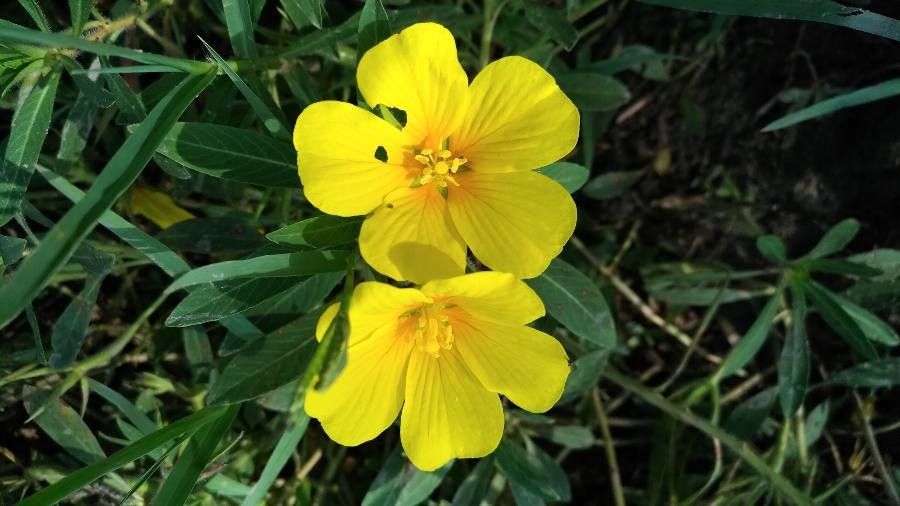
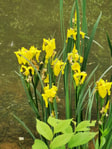
Alternate, dark green leaves tend to be obovate on floating stems and more lance-shaped on upright shoots. Solitary, bright yellow flowers develop in the leaf axils, usually with five large petals. Field guides distinguish large-flower primrose-willow from Ludwigia peploides by its larger, generally overlapping petals; those of creeping water primrose tend to be more separated. 9 5
The setting matters as much as the flower. A dense mat in a ditch, pond, backwater or wet meadow signals a possible dispersal problem. Stem fragments can travel in water or on tools, boats and discarded vegetation, so moving material can spread a population beyond the patch first observed. 10 5
Taxonomy and look-alikes
POWO accepts Ludwigia grandiflora and lists homotypic synonyms including Adenola grandiflora, Jussiaea grandiflora, Jussiaea repens subsp. grandiflora and Ludwigia clavellina var. grandiflora. The consulted WCVP and Trefle records agree on the genus Ludwigia and family Onagraceae. Historical names require care when comparing older and newer records. 1 12 13
The main identification difficulty lies within the yellow-flowered water primrose complex. Ludwigia peploides is another species regulated in France and often covered by the same management publications. Ludwigia hexapetala also appears as a related taxon, or under the older treatment L. grandiflora subsp. hexapetala. These names should not be merged automatically when interpreting distribution or management evidence. 6 11 12
Before an intervention, a field record should include the suspected scientific name, photographs of leaves and flowers, habitat type, occupied area and any other water primroses present. A general identification guide cannot replace the assessment of a botanical specialist or wetland manager, particularly when several closely related taxa may occur together. 4 5
Habitat and distribution
References differ in how broadly they describe the native range. WCVP gives an American range extending from parts of the United States and Guatemala to Bolivia, southern Brazil and northern Argentina. The OFB summarizes the water primroses occurring in France as South American in origin. A cautious description is a complex American range with an important South American center. 12 13 5
In France the plant is introduced. It mainly occupies standing or slowly flowing water: ponds, river margins, ditches, channels, backwaters, wet meadows and streams with low summer flows. These documented habitats describe its ecological opportunities without implying that every water body or every English-speaking region has the same invasion status. 5 9
Terrestrial forms make management more complicated. Since the 2000s, terrestrial forms of water primroses, including L. grandiflora, have colonized wet meadows in western France. They can withstand periods when the ground is no longer submerged and may require approaches different from those used for conventional floating mats. 8
Regulatory context in France
In the consolidated French order of February 14, 2018, as consulted on May 26, 2026, Ludwigia grandiflora appears in Annex I-1 as Jussie à grandes fleurs. Article 2 prohibits activities involving live specimens of the listed species, including introduction, possession, transport, peddling, use, exchange, offering for sale, sale and purchase. These are French provisions, not a statement of the reader's local law. 6
The European Commission explains that species on the Union list are subject to restrictions covering possession, import, sale, breeding, cultivation and release into the environment. Member states must also address prevention, early detection, rapid eradication and the management of widely established species. This European framework retains its geographical scope for readers elsewhere. 7
The practical emphasis is on preventing spread, reporting and supervised management. Care schedules and routine gardening approaches are inappropriate to the regulated French context described here. The relevant local authority must determine the applicable framework elsewhere; the French example provides no authorization to cultivate or move the plant. 6 5
Life cycle, dispersal and impacts
Reproduction is mainly vegetative. Broken stems can yield viable fragments that travel long distances in water or through human activity. Sexual reproduction also occurs, with summer flowering and capsules, but dispersal through stem fragments is the critical management concern. Seasonal timing follows local climate and hydrology rather than one calendar for all hemispheres. 9 10
Dense mats cover the surface, block light and compete with native aquatic and amphibious vegetation. Described impacts include reduced biodiversity, unfavorable conditions for aquatic animals, accumulated biomass, restricted flow and interference with boating, fishing or recreation. The effects extend beyond the footprint of individual stems because the whole water surface and flow regime can be altered. 9 11 5
Terrestrial forms create an additional challenge in wet meadows, exposed banks and agricultural marshland. France's invasive species resource center notes that L. grandiflora can grow well in the drier parts of floodplain meadows. Population dynamics depend on climatic and hydrological conditions, so a floating-mat management plan alone may miss affected ground. 8
Management without cultivation
Avoid planting, exchanging, transporting or introducing the plant to a pond. If a population is found, document it without spreading material: take photographs and record its location, approximate area, habitat, flowers and any drifting fragments. In the French regulatory context these precautions accompany explicit restrictions; elsewhere, seek locally appropriate management advice. 6 5
Improvised pulling can worsen the problem by releasing viable fragments. Management requires their collection and containment, cleaning tools and boats, and follow-up over several seasons. Mechanical, manual, hydraulic or meadow-restoration interventions belong within a local protocol whose timing suits the site. The choice depends on the affected habitat rather than the apparent ease of removing a visible clump. 9 8
Members of the public should contact the local authority, waterway manager, watershed organization or relevant botanical or biodiversity service. Cultivation, propagation, fertilization and ornamental salvage are inappropriate in the regulated setting described. The RHS reaches a comparable practical conclusion in its British context: do not plant, do not encourage growth in the wild, and control plants already held. 5 7 14
Toxicity, uses and safety
The references used do not provide robust, species-specific veterinary evidence for classifying Ludwigia grandiflora as either toxic or non-toxic to cats, dogs or horses. Its status therefore remains unknown. Precautions are to avoid ingestion and food harvesting, and to wash hands after handling material during authorized management work. A missing toxicity finding is not evidence of safety. 10
Past ornamental use helps explain its introduction to France, but does not establish a suitable present-day use. The plant is regulated there, and colonized habitats may be polluted, treated or environmentally sensitive. References to herbivores, pollinators or aquatic wildlife do not establish that people or domestic animals can safely consume it. 5 6 10
The main public concern described here is dispersal, rather than a dramatic, established poisoning syndrome. Residues, boots, nets, buckets, wheels, shovels and boats can all carry fragments. Preventing that movement and reporting suspect populations are therefore central to limiting further spread, even where no one intends to plant or propagate the species. 9 5
Main sources
- Plants of the World Online / Kew, Ludwigia grandiflora (Michx.) Greuter & Burdet
- GBIF Backbone Taxonomy, Ludwigia grandiflora
- Tela Botanica, eFlore BDTFX: Ludwigia grandiflora (Michx.) Greuter & Burdet, nomenclatural record
- Office français de la biodiversité, Water primrose (Ludwigia sp.) management case studies, including removal at Biganos port (2022)
- Office français de la biodiversité, water primroses (Ludwigia sp.)
- Légifrance, order of February 14, 2018 on invasive alien plants
- European Commission, Invasive alien species
- Centre de ressources EEE, terrestrial water primrose forms: management challenges
- UNPG / Centre de ressources EEE invasive alien species guide, water primroses
- USGS NAS, Ludwigia grandiflora species profile
- U.S. Fish and Wildlife Service, Ecological Risk Screening Summary, Ludwigia grandiflora
- Kew / POWO, WCVP data, Ludwigia grandiflora (Michx.) Greuter & Burdet
- Trefle, botanical data service
- Royal Horticultural Society, Ludwigia grandiflora
Frequently asked questions
Can large-flower primrose-willow be planted in a pond?
No planting is recommended. In mainland France, Ludwigia grandiflora is listed under the order of February 14, 2018 regulating vascular plants. Cultivation, sale, exchange and pond planting are therefore not proposed in that legal context.
Why is this water primrose a problem?
It forms dense mats, competes with native plants, changes water quality, slows flows and interferes with uses of aquatic habitats.
How does it spread?
The main management concern is stem fragments carried by water, tools, machinery, plant waste or movements of wet materials.
Should I pull it out as soon as I see it?
Not without a protocol. Improvised pulling can release viable fragments. Photograph it, record the location and contact the site manager, local authority or botanical conservation service.
How does it differ from Ludwigia peploides?
Both are invasive water primroses regulated in France. Ludwigia grandiflora generally has larger, more overlapping yellow petals and often hairy flowering stems; identification still requires care.
Is large-flower primrose-willow toxic to animals?
No robust, species-specific veterinary source has been established for cats, dogs or horses. Its status remains unknown, and ingestion is discouraged.
Do terrestrial forms change management?
Yes. Terrestrial forms observed in western French wet meadows show that the plant is not confined to floating mats. Hydrological timing, mapping and local monitoring become essential.
Similar plants
If you are unsure about a plant’s toxicity, ask a botanist or veterinarian for advice.