
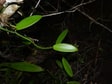
Betel (Piper betle, )
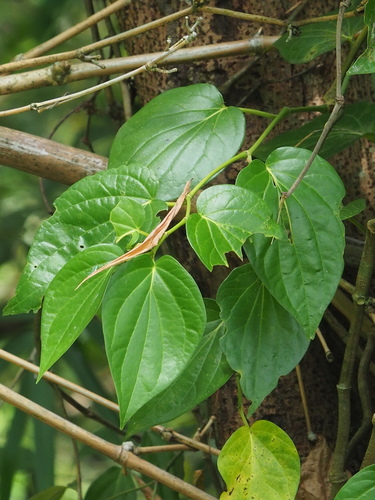


Betel (Piper betle) is a woody perennial vine in the Piperaceae family, grown across South and Southeast Asia for its heart-shaped leaves. Chewed in betel quid for more than two thousand years, this fast-growing dioecious vine climbs bamboo poles or areca palms, unlike black pepper, which is grown for its berries.
Read moreBetel, Betel pepper, Betel vine, Betel leaf and Paan
Place in indirect light or in a shaded room.
Bright partial shade, protected from direct sun


© photo
no rights reserved, uploaded by 葉子 · cc0
Wikimedia Commons · CC BY-SA or Public Domain
© copyright of the Board of Trustees of the Royal Botanic Gardens, Kew.




Global distribution
The exact origin of Piper betle remains debated, often linked to Peninsular Malaysia and the Malesian phytogeographic region. More than two thousand years of cultivation for chewing carried it to Sri Lanka, India and New Guinea; these areas do not all represent its strictly native range.
Identity
Leaves rather than berries make Betel (Piper betle L., 1753) a distinctive crop within the pepper family, Piperaceae. Also called betel pepper or betel vine, this woody perennial climber belongs to Piper. Its leaf has been chewed throughout much of Asia and the Pacific for more than two thousand years, while black pepper is cultivated for its fruit. 1 3
Its precise geographical origin remains debated. Several sources place its early home in Peninsular Malaysia, before the ancient spread of betel chewing carried cultivation to Sri Lanka, India and New Guinea. A long history of planting therefore needs to be distinguished from a strictly native distribution. 4 2
Recognition
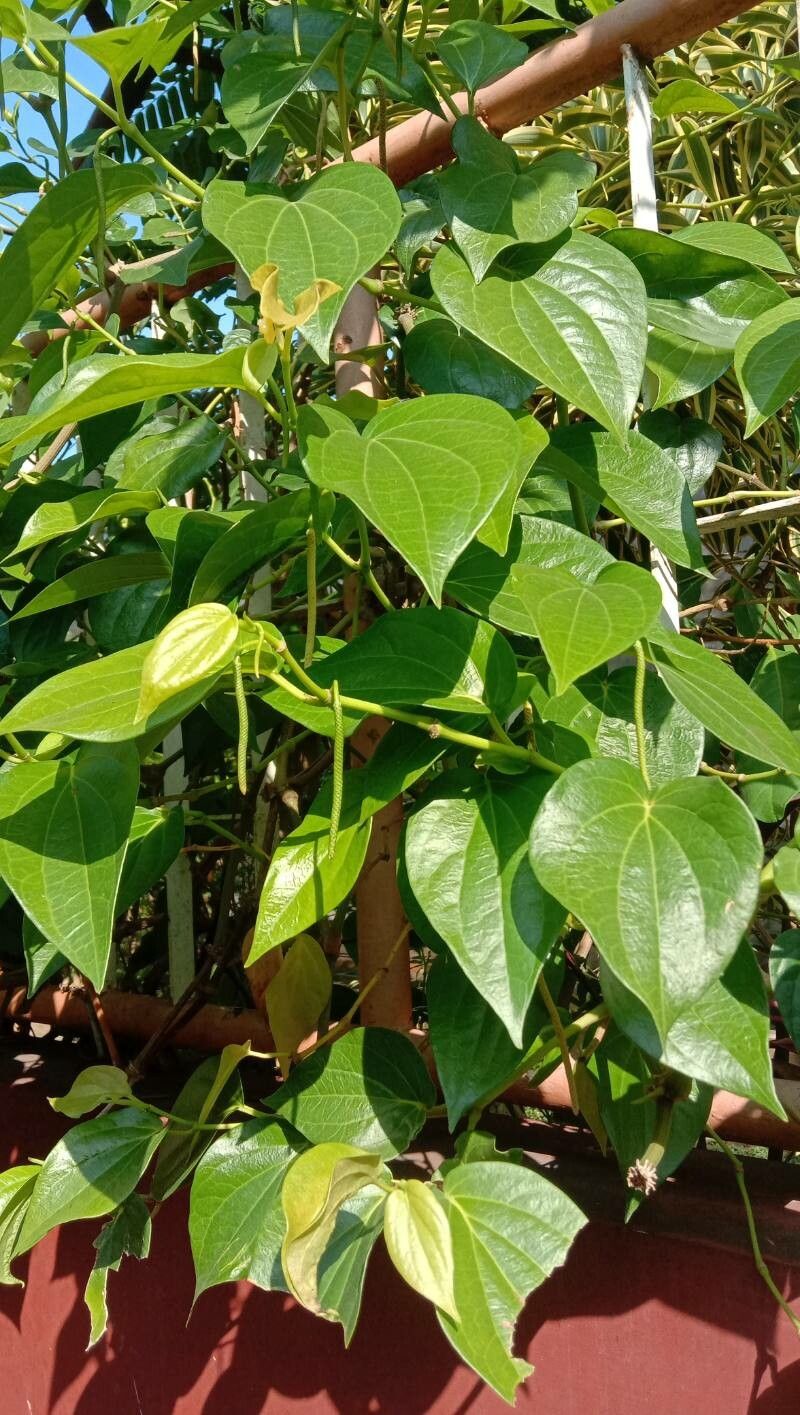
Swollen stem nodes and adventitious roots help identify this dioecious climber, woody at its base. Unrestricted vines can grow 5–20 m (16–66 ft) long; in pots or conservatories they often remain below 5 m (16 ft). Growth becomes rapid once support is available. The roots emerging at the nodes primarily anchor the vine rather than absorb water or nutrients. 4 2
Alternate leaves have long stalks, a glossy heart-shaped blade and conspicuous palmate veins. They commonly measure 5–20 cm (2–8 in) long, depending on the landrace. Tiny flowers without petals form upright spikes opposite the leaves. Male spikes reach 12 cm (5 in), while female spikes remain around 5 cm (2 in), providing a useful distinction between male and female plants in production. 4
Useful taxonomy
Within Piperaceae and the order Piperales, POWO recognizes Piper betle L. as the accepted name, with a range described from Indochina to Malesia. Several forms and varieties have been described within the species without replacing that accepted name:
- Piper betle f. densum (Blume) Fosberg, a named botanical form
- Piper betle f. marianum (Opiz) Fosberg, another botanical form
- Piper betle var. amplifolium C.DC., a named variety
- Piper betle var. siriboa (L.) C.DC., another named variety
The similarly named Piper betleoides C.DC. remains a separate species. Common names bring another source of ambiguity: in India, the leaf becomes paan when incorporated into a chewing preparation, without becoming a different plant. The complete scientific name distinguishes the species despite these overlapping regional uses. 1 3
Habitat and distribution
Humid tropical forest understory provides the setting for Piper betle, which climbs woody or artificial supports. POWO describes its range from Indochina to Malesia. Cultivation now extends far beyond that presumed early home, from Sri Lanka to New Guinea, following a chewing tradition several millennia old. 1 4
Growers in India, Bangladesh and Sri Lanka train vines vertically on bamboo poles or living areca palms in shaded plots protected from wind. Suitable soil is deep, well drained and rich in organic matter, with a neutral to slightly alkaline pH of 7–7.5. This preference differs from the more acidic growing media suitable for many other tropical vines grown in containers. 2
Life cycle and reproduction
Separate male and female betel plants limit seed production in commercial cultivation, making cuttings the main propagation method. Cuttings taken from upright shoots, 30–45 cm (12–18 in) long and carrying 3–5 nodes, root within a few weeks in a warm, moist growing medium. 2
A young vine trained onto a support can yield its first harvestable leaves after 18 months. This is a relatively short wait beside other cultivated Piper vines, including black pepper, which takes several years to produce its first fruit. Leaves can then be picked continuously while the planting remains productive, with no pronounced winter rest in a truly tropical climate. 2
Uses and risks
Chewing preparations account for the main use of betel leaves. A leaf is coated with lime, filled with a slice of areca nut and sometimes spices such as nutmeg, clove or cardamom, then chewed for a mild stimulant effect. The practice also marks social rituals. At South Asian weddings, the heart-shaped leaf and areca nut together symbolize the couple's union. 4
Hydroxychavicol, a major active leaf compound, has been studied for antibacterial and antioxidant properties. A recent review reports no notable cytotoxicity for leaf extract alone in preclinical experiments. The documented risk concerns complete betel quid, rather than the isolated leaf: the International Agency for Research on Cancer classifies areca nut and betel quid preparations as carcinogenic to humans, associated with cancers of the mouth and throat. 5 6 7
Long-term betel quid consumption is also associated with increased risk of insulin resistance and metabolic syndrome, especially in South Asian populations where the habit remains widespread and inexpensive. By contrast, no acute toxicity is recorded in domestic animals from simple contact with a potted plant. 8
Varieties and similar plants
Leaf size, thickness and aroma distinguish betel landraces, rather than separate botanical status; none is registered as a cultivar in the strict sense. In India, Bangla has large leaves grown in West Bengal for betel quid. Kapoori, from Karnataka and Andhra Pradesh, has a strong aroma. Meetha denotes mild leaves sold alongside more pungent types. Sagar Bangla remains a regional landrace mentioned in Indian agricultural literature, without a settled cultivar status. 4
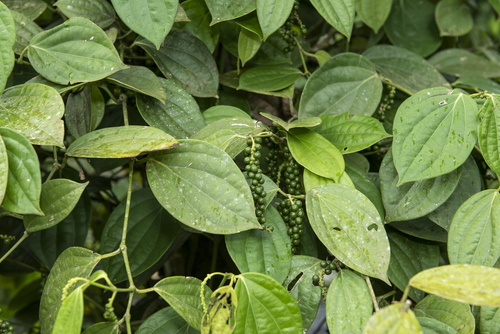
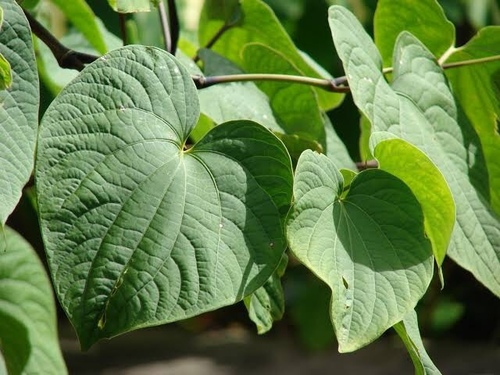
Other heart-leaved Piper can resemble betel, including young Piper nigrum and wild pepper (Piper sarmentosum), used in Southeast Asian cooking to wrap savory preparations. The scientific names help distinguish these uses: Piper betle leaves go into betel quid, whereas Piper sarmentosum leaves wrap food. The two species belong to the same genus but have distinct customary roles.
Main sources
- Plants of the World Online / Kew, Piper betle L.
- Plants For A Future, Piper betle - Betel Pepper
- INPN / MNHN, Piper betle L., 1753
- Pl@ntUse / PlantNet, Piper betle
- Journal of Cellular and Molecular Medicine, 2022, Betelvine (Piper betle L.) - ethnopharmacology and pharmacological review
- Lancet Oncology, 2009, IARC review of human carcinogens - areca nut and betel quid
- National Cancer Institute, Head and Neck Cancers fact sheet
- International Journal of Environmental Research and Public Health, 2020, betel quid and metabolic disease risk
Frequently asked questions
Are betel and areca nut the same plant?
No. Betel (Piper betle) is a Piperaceae vine whose leaves are chewed, while areca nut comes from Areca catechu, a palm in another family. They are combined in betel quid but remain botanically distinct.
Are betel leaves toxic?
No acute toxicity is recorded for the leaf alone, including in domestic animals. The documented risk concerns complete betel quid (leaf, lime and areca nut), classified by IARC as carcinogenic to humans.
Why are betel leaves chewed?
Betel quid combines leaf, lime and areca nut for a mild stimulant effect. It also has social roles, notably at South Asian weddings, where the heart-shaped leaf symbolizes union.
Where does the word betel come from?
The word reached English through Portuguese from Malayalam and Tamil vettila, already used for the leaf chewed traditionally in southern India.
How soon can leaves be harvested?
A vine established on a support can provide its first harvestable leaves after 18 months, sooner than some other Piper vines such as black pepper.
Is betel a pepper?
Botanically, yes. Like black pepper it belongs to Piper, but it is grown for its leaves rather than its berries. The two plants have different uses and risk profiles.
Can betel grow indoors in a temperate climate?
Yes, in a humid conservatory or bright room away from direct sunlight, with high humidity and a sturdy support. It then remains mainly ornamental and is rarely harvested on a large scale.
Similar plants
If you are unsure about a plant’s toxicity, ask a botanist or veterinarian for advice.