
Common purslane (Portulaca oleracea, )
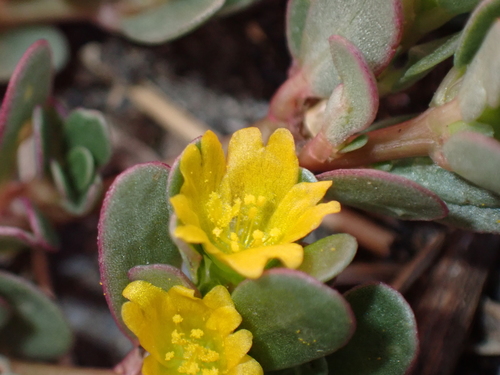
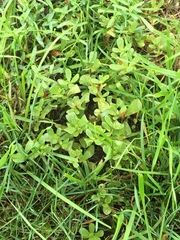
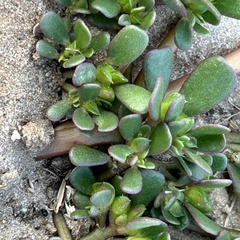
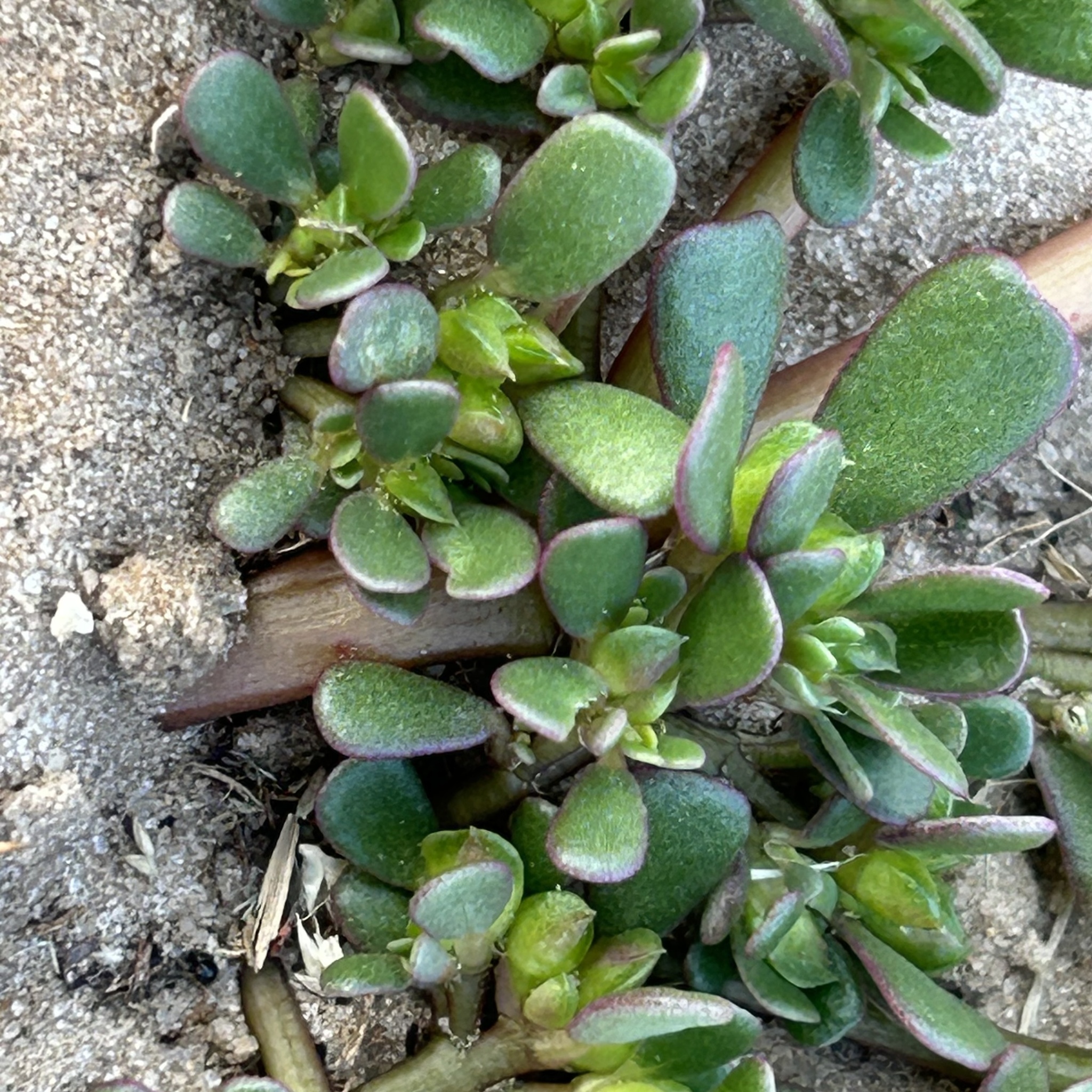
Common purslane (Portulaca oleracea) is a succulent herb in the Portulacaceae family, cultivated and gathered around the Mediterranean since antiquity. Fleshy, reddish stems sprawl across the ground, bearing glossy leaves and small yellow flowers that open for only a few morning hours. A widespread weed of compacted soils, it can regrow from a stem fragment left after hoeing.
Read moreCommon purslane, Little hogweed, Pigweed, Pusley and Verdolaga



© photo
(c) Pierre Corbrion, some rights reserved (CC BY-NC-SA), uploaded by Pierre Corbrion · cc-by-nc-sa
Alex Karasoulos · cc0
Riana Fourie · cc0
© copyright of the Board of Trustees of the Royal Botanic Gardens, Kew.
Global distribution
According to POWO, Portulaca oleracea is native to Macaronesia, Africa, the Caucasus and central and southern Europe, extending to Pakistan and the Arabian Peninsula. Introduced almost everywhere else, it is now nearly cosmopolitan. Its status in the Americas remains debated: seeds found in Ontario sediments dated 1350–1539 suggest a pre-Columbian arrival, before its later widespread horticultural dispersal.
- Native6
- Introduced2
- France
- Spain
- Greece
- Morocco
- Turkey
- Egypt
- United States
- Australia
Hexagons: regions where the plant occurs. Green dots: native range.1
Identity
Common purslane (Portulaca oleracea L., 1753), also known as little hogweed, pigweed, pusley or verdolaga, is a succulent herb in the Portulacaceae family. Carl Linnaeus described it in Species Plantarum. 6 1
The genus name Portulaca is thought to derive from Latin portula, a little lid, referring to the fruit opening in a circle when ripe. The French name pourpier has been linked to popular Latin pulli pes, chicken foot, alluding to the leaf shape. The epithet oleracea, meaning vegetable or herbaceous in Latin, points to its long history as food. 6
Theophrastus already listed purslane in the fourth century BCE among the pot herbs to sow in April. Pliny the Elder, in his Natural History completed in 77 CE, advised wearing the plant as an amulet against illness. 5
Recognition
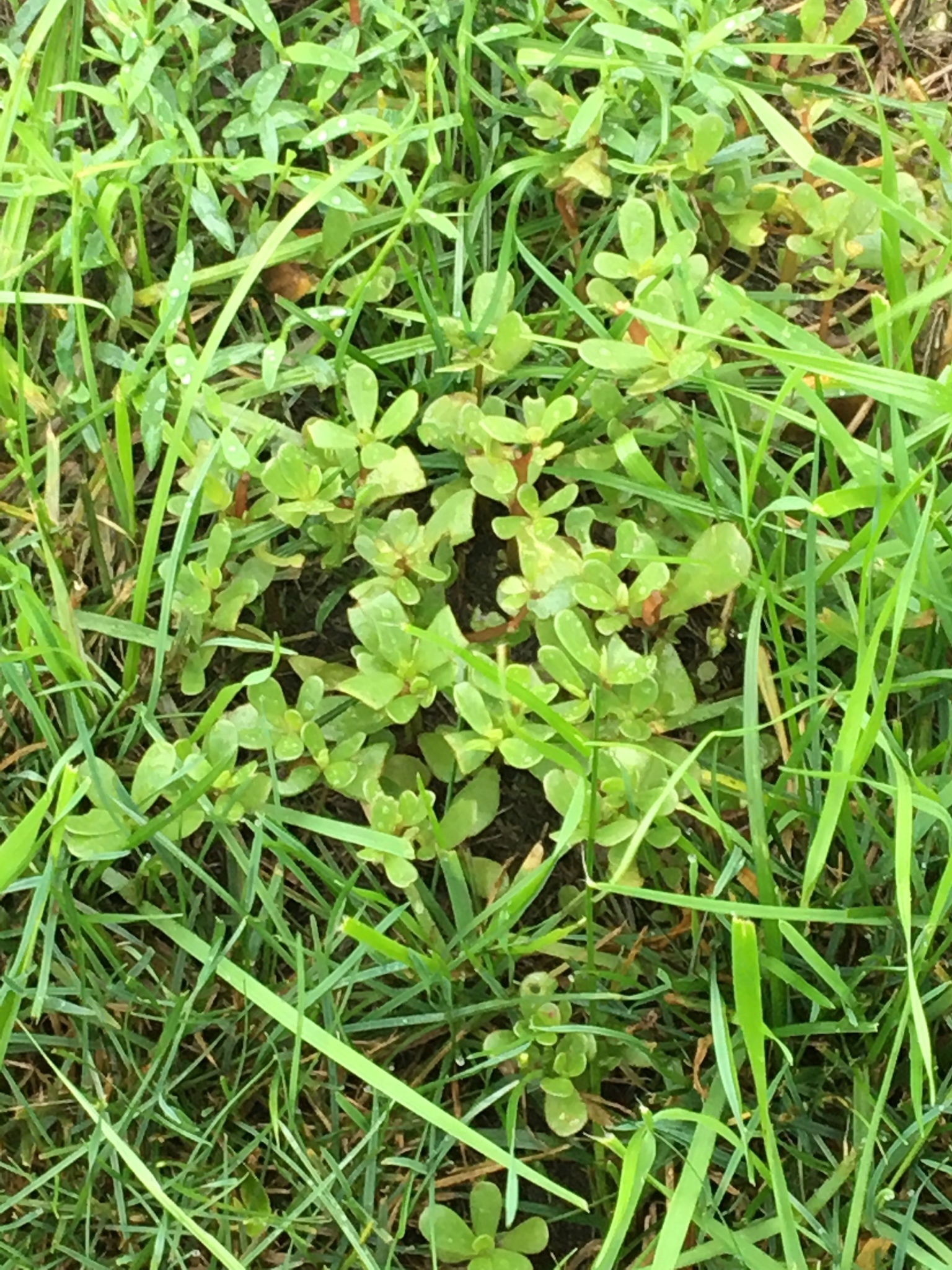
Reddish, fleshy stems form a mat, usually prostrate and branching from the base, spreading 10–30 cm (4–12 in). On rich soil, the plant may grow upright and reach 40 cm (16 in) tall. 5 6
Opposite near the base and alternate toward the tips, the leaves are obovate-oblong, stalkless and fleshy. They average 4 cm (1.6 in) long and 1.5 cm (0.6 in) wide, becoming noticeably larger in fertile soil. Yellow, stalkless flowers grow singly or in clusters at stem axils, with 4–6 petals up to 6 mm (0.24 in) wide, opening for only a few hours on sunny mornings. 4 5
A lidded capsule, or pyxis, opens along a circular line when ripe, releasing glossy black seeds. A well-fed mature clump can produce as many as 240,000 seeds, helping explain dense seedling emergence the following year. 5
Useful taxonomy
Accepted as Portulaca oleracea L., published in 1753, this species belongs to Portulacaceae in the order Caryophyllales. POWO recognizes two varieties: Portulaca oleracea var. oleracea and Portulaca oleracea var. delicatula Fosberg, the latter endemic to Aldabra Atoll in the Seychelles. It also lists two homotypic synonyms, Portulaca hortensis Rupr. and Portulaca officinarum Crantz. 1
Cultivated purslane is often named Portulaca oleracea subsp. sativa, Portulaca sativa or var. sativa. These names describe a more robust cultivated form with larger leaves and seeds, still within the variation of the species rather than botanically distinct. 5
Habitat and range
Macaronesia, Africa, the Caucasus and central and southern Europe, extending to Pakistan and the Arabian Peninsula, make up the native range given by POWO. Introduced almost everywhere else, purslane is nearly cosmopolitan. Its status in the Americas remains debated: seeds from Ontario sediments dated 1350–1539 suggest a pre-Columbian arrival, before its later horticultural spread. 1 9
Compacted, poorly aerated, calcium-poor soils that retain little water suit this plant; its presence can indicate poorly aerated ground. It grows on waste ground, in vegetable gardens and vineyards, on urban sidewalks, dunes and seashores, from sea level to 2,600 m (8,530 ft). 6 7
Human activity has strongly shaped the worldwide distribution of purslane. It colonizes disturbed soils first, and its dispersal is considered mainly human-assisted rather than natural. 8
Life cycle and reproduction
Warm soil above 25 °C (77 °F) favors germination; burial only 5 mm (0.2 in) deep already sharply reduces emergence. Once established, the plant combines C4 photosynthesis with crassulacean acid metabolism (CAM), switching toward the latter when marked drought develops. 5
In temperate Northern Hemisphere conditions, flowering runs mainly from June to August. Each flower opens for a few morning hours before closing to form a capsule. Purslane is self-pollinating, allowing it to set fruit even without visiting pollinators. 6
Spontaneous self-seeding accounts for almost all reproduction, but a fleshy stem fragment left after hoeing can also root and make a complete plant. This is a familiar trap when weeding: cutting the visible stems without collecting the debris may leave living material behind. 11
Uses and risks
All parts of common purslane are eaten raw or cooked, with a slightly tart flavor from oxalic and malic acids. It features in the Cretan diet and is widely cooked around the Mediterranean, in Turkey, Egypt, Mexico and Asia. Its leaves are rich in omega-3 fatty acids (alpha-linolenic acid), vitamin C and vitamin E. 3 6
Substantial amounts of soluble oxalates also accumulate in the leaves. The ASPCA lists Portulaca oleracea as toxic to cats, dogs and horses, with muscle weakness, salivation and tremors possible after substantial ingestion. 2
Livestock face another major risk: the plant can accumulate nitrates in soil with excess nitrogen. Acute nitrite poisoning of cattle, sheep and goats has been documented after large amounts of purslane were eaten in pastures or feedlots. 10
Varieties, look-alikes and related plants
Vegetable seed catalogs offer a limited range of cultivated purslane, chiefly a large-leaved form and a golden variety. Distinguish these from Portulaca grandiflora, moss rose, which is grown for colorful flowers rather than edible leaves. 6 5
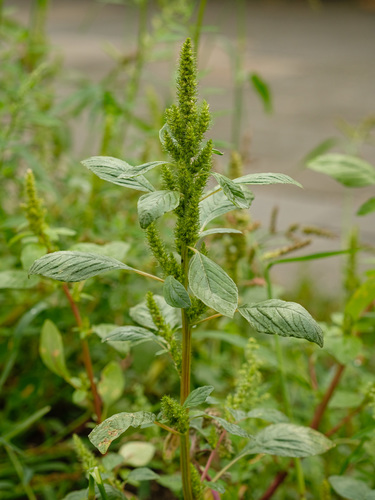
The most consequential look-alike is Euphorbia maculata, spotted spurge. Its reddish, prostrate stems resemble purslane at first glance, but breaking a stem releases irritating milky sap, which purslane lacks. Young seedlings of Amaranthus retroflexus, another weed called pigweed in English, have non-fleshy leaves and grow more upright. 4
Three features together resolve these confusions: fleshy stems without latex, glossy obovate leaves and small, short-lived yellow flowers.
Main sources
- Plants of the World Online / Kew, Portulaca oleracea L.
- ASPCA, Purslane (Portulaca oleracea) toxicity entry
- Plants For A Future, Portulaca oleracea
- Illinois Wildflowers, Common Purslane (Portulaca oleracea)
- Wikipedia EN, Portulaca oleracea
- Wikipedia FR, Portulaca oleracea
- INPN MNHN, Portulaca oleracea L., 1753
- Go Botany / Native Plant Trust, Portulaca oleracea
- Byrne & McAndrews, 1975, Pre-Columbian purslane in the New World, Nature
- Tropical Animal Health and Production, nitrate/nitrite poisoning in feedlot cattle from Portulaca oleracea
- Cornell CALS Weed Science, Common purslane profile
Frequently asked questions
Is common purslane toxic to cats and dogs?
Yes. The ASPCA lists Portulaca oleracea as toxic to cats, dogs and horses because soluble oxalates can cause muscle weakness, salivation and tremors.
Can you eat common purslane?
Yes. All parts can be eaten raw or cooked and have a slightly tart flavor. The leaves are rich in omega-3 fatty acids and vitamins C and E, but also contain substantial oxalates.
How can I tell purslane from spotted spurge?
Spotted spurge has similar reddish, prostrate stems, but releases irritating milky sap when a stem is broken. Common purslane never produces this latex.
Why does purslane regrow after weeding?
A fleshy stem fragment left on the ground after hoeing can root and develop into a whole plant. Collect the debris rather than simply cutting off visible stems.
Is purslane dangerous to livestock?
In soil with excess nitrogen, it can accumulate toxic nitrate levels. Acute poisoning of cattle, sheep and goats has been documented after they ate large quantities.
Where does common purslane come from?
Its native range extends from Macaronesia, Africa and southern Europe to Pakistan. Its status in the Americas remains debated, with pre-Columbian seeds found in Ontario.
Do purslane flowers last long?
No. Each flower opens for only a few hours on a sunny morning before closing to form a capsule. In temperate Northern Hemisphere climates, flowering is mainly from June to August.
Similar plants


If you are unsure about a plant’s toxicity, ask a botanist or veterinarian for advice.