
Candle bush (Senna alata, )
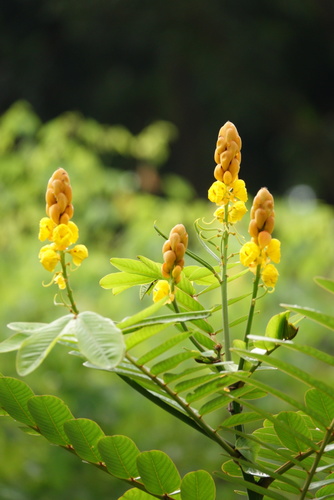
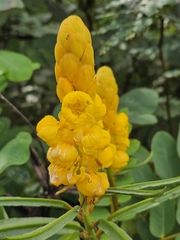
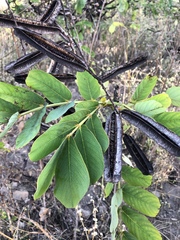
Candle bush (Senna alata) is a shrub in the Fabaceae family, native to tropical South America and now cultivated and naturalized across most warm regions of the world. Its upright golden-yellow flower clusters resemble candles while still in bud. Fresh leaves are traditionally applied to ringworm and other skin conditions, but the plant also forms invasive thickets far from its native range.
Read moreCandle bush, Emperor's candlesticks, Candelabra bush, Empress candle plant, Ringworm bush and Candletree
Allow a few hours of direct sun per day, preferably morning or evening.
Requires full sun; does not flower in shade


© photo
(c) Cheongweei Gan, some rights reserved (CC BY-NC), uploaded by Cheongweei Gan · cc-by-nc
ritirene · CC BY-NC
iNaturalist User · cc-by
Taken May 9, 2022 by Giacomo Sellan (cc-by-sa)
Taken May 28, 2021 by Sébastien TRASBOT (cc-by-sa)
Taken Feb 24, 2011 by Tela Botanica − Céline PIRAT (cc-by-sa)
Taken May 3, 2014 by Tela Botanica − Céline PIRAT (cc-by-sa)
Taken Mar 26, 2022 by pedrogc -- (cc-by-sa)
© copyright of the Board of Trustees of the Royal Botanic Gardens, Kew.


Global distribution
Senna alata is native to tropical South America, from northern Brazil to Colombia, Venezuela and the Guianas, possibly extending to southern Mexico depending on the reference. Introduced as an ornamental and medicinal plant across almost all tropical regions, it has widely naturalized and sometimes become invasive.
- Native5
- Introduced3
- Invasive2
- Brazil
- Colombia
- Venezuela
- French Guiana
- Suriname
- Mexico
- Tropical Africa
- India and South Asia
- Australia
- Polynesia and the Pacific
Hexagons: regions where the plant occurs. Green dots: native range.1
Identity
Candle bush (Senna alata (L.) Roxb., 1832), also called emperor's candlesticks, is a shrub in the Fabaceae family, subfamily Caesalpinioideae. Carl Linnaeus described it in 1753 as Cassia alata. William Roxburgh transferred it to Senna in 1832, the name now accepted by international references. 1 2
“Winged,” the meaning of alata, describes the fruit: each pod valve carries a lengthwise, scalloped membranous wing, distinguishing Senna alata from most other Senna species. In French Guiana and the French West Indies, the Creole names “bois dartre” and “casse ailée” refer to its traditional application to skin lesions and ringworm. 3 4
Recognition
Upright and sparsely branched, Senna alata commonly reaches 1.5–3 m (5–10 ft) and can exceed 5 m (16 ft) in stable tropical conditions. Its stems are green, thick and hairy. Large, even-pinnate leaves measure 30–80 cm (12–31 in) and carry 6–20 pairs of oblong leaflets that increase in size toward the leaf tip. 7 5
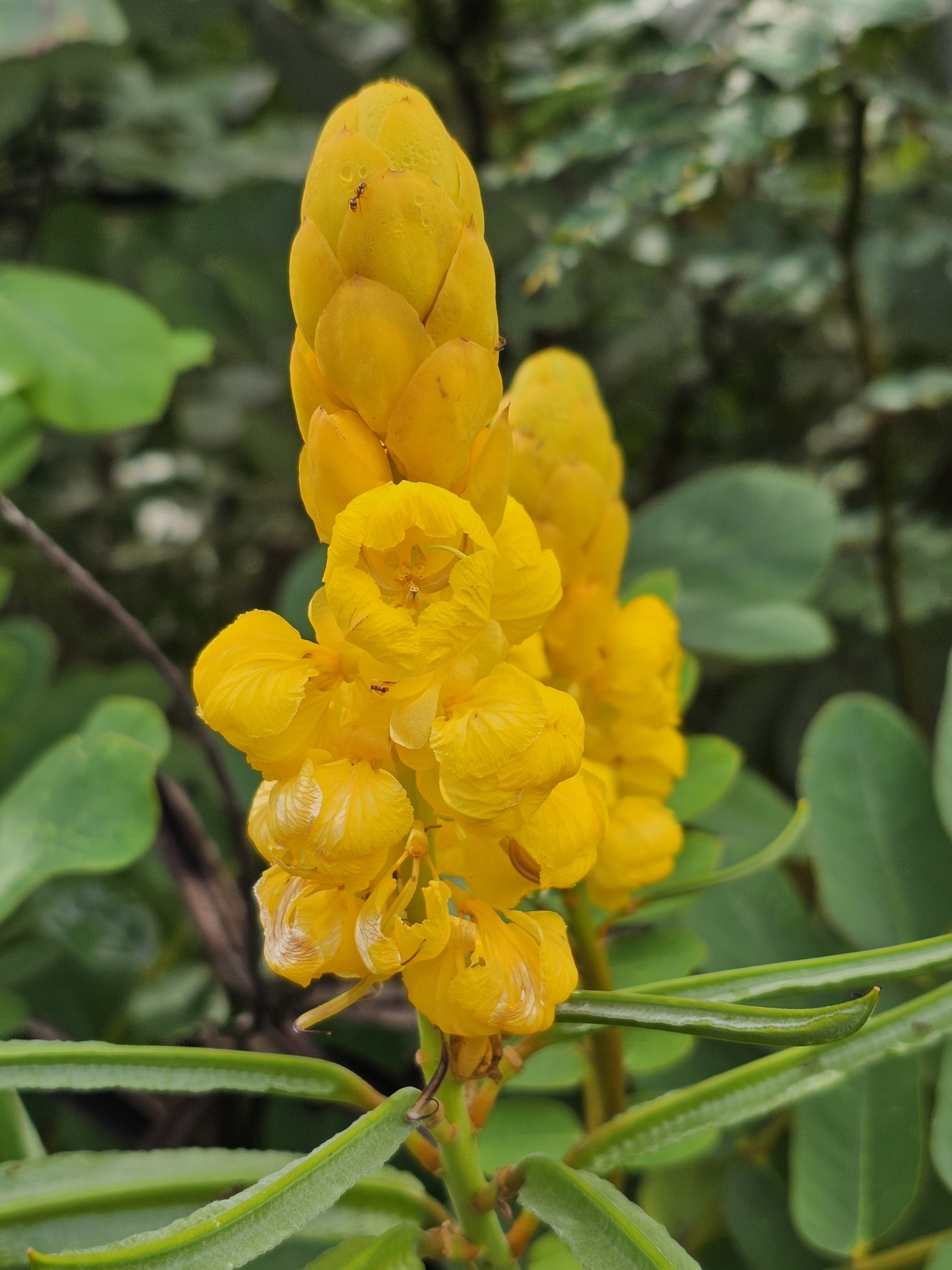
Golden-yellow flowers, sometimes veined purple, measure about 2.5 cm (1 in) across and crowd by the dozen onto upright racemes 10–50 cm (4–20 in) long. Unopened buds resemble a row of candles, explaining the English name candle bush. Only seven of the ten stamens are fertile; they release pollen through pores at their tips, a mechanism shared with most Senna and Cassia. 7
Useful taxonomy
Separation of Senna from Cassia during the nineteenth century changed several species' names without changing their botanical identity. The principal synonyms and historical varieties associated with Senna alata are:
- Cassia alata L., the 1753 basionym
- Cassia alata var. rumphiana DC., a historical varietal name
- Cassia alata var. perennis Pamp., another historical variety
- Cassia bracteata L.f., a synonym
- Herpetica alata (L.) Raf., a former generic combination
When buying this plant, the accepted name Senna alata is the clearest reference, although labels may still use its synonym Cassia alata. Following the 1832 generic transfer, Cassia alata no longer serves as the accepted taxonomic name. 1
Habitat and range
Tropical South America is its native home, from northern Brazil to Colombia, Venezuela and the Guianas, with a possible extension into southern Mexico depending on the taxonomic reference. 7 1
Sunny, disturbed sites support the species: roadsides, riverbanks, waste ground and forest edges, particularly where the water table stays high. 3 7
Introductions for ornamental and medicinal use have carried Senna alata across almost all tropical regions. It has naturalized in Africa, Asia, the Pacific and Australia, sometimes forming dense thickets that reduce native vegetation diversity and earn it a local invasive status. Globally, however, the IUCN lists Senna alata as Least Concern. 7 6
Life cycle and reproduction
Scarified seeds or seeds soaked in hot water germinate within 1–3 weeks. Growth is then fast enough for flowering and fruiting in the first year under favorable conditions. 4 5
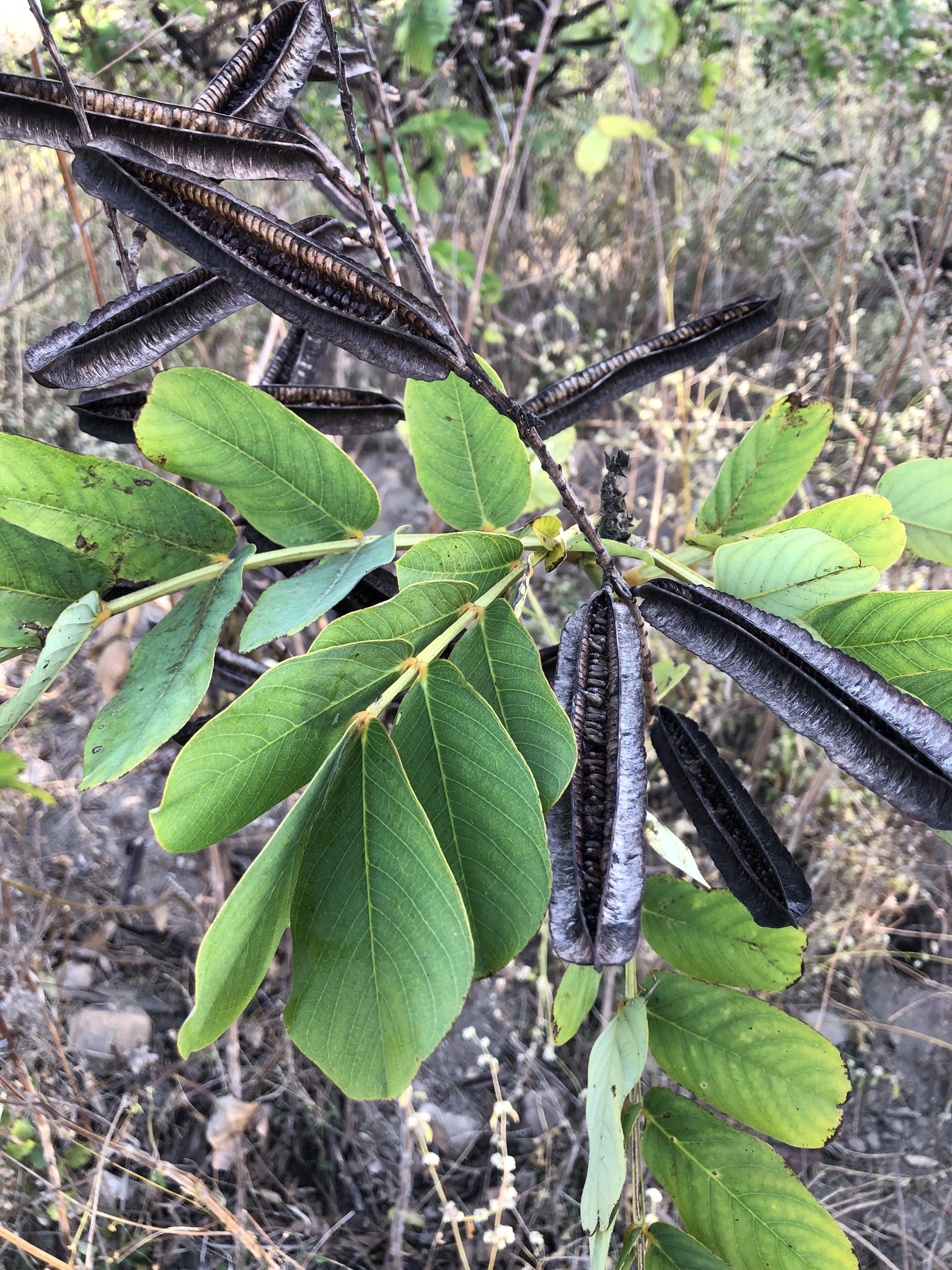
Upright, four-angled pods measure 10–20 cm (4–8 in), starting green and darkening toward black when ripe. Each angle carries a scalloped membranous wing. A pod contains 50–60 flattened seeds, dispersed by water and animals along riverbanks. 7
Individual shrubs remain vigorous for only a few years. Botanical accounts describe a short-lived shrub that often declines after 2–4 years, explaining its abundant seed production rather than long individual survival. 7
Uses and risks
Traditional medicinal practices in tropical America, Africa and Asia document the same skin application: fresh leaves, crushed or made into a decoction, are applied to ringworm, skin lesions, eczema and other fungal infections. This antifungal reputation explains the English name ringworm bush. These are traditional uses. 4 3
Leaf anthraquinones also have laxative effects, as in other medicinal Senna species, and a decoction is traditionally drunk as a purgative. No major toxicity is nevertheless documented for Senna alata in cats and dogs. 4
In gardens, the shrub attracts sulphur butterflies of the genus Phoebis, whose caterpillars feed almost exclusively on Senna and Cassia. Partial defoliation by these caterpillars is therefore a sign of its role as a host plant rather than a disease symptom. 8
Varieties, look-alikes and related plants
Stable horticultural cultivars are not documented for Senna alata. The historical varieties rumphiana and perennis are now synonyms of the typical species, with no recognized distinction in cultivation. 1
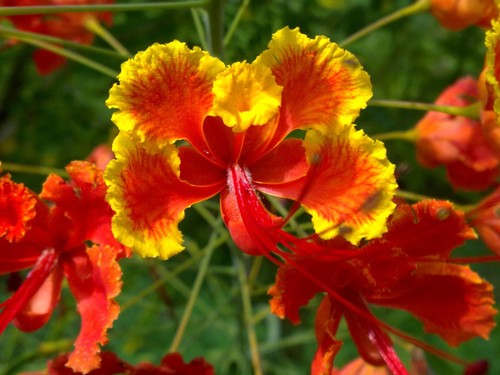
Three related plants can cause confusion. Senna occidentalis is smaller and has unwinged pods. Senna alexandrina, the medicinal senna used pharmaceutically, has much smaller leaflets and no winged pods. Caesalpinia pulcherrima, another ornamental Caesalpinioideae with orange-toned flowers, has finer, twice-pinnate foliage.
None of these three has the 10–20 cm (4–8 in) winged pod of Senna alata. This fruit distinguishes candle bush even when flowers and leaves are unavailable for comparison.
Main sources
- Plants of the World Online / Kew, Senna alata (L.) Roxb.
- Inventaire National du Patrimoine Naturel, Senna alata (candle bush)
- CIRAD, plants of French Guiana rice fields, Senna alata
- Plants For A Future, Senna alata
- Missouri Botanical Garden, Plant Finder, Senna alata
- IUCN Red List, Senna alata assessment (2019)
- Pacific Island Ecosystems at Risk (PIER), Senna alata species info
- University of Florida IFAS, Cloudless Sulphur Phoebis sennae
Frequently asked questions
Is candle bush poisonous to cats and dogs?
No major toxicity is reported for Senna alata in either species. Eating large amounts of leaves may nevertheless cause a laxative effect or mild digestive upset, as with other medicinal Senna species.
Why do Senna alata leaves fold at night?
This movement, called nyctinasty, folds the leaflets together at dusk. It limits water loss and sensitivity to nighttime cold before the foliage opens again in the morning.
Does candle bush really treat ringworm?
A paste or decoction of fresh leaves is traditionally applied to ringworm and other fungal infections in several tropical medicinal traditions. This remains a traditional use and does not replace a medically validated antifungal treatment.
Why is candle bush considered invasive in some countries?
Introduced as an ornamental and medicinal plant, it has naturalized in many tropical regions. In Australia and the Pacific it forms dense thickets that reduce native plant diversity, leading to its local classification as invasive.
How does Senna alata differ from medicinal senna, Senna alexandrina?
Senna alexandrina, used pharmaceutically as a laxative, has much smaller leaflets and no winged pods. Senna alata is distinguished by its large leaves and four-angled fruits with four wings.
How long does candle bush live?
Senna alata is a fast-growing but short-lived shrub, often living only two to four years. Abundant seed production compensates for this short individual lifespan.
Does candle bush need protection from cold?
Yes. It is very frost-sensitive and may die back to the crown below 5 °C (41 °F). In temperate climates it is grown as an annual outdoors or brought into a heated greenhouse for winter.
Similar plants
If you are unsure about a plant’s toxicity, ask a botanist or veterinarian for advice.