
European mountain ash (Sorbus aucuparia, )
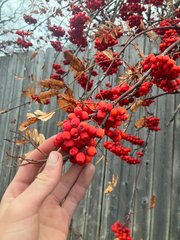
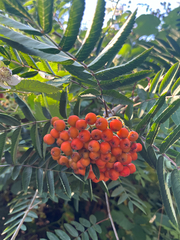
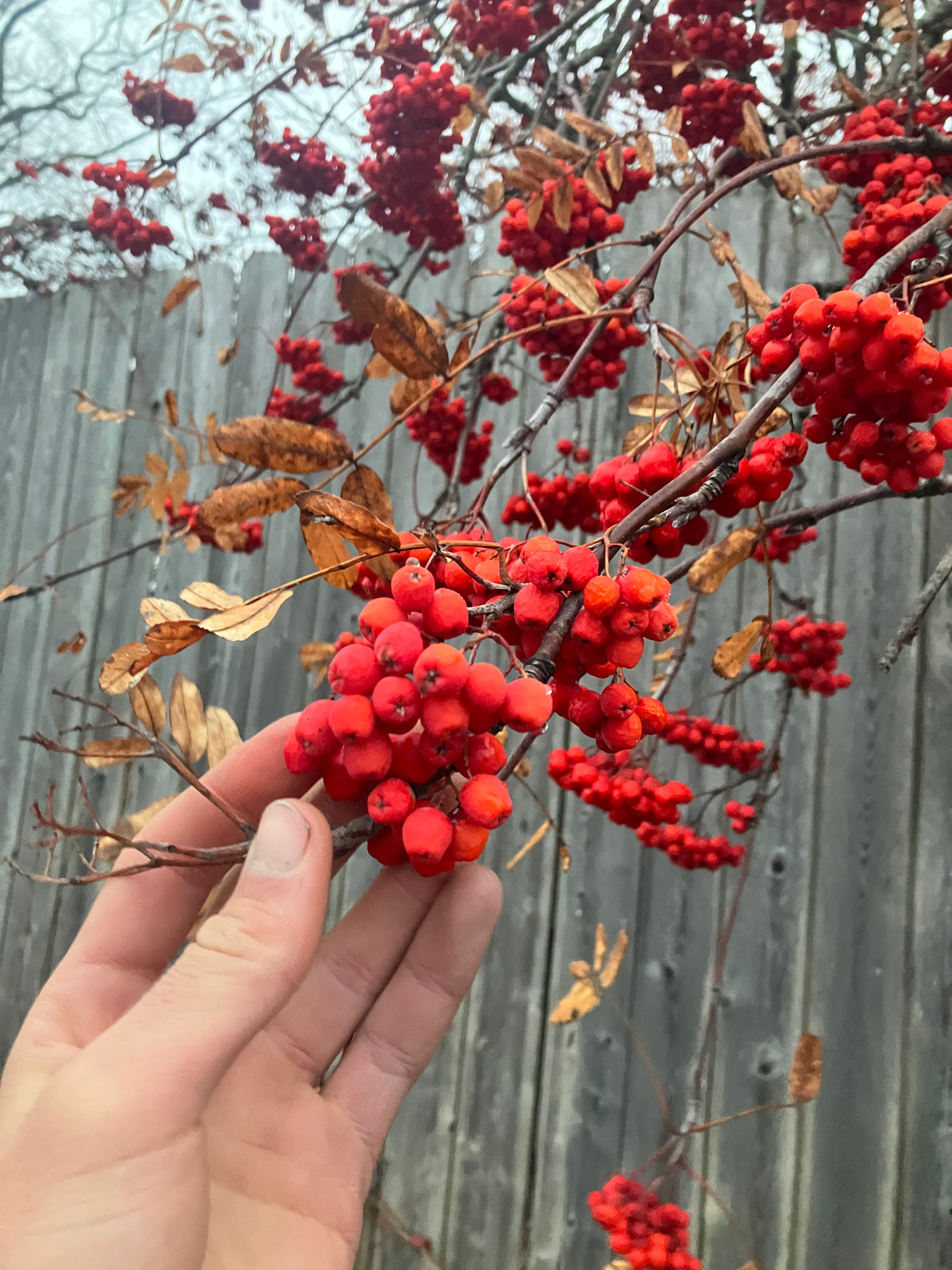
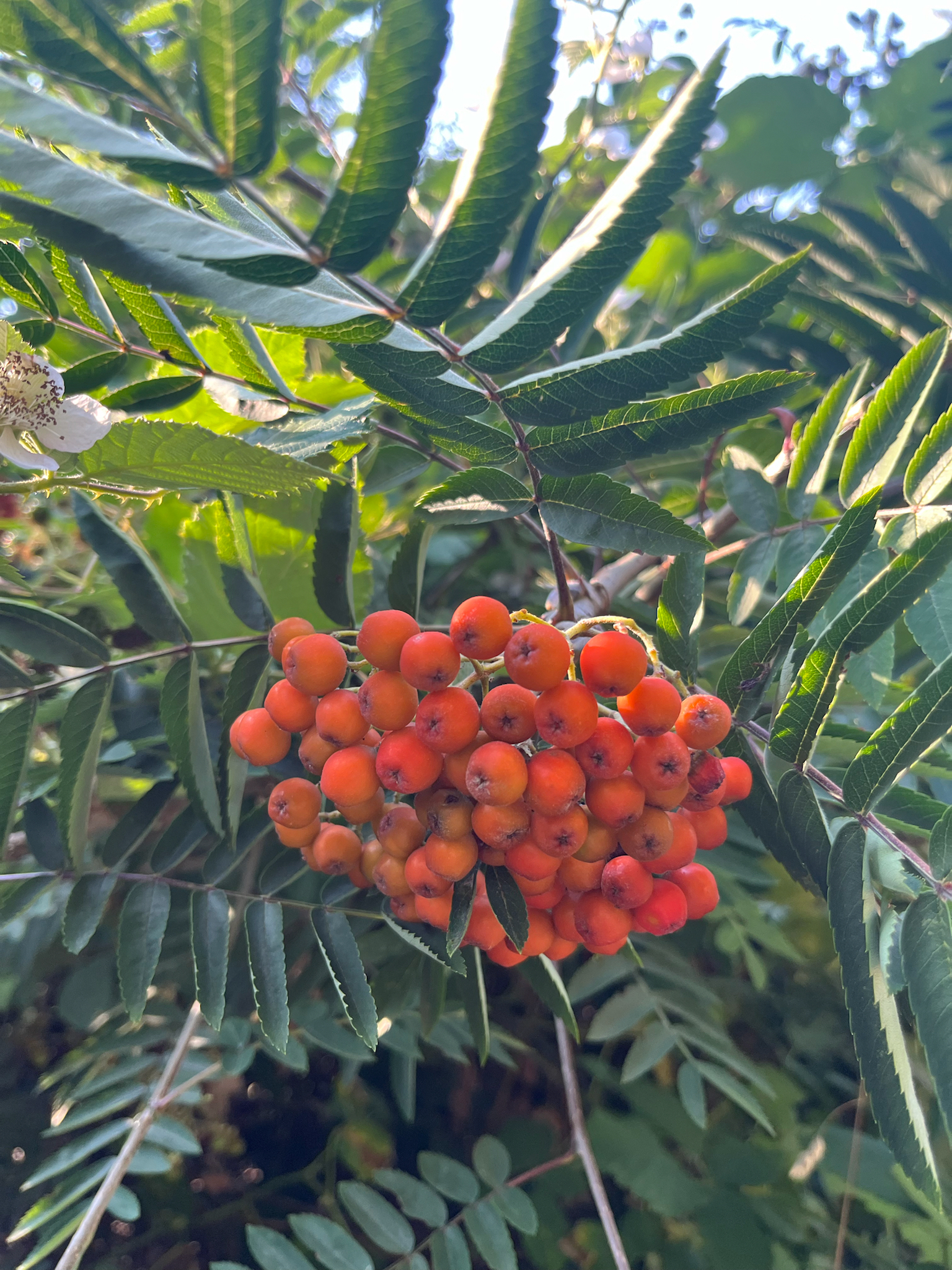
European mountain ash (Sorbus aucuparia) is a medium-sized deciduous tree in the Rosaceae family, native to Europe and western Asia as far as Iran. Pinnate leaves, clusters of small white spring flowers and orange-red berries distinguish it. The berries remain on its branches into fall and are eagerly eaten by birds.
Read moreEuropean mountain ash, Rowan, European rowan and Mountain ash

© photo
(c) Hans Kylberg, some rights reserved (CC BY) · cc-by
Charlie O'Brien · cc0
Therese Phillips · cc0
(c) Chris Fluit, some rights reserved (CC BY) · cc-by
(c) aga_l_, some rights reserved (CC BY) · cc-by
Global distribution
Sorbus aucuparia is native across Europe and western Asia, from Iceland and the British Isles east to the Russian Far East, northern China and Korea, and south to Iran and the Caucasus. In France it grows wild in cool and mountainous regions. Widely planted as an ornamental, it has naturalized beyond this range, notably in North America.
- Native6
- Introduced3
- Metropolitan France
- Iceland
- United Kingdom
- Norway
- Russia
- Iran
- Canada
- United States
- New Zealand
Hexagons: regions where the plant occurs. Green dots: native range.1
Identity
European mountain ash (Sorbus aucuparia L., 1753), also known as rowan, is a deciduous member of the Rosaceae family. It commonly reaches 8–12 m (26–39 ft), occasionally 15 m (49 ft) at maturity. The epithet aucuparia derives from Latin for bird-catching, recalling the former use of its orange-red berries as bait for catching birds in nets. 1 5
Cool mountain districts and open heathland in France support wild European mountain ash. It is also widely planted for its white spring flowers. From fall onward, the orange-red berry clusters feed thrushes and blackbirds, a role reflected in its French common name. 7 8
Recognition
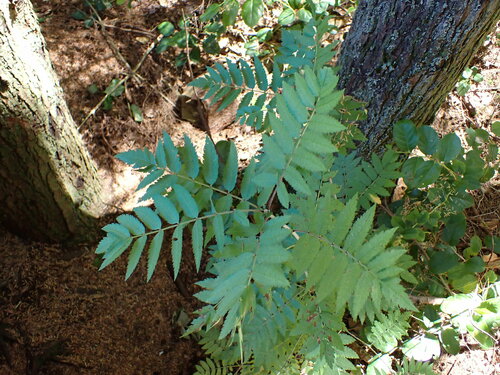
Pinnately compound leaves provide the first identification clue: 9–19 narrow, toothed leaflets with a matte green surface. They resemble ash leaves, but the trees belong to different families. European mountain ash is a rosaceous tree; true ashes belong to Oleaceae. 4 2
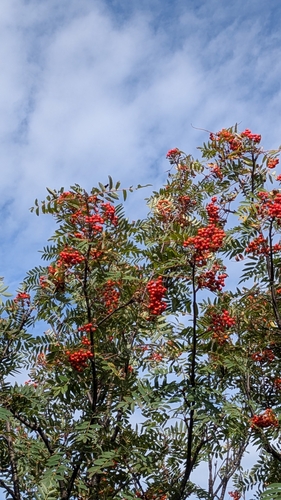
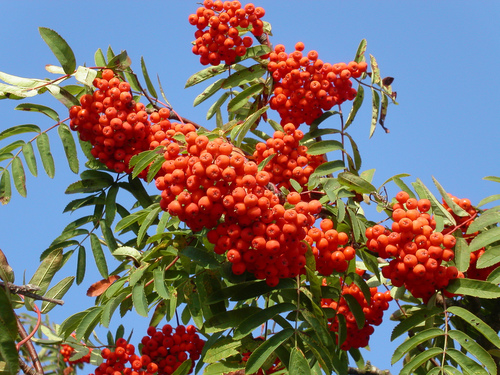
Flat corymbs of many small, five-petaled white flowers appear in spring. Their strong scent can seem unpleasant at close range. Flowers develop through summer and fall into clusters of spherical orange-red berries, about 8–10 mm (0.31–0.39 in) across, which persist on bare branches long after the leaves drop. 3 5
Smooth, silvery-gray bark bears conspicuous horizontal lenticels on young trunks. The initially upright, narrow outline becomes a light, rounded crown with age. Typical height is 8–12 m (26–39 ft), with well-grown specimens reaching 15 m (49 ft). 2 4
Useful taxonomy
The name Sorbus aucuparia L. dates to Linnaeus’s description in 1753. Sorbus contains many closely related species, some of which hybridize naturally and complicate identification in the field. Useful synonyms and infraspecific names include:
- Sorbus aucuparia subsp. lanuginosa (Kit.) Fritsch, a subspecies name;
- Sorbus aucuparia var. fastigiata (Loudon) Hartwig & Rümpler, a botanical variety name;
- Sorbus aucuparia f. pendula (G.Kirchn.) K.Koch, a form name;
- Pyrus aucuparia (L.) Gaertn., a historical synonym placed in Pyrus.
For reliable identification, retain the accepted scientific name, Sorbus aucuparia. Cultivar names such as Sheerwater Seedling and Fastigiata refer to horticultural selections, rather than separate botanical varieties. 1 7
Habitat and range
Across Europe and western Asia, Sorbus aucuparia occupies a broad native range from Iceland and the British Isles east to the Russian Far East, northern China and Korea, and south to Iran and the Caucasus. In France it grows wild in cool, mountainous regions. 8 1
As a sun-loving pioneer, European mountain ash readily colonizes heathland, open woodland margins and rocky mountain slopes on poor soil. Its tolerance of cold and wind allows it to grow at elevations where few other trees survive, often near the treeline. 4 3
Plantings for flowers and ornamental berries have helped it naturalize outside its original range, notably in North America. There it has adapted to urban environments without being listed as invasive in the references used here. 2 5
Life cycle and reproduction
Spring flowering produces white, nectar-rich corymbs that attract many pollinating insects. Fruit develops in summer and ripens into clusters of orange-red berries, remaining on the branches well after leaf fall. 3 5
Birds carry out most seed dispersal. They eat the berries and pass intact seeds after digestion, helping them germinate the following spring. Juvenile growth is fast, slowing once the tree becomes established; full flowering develops between 8 and 15 years. 6 2
Seed propagation is the main way to raise the typical species. Seeds collected in fall and cold-stratified germinate the following spring and remain true to the species. Grafting preserves selected cultivars such as Sheerwater Seedling and Wisley Gold, whose traits are not reliably passed on through seed. 6 4
Uses and risks
Gardens, street plantings and informal hedges use European mountain ash for its hardiness, flowers and ornamental fruit. Several northern European traditions regarded it as protective and planted it near homes to ward off evil spirits. 5 6
European mountain ash is not classified as toxic. Raw berries contain parasorbic acid, which may cause mild digestive discomfort if eaten excessively; no serious animal toxicity target is documented. Once cooked, especially into jelly with apple to balance their acidity, the berries are traditionally eaten in several parts of northern Europe. 6 4
Varieties, look-alikes and related plants
Horticultural selections remain part of the same species. Sheerwater Seedling and Fastigiata have upright, columnar habits for smaller spaces; Pendula has drooping branches. Wisley Gold and Edulis differ in berry color or size. 2
Several other trees and shrubs may cause confusion:
- Sorbus intermedia, Swedish whitebeam, has simple or only shallowly divided leaves rather than compound leaves;
- Sorbus torminalis, wild service tree, has lobed, non-compound leaves;
- Crataegus monogyna, common hawthorn, can look similar from a distance because of its outline and red fruit, but has simple, lobed leaves;
- Sambucus nigra, black elder, has comparable compound leaves but black rather than red berries.
Taken together, pinnate leaves, white corymbs and persistent orange-red berries remain the most reliable features for identifying Sorbus aucuparia. 4 1
Main sources
- Plants of the World Online / Kew, Sorbus aucuparia L.
- Royal Horticultural Society, Sorbus aucuparia - rowan
- Missouri Botanical Garden, Sorbus aucuparia
- NC State Extension, Sorbus aucuparia (European Mountain Ash)
- Encyclopaedia Britannica, mountain ash
- Plants For A Future, Sorbus aucuparia
- Tela Botanica, Sorbus aucuparia L.
- INPN / MNHN, Sorbus aucuparia L., 1753 (cd_nom 124308)
Frequently asked questions
Is European mountain ash poisonous?
No. Raw berries contain parasorbic acid, which may cause mild digestive discomfort if eaten in large quantities, but the species is not classified as toxic to domestic animals or humans. Cooking destroys this acid, allowing the berries to be made into jelly.
How can I tell European mountain ash from a true ash?
Their pinnate leaves look similar, but European mountain ash bears clusters of white flowers followed by orange-red berries. True ash has inconspicuous flowers and winged seeds. Mountain ash also has more downy buds.
Why isn’t my European mountain ash producing berries?
Too much shade or a young tree that has not yet reached 8–15 years usually explains the lack of fruit. A position in full sun and patience generally resolve it.
Is European mountain ash a good garden tree?
Yes. It is a hardy, medium-sized tree suited to small gardens and street planting, especially columnar cultivars such as Sheerwater Seedling and Fastigiata. Its spring flowers and fall berries also attract birds.
Can you eat European mountain ash berries?
Raw berries are bitter and may cause mild digestive irritation in large quantities. Cooked into jelly or jam, often with apple to balance their acidity, they are traditionally eaten in several parts of northern Europe.
How large does European mountain ash grow?
It is a medium-sized tree, commonly reaching 8–12 m (26–39 ft) tall and sometimes 15 m (49 ft) in favorable conditions. Its crown may spread to 8 m (26 ft).
Are yellow-berried cultivars separate species?
No. Wisley Gold and Edulis are horticultural selections of Sorbus aucuparia, chosen for berry color or size rather than separate botanical species.
Similar plants
If you are unsure about a plant’s toxicity, ask a botanist or veterinarian for advice.