
English oak (Quercus robur, )
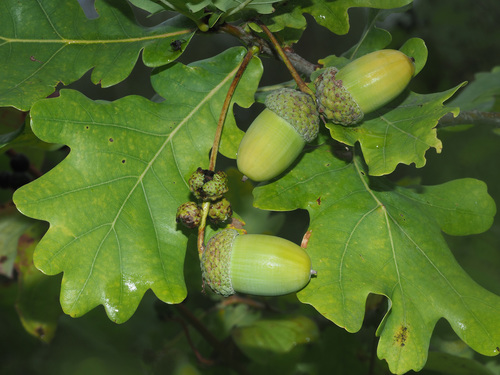
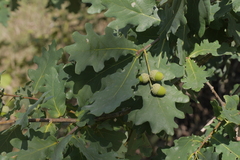
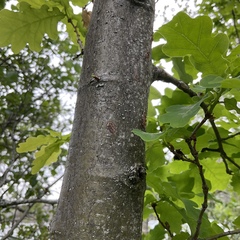
English oak (Quercus robur L., 1753) is a large deciduous tree in the Fagaceae family, native to France and widespread from Europe to Iran. Its leaves have very short stalks and often small ear-shaped lobes at the base, while its acorns hang from long stalks.
Read moreEnglish oak, Common oak, Pedunculate oak and European oak

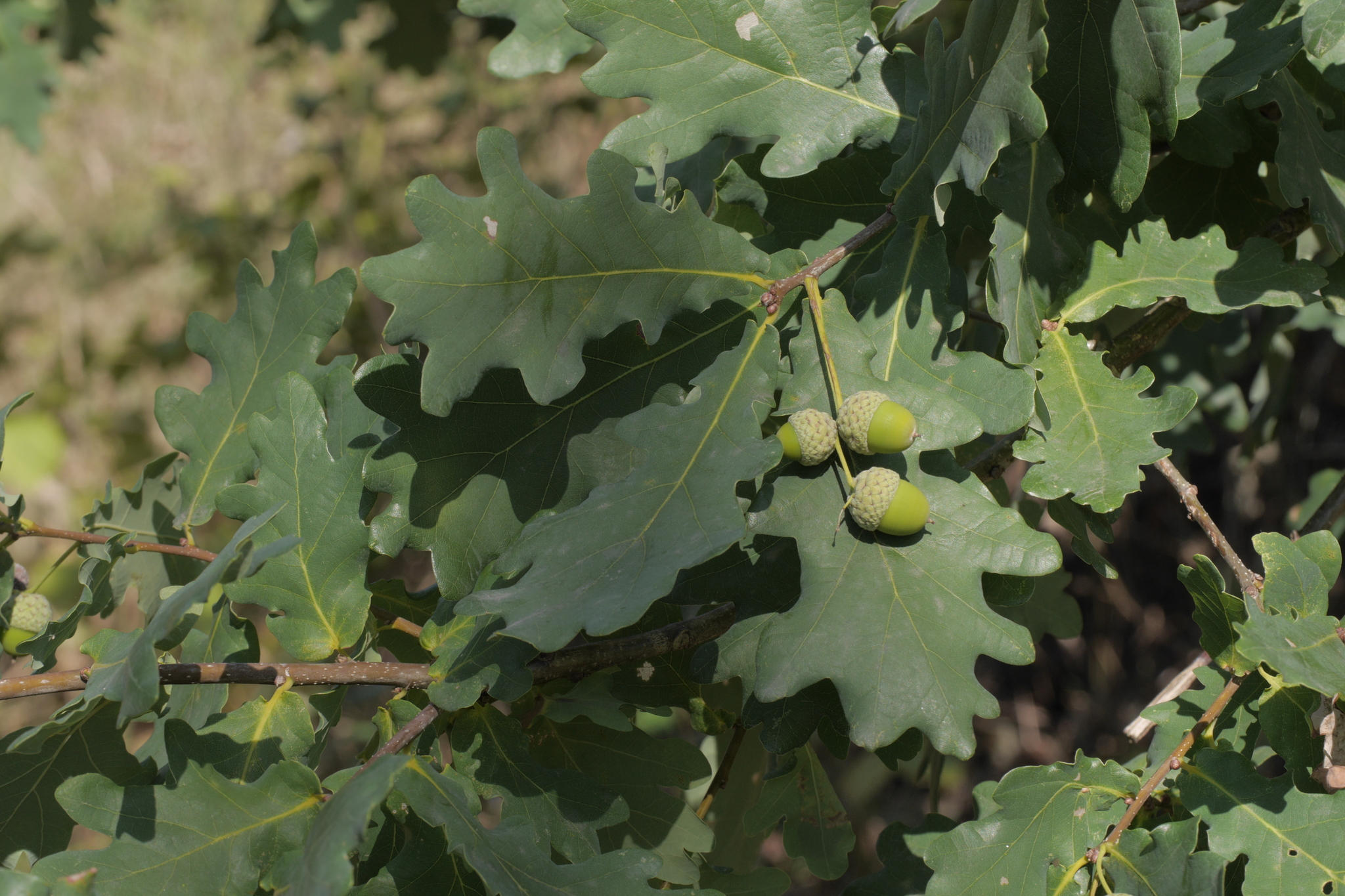
© photo
(c) Felix Riegel, some rights reserved (CC BY-NC), uploaded by Felix Riegel · cc-by-nc
Nico · cc0
Daryl Nolan · cc0
(c) Natalya Ivanova, some rights reserved (CC BY) · cc-by
no rights reserved · cc0
Global distribution
POWO/WCVP records a native range from Europe to Iran, including France. English oak is native in metropolitan France; introductions beyond its native range do not imply an invasive status in France.
- Native8
- Introduced2
- Metropolitan France
- Corsica
- United Kingdom
- Germany
- Italy
- Balkans
- Caucasus
- Iran
- North America
- New Zealand
Hexagons: regions where the plant occurs. Green dots: native range.1
Identity
English oak (Quercus robur L.) is an accepted species in the genus Quercus and the Fagaceae family. POWO/WCVP connects the name with Linnaeus’s publication of 1753 and describes a temperate tree native from Europe to Iran. ↗ ↗
Within metropolitan France, this oak is native rather than an introduced species monitored for invasiveness. Native status does not remove the need for local woodland management or tree health measures; it describes the species’ biogeographic origin. ↗ ↗
Common oak, pedunculate oak and European oak are established names for English oak. Common names vary with context, while the scientific name identifies the species more precisely. “Pedunculate” refers to the elongated stalks carrying its acorns, a useful way to distinguish it from sessile oak. ↗ ↗
Recognition
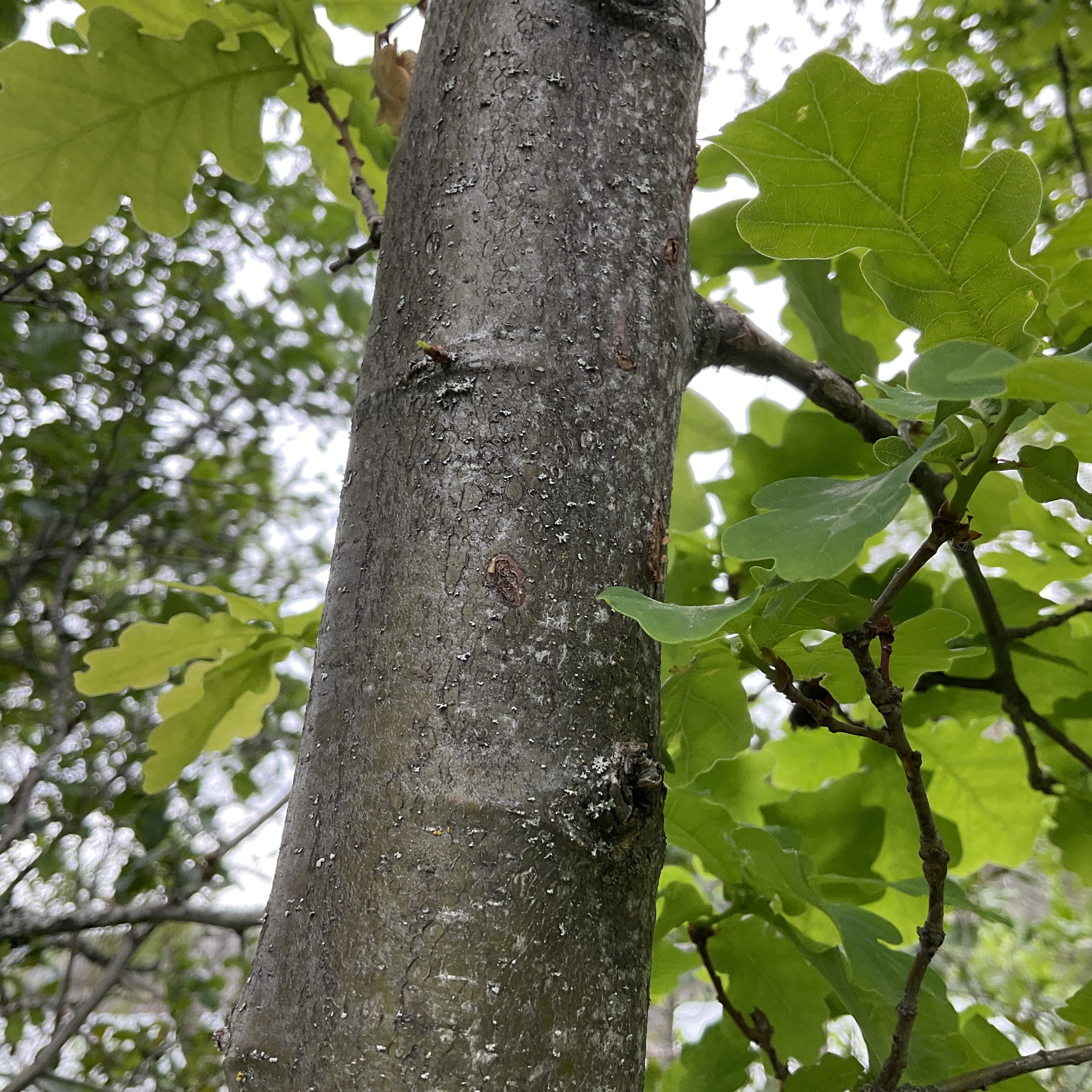
A broad crown and powerful branches characterize mature Quercus robur, a large deciduous tree commonly described as 20–40 m (65–130 ft) tall in cultivation and horticultural accounts. Its trunk becomes massive, gray-brown and fissured with age. Old trees develop cavities, dead wood and small habitats whose ecological value extends beyond the leafy crown. ↗ ↗
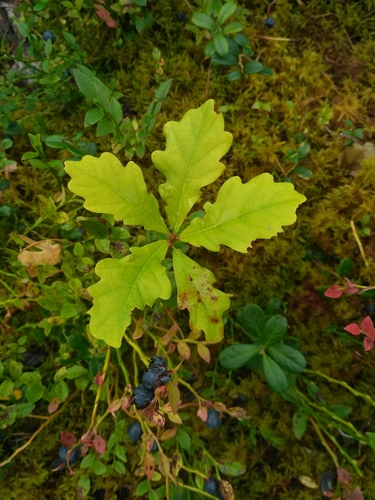
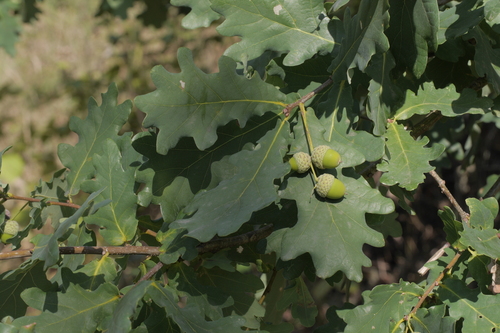
Alternate, dark green leaves have rounded lobes and no spiny margin. The decisive detail is the very short leaf stalk: the blade base appears almost seated on the twig and often forms two small ear-shaped lobes, or auricles. This feature alone is insufficient on an isolated tree, but becomes highly reliable when checked together with the fruit. ↗ ↗
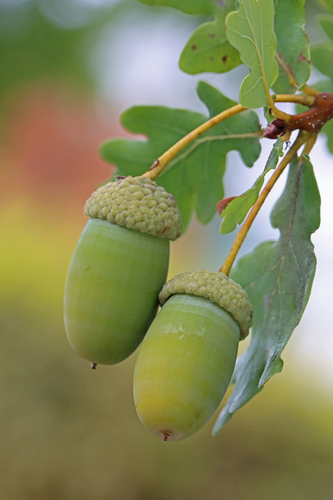
Flowers are inconspicuous. Yellowish male catkins appear in spring, followed by acorns developing from the female flowers. English oak carries its acorns on long stalks, often in small hanging groups. This feature explains the name pedunculate oak and distinguishes it from sessile oak, whose acorns are almost stalkless. ↗ ↗
Taxonomy and names
For naming this species consistently, Quercus robur L. is the accepted botanical reference. POWO and the other taxonomic sources place it in Fagaceae, genus Quercus, with a native range in Europe and western Asia. ↗ ↗ ↗
Oak synonymy is extensive. Quercus longaeva Salisb. is associated with Q. robur as a homotypic synonym, while Quercus pedunculata also occurs in horticultural sources as an old name or synonym. Numerous historically named varieties should not be interpreted automatically as recognized species. ↗ ↗
Hybridization and regional or horticultural variation are common within Quercus. In France, the most useful routine comparison is with sessile oak, Quercus petraea. That species has longer leaf stalks, almost stalkless acorns and an ecology generally better suited to less consistently moist sites. ↗ ↗
Habitat and range
Europe through Iran forms the native range recorded by POWO/WCVP. These sources establish the broad European range rather than a detailed distribution for every French administrative department. Metropolitan France and Corsica fall within the native context, consistent with the taxonomic and forestry references. ↗ ↗ ↗
In France, English oak is associated with plains, valleys, deep soils, clay, loam and moist to wet sites. It tolerates varied soils, including limestone under suitable conditions. Shallow or compacted ground and severe summer drought prevent it from expressing its full growth potential. ↗ ↗
Water availability is an important limit on this oak’s suitability as climates change. It is not equally robust on every site. French forestry documents distinguish it from sessile oak through its stronger preference for soils supplied with water. Planting outside those conditions increases exposure to decline and water stress. ↗
Life cycle, ecology and cultivation
Spring flowering leads to acorns that ripen in autumn and feed a wide range of wildlife, including birds, small mammals and wild hoofed mammals. This food supply accounts for part of the oak’s ecological importance. The same crop also creates a safety concern for domestic animals and livestock. ↗ ↗
Space is the first consideration when planting English oak in a garden. A mature tree greatly exceeds the scale of a compact plot. Planning must allow for the crown and roots, falling acorns, dead branches and the safety responsibilities associated with a tree near a frequently used area. ↗ ↗
The species is propagated from fresh acorns. Named cultivars require a different expectation: seedlings from Fastigiata, Concordia or Variegata do not reliably retain the parent’s form or foliage. Sowing a cultivar’s seed therefore does not guarantee a plant true to that cultivar. ↗ ↗
Uses, edibility and risks
Forestry, landscape planting and ecological value are the principal uses: structural timber, park trees, tall hedges, wooded field boundaries and support for wildlife and biodiversity. English oak timber is often sold together with sessile oak under the general name “oak,” although foresters distinguish their preferred sites and management. ↗ ↗
Acorns have historical uses, including feeding pigs and providing food after preparation. They are unsuitable as a practical food recommendation without more detailed preparation guidance. Raw acorns are tannin-rich, bitter and variable between trees; the references do not provide enough information to turn those historical uses into food advice. ↗ ↗
Animal poisoning is the main safety concern. The ASPCA lists oak as toxic to horses; the consulted ASPCA records leave dog and cat status unknown. Merck and USDA veterinary references chiefly describe poisoning after large intakes of young leaves or acorns, with cattle, sheep and horses particularly affected. ↗ ↗ ↗ ↗
A cautious interpretation is that substantial intake can poison horses and ruminants, dogs warrant caution, and the sources do not establish the risk to cats. Children and adults should not treat raw acorns as freely edible. Substantial ingestion or digestive symptoms call for medical or veterinary advice. ↗ ↗
Cultivars and look-alikes
Horticultural forms of English oak include 'Fastigiata' with a columnar habit, 'Concordia' with golden foliage, 'Variegata' with variegated leaves, 'Pendula' with a weeping habit and 'Attention' with a narrow form. These are cultivated selections rather than the ordinary forms found in spontaneous woodland. ↗ ↗
Sessile oak, Quercus petraea, is the most useful comparison for identification. Both species are frequent in France and their timbers are often grouped commercially. On a living tree, checking leaf stalks, basal auricles, acorn stalks and the growing site together gives better results than relying on one character. ↗ ↗
Oaks also form hybrids and local variants. A single isolated leaf, an acorn picked up from the ground or a nursery cultivar can therefore encourage excessive certainty. Where identification matters for tree health, heritage management or forestry, examine a complete twig, the whole tree and the site context together. ↗ ↗
Main sources
- Plants of the World Online / Kew, Quercus robur L.
- WCVP record, Quercus robur L.
- Royal Horticultural Society, Quercus robur common oak
- RHS plant information, Quercus robur common oak
- NC State Extension Gardener Plant Toolbox, Quercus robur
- Kew, Common oak
- French Ministry of Agriculture / CNPF, English oak profile
- ASPCA, Oak toxicity entry
- Merck Veterinary Manual, Oak Toxicosis in Animals
- ASPCA list of toxic plants, oak
- Perenual plant information, Quercus robur
- Trefle, species data, Quercus robur
- French Wikipedia, Chêne pédonculé (English oak)
Frequently asked questions
Is English oak native to France?
Yes. Taxonomic sources place Quercus robur within its European native range and include France. No invasive non-native species status is assigned to it in metropolitan France.
How can I distinguish Quercus robur from Quercus petraea?
English oak has very short leaf stalks, often with small ear-shaped lobes at the leaf base, and acorns on long stalks. Sessile oak generally has longer leaf stalks and almost stalkless acorns.
Are English oak acorns edible?
Acorns have historical uses after preparation, but are not recommended as a practical food. Raw acorns are tannin-rich and bitter, and dangerous to some animals when eaten in quantity.
Is English oak poisonous to horses?
Yes, strong caution is needed. Oak acorns and young leaves can cause digestive and kidney problems in horses and ruminants, especially after substantial intake.
Can I plant English oak in a small garden?
It is generally unsuitable. This species becomes a very large tree, often 20–40 m tall, with a broad crown and a long lifespan.
Does English oak tolerate drought?
Once established, it tolerates ordinary dry spells, but French forestry sources describe it as less suited to severe summer drought than sessile oak.
Similar plants
If you are unsure about a plant’s toxicity, ask a botanist or veterinarian for advice.