
Pineapple (Ananas comosus, )
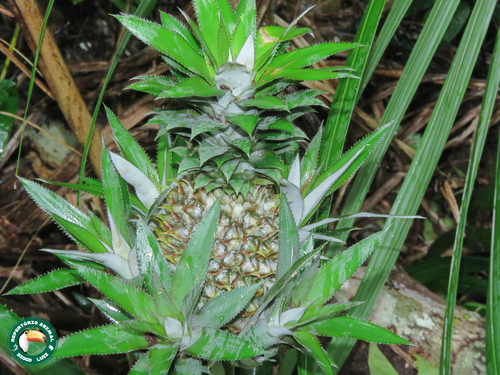
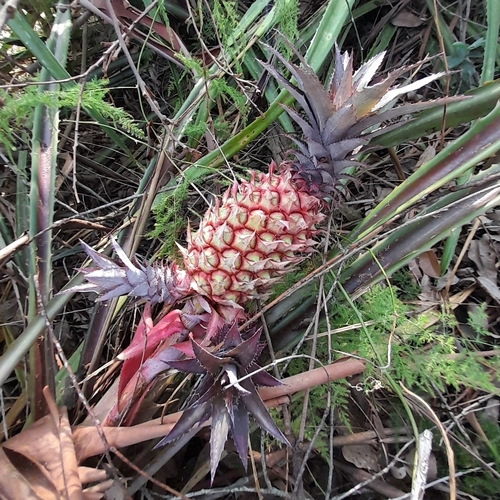
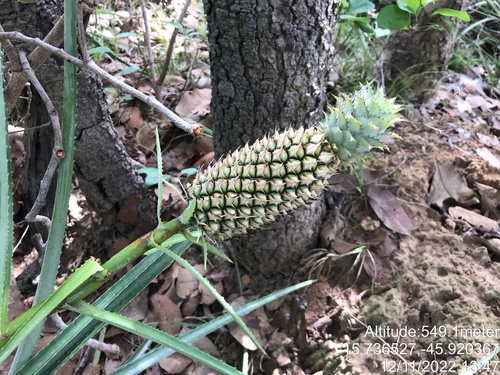
The pineapple (Ananas comosus (L.) Merr.) is an herbaceous perennial in the bromeliad family, Bromeliaceae, native to the Paraná-Paraguay basin of South America. Unlike many epiphytic bromeliads, it grows in the ground as a dense rosette of stiff leaves. Domesticated long before Europeans arrived, it bears a single multiple fruit formed by the fusion of about a hundred flowers and topped by a tuft of leaves.
Read morePiña and Abacaxi
Allow a few hours of direct sun per day, preferably morning or evening.
Global distribution
The pineapple's native range runs from Costa Rica to tropical South America, with a probable center of origin in the Paraná-Paraguay basin, between southern Brazil and Paraguay. Pre-Columbian domestication carried it across tropical America before Europeans arrived, and colonial trade then spread it throughout the world's tropics.
- Native3
- Introduced4
- Brazil
- Paraguay
- Bolivia
- Costa Rica
- Guatemala
- Honduras
- Trinidad and Tobago
Hexagons: sourced regions. Green dots: native range. Statuses according to POWO (Kew).
Identity
The pineapple (Ananas comosus (L.) Merr., 1917) is an herbaceous perennial in the bromeliad family, Bromeliaceae, and the only species of the genus Ananas truly domesticated for its fruit. Many bromeliads sold as houseplants are epiphytes, but this one grows in the ground, as a rosette, in well-drained soil. 1 2
Linnaeus first described the plant as Bromelia comosa in 1753; the current combination, Ananas comosus, is the work of the American botanist Elmer Drew Merrill in 1917. The epithet comosus, Latin for "long-haired," refers to the tuft of leaves crowning the ripe fruit, known as the crown. French references add the qualifiers ananas cultivé and ananas commun to set the crop species apart from the ornamental pineapples of the same genus. 1 3
Recognition
NC State describes a slow-growing herbaceous perennial that forms a compact clump 0.9–1.2 m (3–4 ft) tall and about as wide. Morton notes a rosette of waxy, strap-shaped leaves 50–180 cm (20–70 in) long, their margins often armed with hooked spines, except in the "smooth" cultivars selected for hand harvesting. Depending on the variety, the gray-green foliage may carry red, yellow or ivory stripes. 4 5
Once the plant is mature, a single conical spike rises from the center of the rosette. RHS describes clusters of small purple flowers with reddish yellow bracts, opening in succession before they fuse into one fruit. 6
Botanically, the fruit is a multiple fruit, or sorosis: about a hundred flowers, their bracts and the floral axis merge into one fleshy mass, its rind patterned with hexagonal "eyes." Morton describes it as dark green when immature, turning yellow, orange or reddish depending on the cultivar, and RHS gives a height of up to 30 cm (12 in). A tuft of short leaves, the crown, always sits on top. 5 6
Useful taxonomy
Ananas belongs to the subfamily Bromelioideae within the Bromeliaceae and holds only a handful of accepted species. Ananas comosus is the only one grown on a large scale for fruit; the others remain confined to ornamental horticulture or collections. 1
Several historical names and botanical varieties circulate in the synonymy and in the trade:
- Bromelia comosa L., the 1753 basionym
- Bromelia ananas L.
- Ananas sativus Schult. & Schult.f.
- Ananas comosus var. bracteatus (Lindl.) Coppens & F.Leal
- Ananas comosus var. erectifolius (L.B.Sm.) Coppens & F.Leal
The accepted botanical varieties are more than synonyms. Var. bracteatus is the red ornamental pineapple, with showy spiny bracts and barely edible fruit, while var. erectifolius is the fiber pineapple, grown in Amazonia for its textile leaves rather than its fruit. For the common fruiting pineapple, the dependable name is Ananas comosus var. comosus. 1
Habitat and range
Its native range stretches from Costa Rica to tropical South America, with a probable center of origin in the Paraná-Paraguay basin, between southern Brazil and Paraguay. 5 4
PFAF places its natural habitat in lowland savannas and forest edges of the humid tropics, up to 1,800 m (5,900 ft), on well-drained soil rich in organic matter. 2
Domestication predates European contact: Indigenous peoples of tropical America had already carried the plant far beyond its native range when Christopher Columbus encountered the fruit on Guadeloupe in 1493, then in Panama in 1502. Portuguese and Spanish trade then brought it to the Philippines and Hawaii in the 16th century, to China in 1594, to South Africa around 1655 and to Europe in 1650, where greenhouse cultivation began in England in 1712. It has since naturalized in Costa Rica, Guatemala, Honduras and Trinidad. 5
Life cycle and reproduction
Growers almost always propagate pineapple vegetatively, from the fruit crown, side shoots ("slips"), basal shoots ("suckers") or regrowth from the old stool ("ratoons"). Morton gives a planting depth of 5 cm (2 in) for crowns, against 9–10 cm (3.5–4 in) for slips and suckers. 5
One commercial propagation method cuts the stem lengthwise into four triangular strips, set 10 cm (4 in) apart in sterilized medium. Shoots appear in 3–5 weeks and can be transplanted after 6–8 weeks, a quick way to multiply a cultivar without going through seed. 5
Time to fruiting depends on the starting material. A seedling 15–18 months old still needs another 16–30 months to fruit, whereas a plant grown from a crown or slip fruits in 15–22 months. In Puerto Rico, the Red Spanish cultivar reaches harvest about 150 days after natural flowering. 5
Uses and risks
Ripe pineapple is eaten fresh, in fruit salads or compotes, baked in pies or served as a side, and above all canned, by far its largest commercial outlet worldwide. In the Philippines the fermented pulp becomes nata de piña; elsewhere, young shoots, the terminal bud and the inflorescences are eaten raw or cooked. 5
PFAF describes the fruit as rich in vitamins A and C, with bromelain aiding digestion; the leaves have a traditional use as a vermifuge and purgative. 2
Unripe fruit, by contrast, is not fit to eat: Morton describes it as irritating to the throat and strongly purgative. Even ripe, the sap and flesh can irritate the mouth and skin of sensitive people, an effect attributed to bromelain and to calcium oxalate crystals in the tissues. 5 4
The leaves also yield a white, silky fiber, extracted in the Philippines before 1591 by retting in water. This cloth, called piña, is still woven today on the island of Panay and in Taiwan. 5
Varieties, look-alikes and related plants
World commercial production rests on a small number of cultivars. Smooth Cayenne, selected in Venezuela and introduced from French Guiana in 1820, dominates the canning market with nearly spineless fruit of 1.8–4.5 kg (4–10 lb) and yellow, low-fiber flesh. Queen is a dwarf, compact form, hardier against cold and disease, with more fragrant fruit of 0.45–1.13 kg (1–2.5 lb). Red Spanish, spines and all, remains widely grown in the Caribbean, Venezuela and Mexico, with orange-red fruit of 1.4–2.7 kg (3–6 lb). Abacaxi and Sugarloaf, with very sweet white flesh, are too fragile for commercial shipping and stay local-market varieties. 5
NC State also mentions an ornamental cultivar with cream-variegated leaves, grown for its foliage more than its fruit. 4
Confusion here rarely involves other genera. It comes from the botanical varieties of Ananas comosus itself: var. bracteatus, the red ornamental pineapple with spiny bracts, should not be planted in the hope of good edible fruit, and var. erectifolius, grown for fiber in Amazonia, does not produce the familiar commercial fruit either. Depending on what you want from the plant, the cultivar name matters more than the binomial alone. 1 5
Main sources
- Plants of the World Online / Kew, Ananas comosus (L.) Merr.
- Royal Horticultural Society, Ananas comosus, pineapple
- NC State Extension Gardener Plant Toolbox, Ananas comosus
- Julia Morton, Fruits of Warm Climates, Pineapple
- Plants For A Future, Ananas comosus
- INPN MNHN, Ananas comosus (L.) Merr., 1917
- Tela Botanica eFlore BDTFX, Ananas comosus
Frequently asked questions
Is pineapple toxic to cats or dogs?
The ASPCA lists pineapple as non-toxic to cats and dogs. The sap and unripe fruit can still irritate the mouth and skin, and the spiny leaves pose mainly a mechanical risk.
Why won't my pineapple plant fruit?
The plant needs full sun and enough maturity. Flowering usually comes only after 15 to 22 months of vegetative growth, and rarely happens indoors in poor light.
Can you grow a pineapple from the crown of a store-bought fruit?
Yes. The crown roots within a few weeks in a slightly moist mix, but the plant then takes several years to fruit, especially without strong light and steady warmth.
Is unripe pineapple dangerous?
Unripe fruit is described as irritating to the throat and strongly purgative if eaten. Wait for full ripeness, shown by a yellow to reddish rind.
What is the difference between the edible pineapple and the red ornamental pineapple?
The red pineapple is the botanical variety Ananas comosus var. bracteatus, grown for its showy spiny bracts, not for good edible fruit like the typical variety.
Where does the pineapple come from?
Its probable center of origin lies in the Paraná-Paraguay basin, between southern Brazil and Paraguay. Indigenous peoples spread it across tropical America well before Europeans arrived.
What are the main commercial pineapple varieties?
Smooth Cayenne dominates the world canning industry, Queen gives more fragrant fruit on a dwarf plant, and Red Spanish is still widely grown in the Caribbean and Central America despite its spines.
Similar plants
Botanical data compiled from reference sources (RHS, Kew Gardens, POWO). This profile is for guidance only and is not a substitute for advice from a botanist or veterinarian if you have concerns about toxicity.