
Greater burdock (Arctium lappa, )

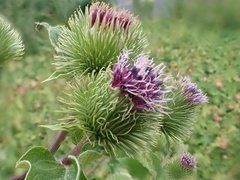
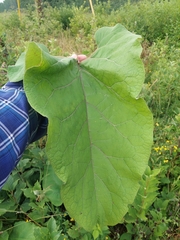
Greater burdock (Arctium lappa L., 1753) is a biennial in the Asteraceae, native to temperate Europe and Asia. Large heart-shaped leaves have woolly undersides, and purple flower heads in flat-topped clusters become hooked burs. The fleshy root is grown as a vegetable, notably in Japan as gobo; the hooks inspired Velcro.
Read moreGreater burdock, Great burdock and Gobo
Allow a few hours of direct sun per day, preferably morning or evening.
Full sun to partial shade


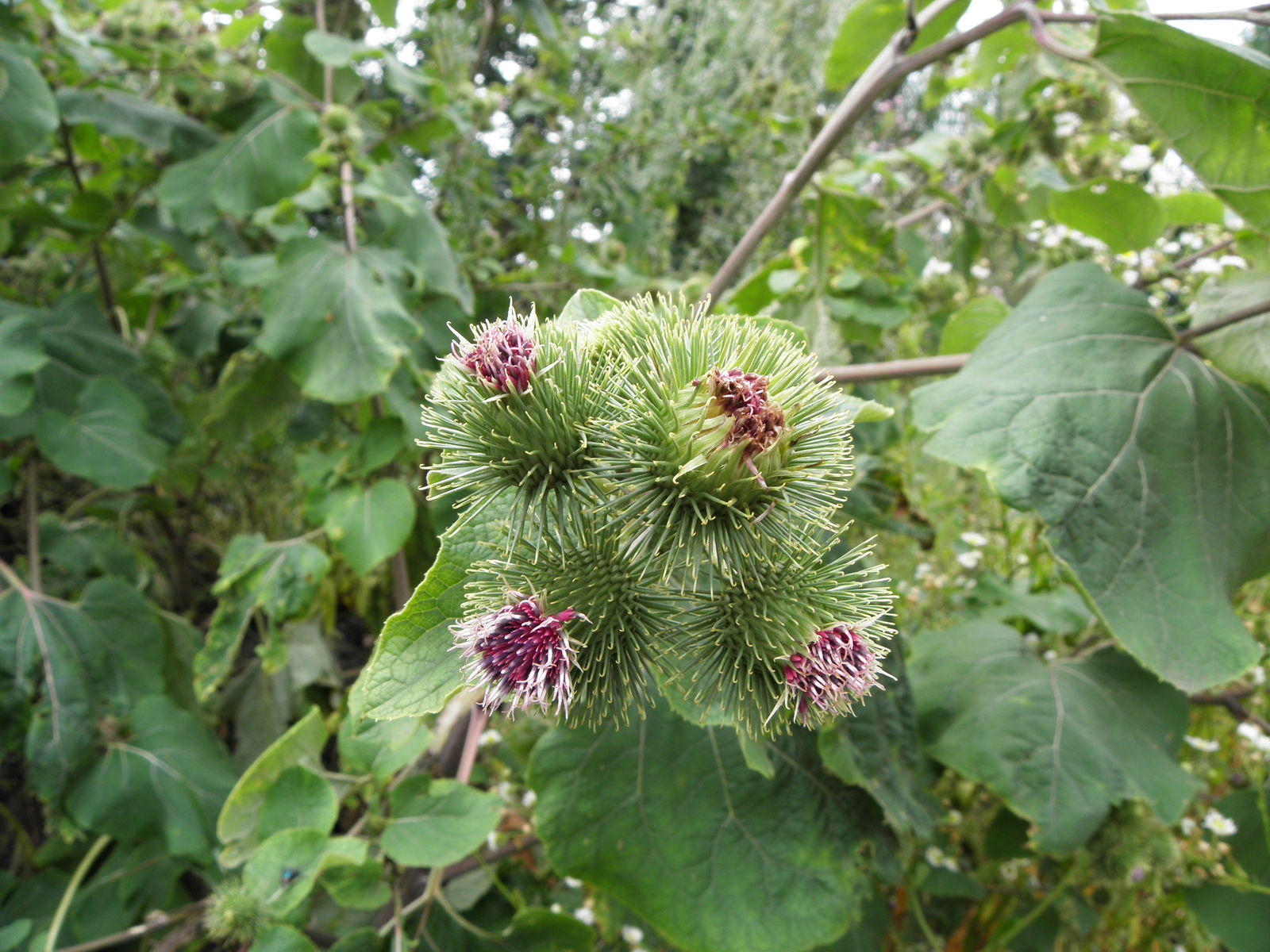
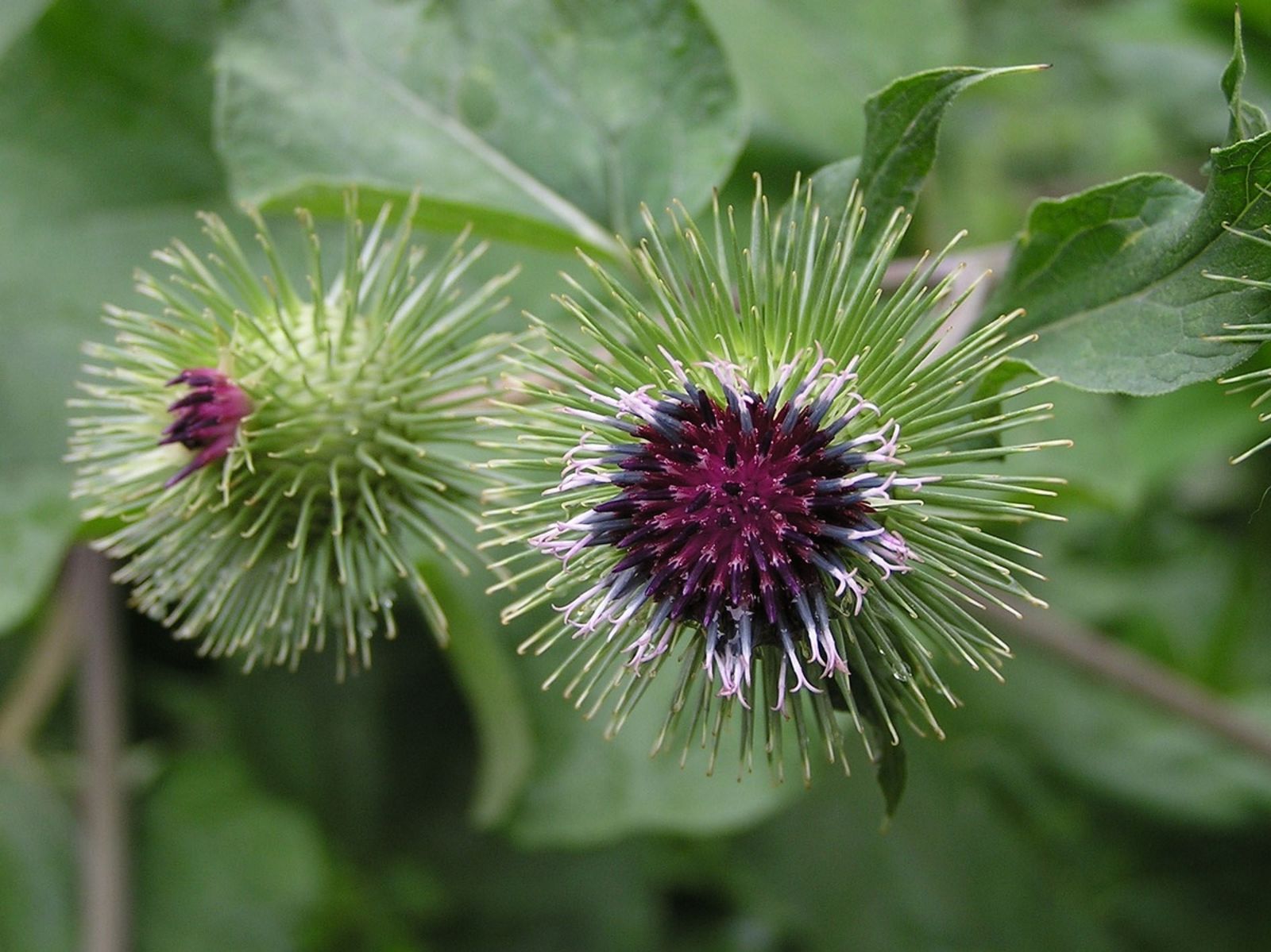

© photo
(c) tlit46, some rights reserved (CC BY-NC), uploaded by tlit46 · cc-by-nc
Jean-Paul Boerekamps · cc0
Carter Dorscht · cc0
Taken May 16, 2022 by yvon s (cc-by-sa)
Taken May 8, 2021 by Oosaagi (cc-by-sa)
Taken Jul 8, 2022 by Kai Best (cc-by-sa)
Taken Jun 18, 2021 by virginie boubee (cc-by-sa)
Taken Jul 20, 2021 by Plant_Anne (cc-by-sa)
© copyright of the Board of Trustees of the Royal Botanic Gardens, Kew.




Global distribution
Greater burdock is native to temperate Europe and Asia, where it grows on nitrogen-rich waste ground, rubble and path margins. It has been widely introduced to North and South America, ranging from unobtrusive naturalization to spreading populations monitored beside crops.
- Native4
- Introduced3
- France
- Germany
- Italy
- China
- Canada
- United States
- Brazil
Hexagons: regions where the plant occurs. Green dots: native range.1
Identity
Greater burdock (Arctium lappa L., 1753), also called great burdock or gobo, is a biennial in the Asteraceae. Arctium comes from Greek arktos, “bear,” referring to its shaggy appearance; lappa derives from Greek lambanô, “to seize,” describing the hooks surrounding its fruits. 8 1
The French name bardane traces back through medieval Latin bardana and late Latin dardana to a Germanic word for a dart or small arrow, referring to the barbed fruits. 8
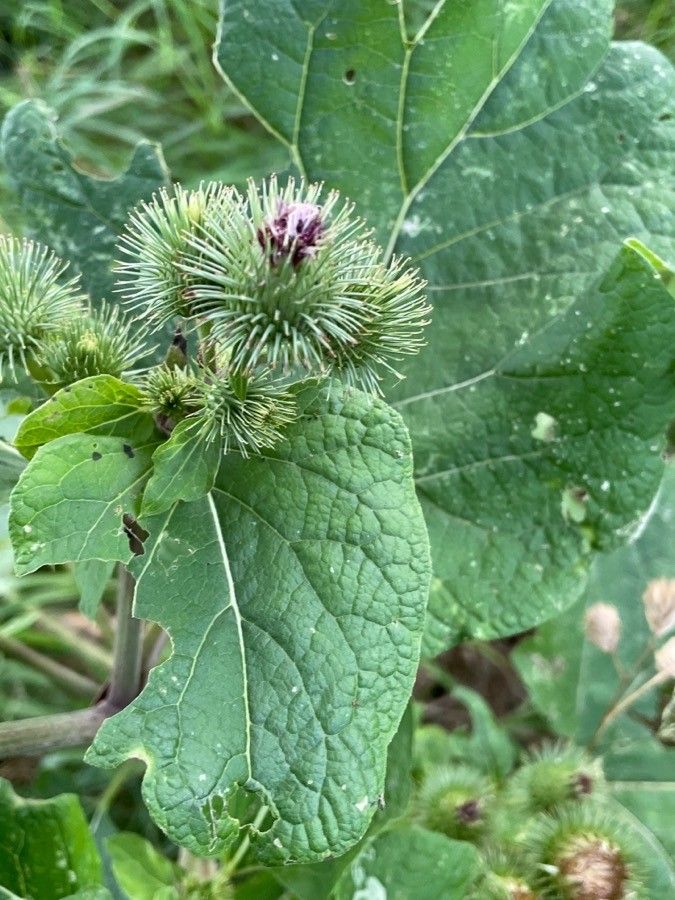
A useful field distinction from other burdocks is the basal leaf stalk: unlike the hollow petiole of Arctium minus, greater burdock's is solid and grooved along its length. 4
Recognition
Greater burdock commonly grows 1.5–3 m (5–10 ft) tall and 1–1.5 m (3–5 ft) across. Its fleshy taproot reaches down to 50 cm (20 in), brown outside and white inside. 2 8
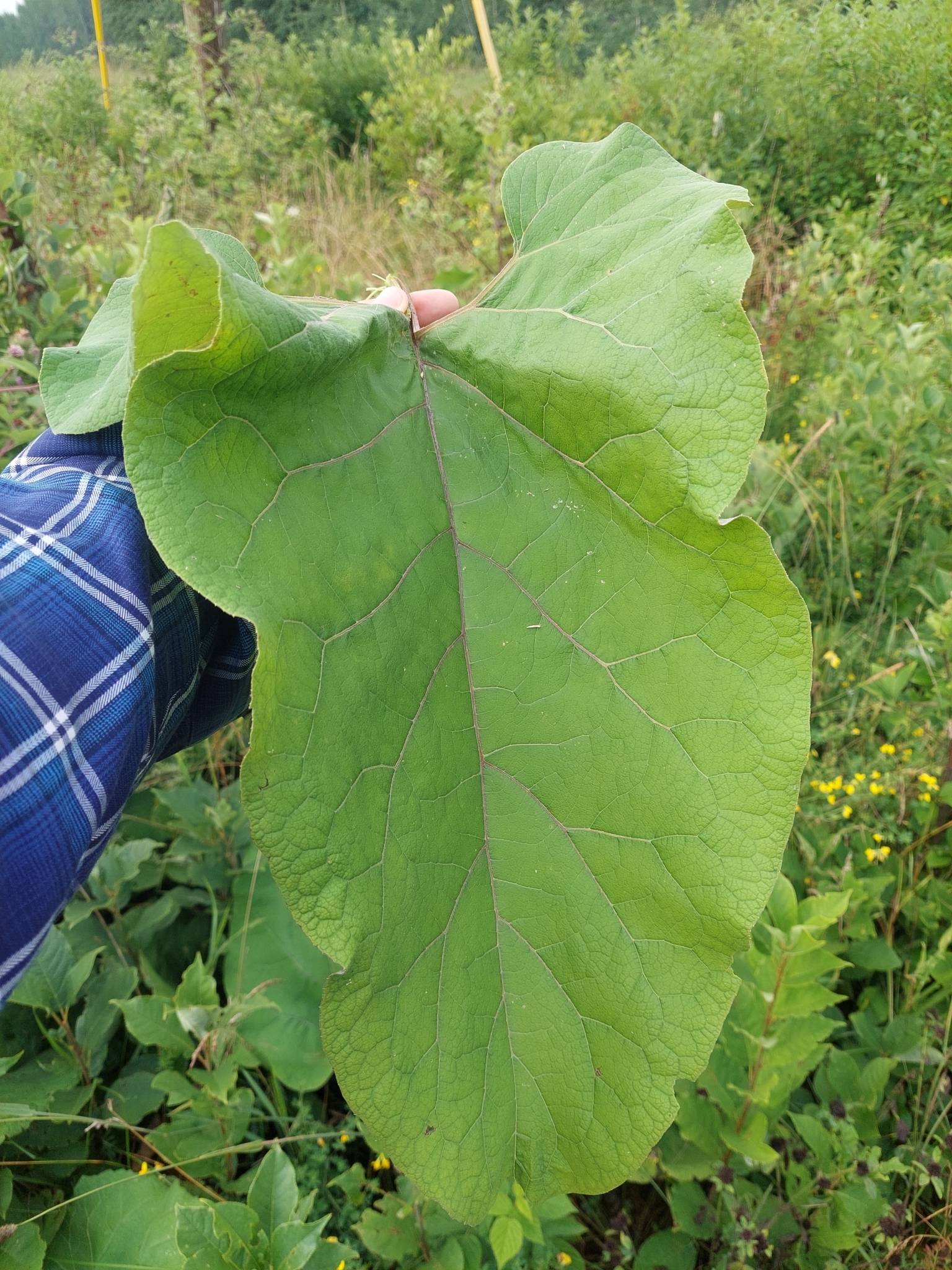
Broad, heart-shaped basal leaves are often more than 15 cm (6 in) long, dull green above and whitish-woolly underneath. Their solid petioles have an upper groove, distinguishing the plant from its close relative Arctium minus, which has hollow petioles. 4
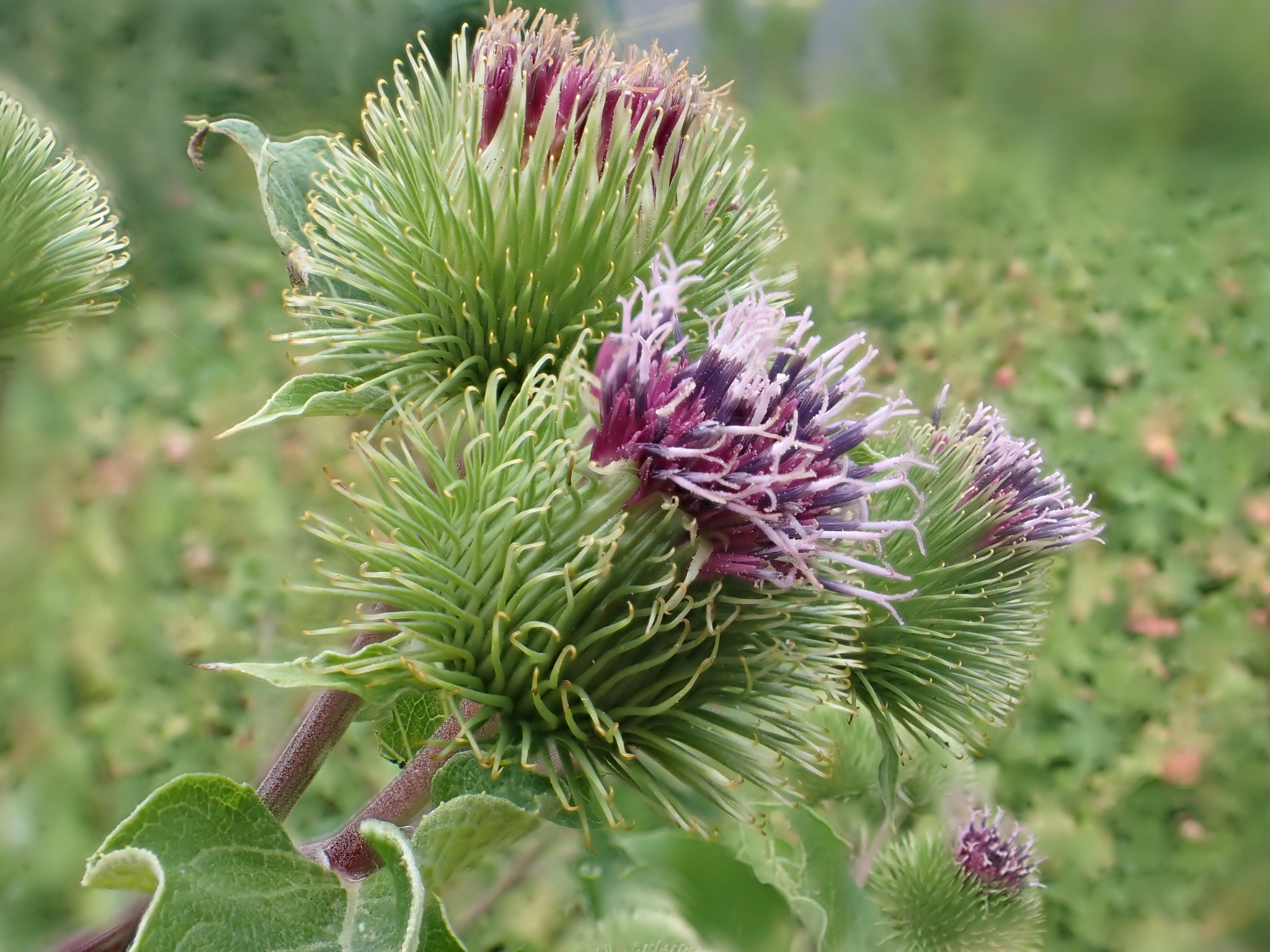
Purple flower heads 2.5–4 cm (1–1.6 in) across form flat-topped corymbs on branched, grooved stems during summer into early fall. Each spent head becomes a bur surrounded by hooked bracts, enclosing gray to brown achenes 5–6 mm (0.20–0.24 in) long with a short, yellowish pappus. 4 8
Useful taxonomy
Plants of the World Online accepts Arctium lappa L., published in 1753, as a member of the Asteraceae native to temperate Eurasia. 1 6
Names found in its botanical synonymy include:
- Arctium lappa var. tomentosum A.Gray
- Arctium lappa var. purpurascens Fernald & Wiegand
- Arctium lappa subsp. nemorosum (Lej.) P.D.Sell
- Arctium lappa subsp. pubens (Bab.) P.D.Sell
Related species such as Arctium minus and Arctium tomentosum share the general name “burdock” but are different plants. The scientific name remains the reliable reference when buying seed or identifying a plant. 1
Habitat and distribution
Greater burdock is native to temperate Europe and Asia, growing on waste ground, rubble, path margins and banks in nitrogen-rich soil. 1 8
It is common throughout France, associated with disturbed ground and places near human habitation rather than undisturbed natural habitats. 8
Introductions have taken it well beyond its native range, notably to Canada, the northeastern and parts of the central United States, and Brazil, where it grows beside roads and cultivated land. 4
Life cycle and reproduction
Greater burdock is biennial. Seed germinates in local spring and produces a first-year leaf rosette without a flowering stem, while the taproot thickens underground. 4
After overwintering as a rosette, the vernalized plant sends up a branched stem the following spring, sometimes exceeding 2 m (6.6 ft), then flowers in corymbs through summer into early fall. 4 2
Spent heads become hooked burs that attach to fur or clothing, carrying the achenes long distances rather than relying on wind. This attachment directly inspired Swiss engineer George de Mestral's invention of Velcro. In 1941 he examined burs caught in his dog's coat after an Alpine walk and developed the fastening mechanism, patented fourteen years later. 8 7
Uses and risks
Harvested in the fall of the first year before bolting, the root is cooked as a vegetable resembling salsify. It contains about 45% inulin, an indigestible storage carbohydrate. 3 8
In Japan it is grown commercially as gobo, used in dishes such as kinpira gobo: the root is cut into thin sticks and braised with soy sauce. 8
NC State Extension reports no ingestion toxicity in humans or domestic animals, but describes a substantial mechanical hazard. Hooks and bristles can severely irritate eyes, skin or airways in humans, dogs, horses and other livestock. Entanglement in burs has killed small birds and bats. 4
Roots and leaves are also studied for arctigenin, chlorogenic acid and flavonoids, compounds with antioxidant and anti-inflammatory effects reported in laboratory and animal studies. 5
Varieties, lookalikes and related plants
Greater burdock has no widely grown ornamental cultivar, but vegetable varieties have been selected for root length and tenderness. 'Takinogawa' is a long-rooted Japanese heritage variety from the Edo period; 'Watanabe Early' matures earlier and has a shorter root. 3
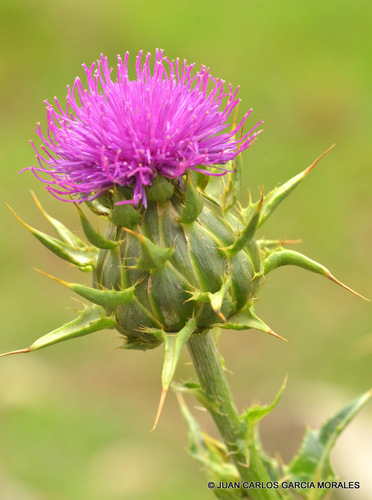
Two related burdocks can cause confusion: Arctium minus is smaller with hollow rather than solid petioles, while Arctium tomentosum has cottony hairs on the flower-head bracts, absent in greater burdock. Silybum marianum grows in similar disturbed habitats but belongs to another genus. Its white-marbled leaves and fruit without hooks distinguish it readily.
The solid, grooved petiole is therefore more reliable than overall height or flower-head color, both of which vary with growing conditions, for confirming Arctium lappa in the field. 4
Main sources
- Plants of the World Online / Kew, Arctium lappa L.
- Royal Horticultural Society, Arctium lappa - greater burdock
- Plants For A Future, Arctium lappa - Greater Burdock
- NC State Extension Gardener Plant Toolbox, Arctium lappa
- PMC, review of Arctium lappa root phytochemistry and pharmacology
- Integrated Taxonomic Information System, Arctium lappa L.
- National Inventors Hall of Fame, how a walk in the woods led to Velcro
- Reader file from Wikipedia FR, Grande bardane
Frequently asked questions
Is greater burdock toxic to cats and dogs?
No ingestion toxicity is documented. The main risk is mechanical: mature flower-head hooks can irritate skin, eyes or airways and become persistently tangled in fur.
Why do burs cling so strongly to fur and clothes?
Curved hooks tip the bracts surrounding each mature head. Swiss engineer George de Mestral examined them in his dog’s coat in 1941, directly inspiring the invention of Velcro.
Can you eat greater burdock root?
Yes. Harvested in the fall of its first year before bolting, it is cooked like salsify. It is grown commercially in Japan as gobo.
How do you distinguish Arctium lappa from other burdocks?
The most reliable feature is the basal leaf petiole, solid and grooved in Arctium lappa but hollow in Arctium minus. Greater height and larger flower heads support identification.
Why does my burdock not flower in its first year?
It is biennial. The first year produces a rosette without a flower stem while the root thickens underground. Flowering follows a winter of vernalization in the second year.
How do you keep greater burdock from taking over a garden?
Cut heads as they start browning, before mature hooked burs attach to animals and disperse the achenes. This is the only measure needed to contain self-sowing.
Is greater burdock dangerous to birds?
NC State Extension reports that entanglement in burs has killed small birds and bats. This is a mechanical hazard distinct from ingestion toxicity.
Similar plants
If you are unsure about a plant’s toxicity, ask a botanist or veterinarian for advice.