
Elephant's-foot (Beaucarnea recurvata, )
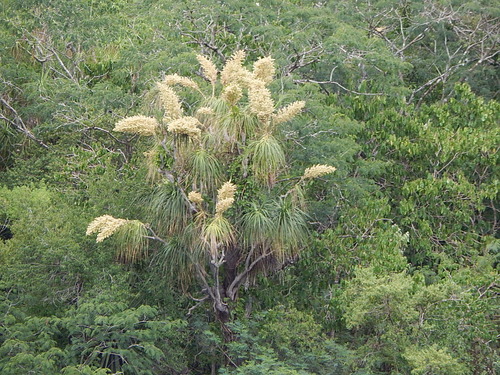
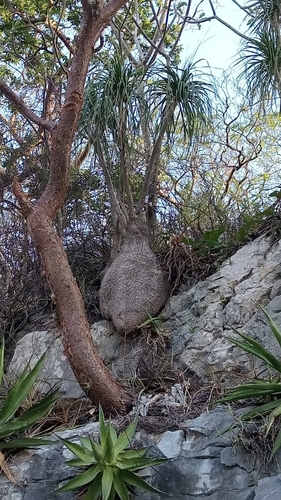
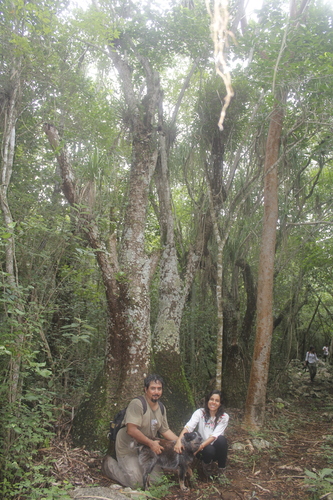
Elephant's-foot (Beaucarnea recurvata), better known in many shops as ponytail palm, is a tree-like plant in the family Asparagaceae, native to the dry regions of eastern Mexico. Despite the palm label, it is not a true palm: its swollen base, a water-storing caudex, carries a tuft of long, narrow, drooping leaves.
Read morePonytail palm, Bottle palm and Nolina
Global distribution
The native range of Beaucarnea recurvata is limited to eastern Mexico. The IUCN now considers it confined to the state of Veracruz, while botanical databases also list Oaxaca, Puebla, San Luis Potosí and Tamaulipas. Widely grown as an ornamental, the ponytail palm is cultivated far beyond this narrow range.
Identity
Elephant's-foot (Beaucarnea recurvata (K.Koch & Fintelm.) Lem.), sold just as often as ponytail palm, is a tree-like plant in the genus Beaucarnea, family Asparagaceae. The palm in its trade name comes from the tuft of drooping leaves; the species has no close link to the true palms. 1 2
Across much of the English-speaking world it is known above all as an easygoing houseplant, labeled elephant's-foot, ponytail palm or bottle palm. Its most striking feature is the strongly swollen base, a caudex that stores water and gives the plant its unmistakable outline. 3 4
Recognition
Look first at the caudex: a trunk whose base thickens into a woody bulb with gray, fissured bark, topped by a narrower stem. On very old specimens this water reserve can reach 1 m (3.3 ft) across; in a pot it stays far more modest. 4 5
At the top sits a crown of long, narrow strap-like leaves, slightly rough along the margins, that spill down like a fountain. On a mature plant they commonly measure 1 m (3.3 ft) long, sometimes more, while staying only 1–2 cm (0.4–0.8 in) wide. 3 6
Grown indoors, the plant stays compact at 1–2 m (3.3–6.5 ft) and grows slowly. In its Mexican range it becomes a genuine tree that can reach 9 m (30 ft), on a massive caudex built up over decades. 5 4
Useful taxonomy
Charles Lemaire published the name Beaucarnea recurvata (K.Koch & Fintelm.) Lem. in 1861. The genus Beaucarnea sits close to Nolina, which accounts for many of the older names and nursery labels; the main synonyms to know are:
- Nolina recurvata (Lem.) Hemsl.
- Beaucarnea tuberculata Roezl
- Pincenectia recurvata (Lem.) Lem.
- Nolina tuberculata (Roezl) hort.
The stable reference is the accepted scientific name, Beaucarnea recurvata. Its place in Asparagaceae is itself fairly recent: long classified under Agavaceae or Nolinaceae, the species now sits in this broad family. 1 2
Habitat and range
Home ground for Beaucarnea recurvata is the semi-arid east of Mexico. The IUCN now considers its range confined to the state of Veracruz, but standard botanical databases also list Oaxaca, Puebla, San Luis Potosí and Tamaulipas. There it grows on rocky, free-draining soils, in dry forest and xeric scrub. 1 4
The caudex is the key adaptation to this setting. By storing water, it carries the plant through long dry seasons without harm. That drought strategy is why the plant fears excess moisture far more than drought. 5 6
Widely grown as an ornamental, elephant's-foot now turns up far beyond its native range: as a garden plant where climates are mild and frost is rare, and as a houseplant elsewhere. These cultivated areas should be kept separate from the small, closely watched native range in Mexico. 3 2
Life cycle and reproduction
Male and female flowers grow on separate plants: the species is dioecious. Flowering mostly appears on old specimens, as a large upright panicle of small cream flowers in summer. In a pot it is a rare event, and the plant is grown for its shape rather than its blooms. 4 5
Pollinated flowers produce small capsules holding the seeds. Growing from seed is the most reliable route, though a slow one: a seedling needs several years to form a visible caudex. Sow in warmth, in a very free-draining mix, keeping it barely moist until the seedlings emerge, roughly three to six weeks later. 6 3
A second option is to separate the offsets that sometimes form at the base of the caudex on older plants. Carefully detached and rooted in a free-draining mix, they reproduce the parent plant faithfully. Either way, patience rules: this is one of the most unhurried houseplants there is. 5 4
Uses and risks
Today Beaucarnea recurvata is grown almost entirely as an ornamental: a low-fuss houseplant or, where the climate is mild, dry and largely frost-free (roughly USDA zones 9 to 11), a garden tree with a dramatic silhouette. Its longevity is remarkable, with specimens several centuries old recorded in Mexico. 4 2
For households with animals, elephant's-foot is one of the most reassuring large houseplants. The ASPCA lists it as non-toxic to cats, dogs and horses, with no signs of poisoning reported. It can share a home safely with pets, which is unusual for an indoor plant of this size. The only real risk comes from care: a potting mix kept too wet rots the caudex. 7 5
Varieties, look-alikes and related plants
Most plants on sale are the wild form with a single caudex. You will also find multi-headed specimens, produced by pruning or natural branching, that carry several tufts of leaves. These are not separate species. Before buying, check that the caudex is firm, free of soft spots, and that the foliage looks even. 3
Common look-alikes include:
- Beaucarnea stricta, with stiffer, more upright leaves
- Beaucarnea guatemalensis, closely related but different in habit and coloring
- Nolina species, a neighboring genus with comparable habit and foliage
A swollen, gray-barked caudex and long, narrow, drooping leaves remain the most reliable clues that a plant sold as elephant's-foot really is Beaucarnea recurvata. 1 4
Main sources
- Plants of the World Online / Kew, Beaucarnea recurvata (K.Koch & Fintelm.) Lem.
- Royal Horticultural Society, Beaucarnea recurvata, ponytail palm
- Missouri Botanical Garden, Beaucarnea recurvata
- North Carolina State Extension, Beaucarnea recurvata
- Plants For A Future, Beaucarnea recurvata
- ASPCA, Bottle Palm (Beaucarnea recurvata) non-toxic plant entry
- Wikipedia, Beaucarnea recurvata
Frequently asked questions
Is Beaucarnea recurvata toxic?
No. The ASPCA lists elephant's-foot as non-toxic to cats, dogs and horses. It is one of the safest large houseplants to keep around pets.
Is elephant's-foot a true palm?
No, despite the name ponytail palm. It belongs to the family Asparagaceae and is not closely related to the true palms (Arecaceae); only its tuft of drooping leaves explains the mix-up.
Why is the base of my Beaucarnea swollen?
That swelling is a caudex, a water-storage organ that helps the plant get through the dry seasons of its Mexican range. It thickens slowly with age and gives the plant its elephant's-foot silhouette.
How often should you water elephant's-foot?
Water sparingly, roughly once every two to three weeks in summer and once a month in winter, letting the potting mix dry out completely in between. Too much water rots the caudex.
Does Beaucarnea recurvata flower indoors?
Flowering is rare and comes late. It mostly appears on old plants, as an upright panicle of small cream flowers in summer. Indoors, the plant is grown mainly for its shape.
How much light does a ponytail palm need?
Bright light, ideally with some direct sun. Near the sunniest window in the house, it keeps dense foliage. Low light makes the leaves stretch and weaken.
How big does elephant's-foot get?
Indoors, it rarely exceeds 1.5 to 2 m (5 to 6.5 ft), even after many years. In its native range it is a tree that can reach several meters tall on a thick caudex.
What plants is Beaucarnea recurvata confused with?
Mix-ups mostly involve other Beaucarnea species and Nolina species with a similar habit. The swollen caudex and the narrow, drooping leaves remain the most reliable clues.
Similar plants
Botanical data compiled from reference sources (RHS, Kew Gardens, POWO). This profile is for guidance only and is not a substitute for advice from a botanist or veterinarian if you have concerns about toxicity.