
Quail grass (Celosia argentea, )
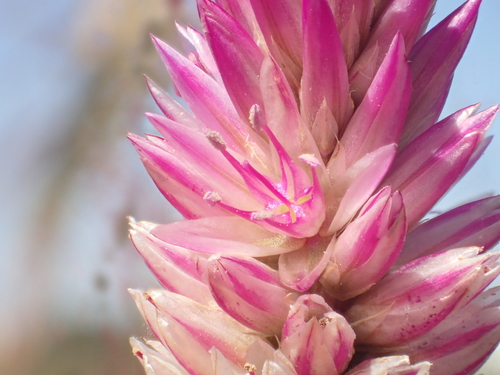
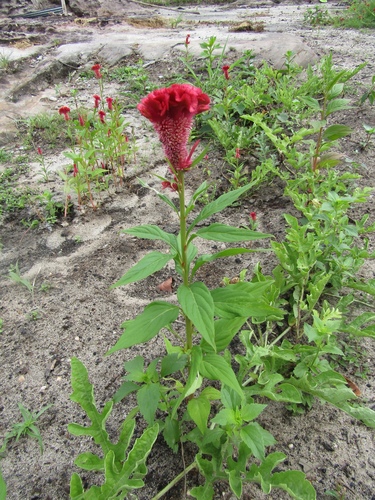
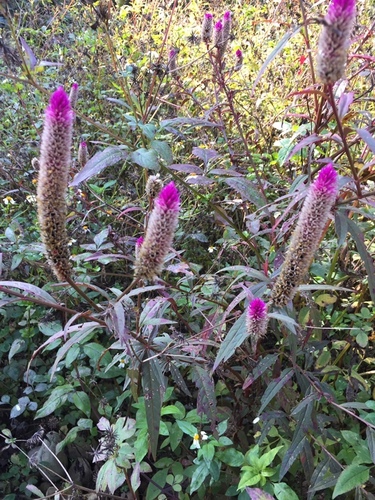
Quail grass (Celosia argentea) is an herbaceous annual in the amaranth family, Amaranthaceae, whose native range is still disputed between tropical Africa and South Asia. Its dry, dense flower heads, shaped as spikes, feathery plumes or fleshy crests depending on the garden form, make it at once an ornamental, a leafy vegetable in West Africa and a traditional medicinal plant.
Read moreCockscomb, Plumed cockscomb, Silver cock's comb and Lagos spinach
Place in full sun, with intense direct light all day long.
Global distribution
The native range of Celosia argentea is still debated. Plants of the World Online places it in tropical Africa, while the US NPGS reference database considers it uncertain and leans toward India. Widely grown in Asia since ancient times, the species has since naturalized across almost the whole tropical and subtropical belt, where it sometimes behaves as a crop weed.
- Native2
- Introduced1
- Invasive2
- Nigeria
- Ghana
- United States (Hawaii)
- India
- China
Hexagons: sourced regions. Green dots: native range. Statuses according to POWO (Kew).
Identity
Quail grass (Celosia argentea L., 1753), better known in gardens as cockscomb or plumed celosia depending on the form, is an herbaceous annual in the genus Celosia, family Amaranthaceae. The genus name comes from the Greek kêlos, "burned," a nod to the fiery look of the red and orange plumes; the epithet argentea refers to the form first described, whose paler flowers have a silvery cast. 1 2
Which common name you hear depends on the plant's silhouette: cockscomb for the fasciated forms, plumed celosia for upright panicles, and Lagos spinach for the variety grown as a leafy vegetable in West Africa. All three cover one and the same botanical species. 3 4
Recognition
Upright and branching, the plant ranges from 30 cm (12 in) in dwarf cultivars to more than 1.5 m (5 ft) in field-grown forms. The smooth stem is often flushed red or purple and carries simple, alternate, lance-shaped to oval leaves 7–15 cm (3–6 in) long, light to dark green, sometimes darker on flowering stems. 3 5
Tiny bisexual flowers crowd into dry, papery inflorescences 10–25 cm (4–10 in) long, shaped as a spike, a feathery panicle or a fleshy crest depending on the garden form. Colors run from red and orange to yellow, pink and purple. Once dried, these flower heads hold their color for several weeks, which sets celosia apart from most bedding flowers. 6 3
After pollination, each flower produces a small dry capsule, a utricle that opens by a lid and releases lens-shaped seeds, black and glossy. The capsule often stays on the withered stalk, a handy clue for spotting a celosia late in the season, even after the colors have gone. 5
Useful taxonomy
Garden forms long carried separate botanical names before being sunk into synonymy under Celosia argentea. The main synonyms to know are:
- Celosia argentea var. cristata (L.) Kuntze
- Celosia argentea f. cristata (L.) Schinz
- Celosia argentea var. plumosa (Barr & Sugden) Bakh.f.
- Celosia argentea var. vera Kuntze
- Celosia linearis E.Vilm.
Cristata causes most of the confusion: for buyers, the same name stands for both a botanical synonym and a garden group still sold under it, the cockscomb. What does not move is the accepted scientific name, Celosia argentea. 1 2
Habitat and range
Where the species first grew is still an open question. Plants of the World Online places it in tropical Africa, while the US reference database GRIN considers it uncertain and leans toward India. Widely grown in Asia since ancient times, it has since naturalized across almost the entire tropical and subtropical belt. 1 4
Quail grass colonizes waste ground and field margins on disturbed soil, up to 1,600 m (5,200 ft) in Nepal. Regarded as a troublesome weed in some crops in India and China, it has also naturalized on Pacific islands such as Hawaii, where it forms dense stands thanks to wind-scattered seed and a soil seed bank that stays viable for several seasons. 5 7
Life cycle and reproduction
A fast-cycling annual, Celosia argentea starts blooming 8–10 weeks after sowing. Seeds germinate in 5–7 days in warm conditions, sown in place once frost danger has passed or started indoors six to eight weeks earlier. Bloom begins in summer and runs until the first frost where winters bring one, each flower head staying colorful for up to eight weeks. 5 3
Spent flowers give way to dry capsules that shed tiny, glossy black seeds. This heavy seed set, together with a seed bank that survives several seasons, explains both how easily it self-sows in gardens and the weedy behavior seen in some tropical regions. 7 4
Uses and risks
Ornament comes first: bedding plant, cut flower and above all dried flower, keeping its color for weeks after the stem is cut. In West Africa, the leafy variety called Lagos spinach is an everyday vegetable; young leaves and shoots are cooked in soups or as a side dish, tasting much like spinach, and the seeds yield an edible oil. 3 5
In traditional herbal medicine, the seeds and dried flowers serve as an astringent and to stanch bleeding, and are used for diarrhea and some eye complaints; a seed extract dilates the pupils and is contraindicated for people with glaucoma. For households with pets, the plant is listed as nontoxic to cats, dogs and horses. 5 3
Across West Africa, growing Celosia argentea for its leaves is a market-garden crop in its own right, separate from ornamental selections, with leaves harvested over several cuttings before the plant bolts. 8 5
Varieties, look-alikes and related plants
Three garden groups share the market: Plumosa, with upright feathery plumes (New Look, Century, Fresh Look, several with RHS awards); Spicata, with slender tapering spikes sold as Flamingo Feather; and Cristata, whose fleshy, fasciated flower head gives the cockscomb its name. 9 3
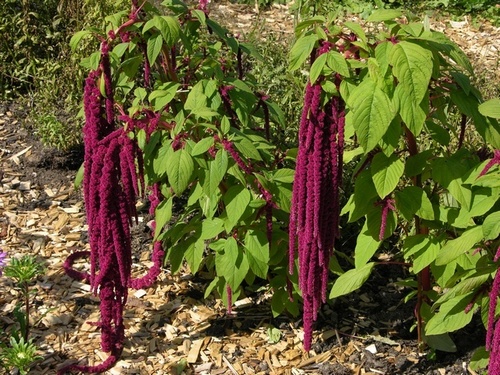
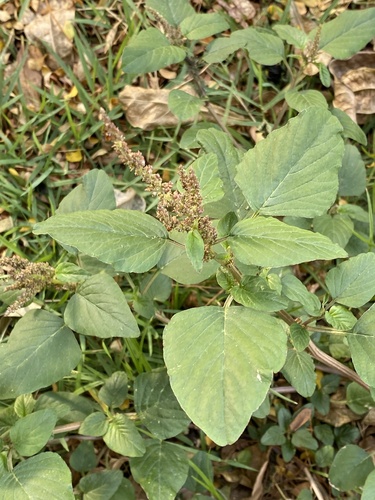
Mix-ups most often involve amaranths of the genus Amaranthus, with looser, drooping inflorescences, and globe amaranth (Gomphrena globosa), whose dry flower heads share the same long-lasting papery texture. Upright habit, an often reddish stem and the exact shape of the inflorescence remain the best clues for telling Celosia argentea from those two genera. 6
Main sources
- Plants of the World Online / Kew, Celosia argentea L.
- Integrated Taxonomic Information System, Celosia argentea L.
- NC State Extension, Celosia argentea (Cockscomb)
- Missouri Botanical Garden Plant Finder, Celosia argentea
- Plants For A Future, Celosia argentea
- Purdue University Center for New Crops, vegetable Celosia argentea proceedings
- USDA GRIN Taxonomy, Celosia argentea L.
- Pacific Island Ecosystems at Risk (PIER), Celosia argentea
- Royal Horticultural Society, Celosia argentea var. cristata
Frequently asked questions
Is quail grass toxic to cats and dogs?
No. No toxicological data point to a harmful active compound in Celosia argentea, and veterinary databases list it as nontoxic to cats, dogs and horses.
What is the difference between cockscomb, plumed and wheat celosia?
They are three garden forms of the same species. The Cristata group (cockscomb) bears a fleshy, fasciated flower head, the Plumosa group upright feathery plumes, and the Spicata group slender spikes that resemble colored wheat.
Can you eat quail grass leaves?
Yes, in the form var. argentea known as Lagos spinach in West Africa. Young leaves and shoots are cooked in soups or as a side dish, with a flavor close to spinach.
Why are my celosias rotting at the base?
Too much moisture around the crown, in poorly drained soil or with plants set too close together, encourages root rot and stem collapse. Free-draining soil and enough spacing reduce the risk.
Is quail grass an invasive weed?
It is considered a troublesome weed in some crops in India and China, and it has naturalized on Pacific islands such as Hawaii. In many temperate gardens it is simply grown as a bedding annual.
Does quail grass need a lot of water?
It tolerates drought well once established, but regular, moderate watering during bloom extends the life of the flower heads, which stay colorful for several weeks.
Can I resow seed saved from my own plants?
Yes, the dry capsules release viable black seeds. Cultivars from horticultural breeding, however, often produce less uniform offspring than purchased seed.
Similar plants
Botanical data compiled from reference sources (RHS, Kew Gardens, POWO). This profile is for guidance only and is not a substitute for advice from a botanist or veterinarian if you have concerns about toxicity.