
Suicide tree (Cerbera odollam, )
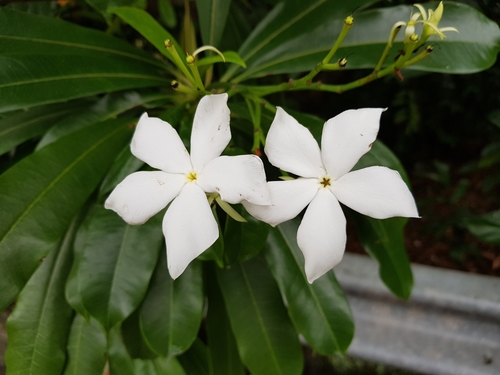

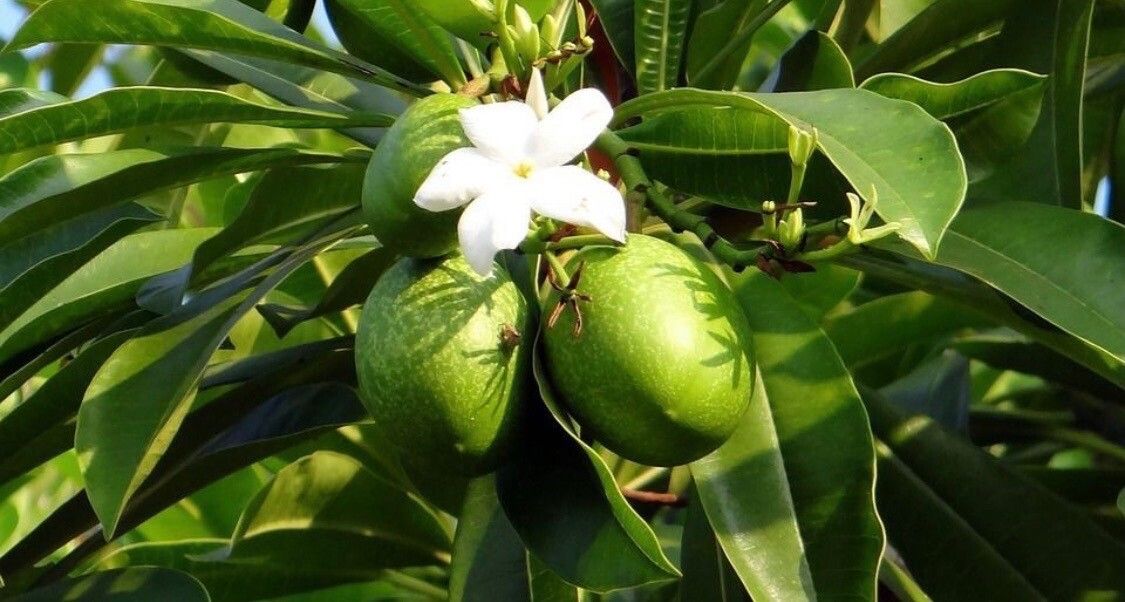
Suicide tree (Cerbera odollam) is a small coastal tree in the Apocynaceae, native from southern India and Sri Lanka to the western Pacific. It bears fragrant white flowers with yellow centers and fruit resembling a small mango, green at first, then purple and finally black when ripe. Beneath its light, buoyant husk lies a stone containing cerberin, a cardiac poison associated with documented fatal use in India.
Read moreSuicide tree, Pong-pong and Pong-pong tree
Place in full sun, with intense direct light all day long.



© photo
(c) Cheongweei Gan, some rights reserved (CC BY-NC), uploaded by Cheongweei Gan · cc-by-nc
Wikimedia Commons · CC BY-SA or Public Domain
Wikipedia · CC BY-SA
Taken Jan 13, 2020 by Chee Keong Chan (cc-by-sa)
Taken Feb 12, 2021 by lo' (cc-by-sa)
© copyright of the Board of Trustees of the Royal Botanic Gardens, Kew.



Global distribution
Cerbera odollam is native from southern India and Sri Lanka to the western Pacific, through mainland and island Southeast Asia and northern Australia. Widely introduced as an ornamental in tropical coastal regions, it lacks frost tolerance, limiting naturalization outside this climatic belt.
- Native8
- Introduced1
- India
- Sri Lanka
- Malaysia
- Singapore
- Myanmar
- Vietnam
- Indonesia
- Australia
- French Polynesia
Hexagons: regions where the plant occurs. Green dots: native range.1
Identity
Suicide tree (Cerbera odollam Gaertn., 1791), also called pong-pong or othalanga, is an accepted species of Cerbera in the Apocynaceae. German botanist Joseph Gaertner described it in 1791. The genus name refers to Cerberus, the three-headed dog guarding the entrance to the underworld in Greek mythology, an allusion that directly signals the species’ danger. 1
Suicide tree describes a documented practice that continues in parts of southern India, where its seeds are used to end lives. 3 The seed kernel concentrates cerberin, a cardiac poison capable of killing an adult after a single seed is swallowed. 5 Pong-pong occurs chiefly in English-language scientific literature from Southeast Asia, without reference to the seed’s danger. 6
The appearance of this small coastal tree, with glossy foliage and fragrant white flowers, gives no warning of its lethal toxicity. 2
Recognition
A mature pong-pong reaches 8–12 m (26–39 ft) tall and spreads 4–8 m (13–26 ft). Its knobbly trunk is often buttressed at the base, beneath rough gray bark. 2
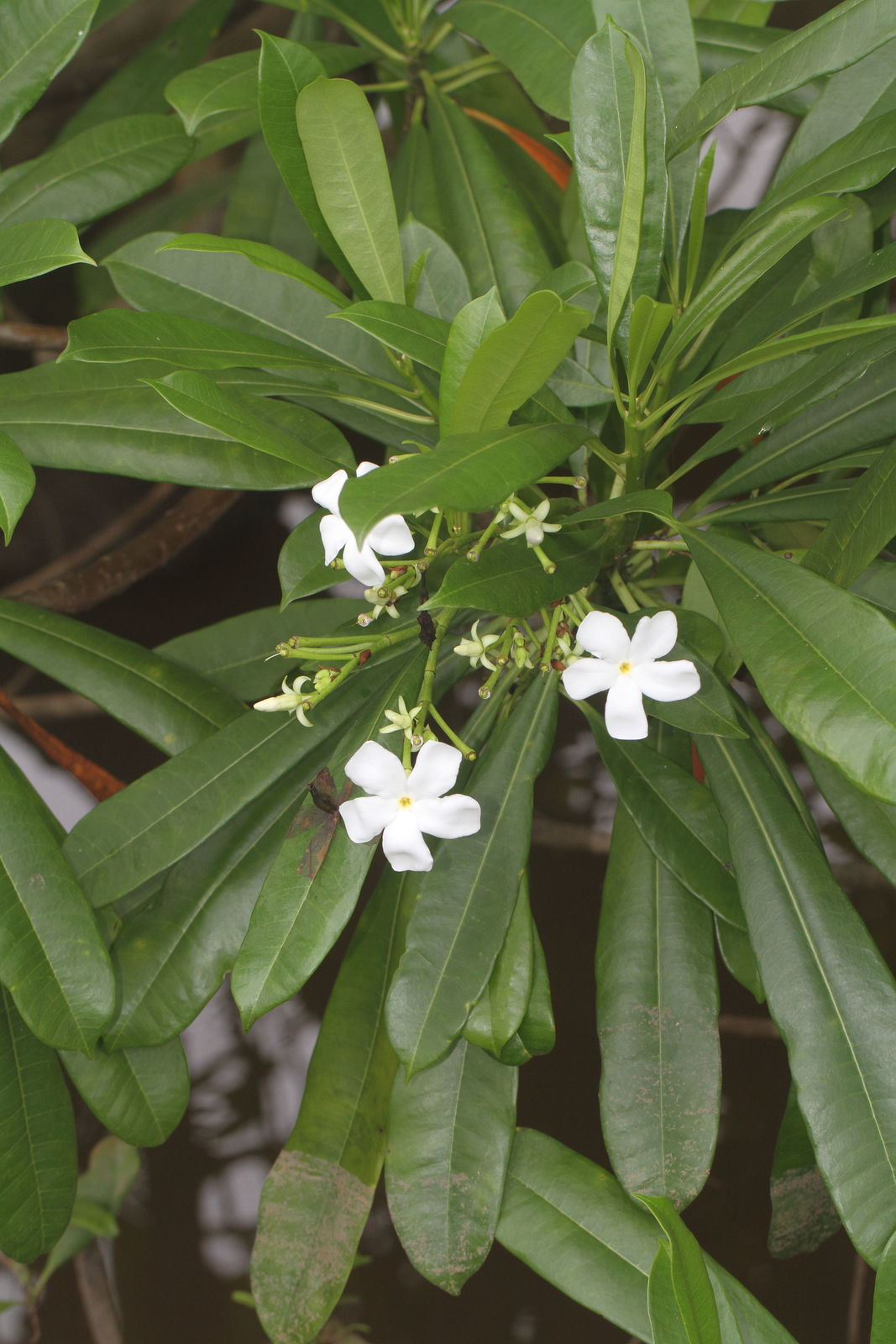
Glossy, dark-green leaves gather near the branch tips. Narrowly obovate, they end in a fine point. Aging leaves often turn orange before falling, a useful supporting identification feature. 2
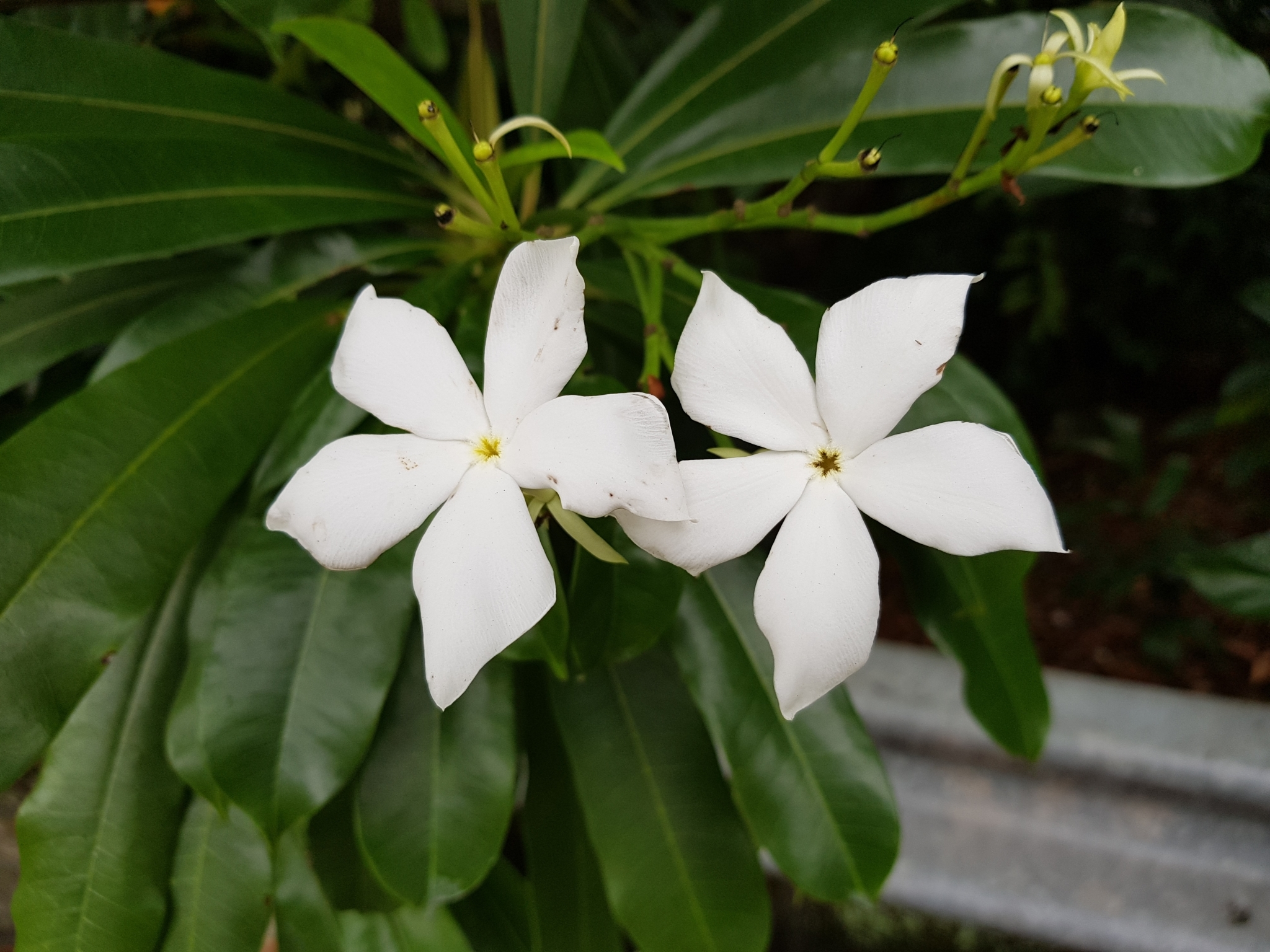
White flowers with yellow centers measure about 5–7 cm (2–2.8 in) across and have a pronounced fragrance. Any broken leaf or stem releases milky white latex, typical of Apocynaceae and irritating on contact. 7
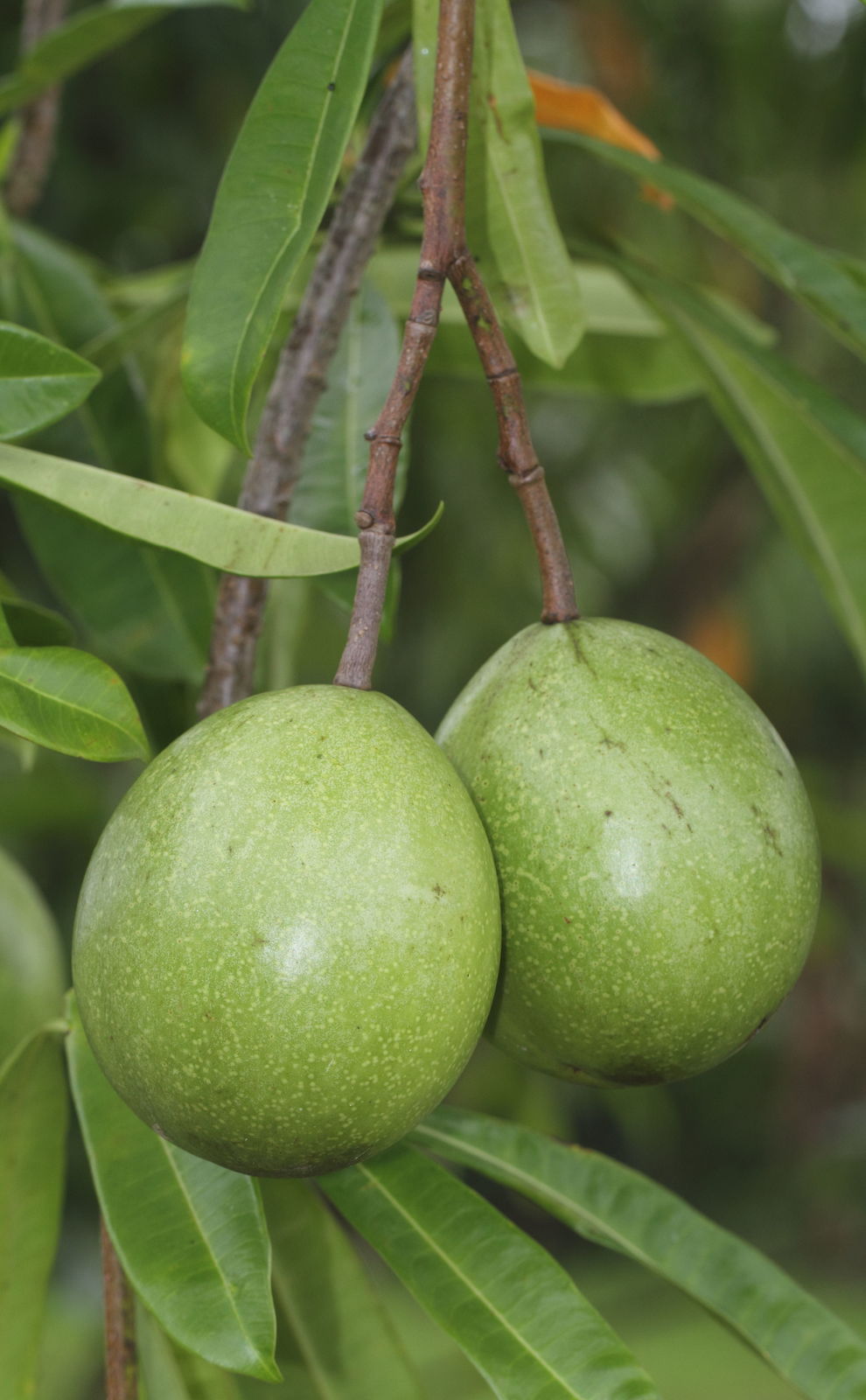
Fruit turns from green to purple and finally purplish black when fully ripe. Its resemblance to a small mango contributes to accidental poisoning, particularly in young children. Beneath a light, fibrous husk lies a single large stone, the plant’s most toxic part, far more dangerous than its bark or leaves. 2 5
Taxonomy and names
Cerbera odollam Gaertn. is the name accepted by Plants of the World Online. One variety long circulated under this name before being assigned to a neighboring species:
- Cerbera odollam var. mugfordii F.M.Bailey, now treated as a synonym of Cerbera manghas L.
- Odollam Adans., an older genus name
- Tanghinia odollam (Gaertn.) G.Don
The reassignment of var. mugfordii illustrates a frequent source of confusion. Sea mango, Cerbera manghas, shares the genus and comparable toxicity with C. odollam, but remains botanically distinct. The full scientific name provides the stable reference. 1 8
Habitat and range
From southern India and Sri Lanka, the native range extends through mainland and island Southeast Asia and northern Australia to the western Pacific. 1
Coastal forests, the landward side of mangroves, riverbanks and coastal swamps provide habitat, often behind the first line of mangrove trees. 6
A light, fibrous husk keeps the fruit afloat, allowing seeds to drift long distances on ocean currents before germinating on a distant beach or riverbank. Pong-pong has been widely introduced as an ornamental in tropical gardens and warm coastal regions, but is unsuited to winter exposure where conditions become even moderately cool. 7
Life cycle and reproduction
In a stable equatorial climate, pong-pong flowers and fruits through much of the year, without marked winter dormancy. 6
Pollinated flowers develop fruit that takes several months to ripen, progressing from green to purplish black. Propagation is almost exclusively by fresh seed; semi-ripe cuttings are possible but much less commonly used in practice. 6
Outside its native range, the tree never reaches the same development. Growth slows markedly below 22 °C (72 °F), and the species becomes sensitive below 10 °C (50 °F).
Uses and risks
The seed kernel holds the principal danger: cerberin, a cardenolide cardiac glycoside, accompanied by cerberoside and odollin. These substances inhibit the sodium-potassium pump in heart cells through a mechanism similar to digoxin, causing bradycardia, conduction blocks and potentially fatal hyperkalemia. 5 4
A single seed can sometimes kill an adult, and its bitter taste is readily masked in spicy food, explaining its documented use in deliberate poisoning. In Kerala, India, an 11-year study covering 1989–1999 recorded 537 deaths, roughly one a week, mostly among women. 3
Poisoning is a cardiac emergency. Clinical management combines supportive treatment, atropine and sometimes temporary pacing, without guaranteed success once symptoms develop. A North American case reported in 2018 ended fatally despite twenty vials of digoxin-specific antibodies. 5
Apart from its lethal toxicity, the bark and leaves have traditional purgative and vermifuge uses; seed oil is used locally against scabies. These practices lack modern pharmaceutical validation. 6
Varieties, look-alikes and related plants
Named horticultural cultivars are not documented for Cerbera odollam. It remains chiefly wild or semi-wild, without extensive ornamental selection.
A frequent, well-documented confusion involves its sister species Cerbera manghas, whose fruit and flowers look very similar. Historically associated with Madagascar and the tangena ordeal, practiced until the 19th century to determine an accused person’s guilt, C. manghas has a different history from the more recent, better-documented record of C. odollam in South Asia. 8
Another, less sinister but genuine confusion involves a young mango (Mangifera indica). Pong-pong has a rounder fruit shape and releases white latex when a fruit stalk is broken.
Main sources
- Plants of the World Online / Kew, Cerbera odollam Gaertn.
- NParks FloraFauna Singapore, Cerbera odollam
- PubMed, Gaillard et al. 2004, Cerbera odollam — a 'suicide tree' and cause of death in the state of Kerala, India
- PubMed, Cerbera odollam toxicity — a review
- PMC, Fatality Following Intentional Ingestion of Cerbera odollam Seeds
- Useful Tropical Plants database, Cerbera odollam
- Espèces-menacées.fr, Cerbera odollam — l'arbre du suicide
- Pl@ntUse / PROTA, Cerbera manghas
Frequently asked questions
Can the suicide tree really be fatal?
Yes. The seed kernel contains cerberin, a cardiac poison that can be fatal after a single seed is ingested. Its taste can readily be masked in spicy food.
Can the suicide tree be grown as an ornamental tree?
It is planted as a shade tree in South and Southeast Asia for its foliage and fragrant flowers, but should never be grown near children or domestic animals because seeds fall to the ground.
How do Cerbera odollam and Cerbera manghas differ?
Both are closely related and poisonous, but Cerbera manghas has a longer, reddish floral throat and often bears fruit in pairs. It is historically associated with the Malagasy tangena ordeal.
Why is Cerbera odollam called the suicide tree?
The nickname refers to a documented practice that continues in parts of Kerala, India, where Cerbera odollam seeds are used in suicide. Several hundred deaths were recorded over an eleven-year study.
Does the suicide tree fruit look like a mango?
Yes, in shape and in its changing color, from green through purple to black. White latex is released when a fruit stalk is broken.
How is Cerbera odollam poisoning treated?
It is a cardiac emergency. Clinical management combines supportive treatment, atropine and sometimes temporary pacing; the effectiveness of digoxin-specific antibodies remains variable once symptoms develop.
Similar plants

If you are unsure about a plant’s toxicity, ask a botanist or veterinarian for advice.