
Hinoki cypress (Chamaecyparis obtusa, )
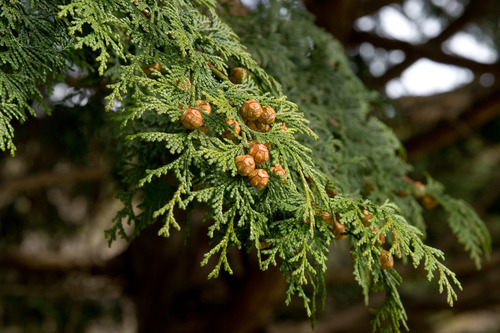
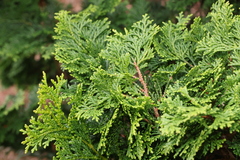
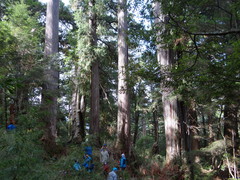
Hinoki cypress (Chamaecyparis obtusa) is a large evergreen Cupressaceae conifer native to temperate mountains in central and southern Japan. Flat scale foliage has fine white markings beneath the sprays. Reddish-brown fibrous bark peels in strips, and cones are tiny and round. Hinoki timber holds a special place in Japanese sacred architecture.
Read moreHinoki cypress, Japanese cypress and Hinoki
Allow a few hours of direct sun per day, preferably morning or evening.
Full sun to light partial shade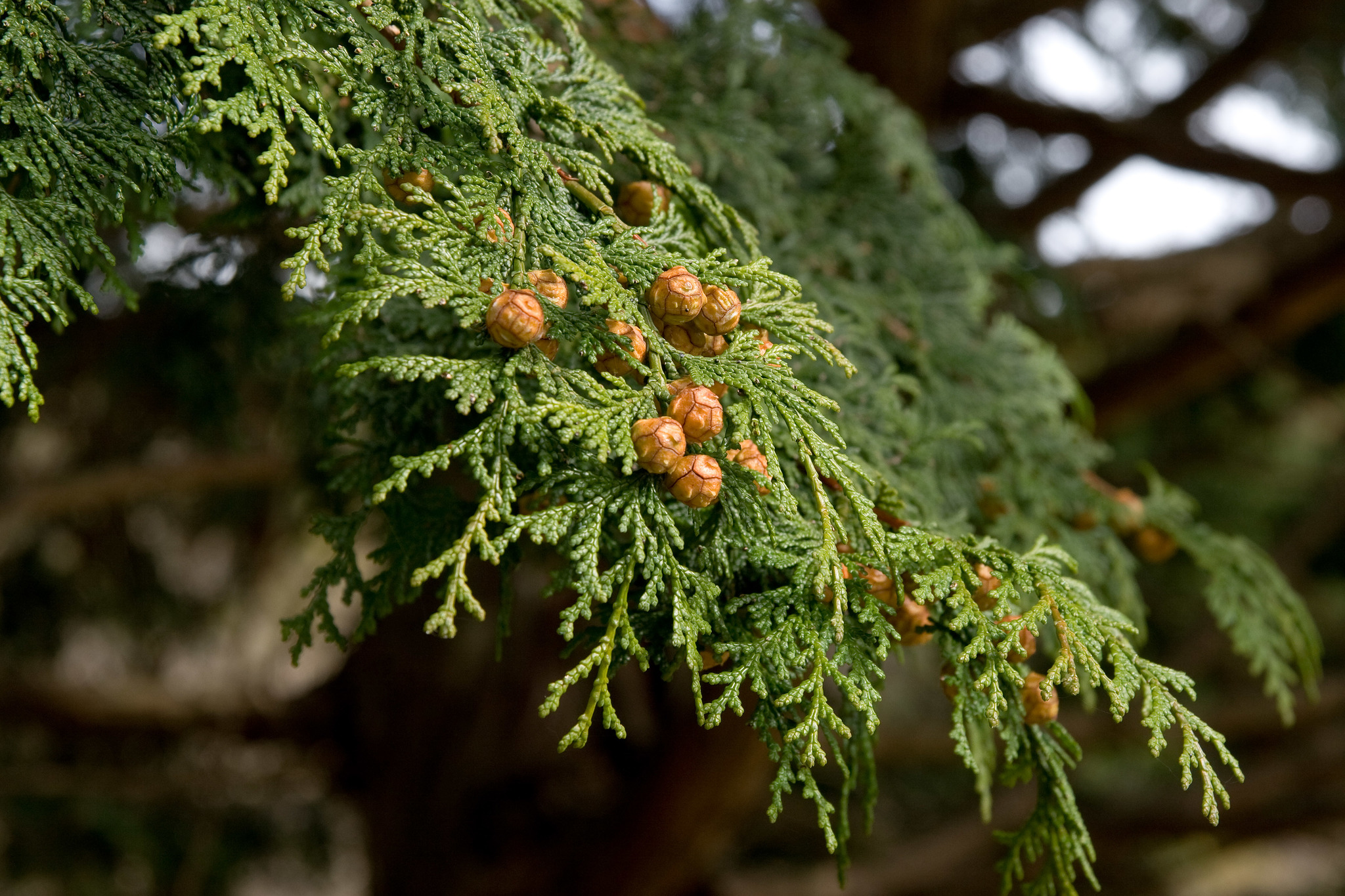

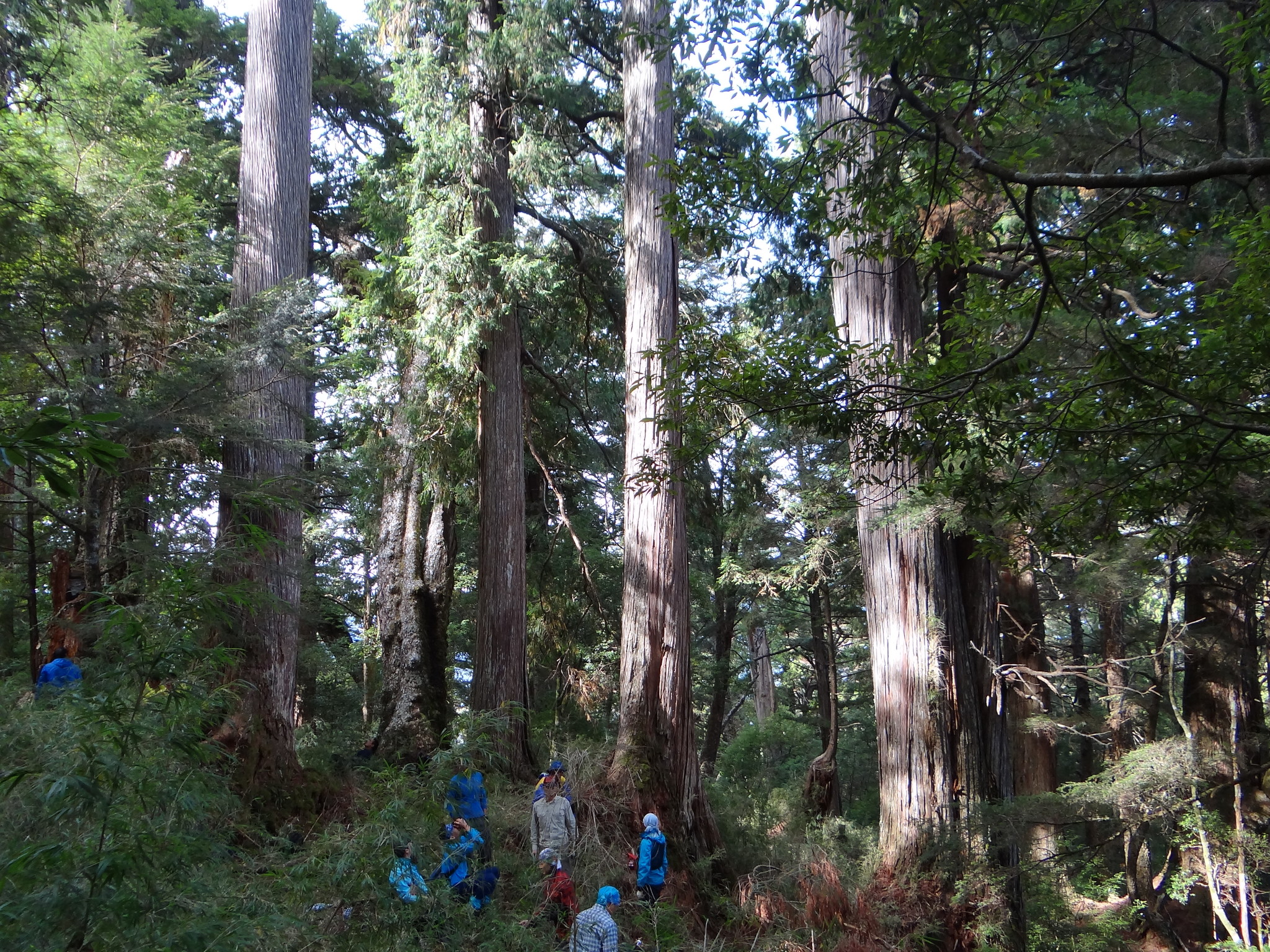


© photo
(c) Σ64, some rights reserved (CC BY) · cc-by
Stephen James McWilliam · cc0
呂一起(Lu i-chi) · cc-by
Taken Nov 15, 2014 by Photoflora - Jean-Luc TASSET (©)
Taken Jan 30, 2022 by Mauro Monteiro (cc-by-sa)
Taken Jan 7, 2021 by Espinoza-Zevallos Marco Elías (cc-by-sa)




Global distribution
The native range covers central and southern Japan, chiefly Honshu, Shikoku and Kyushu, at 300–1,500 m. Distinct var. formosana occupies Taiwan’s mountains at 1,600–2,900 m. Miocene fossils found as far west as Germany show a formerly wider range. Outside Asia it is grown ornamentally in temperate climates, without documented invasive behavior.
Identity
Hinoki cypress (Chamaecyparis obtusa (Siebold & Zucc.) Endl., 1847), also called Japanese cypress, belongs to the Cupressaceae genus Chamaecyparis. Greek chamai, low or dwarf, and kyparissos, cypress, form the generic name. It is distinct from true cypresses in Cupressus, despite a similar outline. 1 3
In Japan the tree is called hinoki, literally fire tree. Its wood was long used to generate fire by friction in Shinto shrines, before becoming one of the archipelago’s most prized structural timbers. 3
Siebold and Zuccarini first described the species as Retinospora obtusa in 1844. Austrian botanist Stephan Endlicher transferred it to Chamaecyparis in 1847, establishing the accepted name. 1
Recognition
Flat, scale-like foliage forms flexible fans with drooping tips. Individual scales are just 2–4 mm (0.08–0.16 in) long and have blunt, rounded tips, unlike the sharply pointed leaves of Sawara cypress (Chamaecyparis pisifera). Fine white X-shaped marks beneath the sprays help confirm identification. 4 3
Reddish-brown, fibrous bark separates into fine vertical strips on older trees, as in several other Cupressaceae. Native trees commonly reach 15–40 m (49–131 ft) tall, with trunks sometimes exceeding 3 m (10 ft) in diameter, while the conical crown spreads only 3–8 m (10–26 ft). This creates a tall, narrow outline. Ornamental specimens are often smaller, around 10–20 m (33–66 ft). 3 5
Small, round cones measure 8–12 mm (0.3–0.5 in) across and have eight to ten scales. They release winged seeds about 3 mm (0.12 in) long. Crushed foliage gives off a characteristic resinous odor. 3
Useful taxonomy
The accepted scientific name, Chamaecyparis obtusa, provides the stable reference. Important historical names and synonyms include:
- Retinospora obtusa Siebold & Zucc.;
- Chamaecyparis obtusa var. formosana Hayata;
- Chamaecyparis taiwanensis Masam. & Suzuki.
Two distinct populations are usually distinguished: typical var. obtusa in central and southern Japan, and Taiwanese var. formosana, sometimes treated as the separate species Chamaecyparis taiwanensis. Cone size helps distinguish them: 7–9 mm (0.28–0.35 in) in the Taiwanese variety, compared with 8–12 mm (0.3–0.5 in) in the typical variety. 1 3
Sawara cypress, Chamaecyparis pisifera, is the most frequent field confusion. Its scales end in much sharper, tapering points than the blunt leaves of C. obtusa, the character reflected in the epithet obtusa. 4
Habitat and range
Central and southern Japan, chiefly Honshu, Shikoku and Kyushu, form its native range. Pure or mixed mountain forests occur at 300–1,500 m (980–4,900 ft) under moderately humid conditions. Depending on seed provenance, trees withstand winter lows of −25 to −30 °C (−13 to −22 °F) and heat peaks of 35 °C (95 °F) without direct damage, matching the source’s USDA zones 4–8. 1 4
Taiwanese var. formosana occupies higher mixed mountain forests at 1,600–2,900 m (5,250–9,500 ft). The species once ranged much farther afield: Miocene fossils indicate its presence as far west as Germany, well beyond its modern eastern Asian distribution. 3
Temperate European and North American horticulture now makes widespread ornamental use of hinoki cypress, without documented invasive behavior. Nevertheless, the IUCN lists it as Near Threatened, following intensive historic harvesting of structural timber whose original extent is poorly quantified. 2 7 8
Life cycle and reproduction
Hinoki cypress is a monoecious gymnosperm: one tree carries both pollen and seed cones, wind-pollinated in spring. Seedlings first bear prickly juvenile needles and gradually develop adult scale leaves. A one- or two-year-old seedling is only 15–40 cm (6–16 in) tall; reaching 15–40 m (49–131 ft) takes several decades. 6
Fertilized seed cones mature within a season and release small winged seeds in autumn. Nursery seed propagation involves two-stage stratification, one month warm and one month cold. Germination can then extend over eighteen months. 6
Cultivars are chiefly propagated by cuttings, taken in late summer–autumn or late winter and rooted in sandy substrate. This alone preserves a dwarf form or selected foliage color faithfully. In the ground, growth is fastest over the first five to twenty years, when height increases from 3 to 15 m (10–49 ft). It then slows toward a mature height of 15–40 m (49–131 ft) between twenty and eighty years; dwarf container cultivars grow more slowly still. 6 4
Uses and risks
Pale, fragrant, naturally decay-resistant hinoki timber has a special place in Japanese architecture. It was used for Horyu-ji, among the oldest surviving major wooden buildings, from the eighth-century Nara period, and for the Ise shrine, rebuilt to the same design every twenty years under the Shikinen Sengu ritual. 3
The species and its more than 200 cultivars serve as specimens, hedges and screens, with dwarf forms particularly familiar in bonsai. Japanese maple and Japanese azalea complement it, sharing a preference for moist, slightly acidic soil beneath the canopy. 2 6
Available information describes hinoki cypress as non-toxic to cats, dogs and people. Horse status remains uncertain because species-specific data are lacking. 6 7
Poor drainage encourages root rot in the tree itself. Drought-weakened specimens are also more vulnerable to bagworms, scale insects and juniper blight. These are its main documented plant-health problems. 4 5
Varieties, look-alikes and related plants
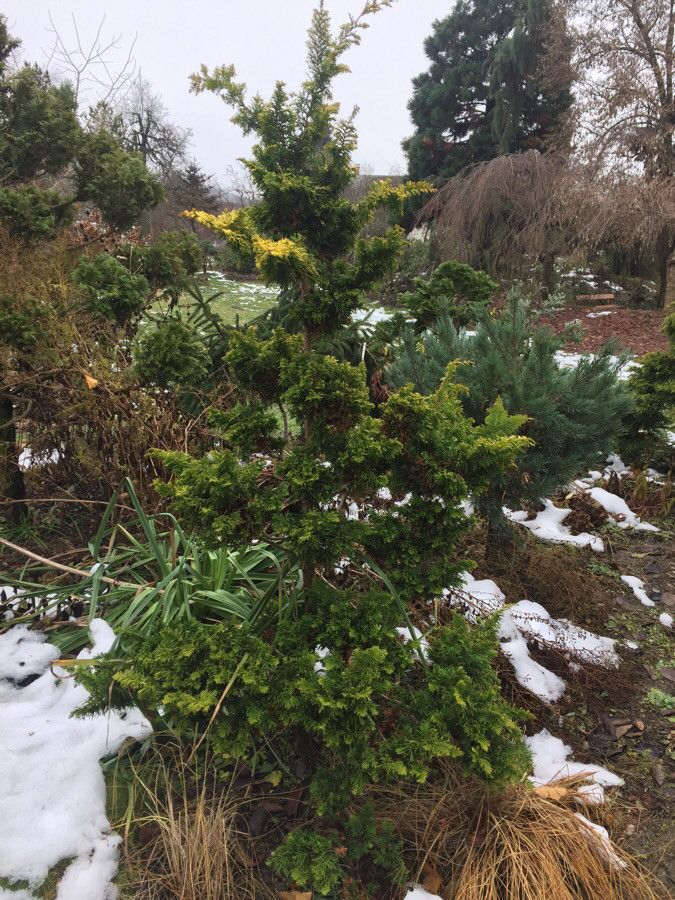
More than 200 cultivars range from full-sized park trees to dwarfs less than 30 cm (12 in) tall. Slow-growing Nana Gracilis, with shell-like branch fans, is widely used for bonsai. Crippsii has pendulous golden foliage and the RHS Award of Garden Merit. Fernspray Gold carries golden, fern-like sprays. Nana Aurea opens spring with golden shoots that partly green up later in the season. 2
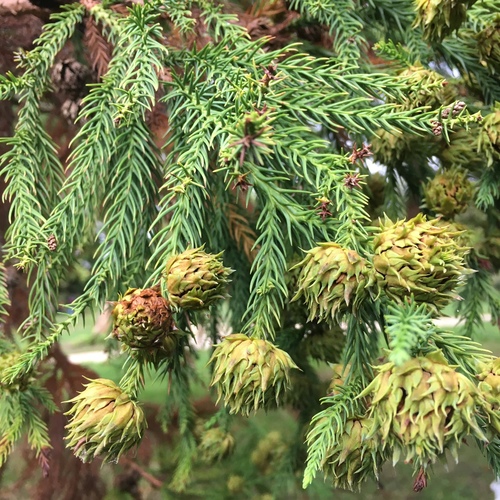
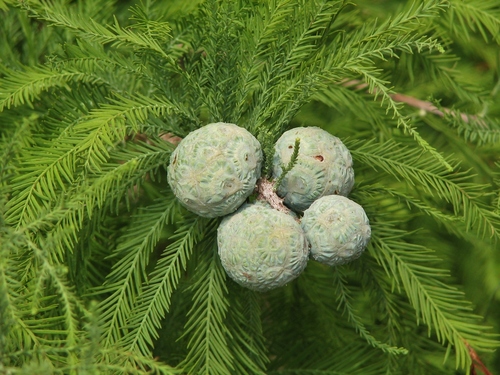
Sawara cypress (Chamaecyparis pisifera) is the most frequent confusion, with pointed rather than blunt scales. Thuja, whose undersides have different markings, and true cypresses in the distinct genus Cupressus can also resemble hinoki in general outline.
Blunt scales, fibrous bark peeling in strips and small cones with eight to ten scales provide the most reliable combination for identifying Chamaecyparis obtusa. 4 3
Main sources
- Plants of the World Online / Kew, Chamaecyparis obtusa (Siebold & Zucc.) Endl.
- Royal Horticultural Society, Chamaecyparis obtusa - hinoki cypress
- The Gymnosperm Database, Chamaecyparis obtusa
- NC State Extension, Chamaecyparis obtusa (Hinoki Cypress)
- Missouri Botanical Garden Plant Finder, Chamaecyparis obtusa
- Plants For A Future, Chamaecyparis obtusa
- INPN / MNHN, Chamaecyparis obtusa (Siebold & Zucc.) Endl., 1847 (cd_nom 610828)
- IUCN Red List, Chamaecyparis obtusa assessment
Frequently asked questions
Is hinoki cypress a true cypress?
No. Chamaecyparis, the false cypresses, is distinct from Cupressus, the true cypresses. Both belong to Cupressaceae, but cones and foliage differ enough to separate the genera botanically.
Is hinoki cypress poisonous to cats and dogs?
No data classify Chamaecyparis obtusa as poisonous to common domestic animals. Only horse status remains uncertain, because species-specific studies are lacking.
Why is hinoki timber so prized in Japan?
Its pale, fragrant, naturally decay-resistant wood was used for major buildings including Horyu-ji temple and the Ise shrine, rebuilt to the same design every twenty years for centuries.
How tall does a mature hinoki cypress grow?
In its native Japanese range it commonly reaches 15–40 m (49–131 ft). Ornamental trees often stay smaller, and many dwarf cultivars rarely exceed 1–2 m (3–6.5 ft).
How do var. obtusa and var. formosana differ?
Typical var. obtusa grows in Japan at 300–1,500 m (980–4,900 ft). Taiwanese var. formosana occupies higher mountains at 1,600–2,900 m (5,250–9,500 ft) and has slightly smaller cones.
Can hinoki cypress be grown as bonsai?
Yes. It is one of the conifers most widely used for bonsai, particularly dwarf cultivars such as Nana Gracilis, valued for slow growth and shell-like sprays that are readily shaped.
How does hinoki cypress differ from Sawara cypress?
The scales of C. obtusa have rounded, blunt tips. Those of Sawara cypress, Chamaecyparis pisifera, are distinctly sharper and tapering, the most reliable distinction between the species.
Similar plants
If you are unsure about a plant’s toxicity, ask a botanist or veterinarian for advice.