
European fan palm (Chamaerops humilis, )
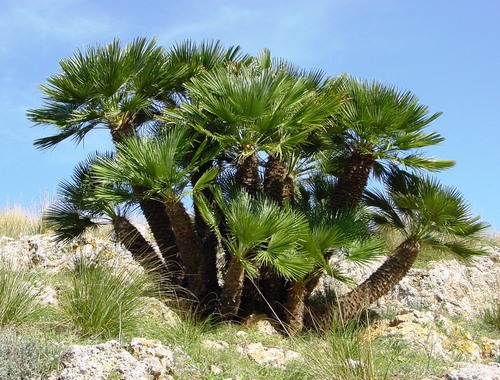

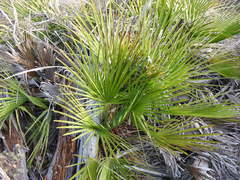
European fan palm (Chamaerops humilis) is a low, spiny, clump-forming member of the Arecaceae from the dry western Mediterranean. Alongside Phoenix theophrasti, it is one of only two palms native to continental Europe. A specialized pollinating weevil and seed dispersal by badgers give it an unusual reproductive ecology among cultivated palms.
Read moreEuropean fan palm and Palmito
Place in full sun, with intense direct light all day long.
Full sun preferred; tolerates partial shade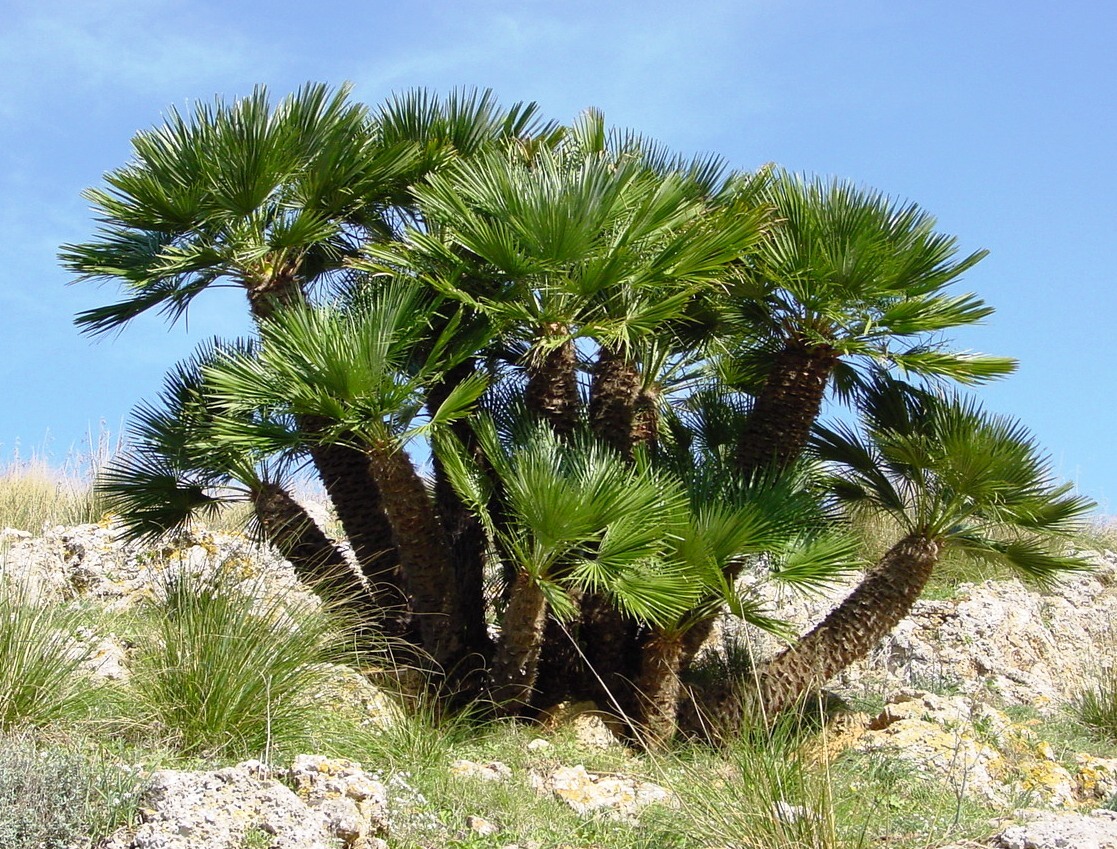
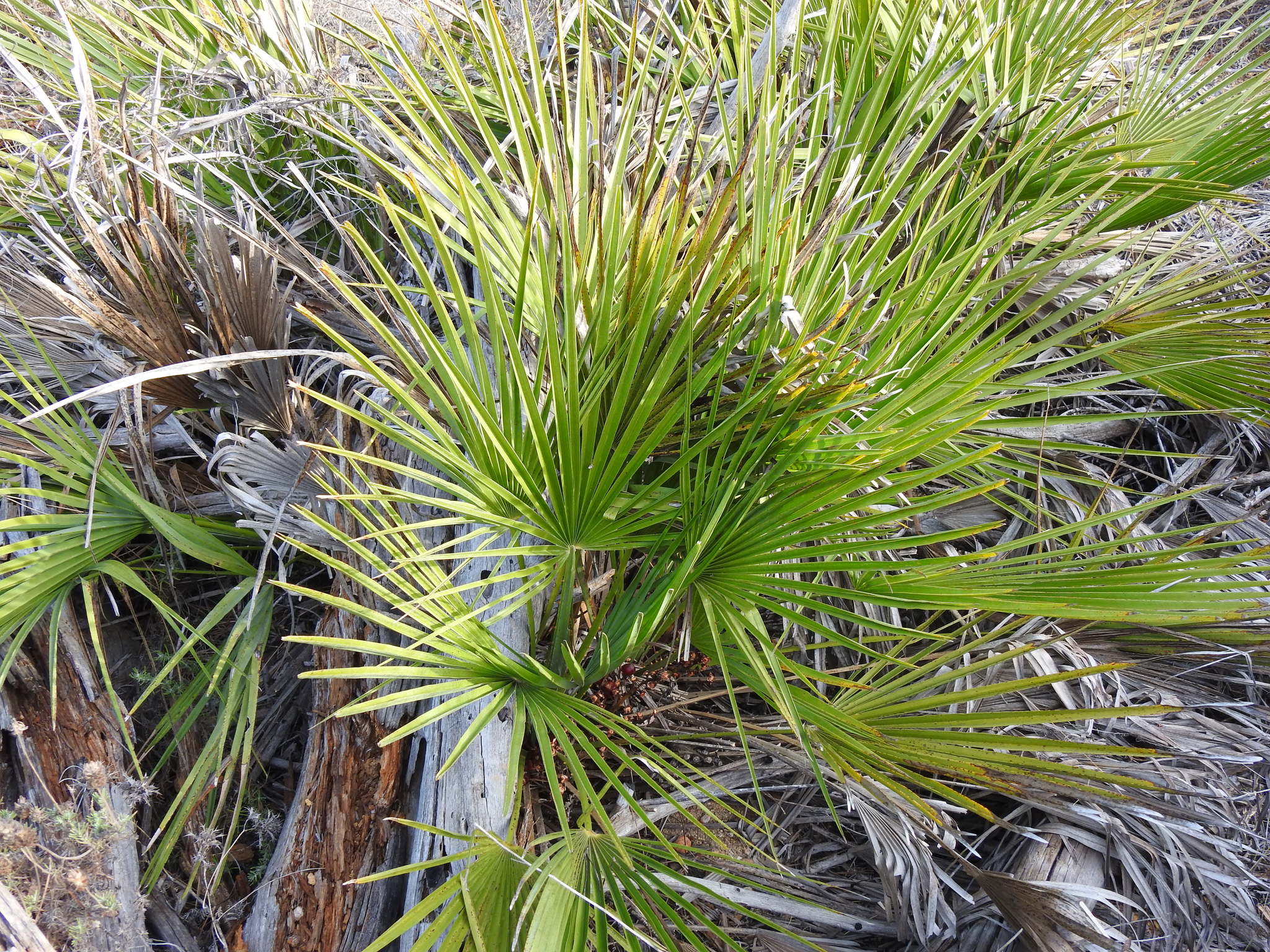


© photo
(c) tato grasso, some rights reserved (CC BY-SA) · cc-by-sa
Oleg Kosterin · cc0
Duarte Frade · cc-by
Taken Feb 1, 2015 by Tela Botanica − Patrick LEBOULENGER (cc-by-sa)
Taken Mar 25, 2007 by Tela Botanica − Errol VELA (cc-by-sa)
Taken Jul 25, 2019 by Diego Alex (cc-by-sa)
Taken Jan 20, 2022 by Fabrice Rubio (cc-by-sa)
© copyright of the Board of Trustees of the Royal Botanic Gardens, Kew.




Global distribution
The native range covers the western and central Mediterranean, from Portugal and Spain to the Maghreb and Italy. In mainland France it is very rare, confined to a few sites near its northern natural limit, and nationally protected.
- Native8
- Introduced2
- Spain
- Morocco
- Algeria
- Tunisia
- Italy
- Portugal
- Metropolitan France
- Malta
- California (United States)
- Australia
Hexagons: regions where the plant occurs. Green dots: native range.1
Identity
European fan palm (Chamaerops humilis L., 1753), also known as palmito, is the only species in the genus Chamaerops, in the Arecaceae. Together with Phoenix theophrasti, native to Crete, it is one of only two palms truly native to continental Europe. 1 3
The scientific name combines the Greek roots khamai (on the ground, dwarf) and rhôps (shrub), describing its low, bushy outline beside taller tropical palms. The French name palmier doum is misleading: the true doum, Hyphaene thebaica, belongs to a different African genus and has a branching trunk, whereas the European fan palm's trunk never forks. 5
Recognition
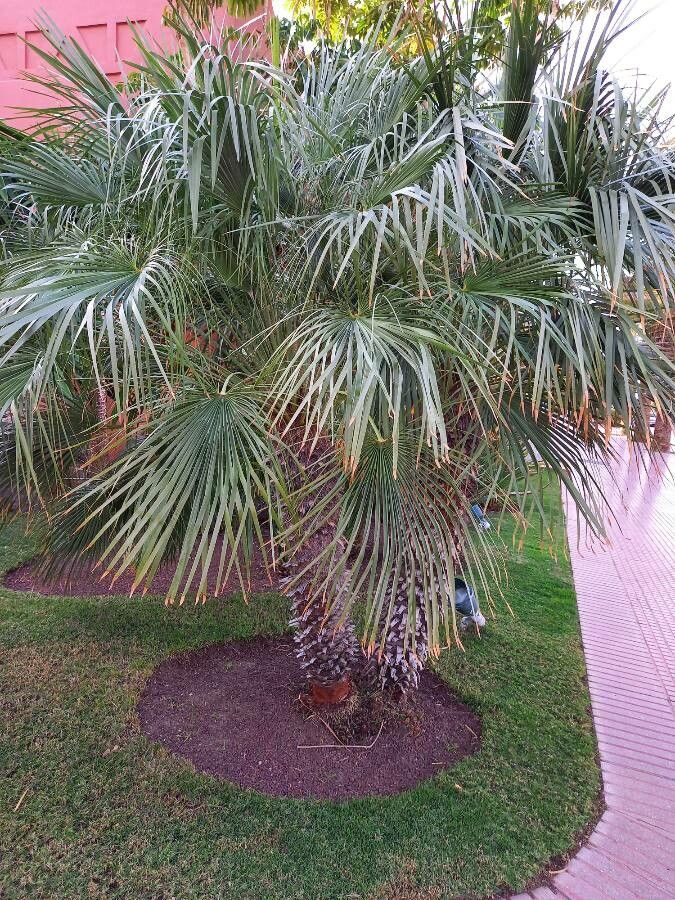
Several short, closely spaced stems arise from a single base, giving European fan palm its clumping habit. Wild plants are often almost trunkless, rarely exceeding 2 m (6.5 ft). In cultivation, a plant trained to a single stem can reach 5–8 m (16–26 ft) after several decades, as illustrated by the specimen planted in Padua's botanical garden in 1585. 3 2
The leaves form terminal rosettes of fan-shaped blades, 60–90 cm (2–3 ft) across. Each is borne on a long petiole armed with sharp spines along both edges. A leaf has 10–20 stiff leaflets, clear green above and paler, sometimes glaucous, below. 2
Small yellow spadices, each enclosed by a short spathe, appear from spring into early summer in its Northern Hemisphere range, only once plants are sufficiently old. 4
Useful taxonomy
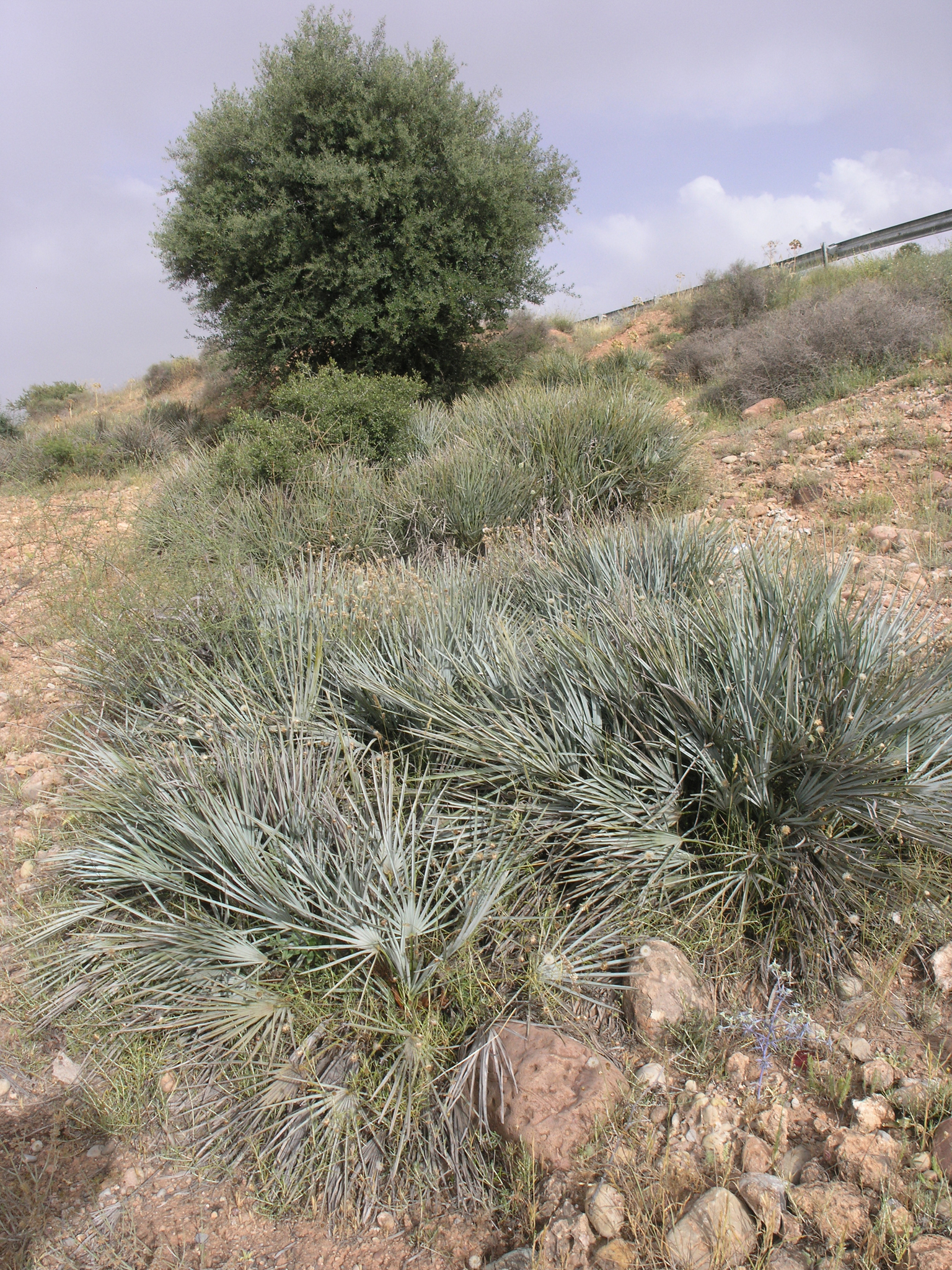
Two botanical varieties are accepted within Chamaerops humilis. The typical variety, Chamaerops humilis var. humilis, has green foliage and occupies most of the range. Chamaerops humilis var. argentea (Anon.) André, from Morocco's Atlas Mountains, has glaucous foliage and is more cold-hardy than the typical form. 1
A revision published in 2021 places a waxy form close to argentea under the name Chamaerops humilis subsp. cerifera (Becc.) Giovino & Domina, a status still disputed by different authors. The accepted name, Chamaerops humilis, remains the best guide when buying plants. Horticultural labels such as 'Vulcano' and 'Stella' have no taxonomic standing and may sometimes represent the same plant sold under different labels. 1
Habitat and range
Across the western and central Mediterranean, European fan palm is native to Spain, Portugal, southern France, Italy, Morocco, Algeria and Tunisia. 3 1
Wild populations in mainland France are very rare, confined to a few sites near the northern limit of the natural range. National protection in France prohibits destroying, collecting or trading wild individuals. 5
Dry garrigue and maquis, rocky slopes and sandy or calcareous soils provide its habitat, from the coast to 1,200 m (3,900 ft). Following fire, the underground base sends up new shoots. By recolonizing exposed ground, this regrowth helps limit erosion on coastal slopes. 6
The IUCN Red List assesses the species as Least Concern. Its Mediterranean range remains extensive, although coastal urban development is putting pressure on some local populations. 6
Life cycle and reproduction
Male and female flowers usually occur on separate plants, making this palm predominantly dioecious, although occasional mixed inflorescences have been reported. Pollination depends almost entirely on one insect, the weevil Derelomus chamaeropsis. Its larvae develop in male inflorescences while adults carry pollen to female flowers: a nursery pollination mutualism in which the insect benefits without harming the plant. 7
The oval drupe is 2–5 cm (0.8–2 in) long, reddish brown when ripe, with fibrous, astringent flesh. In southern Spain its main seed disperser is an unexpected mammal, the European badger (Meles meles), attracted by the ripe fruit's strong smell. Passage through the gut damages some seeds but also carries them over long distances. 8
Seeds germinate slowly and irregularly. A common alternative is separating basal offshoots, which reproduces the parent plant faithfully without waiting for flowers. 4
Uses and risks
Compact growth and tolerance of salt-laden winds make European fan palm primarily an ornamental for Mediterranean and coastal gardens. Where the climate is cooler, it is also grown in a large terrace container. 2
Historically, the leaves supplied strong vegetable fiber, processed in North Africa for stuffing, basketry and rope. The edible but bland heart of young plants also served as famine food. 4
Standard poisonous-plant references document no dangerous active compound in European fan palm. Its practical risk is mechanical injury: the long petiole spines can cause deep wounds during pruning or injure an animal brushing against them. 4
The South American palm moth Paysandisia archon, introduced to Europe around 2000, is the best-documented threat to this palm, ahead of red palm weevil and scale insects. It lays eggs in the plant's heart, where the larvae tunnel and eventually kill it. 9
Varieties, look-alikes and related plants
Collectors grow the glaucous variety argentea and horticultural cultivars such as 'Vulcano', compact and almost spineless, and 'Stella'. None of these labels changes the accepted scientific name. 1
Common sources of confusion include:
- Trachycarpus fortunei, which has a single trunk clothed in persistent brown fiber and no conspicuous petiole spines;
- Washingtonia species, much taller palms with a slender solitary trunk, often bare along its full length;
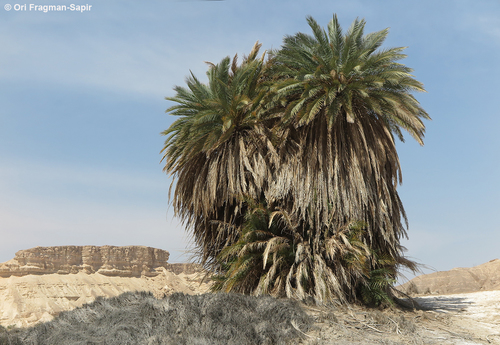
- Hyphaene thebaica, the true doum, whose trunk forks, unlike the unbranched trunks of European fan palm.
The scientific name, together with the clump of stems and spiny petioles, separates these palms quickly without waiting for flowers or fruit.
Main sources
- Plants of the World Online / Kew, Chamaerops humilis L.
- Royal Horticultural Society, Chamaerops humilis details
- Missouri Botanical Garden, Plant Finder, Chamaerops humilis
- Plants For A Future, Chamaerops humilis
- INPN, Chamaerops humilis L., 1753, Palmier nain
- IUCN Red List, Chamaerops humilis assessment
- PMC / Annals of Botany, Spatio-temporal arrangement of Chamaerops humilis inflorescences and Derelomus chamaeropsis occupancy
- PubMed, Fedriani & Delibes, Dangerous liaisons disperse the Mediterranean dwarf palm
- Defra Plant Health Portal, Paysandisia archon factsheet
Frequently asked questions
Is European fan palm poisonous to cats and dogs?
No toxic compound is documented for Chamaerops humilis in the databases consulted. The practical risk is mechanical: long petiole spines can injure an animal brushing against them.
Why does my European fan palm have no clear trunk?
Wild plants grow as multistemmed clumps without a clear trunk. A single trunk develops only when basal offshoots are regularly removed, a deliberate form of training rather than the spontaneous habit.
How can I distinguish European fan palm from Trachycarpus fortunei?
European fan palm forms a spiny clump of several stems. Trachycarpus fortunei has a single trunk covered in persistent brown fiber and petioles without conspicuous spines.
Where is European fan palm native?
Its native range spans the western and central Mediterranean, from Spain and Portugal to the Maghreb and Italy. Together with Phoenix theophrasti, it is one of only two palms native to continental Europe.
Can European fan palm grow outdoors in France?
Yes, particularly in southern France and along the Atlantic coast, where it tolerates brief frosts down to -12 °C (10 °F). Wild populations in the country are protected.
How does European fan palm reproduce?
Pollination depends almost entirely on a specialized weevil, Derelomus chamaeropsis. In southern Spain, European badgers then disperse the seeds after eating ripe fruit.
What is the main threat to European fan palm?
The South American palm moth Paysandisia archon, introduced to Europe around 2000. Its larvae bore lethal tunnels into the plant's heart.
Similar plants
If you are unsure about a plant’s toxicity, ask a botanist or veterinarian for advice.