
Garden pink (Dianthus plumarius, )


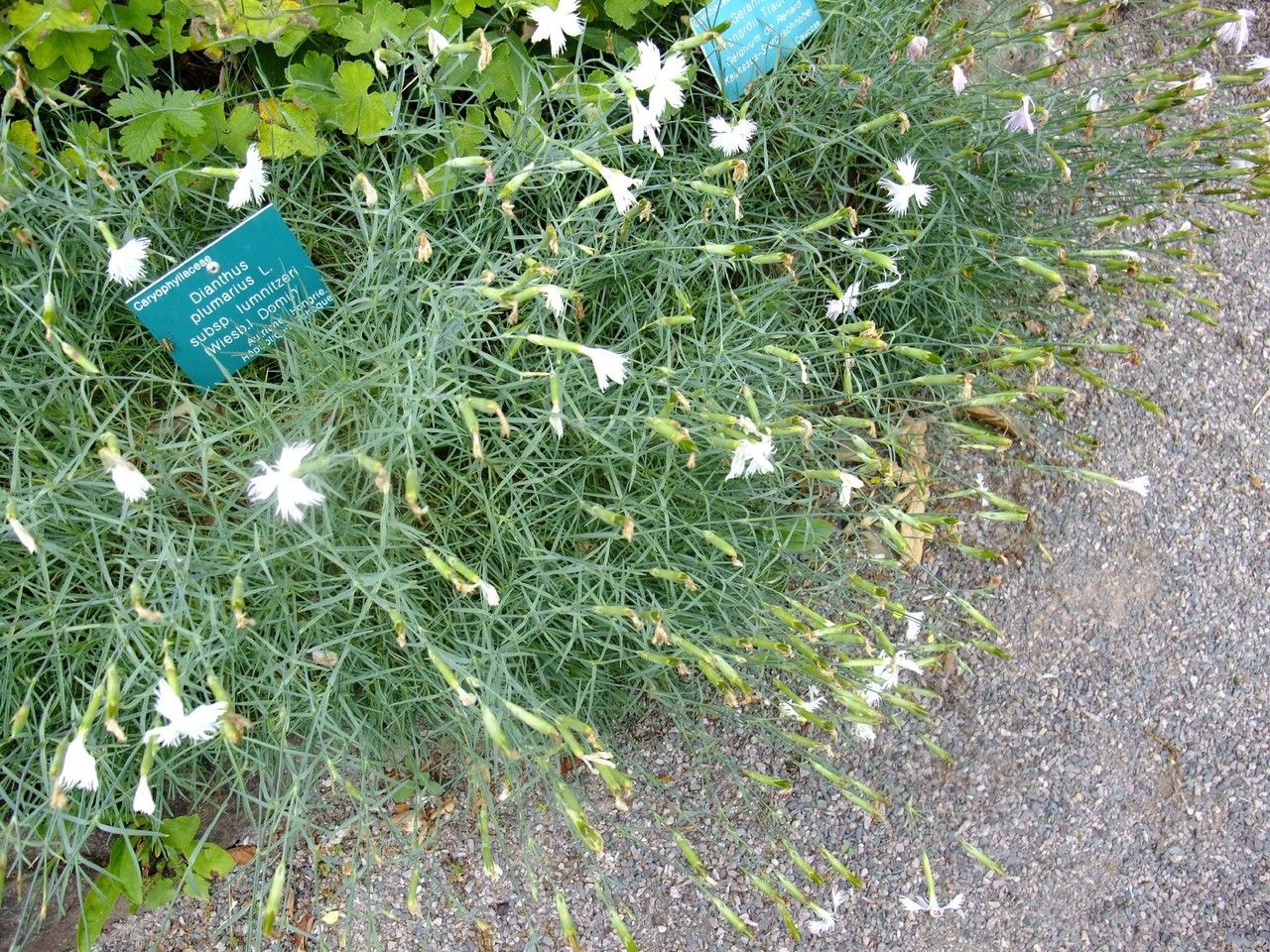
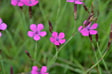
Garden pink (Dianthus plumarius L., 1753) is a perennial in the Caryophyllaceae family, often evergreen, forming a cushion of narrow gray-green to blue-green leaves. Its strongly scented flowers have finely divided petals and belong to the familiar cottage pinks. In gardens it prefers full sun, freely draining soil and moderate watering.
Read moreGarden pink, Cottage pink, Feathered pink, Clove pink and Pheasant’s-eye pink
Place in full sun, with intense direct light all day long.


© photo
(c) Liana Kirkey, some rights reserved (CC BY-NC), uploaded by Liana Kirkey · cc-by-nc
Wikimedia Commons · CC BY-SA or Public Domain
Wikipedia · CC BY-SA
Taken May 9, 2021 by Sabaté Sant Jordi (cc-by-sa)
Taken Jun 11, 2021 by Camille Maravat (cc-by-sa)
Taken Jun 8, 2019 by Lucier Louis (cc-by-sa)
Taken Aug 15, 2016 by Photoflora - Benoit BOCK (©)
Taken Jun 11, 2022 by Laszlo T (cc-by-sa)
© copyright of the Board of Trustees of the Royal Botanic Gardens, Kew.




Global distribution
POWO/WCVP places the native range of Dianthus plumarius from the eastern Alps to the northwestern Balkans, including Austria, Hungary, Italy and the northwestern Balkan Peninsula. France is listed among introductions; French records mainly concern cultivated, escaped or locally naturalized plants.
- Native4
- Introduced5
- Austria
- Hungary
- Italy
- Northwestern Balkans
- Metropolitan France
- Germany
- Great Britain
- Spain
- Temperate North America
Hexagons: regions where the plant occurs. Green dots: native range.1
Identity
Garden pink (Dianthus plumarius L.) is an accepted species of Dianthus in the Caryophyllaceae. POWO/WCVP and WFO trace the name to Species Plantarum in 1753; GBIF records the same Linnaean publication in its taxonomic backbone. 1 2 3
Cottage pink, feathered pink, clove pink and pheasant’s-eye pink are English names used alongside garden pink. French names include “œillet mignardise,” “œillet plumeux,” “œillet de plume” and “œillet plumet.” The names evoke an old garden favorite, finely divided petals and a clove-like scent. 7 4 8
The French word “mignardise” captures its small, ornamental character. It lacks both the tall stems of a florist’s carnation and the very low carpet of maiden pink. This fragrant perennial cushion suits dry borders, its finely cut flowers rising above glaucous foliage. 4 7
Recognition
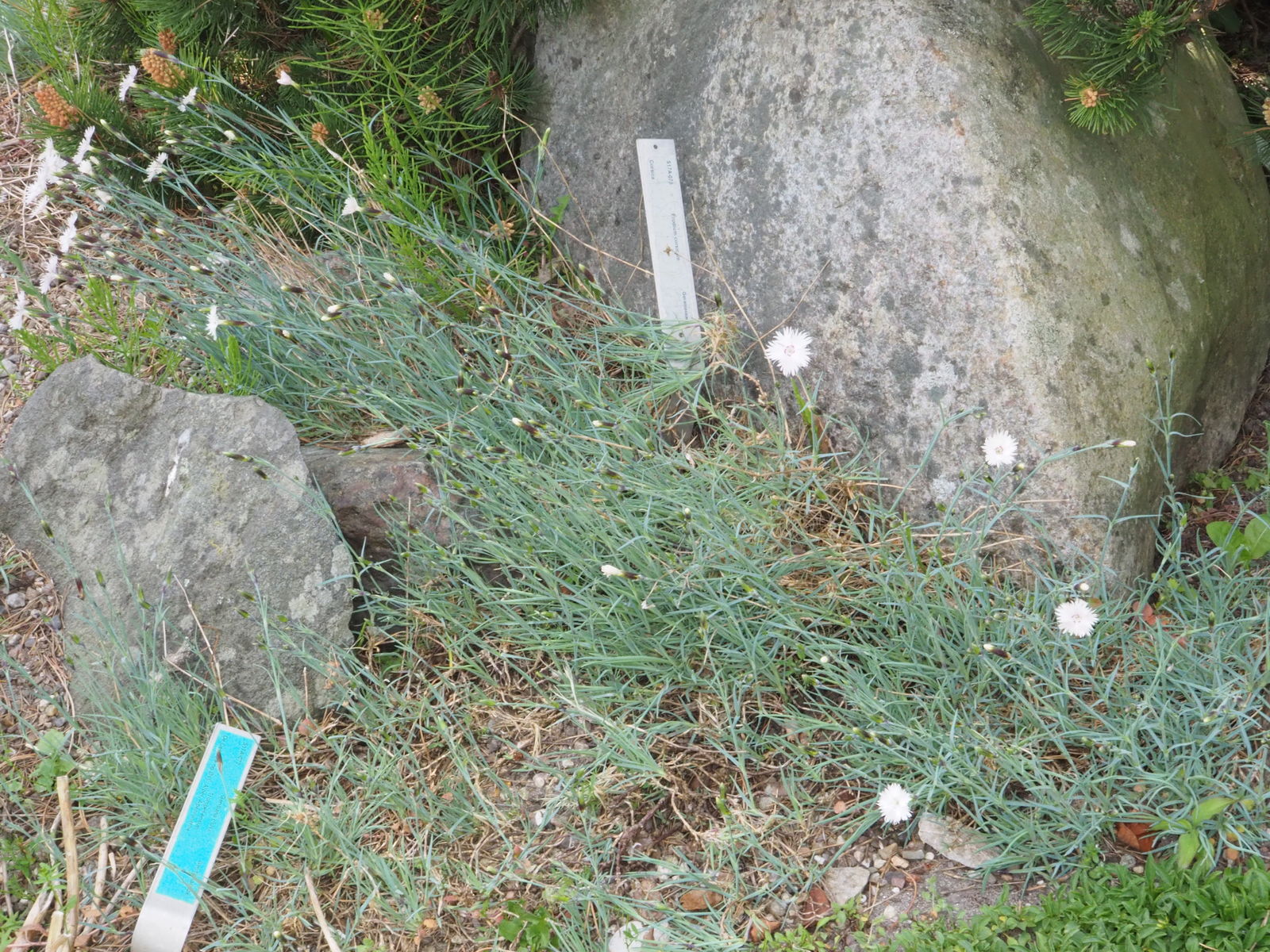
Low, evergreen or semi-evergreen clumps give garden pink its compact ground-cover habit. NC State gives a height of 15–60 cm (6–24 in) and width of about 45–60 cm (18–24 in); RHS gives a lower horticultural range of 0.1–0.5 m (4–20 in) for both height and spread. 7 4
Opposite, simple leaves are linear, stalkless and narrow, colored gray-green to blue-green. Their fine cushion remains ornamental outside flowering, provided moisture does not linger at the crown. Green flowering stems are upright, hairless and branched toward the top. 7 8
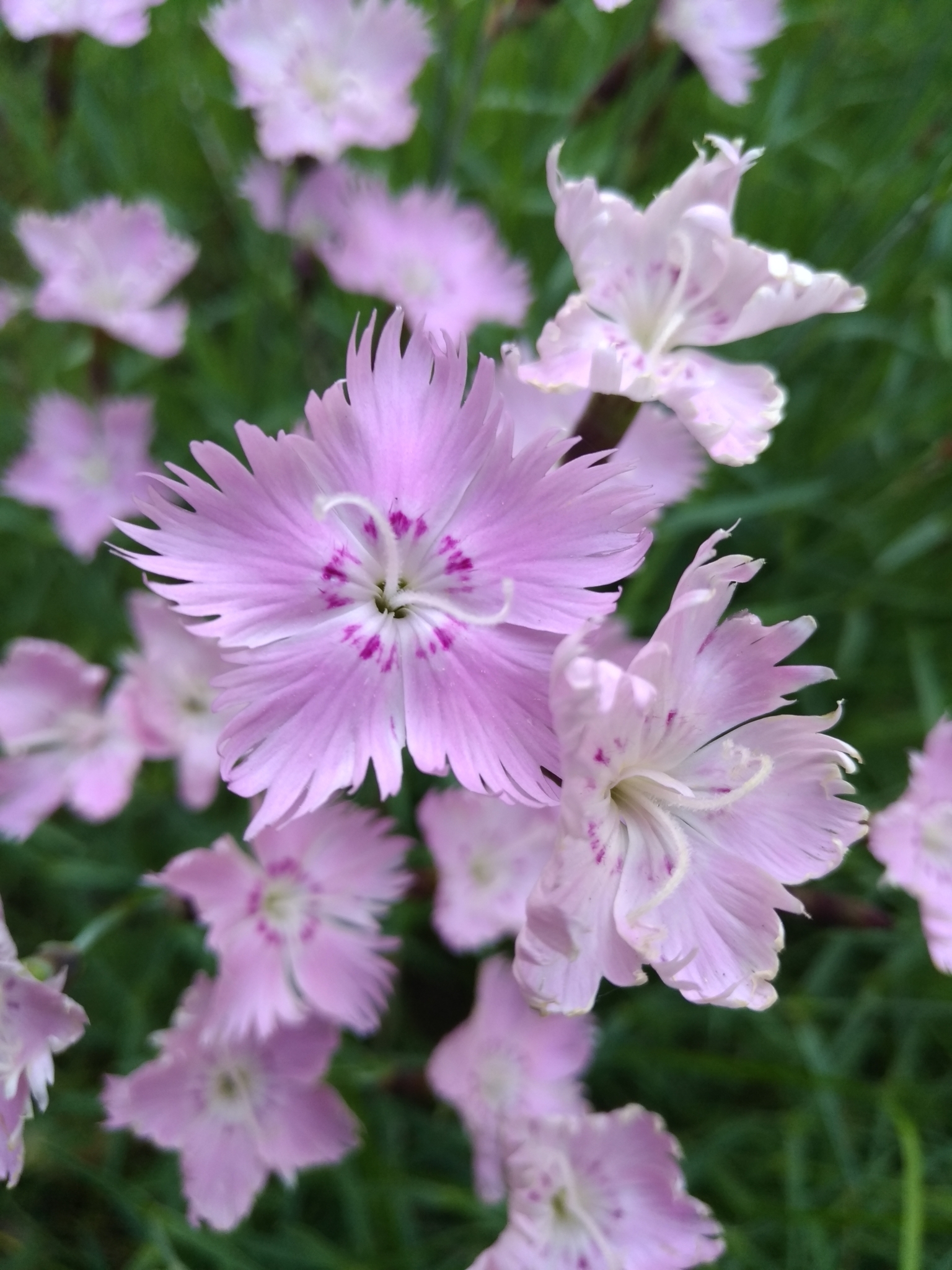
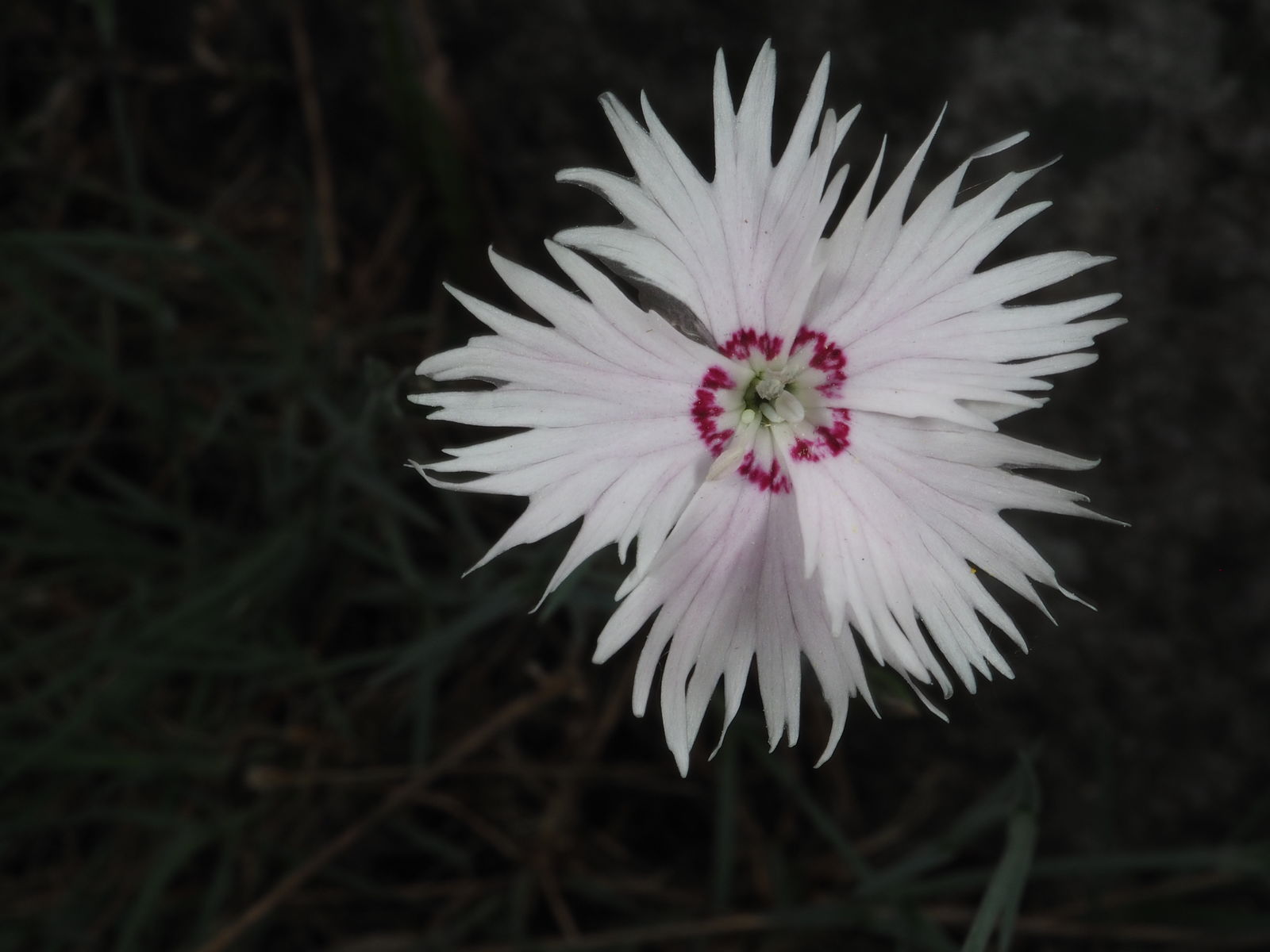
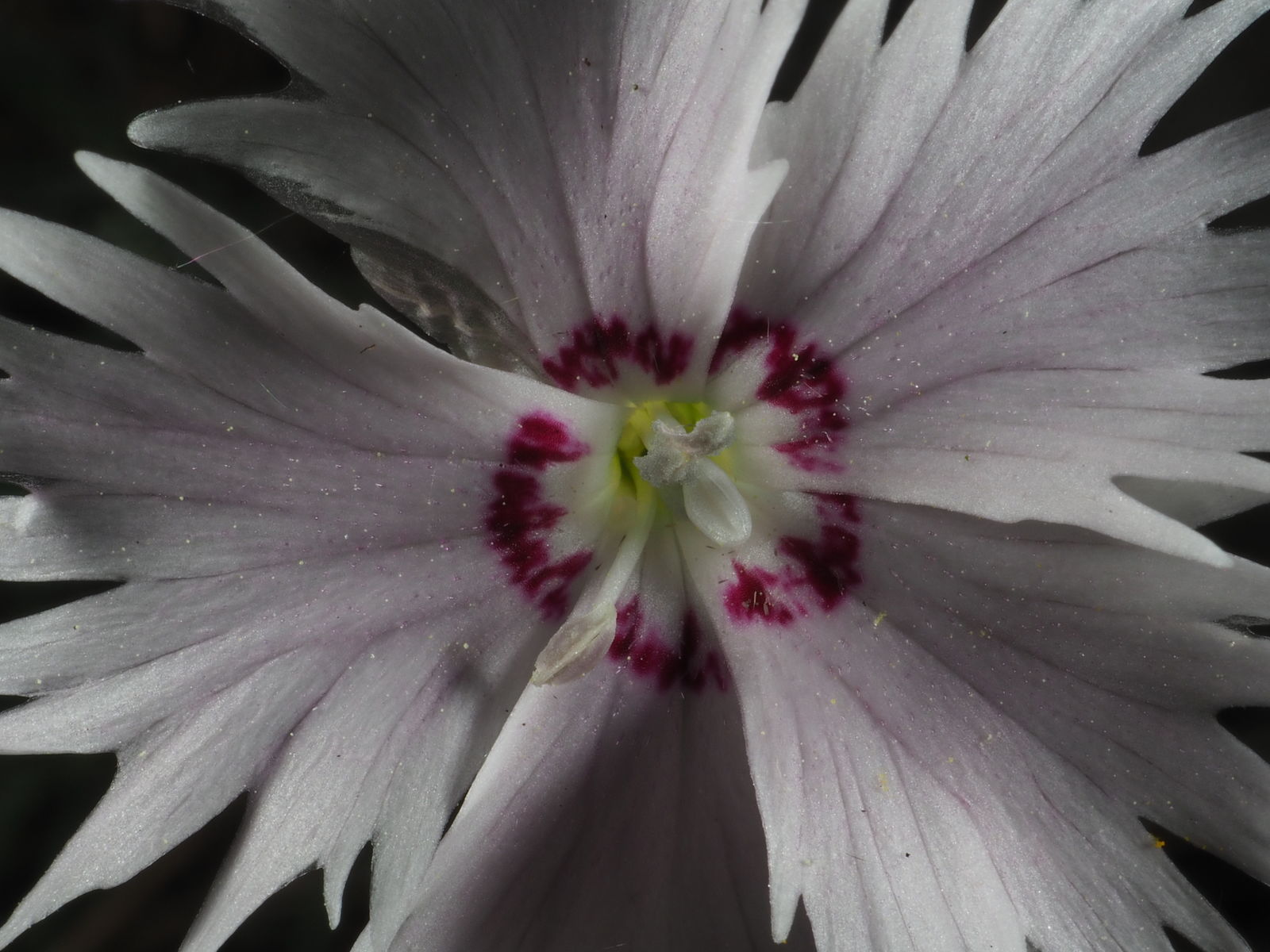
Fragrance and petal shape make the flowers particularly distinctive. Five strongly fringed petals are often pink, red, white or bicolored, with a pronounced clove scent. NC State describes small cymes of three to five flowers; RHS describes small clusters of fragrant, saucer-shaped flowers from late spring into summer. 7 4
Taxonomy and names
Older names remain part of the species’ nomenclatural history. POWO lists the homotypic synonyms Caryophyllus plumarius (L.) Moench, Cylichnanthus plumarius (L.) Dulac, Silene plumaria (L.) E.H.L.Krause and Tunica plumaria (L.) Scop. GBIF also includes historical or horticultural names such as Dianthus hortensis, Dianthus blandus and Dianthus odoratus. 1 3
Two accepted infraspecific taxa are recognized by POWO, including the typical subspecies and Dianthus plumarius subsp. regis-stephani. A named garden cultivar is not automatically a botanical subspecies; the ranks describe different kinds of distinction. 1
Shifting garden names partly reflect this synonymy. SNHF uses the older horticultural expression “Dianthus plumosus or plumarius,” whereas modern taxonomic accounts accept Dianthus plumarius L. The older expression belongs to horticultural history rather than replacing the accepted Kew/WFO binomial. 8 1 2
Habitat and range
The eastern Alps to the northwestern Balkans form the native range in POWO/WCVP, with Austria, Hungary, Italy and the northwestern Balkan Peninsula listed as native regions. France appears instead among introductions. 1
French occurrences concern a cultivated plant that can escape. Tela Botanica links the taxon to INPN number 94794, and the Biodiv’AURA atlas describes it as cultivated and sometimes naturalized, with rare historical regional observations. These records establish a tracked presence, not a generally native status in metropolitan France. 9 10
Its temperate, mineral-soil background suits full sun and well-drained, neutral to alkaline soil, often chalky, sandy or stony. Plants tolerate soil that becomes dry for a time, but not stagnant moisture that deprives the crown of air. 4 7 8
In metropolitan France, garden pink is introduced, with occasional escapes or local naturalization documented in French accounts. This presence does not amount to an invasive alien classification there; a regional introduction must remain distinct from a native range or invasive status. 1 10
Life cycle and cultivation
Short to moderately lived, Dianthus plumarius is a perennial sometimes described as a subshrub in taxonomic databases. Renewing clumps keeps them more attractive: NC State recommends division in spring every 2–3 years, and SNHF notes that old plants deteriorate without periodic renewal. 1 7 8
Late spring through summer is the main flowering season. NC State gives May to August in its Northern Hemisphere setting; SNHF extends the horticultural period to April–September, depending on form and care. Removing or shearing faded flowers keeps the clump tidy and can encourage longer flowering. 7 8
Success depends on plenty of light, free drainage and restrained feeding. NC State emphasizes full sun and allowing soil to dry between waterings. SNHF recommends neutral to alkaline conditions and discourages heavy fertilizer applications, allowing a modest, slow-release form instead. 7 8
Propagation uses seed, division, cuttings of non-flowering stems or rooted pieces separated from the clump. To preserve a particular cultivar, vegetative methods are more reliable than seed: offspring can differ in scent, color, density and the depth of the petal divisions. 7 8
Uses and toxicity
Ornamental uses include low borders, rock gardens, walls, banks, sunny pots and small fragrant bouquets. NC State records bees, butterflies and hummingbirds in its North American setting. Open flowers also attract visiting insects in France, without making the plant a major ecological restoration tool. 7
Petal uses need a cautious distinction from eating garden flowers. NC State records cordials, syrups, sauces and vinegars, but flowers bought for gardens or bouquets are not recommended for consumption. Treatments, exact identification and individual sensitivity all affect risk. 7
Low animal toxicity is documented. NC State assigns Dianthus plumarius low-severity poison characteristics, records triterpenoid saponins, minor skin irritation and possible vomiting, and flags problems for cats, dogs and horses. ASPCA lists pinks within Dianthus as toxic to dogs and cats, with mild digestive signs and dermatitis. 7 11
Horse evidence calls for a more cautious distinction. NC State directly flags horses for Dianthus plumarius, but ASPCA’s Pinks account does not list them; its Carnation account does list horses for Dianthus caryophyllus. The position for garden pink remains precautionary, rather than a strong claim of systemic horse toxicity. 7 11 12
Cultivars and garden look-alikes
Garden selections include Birmingham, Cottage Pink, Rosish One and Ipswich Pinks Group. NC State illustrates Birmingham and Cottage Pink; RHS documents Rosish One and the Ipswich Pinks Group. These are garden cultivars or groups, not separate species. 7 5 6
Other Dianthus provide the usual look-alikes. Dianthus caryophyllus is the taller common or florist’s carnation, extensively selected for cutting; Dianthus deltoides makes a lower mat with small, often dark-ringed flowers; Dianthus barbatus has dense heads of small flowers; and Dianthus chinensis is often grown as annual or biennial bedding. 1 7
When buying, inspect the plant as well as its label: compact healthy foliage, a firm base, a freely draining pot, fragrant flowers, no leaf spots and roots that are not standing in water. A heavily flowering but saturated clump may decline quickly after planting if the garden soil holds moisture. 7 8
Main sources
- Plants of the World Online / Kew, Dianthus plumarius L.
- World Flora Online, Dianthus plumarius L.
- GBIF Backbone Taxonomy, Dianthus plumarius L.
- Royal Horticultural Society, Dianthus plumarius, clove pink
- Royal Horticultural Society, Dianthus plumarius Rosish One
- Royal Horticultural Society, Dianthus plumarius Ipswich Pinks Group
- NC State Extension Gardener Plant Toolbox, Dianthus plumarius
- Société Nationale d'Horticulture de France, Garden pink
- Tela Botanica eFlore, Dianthus plumarius L.
- Biodiv'AURA Atlas / SINP AURA, Dianthus plumarius L., 1753
- ASPCA, Pinks toxicity entry
- ASPCA, Carnation toxicity entry
Frequently asked questions
Is garden pink native to France?
No. POWO lists France among introduced regions; French accounts mainly document cultivated, escaped or locally naturalized plants.
How does garden pink differ from a florist’s carnation?
Florist’s carnation generally means Dianthus caryophyllus and its cut-flower lines. Dianthus plumarius is lower, forms a cushion and has strongly fringed, fragrant flowers for rock gardens or borders.
How much water does garden pink need?
Little once established. It prefers to dry between waterings. During drought, 5–15 mm (0.2–0.6 in) per week is often enough in drained soil, adjusted for heat, the container and rainfall.
Is garden pink toxic to cats and dogs?
Yes, although toxicity is low. NC State flags Dianthus plumarius as a problem for cats and dogs and records triterpenoid saponins, irritation and possible vomiting. ASPCA describes mild signs for pinks within Dianthus.
What about horses?
Caution is more appropriate than a strong conclusion. NC State flags a possible problem for horses with Dianthus plumarius, but ASPCA’s Pinks account does not list horses under that common name. Preventing grazing is the simplest precaution.
Should I eat the flowers?
Food use is not recommended. Some horticultural accounts mention petals used in syrups or vinegars, but the plant can irritate animals and flowers from garden centers may have been treated.
Why is the center of my clump opening up?
This often happens with age, particularly in rich or wet soil. Divide every two to three years, replant the younger outer portions and keep the crown dry to limit the problem.
Similar plants
If you are unsure about a plant’s toxicity, ask a botanist or veterinarian for advice.