
Miniature umbrella tree (Heptapleurum arboricola, )
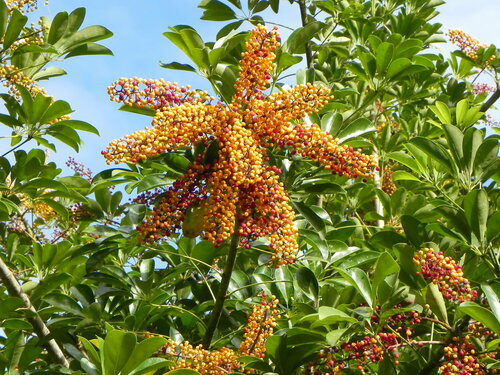
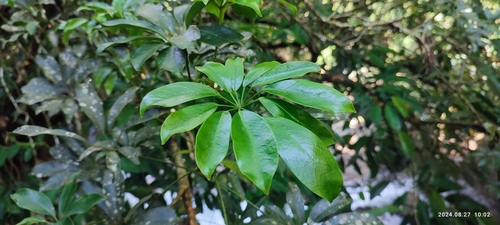
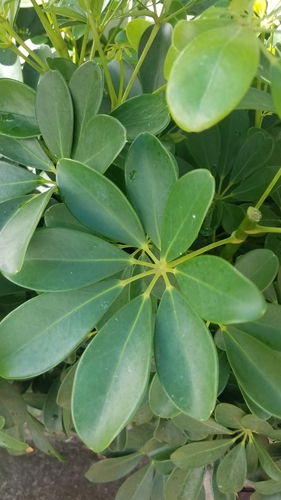
The miniature umbrella tree (Heptapleurum arboricola), long sold as Schefflera arboricola, is an evergreen shrub in the ivy family, Araliaceae, native to Taiwan and the Chinese island of Hainan. In the wild it becomes a scrambling shrub several meters tall; indoors it stays an upright foliage plant with glossy, palmate leaves held like open parasols.
Read moreDwarf umbrella tree, Dwarf schefflera, Hawaiian umbrella tree and Parasol plant
Global distribution
The native range of Heptapleurum arboricola is limited to Taiwan and the Chinese island of Hainan. Widely grown as a houseplant, it has naturalized beyond that range, notably in Florida and several tropical regions; these areas of introduction should be kept distinct from the native range.
- Native2
- Introduced3
- Taiwan
- China (Hainan)
- United States (Florida)
- Hawaii
- Eastern Australia
Hexagons: sourced regions. Green dots: native range. Statuses according to POWO (Kew).
Identity
The miniature umbrella tree (Heptapleurum arboricola Hayata, 1916), long sold as Schefflera arboricola, is an evergreen shrub in the genus Heptapleurum, part of the ivy family, Araliaceae. The common name describes its leaflets, arranged in a ring at the tip of a long stalk like the ribs of an open umbrella. 1 2
Across much of the world the species is best known as an easygoing houseplant, labeled dwarf schefflera or simply umbrella plant. Smooth, glossy, palmate foliage makes it a compact and forgiving choice for bright rooms. 3 4
Recognition
Look first at the leaves. They are palmately compound, usually with 7–9 leaflets radiating in a circle like a parasol. Each leaflet is obovate to elliptic, leathery and shiny, 5–11 cm (2–4.5 in) long, and dark green on the common forms. 2 4
Growth is bushy and branched: the flexible stems fill out after pinching, which is why well-grown plants look so dense. In summer, and mainly in the tropics, the plant bears small red flowers in panicles, followed by round orange drupes about 6 mm (0.25 in) across that turn black when ripe. 2 3
Grown indoors, the miniature umbrella tree stays an upright shrub of 1–2 m (3.3–6.5 ft), often sold as a dense clump. In its native range and under tropical conditions it reaches 3–8 m (10–26 ft), scrambling through other vegetation and sometimes perching as an epiphyte on a host tree. 4 5
Useful taxonomy
Bunzō Hayata described the species in 1916 as Heptapleurum arboricola. For decades it sat in the genus Schefflera, and that name still dominates garden centers. The main names to know are:
- Schefflera arboricola (Hayata) Merr.
- Schefflera kwangsiensis Merr. ex H.L.Li
- Schefflera odorata (Blanco) Merr. & Rolfe
- Heptapleurum arboricolum Hayata
The reliable anchor is the accepted scientific name, Heptapleurum arboricola. Cultivar names such as Gold Capella or Nora mark horticultural selections, not separate species or botanical varieties. 1 3
Habitat and range
The wild plant comes from the humid forests of Taiwan and the Chinese island of Hainan, growing on lowlands and wooded slopes in warm, moist air. There it forms a scrambling shrub that readily leans on neighboring vegetation. 1 4
Like other tropical Araliaceae, it can settle as an epiphyte on another tree's trunk without parasitizing it, using the host as a support to reach brighter light filtered by the canopy. That adaptability helps explain its vigor in a pot and how easily it roots from cuttings. 2 5
Widely planted as an ornamental, the miniature umbrella tree has naturalized outside its range, notably in Florida, Hawaii and several tropical and subtropical regions, where it can become locally invasive. Those areas of introduction should be kept separate from its Asian native range. 4 2
Life cycle and reproduction
Indoor plants seldom bloom, but flowering is normal on a mature specimen planted in the ground in a warm climate. The small red flowers sit in upright panicles and give way to fleshy orange drupes that darken as they ripen; birds eat them and are the species' main seed dispersers. 2 4
Away from its native range, fruit on houseplants is incidental, and growers are after the foliage rather than the fruit. Maturity shows mostly as a denser habit and more leaflets per leaf. 3 5
Propagation relies mainly on stem cuttings with a node, air layering on bare stems or, less often, seed sown fresh. A cutting taken just below a node and kept warm in bright indirect light forms its first roots in three to six weeks; let the cut end dry off before potting it. Air layering means wounding the stem, wrapping it in moist sphagnum moss and waiting for roots before severing the new plant. 2 3
Uses and risks
Heptapleurum arboricola is grown for ornament: as an indoor foliage plant or, in the tropics, as a hedge and border shrub. It takes pruning well, which also makes it a popular bonsai subject, trained small with a thickened trunk and a parasol crown. 3 4
Every part of the plant contains irritating, insoluble calcium oxalate crystals. Chewed or swallowed, they cause intense burning in the mouth, drooling, vomiting and difficulty swallowing, and the sap can irritate sensitive skin. The ASPCA lists schefflera as toxic to cats and dogs, so keep it out of reach of pets and young children and wear gloves when pruning. 6 7
Varieties, look-alikes and related plants
The many forms on sale are not separate species. Gold Capella, the most widespread, has golden-yellow variegation; Nora is a dense form with small bright green leaflets; Gerda and Melanie carry cream to gold variegation; Compacta is a stocky plant with short internodes. Before buying, check the cultivar name, the state of the roots and how full the foliage is. 3 8
Common look-alikes include:
- Heptapleurum actinophyllum, the umbrella tree, with much larger leaflets and a tree-like habit
- Heptapleurum elegantissimum, with narrow, toothed leaflets
- some Dizygotheca and false aralias with fine, deeply cut foliage
Medium-sized, very glossy leaflets arranged like a parasol, together with a bushy habit, remain the most dependable clues that a plant sold as dwarf schefflera really is Heptapleurum arboricola. 4 5
Main sources
- Plants of the World Online / Kew, Heptapleurum arboricola Hayata
- Royal Horticultural Society, Heptapleurum arboricola, umbrella tree
- Missouri Botanical Garden, Schefflera arboricola
- NC State Extension, Heptapleurum arboricola (dwarf umbrella tree)
- Encyclopaedia Britannica, Schefflera (umbrella tree)
- ASPCA, Schefflera toxicity entry
- Merck Veterinary Manual, houseplants with insoluble calcium oxalates
- Chicago Botanic Garden, Schefflera arboricola dwarf umbrella tree
Frequently asked questions
Is Heptapleurum arboricola toxic?
Yes. All parts contain irritating calcium oxalate crystals. The ASPCA lists schefflera as toxic to cats and dogs, causing a burning mouth, drooling and vomiting, so keep it out of reach of pets and young children.
Why is my Heptapleurum arboricola dropping leaflets?
Leaflet drop often follows a move to a new spot, a cold draft, or too much or too little water. Keeping temperature and watering steady limits this stress, which is common after purchase or a move.
Schefflera or Heptapleurum, which name is correct?
Both refer to the same plant. After a taxonomic revision, the species moved from Schefflera to Heptapleurum; Schefflera arboricola remains a synonym still widely used in the nursery trade.
How do I make my schefflera bushier?
Pinch out the growing tips in spring and give the plant bright indirect light. Pinching triggers new branching, while low light stretches the stems and thins the foliage.
How much light does a miniature umbrella tree need?
Bright but indirect light gives the best foliage. It tolerates partial shade at the cost of looser growth, and harsh direct sun can bleach the leaflets.
How big does Heptapleurum arboricola get?
Indoors it commonly reaches 1–2 m (3.3–6.5 ft). In its tropical native range it is a shrub that can reach 3–8 m (10–26 ft), with a scrambling and sometimes epiphytic habit.
Are variegated forms different species?
No. Gold Capella, Gerda and Melanie are cultivars selected for variegation, not distinct species. They need a little more light to keep their leaflets colorful.
Similar plants
Botanical data compiled from reference sources (RHS, Kew Gardens, POWO). This profile is for guidance only and is not a substitute for advice from a botanist or veterinarian if you have concerns about toxicity.