
Tree peony (Paeonia × suffruticosa, )


Tree peony (Paeonia × suffruticosa Andrews) is a deciduous shrub in the Paeoniaceae, long cultivated in China and Japan for its very large spring flowers. It retains a woody framework through winter, unlike herbaceous peonies. Despite its name, it remains a slow-growing shrub that needs careful planting.
Read moreTree peony, Moutan peony, Mudan and Chinese tree peony
Allow a few hours of direct sun per day, preferably morning or evening.
Gentle full sun to light partial shade


© photo
Wikimedia Commons · CC BY-SA or Public Domain
(c) jamie-aa, some rights reserved (CC BY) · cc-by
Global distribution
POWO/Kew accepts Paeonia × suffruticosa as a hybrid, with a native range in Henan, China, and the parentage P. jishanensis × P. rockii. Horticultural sources often apply the name more broadly to complex woody cultivars.
- Native2
- Introduced3
- China (Henan)
- Southeastern China
- South-central China
- Inner Mongolia
- Korea
Hexagons: regions where the plant occurs. Green dots: native range.1
Identity
Tree peony (Paeonia × suffruticosa Andrews) is a woody peony in the Paeoniaceae. POWO/Kew accepts the name as a hybrid, published by Henry Charles Andrews in 1804, and gives its parentage as P. jishanensis × P. rockii. 1
The name tree peony describes its persistent woody stems rather than a true tree habit: it remains a shrub through winter. Moutan peony, mudan and Chinese tree peony refer to its Chinese horticultural background and cultivars grown for centuries. 3 6
Catalog usage requires care. Western catalogs may use Paeonia × suffruticosa for tree peonies with complex parentage rather than only the narrowly defined taxon. NC State describes ancient Chinese cultigens; Oregon State notes that many plants sold under this name are probably hybrids involving several woody species. 5 6
Recognition
Upright, slow-growing and sparsely branched, Tree peony is a deciduous shrub. Leaves fall in autumn but stems remain, distinguishing it from herbaceous peonies that regrow from the crown each year. RHS gives typical garden heights of 1.5–2.5 m (5–8 ft) with a smaller spread; NC State describes plants reaching about 2 m (6.5 ft) in good conditions. 3 5
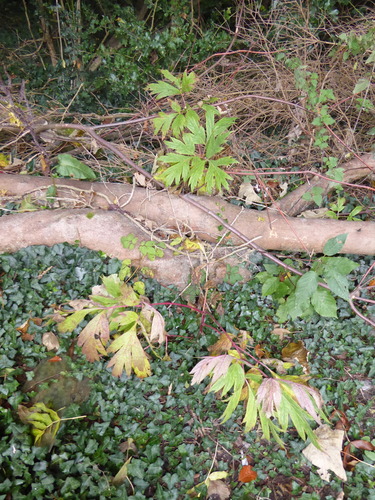
Alternate, compound leaves are deeply divided into lobed leaflets. Oregon State describes foliage that is light green above and more blue-green below, on thick stems that do not die to ground level in winter. This foliage can be as useful as the flowers when distinguishing woody from herbaceous peonies. 6 5
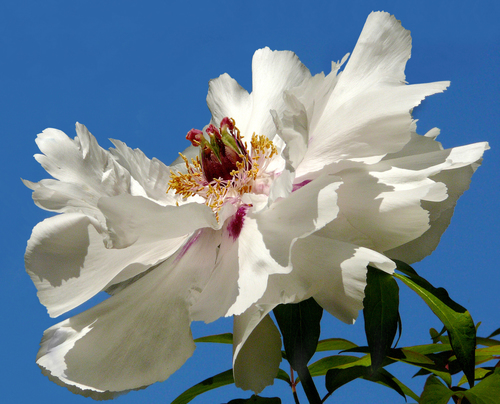
Large, terminal, bowl-shaped flowers are the showpiece. They may be single, semidouble or double, in white, pink, red or purple, with yellow in some hybrids. RHS places flowering from late spring into early summer; WSU notes that tree peonies often flower before herbaceous peonies, with blooms approaching 30 cm (12 in) across. 3 7
Useful taxonomy
For botanical identification, retain Paeonia × suffruticosa Andrews. POWO treats it as an accepted hybrid, with a narrowly defined native range in Henan, China, and synonyms including Paeonia × moutan, Paeonia × arborea, Paeonia × chinensis and Paeonia × papaveracea. 1
GBIF also records Paeonia ×suffruticosa Andrews, with Andrews 1804 and several historical or horticultural synonyms. Spelling varies: x suffruticosa, × suffruticosa and sometimes suffruticosa without the hybrid sign appear in gardening texts. 2
Gardeners need to distinguish several groups. A plant sold as tree peony may belong to the suffruticosa group, rockii group, lutea hybrids, P. delavayi or a complex selection. Cultivar name, basal petal blotches, stem vigor and nursery provenance often tell more than an abbreviated label. 5 6
Habitat and range
For the accepted taxon, POWO/Kew records a native range in China, specifically Henan, and describes a temperate-biome shrub. The same account records introductions or occurrences beyond that range in south-central China, Inner Mongolia and Korea. 1
Horticultural references give a broader account: RHS lists western China, while EPPO describes a probably Chinese origin, no known wild occurrence within its treatment, and widespread ornamental cultivation as cultivars and hybrids. These differences reflect an ancient cultivated plant linked with several related woody species; they should not be flattened into one simple origin. 3 10
In France, this peony is treated as cultivated, with no invasive status assigned here. It needs a stable position, deep, humus-rich, well-drained soil and shelter from cold or drying winds, which readily damage young shoots and large flowers. 4
Grafting, planting and pruning
Grafting determines one of the most important planting details. Many nursery tree peonies are grafted onto herbaceous peony roots. RHS recommends burying the union about 15 cm (6 in) below soil level to encourage the woody part to form its own roots; WSU gives a similar depth of about 10–13 cm (4–5 in). 4 7
Shoots arising below the graft may belong to the rootstock, particularly if they are red, glossy or strongly herbaceous. Remove them at their point of origin so that they do not compete with the woody cultivar. 4 6
During establishment, especially in the first season, water regularly: 10–20 mm (0.4–0.8 in) per week in dry weather is a practical guide, followed by time for excess water to drain. Established plants tolerate drought better, but a long dry spell may reduce flowering the following year. 4
Prune lightly, preserving the permanent framework. Do not cut a tree peony back like a herbaceous peony. RHS advises removing faded flowers, cutting out dead wood in late winter and shortening only stems that have become too long with age. Keeping this framework is the key difference in maintenance. 4
Life cycle and flowering
Growth resumes in spring from woody stems. Young leaves and buds are vulnerable to late frost: a cold night may blacken tissue or prevent buds from opening. Choose a bright, sheltered position away from frost pockets and wind corridors. 4
Spectacular flowering still requires patience. RHS notes that a tree peony may need up to four years to settle and flower well again, even if bought in bloom. Its account of P. × suffruticosa gives 5–10 years to reach mature size. 4 3
Follicles contain the seeds. RHS advises collecting viable black seeds; red seeds, when present, are generally unfertilized. Growing a cultivar from seed remains slow and unpredictable because seedlings do not faithfully reproduce the parent plant. 4 5
Uses and risks
As an ornamental shrub, Tree peony suits a spring specimen planting, shrub border, Asian-inspired garden, bright border or lightly shaded scene. Flowers can occasionally be cut, but its slow growth means a young framework should not be unbalanced simply to fill a vase. 3 5
Tree peony is not a food plant. Mudan may also evoke medicinal uses of root bark in other settings, but these provide no safe home-use method, dose or preparation. In a garden, the practical advice is to avoid chewing or brewing plant parts and keep them away from children. 1
Animal safety calls for caution. The ASPCA lists 'Peony' as toxic to dogs, cats and horses, with paeonol and signs including vomiting, diarrhea and depression. Pet Poison Helpline says paeonol is concentrated in bark and digestive signs mainly follow substantial ingestion. RHS also reports possible skin irritation in dogs and cats from P. × suffruticosa. 8 9 3
Cultivars and look-alikes
Choose cultivars by flower color, form and vigor: single, semidouble or double; white, pink, red or purple, with yellow or apricot in some hybrids. NC State cites 'Shima Nishiki', whose semidouble purple-red flowers are streaked with white. 5
Peonies in the rockii group often have a large dark blotch at each petal base and are generally very hardy. Lutea hybrids and those derived from P. delavayi may have yellow or changing colors, but their behavior differs; horticultural references note greater winter wood damage in some cases. 5 6
Itoh hybrids are easily confused with tree peonies. They combine large, woody-peony-type flowers with a habit closer to herbaceous peonies and die back more in winter. When buying or assessing a plant, examine its winter framework, graft position, full label and cultivar name. 7 4
Common problems
RHS identifies peony wilt as a serious disease, often associated with Botrytis gray mold, causing wilting, damaged buds and young tissue dieback. Basic control is cultural: improve air circulation, water at soil level, remove affected parts and clear debris. 4 7
Many other problems arise from the site: deep shade, cold wind, late frost, compacted soil, winter wet or root competition. Ants on peonies often worry gardeners, but WSU explains that they feed on sugary substances on buds and do not need treatment. 4 7
A recently planted or moved tree peony may simply need time. More fertilizer is not always the answer: steady watering, correct mulching, adequate light and avoiding another move often matter more. 4
Main sources
- Plants of the World Online / Kew, Paeonia × suffruticosa Andrews
- GBIF Backbone Taxonomy, Paeonia ×suffruticosa Andrews
- Royal Horticultural Society, Paeonia × suffruticosa
- Royal Horticultural Society, How to grow tree peonies
- NC State Extension Gardener Plant Toolbox, Paeonia — Woody Types, including Suffruticosa Hybrids
- Oregon State University Landscape Plants, Paeonia suffruticosa
- Washington State University Extension, Peonies
- ASPCA, Peony toxicity entry
- Pet Poison Helpline, Peony
- EPPO Global Database, Paeonia x suffruticosa
Frequently asked questions
Is a tree peony really a tree?
No. It is a deciduous shrub: its woody stems remain through winter, but it does not form a tree trunk in the usual horticultural sense.
Should I cut Paeonia × suffruticosa to the ground?
No. Unlike herbaceous peonies, Tree peony retains its framework. Mainly remove dead wood, faded flowers and rootstock shoots.
Why plant a grafted tree peony so deeply?
Many plants are grafted onto herbaceous peony roots. Burying the graft 10–15 cm (4–6 in) deep encourages the woody peony to form its own roots and reduces rootstock shoots.
Why is my tree peony not flowering?
It can take several years to establish. Shade, prolonged drought, late frost or recent transplanting can also reduce flowering.
Is Tree peony toxic to animals?
Treat it as toxic as a precaution. The ASPCA lists peonies as toxic to dogs, cats and horses, identifying paeonol and digestive signs; Pet Poison Helpline mainly highlights the risk after substantial ingestion.
How does it differ from P. rockii or Itoh hybrids?
P. rockii and its cultivars often have a large dark blotch at the petal base. Itoh hybrids combine herbaceous and woody peony traits but die back more in winter than true woody peonies.
Similar plants
If you are unsure about a plant’s toxicity, ask a botanist or veterinarian for advice.