
Common selfheal (Prunella vulgaris, )
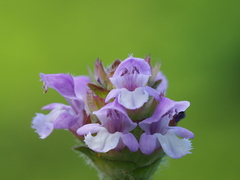
Common selfheal (Prunella vulgaris) is a mat-forming perennial in the Lamiaceae family, found across almost all the temperate Northern Hemisphere and south to Central America. Creeping square stems form a low carpet topped by dense blue-violet flower spikes, a compact outline that distinguishes it from many other meadow mints.
Read moreCommon selfheal, Self-heal, Heal-all, Carpenter’s herb, Brownwort and Heart-of-the-earth
Give plenty of ambient light without direct sun on the leaves.
Full sun to partial shade; moist soil recommended
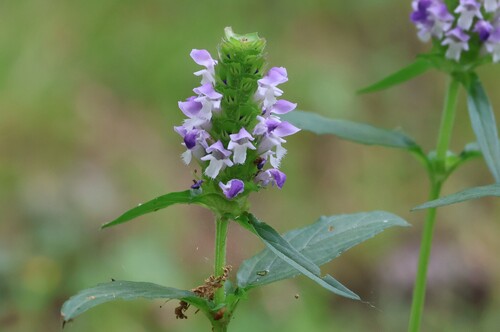
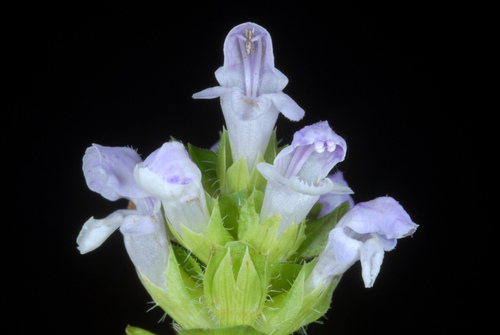
© photo
(c) kenbuchholz, some rights reserved (CC BY-NC) · cc-by-nc
葉子 · cc0
Svetlana Polevova · cc0
(c) Millie Basden, some rights reserved (CC BY) · cc-by
(c) Douglas Goldman, some rights reserved (CC BY-SA) · cc-by-sa
Global distribution
POWO places the native range of Prunella vulgaris across almost all the temperate and subtropical Northern Hemisphere, extending to Central America. Introduced in the 19th century to Australia, New Zealand and Hawaii, it is now regarded as locally invasive in lawns and moist meadows there.
- Native5
- Introduced2
- Invasive1
- Europe
- North America
- Temperate Asia
- North Africa
- France
- New Zealand
- South America
- Australia
Hexagons: regions where the plant occurs. Green dots: native range.1
Identity
Common selfheal (Prunella vulgaris L., 1753), also called self-heal or heal-all, is an accepted Lamiaceae species described by Linnaeus in Species Plantarum. POWO reports no major disputed synonymy at species level. Its familiar names reflect a long history of use as a healing herb. 1 4
The name Prunella is thought to derive from German die Bräune, referring to a throat infection or diphtheria. The plant was used for such throat conditions long before Linnaeus classified it. The epithet vulgaris simply means “common,” fitting its almost cosmopolitan distribution. 4 5
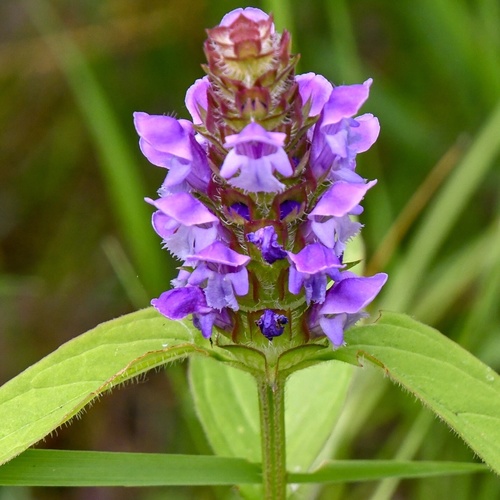
About fifteen Eurasian and North American Lamiaceae species belong to Prunella, including Prunella grandiflora and Prunella laciniata. One detail usually helps separate common selfheal: its flowering stem retains opposite leaves immediately below the spike, whereas the corresponding part of the stem in Prunella grandiflora is leafless. 9
Recognition
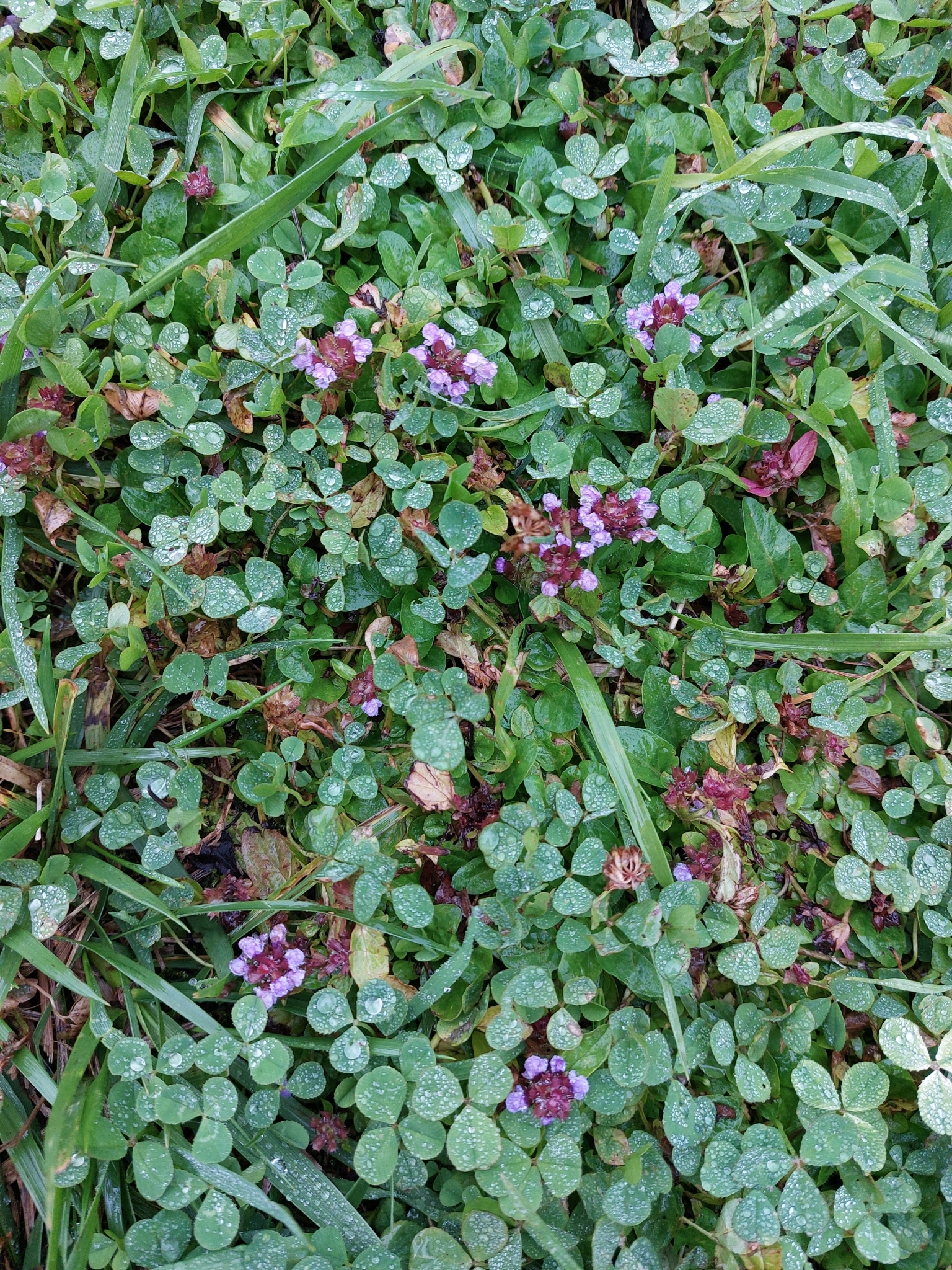
Reddish square stems creep across the ground and root at their nodes, forming a low mat with the characteristic stem shape of Lamiaceae. Opposite leaves are oval to lance-shaped, entire or slightly toothed, 2–6 cm (about 1–2.5 in) long, and borne on short stalks. Plants stand 10–30 cm (4–12 in) tall, sometimes reaching 50 cm (20 in) on rich, moist soil. 4 2
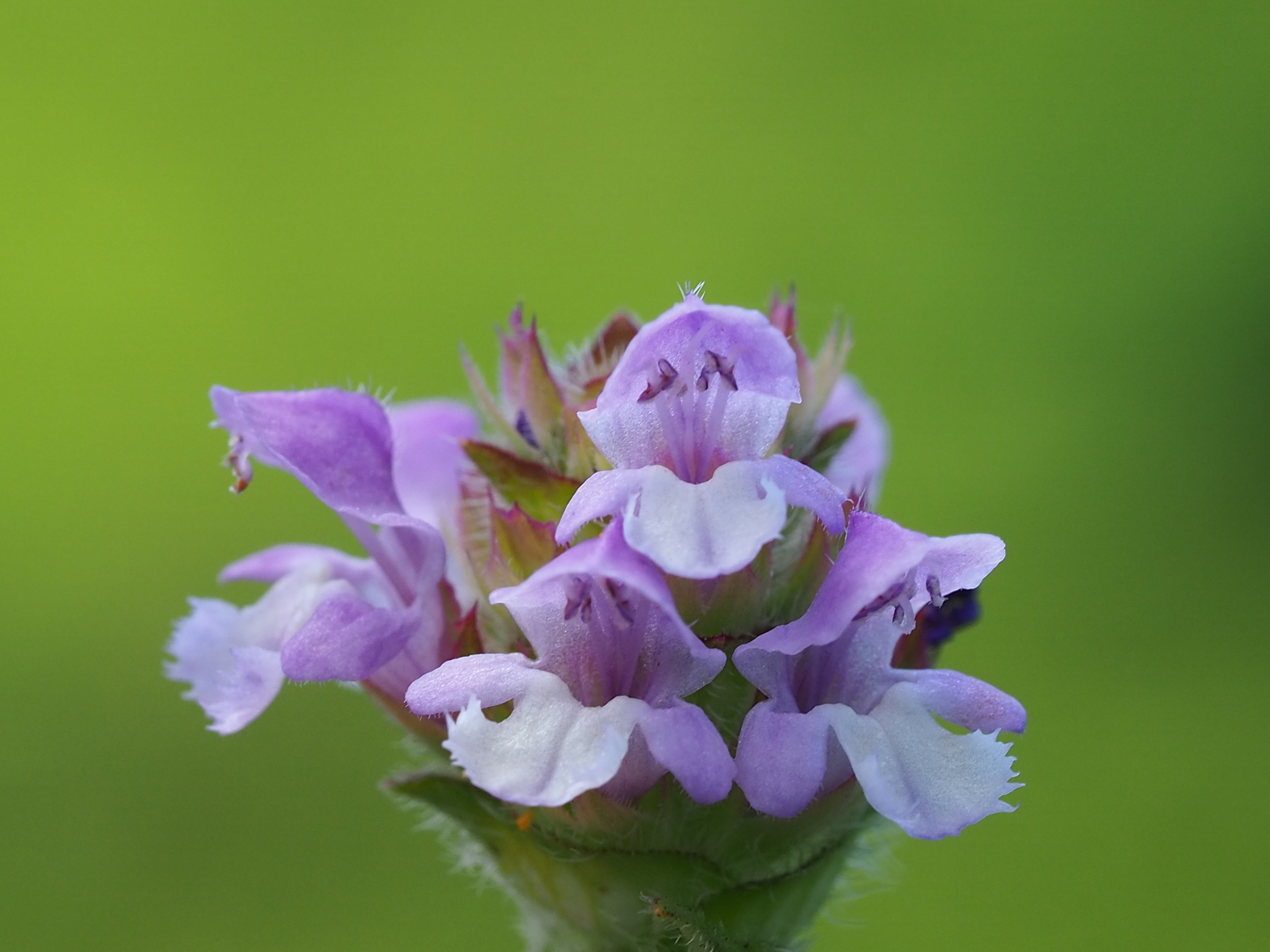
A short, dense, cylindrical flower spike is often purple-tinged at its base because of tightly packed bracts. Each flower has a tubular, two-lipped corolla: the upper lip forms a hood and the lower one a fringed cup. Blue-violet is the dominant color; pink and white occur less often. 4 2
In France, flowering extends from June to September, later than many meadow mints that mainly bloom in spring. A plant without a visible spike may still be young or have been mown before flowering. The mat remains recognizable through its opposite leaves and square creeping stems. 5
Useful taxonomy
Five subspecies are recognized by POWO: subsp. vulgaris in Macaronesia, North Africa and temperate Eurasia; subsp. lanceolata in the Russian Far East, Korea, Japan, North America and Central America; subsp. asiatica from China to the Aleutian Islands; subsp. hispida from southern India to southern China; and subsp. estremadurensis, restricted to Portugal. 1
This geographic diversity explains why descriptions differ between continents. North American populations of subsp. lanceolata have narrower leaves than the European type, while remaining within the same species. Leaf width therefore needs to be interpreted alongside the plant's other identifying features. 4
Within Lamiaceae, Prunella vulgaris belongs to subfamily Nepetoideae and tribe Mentheae, alongside thyme and mint. The natural hybrid Prunella x intermedia, derived from crossing with Prunella laciniata, occurs where their ranges overlap in central and southern Europe. 9
Habitat and distribution
Almost the entire temperate and subtropical Northern Hemisphere, south to Central America, lies within the native range recorded by POWO. This includes Europe, temperate Asia, North Africa and North America. Meadows, pastures, open woodland edges, lawns and path margins provide habitat on nitrogen-rich, neutral to basic soils. 1 4
Introductions to Australia, New Zealand and Hawaii during the 19th century established dense mats in lawns and moist meadows, where the species is now regarded as locally invasive. In South America it remains chiefly a weed of disturbed ground. Its behavior outside the native range can therefore differ from its familiar meadow role in Europe. 4
In France, where it is native, INPN and Tela Botanica do not place it among species requiring monitoring. It is an ordinary component of meadows, woodland margins and lawns, helped by its tolerance of repeated mowing. This French status does not describe its status in other countries. 7 8
Life cycle and reproduction
Seeds and clonal growth provide two complementary routes of reproduction. Each pollinated flower produces up to four nutlets inside the persistent calyx, released gradually as the spike dries and browns. Meanwhile, creeping stems root at their nodes and form new plants capable of independence from the parent. 4 3
Bumblebees and butterflies pollinate the flowers, which remain attractive through summer after many meadow perennials have finished blooming. This later flowering accounts for selfheal's inclusion in flowering lawn mixtures for pollinators. It extends nectar availability into September, when many other meadow perennials no longer provide it. 4
One spring sowing can establish a mat within a season on moist soil. Dividing an already rooted clump in spring or fall gives an even faster result, using the same capacity for vegetative spread that maintains the plant in lawns. 3
Uses and risks
Traditional medicinal use is more extensively documented than food use. Several Indigenous North American peoples, including the Quileute and Quinault, extracted the plant's juice for treating boils. In traditional Chinese medicine, the dried spike, xia ku cao (夏枯草), is still used in herbal teas sold for fever and skin conditions. These are records of traditional uses. 4
Young leaves and stems are eaten raw in salads, cooked as greens or used in a cold infusion. Tannins give a slightly bitter flavor. The plant also contains rosmarinic acid and ursolic acid, compounds common among aromatic members of the mint family. 3 4
Plant toxicity databases report no documented risk for humans, cats or dogs. Information for horses remains limited in the absence of a published study; the lack of information for that animal should remain visible alongside the better documented household-pet status. 3
Varieties, lookalikes and related plants
Named commercial cultivars are uncommon, and most plants sold correspond to the wild type. White-flowered f. albiflora and the narrow-leaved North American subsp. lanceolata are chiefly documented in botanical literature rather than widely distributed through ordinary horticultural trade. 1
Common lookalikes include:
- Prunella laciniata, with white to cream flowers and often more deeply divided foliage;
- Prunella grandiflora, with much larger flowers and a flowering stem without leaves immediately below the spike, sold as ornamental ground cover;
- Prunella x intermedia, a natural hybrid in the genus;
- Ajuga reptans, whose blue flowers are arranged in tiers along the stem rather than concentrated in a tight terminal spike.
These distinctions matter because common selfheal shares meadow and lawn habitats with related plants, increasing opportunities for confusion in the field. Looking at flower arrangement as well as leaf placement is more informative than relying on blue flower color alone. 9
Main sources
- Plants of the World Online / Kew, Prunella vulgaris L.
- Royal Horticultural Society, Prunella vulgaris - Selfheal
- Plants For A Future, Prunella vulgaris
- Wikipedia EN, Prunella vulgaris (Selfheal)
- Wikipedia FR, Common selfheal (Prunella vulgaris)
- Wikidata, Prunella vulgaris
- INPN / MNHN–OFB, Prunella vulgaris L., CD_NOM 116012: original species notice, archived 5 October 2022
- Tela Botanica, eFlore BDTFX: Prunella vulgaris L. — official nomenclatural record 75307
- Wikipedia EN, Prunella (genus)
Frequently asked questions
Is common selfheal toxic?
No. Plant toxicity databases classify it as non-toxic to humans, cats and dogs. Its traditional food and medicinal uses, in salads or infusions, have been documented for centuries.
How can Prunella vulgaris be distinguished from Prunella laciniata?
Prunella laciniata has white to cream flowers and often more deeply divided leaves, while Prunella vulgaris has blue-violet flowers and entire or slightly toothed leaves. They sometimes hybridize as Prunella x intermedia.
Is common selfheal invasive in lawns?
It is native and not classified as invasive in France. Outside its native range, especially in Australia and New Zealand, it forms dense mats in moist lawns and is regarded as a weed.
Can common selfheal be eaten?
Young leaves and stems can be eaten raw in salads, cooked as greens or used in a cold infusion. Tannins give them a slightly bitter taste.
Why do some spikes stay brown after flowering?
The flower spike turns brown after its flowers fade, a feature reflected in the Chinese name xia ku cao, meaning herb that dries in summer. Seeds continue ripening among the dried bracts.
Does common selfheal tolerate mowing?
Yes, better than most flowering perennials. Its low habit and creeping stems make it a frequent component of flowering lawns and meadows mown several times per season.
Similar plants
If you are unsure about a plant’s toxicity, ask a botanist or veterinarian for advice.