
Northern red oak (Quercus rubra, )
Northern red oak (Quercus rubra) is a large deciduous oak in the Fagaceae family, native to eastern and north-central North America. It has shallowly lobed leaves with fine bristle tips, acorns that take two seasons to ripen and bark with long shiny stripes. Introduced to Europe for fast growth and timber, it is now considered potentially invasive in several French regions.
Read moreNorthern red oak, Red oak and Common red oak
Allow a few hours of direct sun per day, preferably morning or evening.
Full sun; young trees tolerate partial shade below the canopy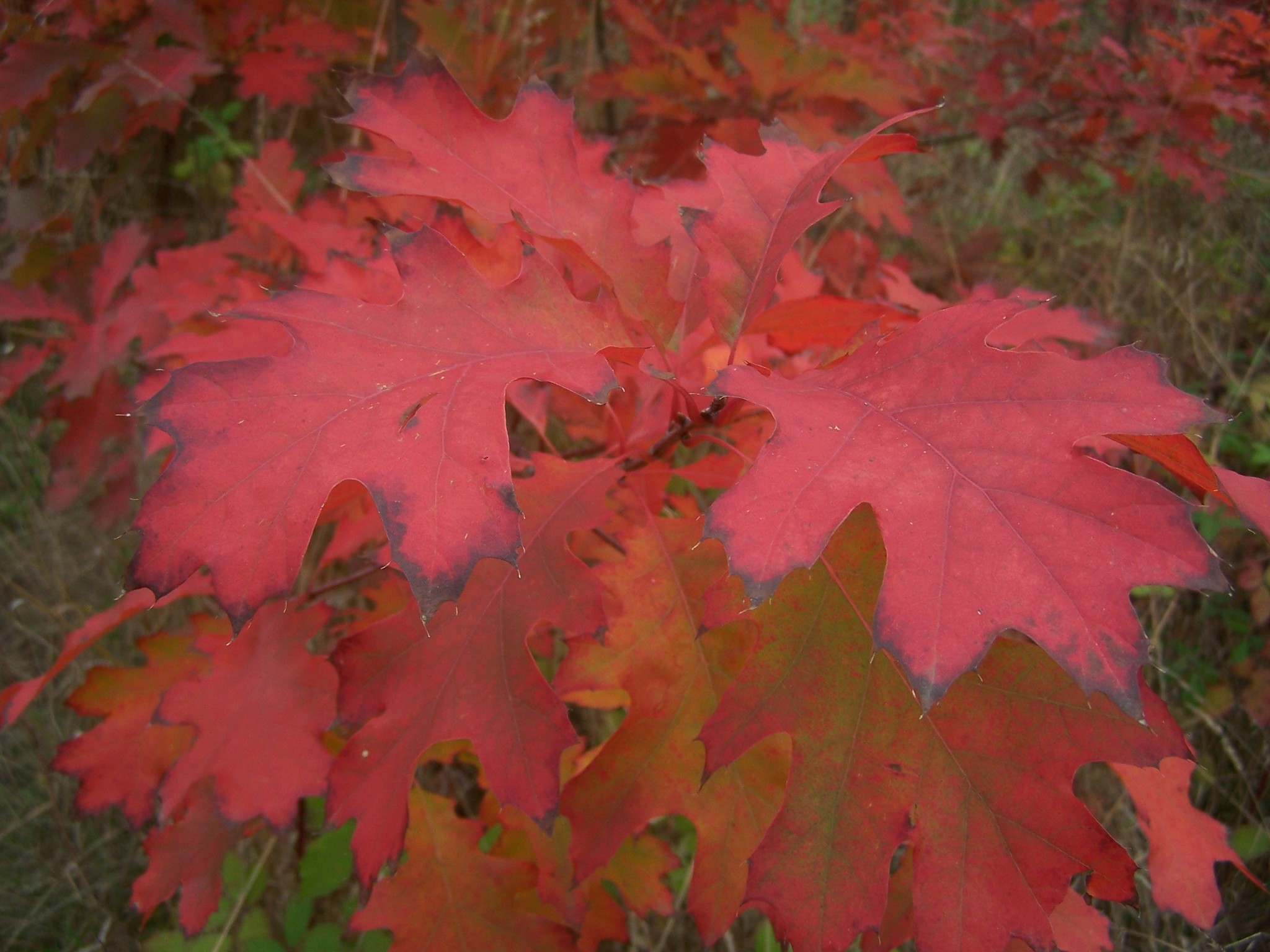
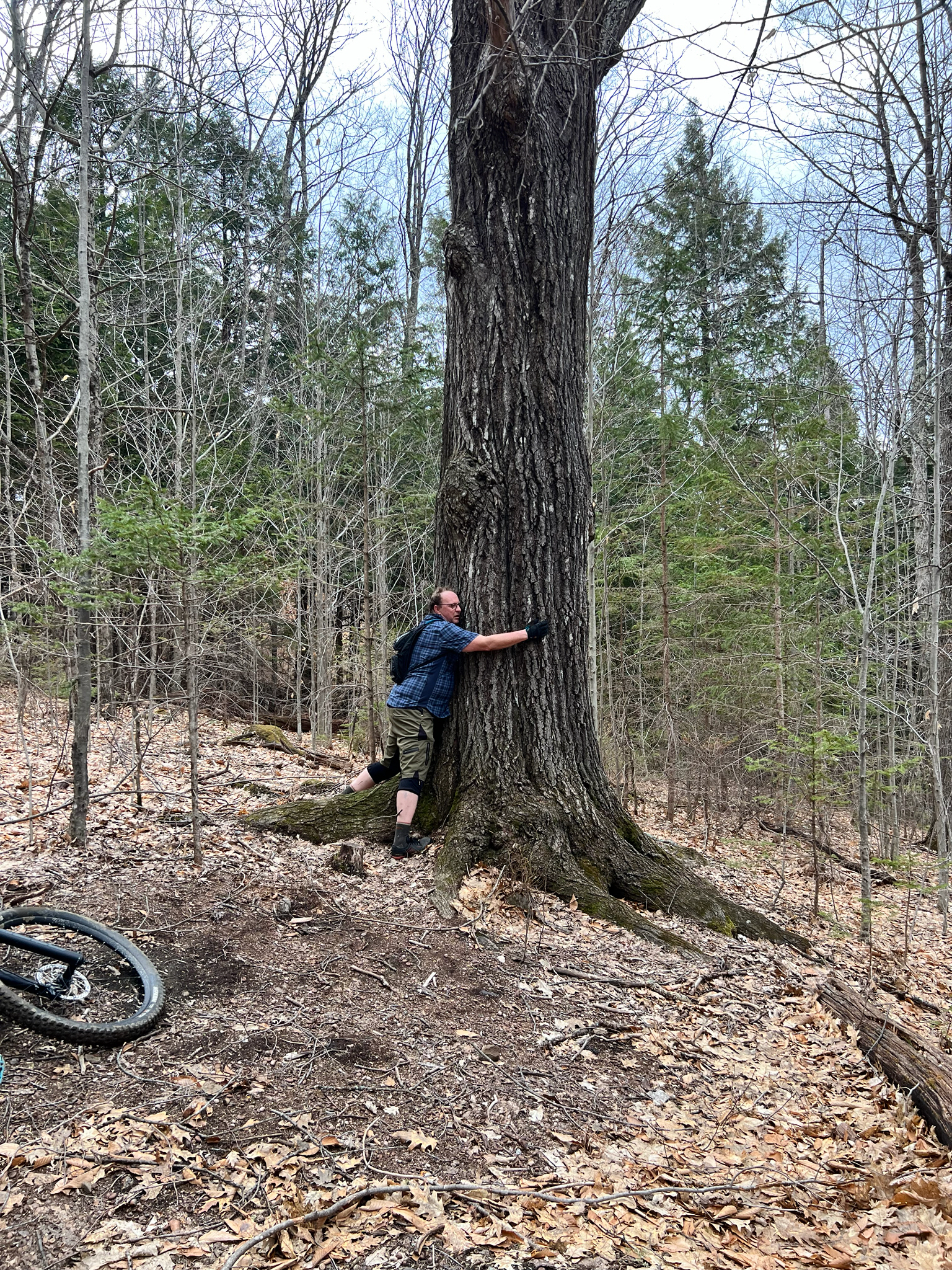
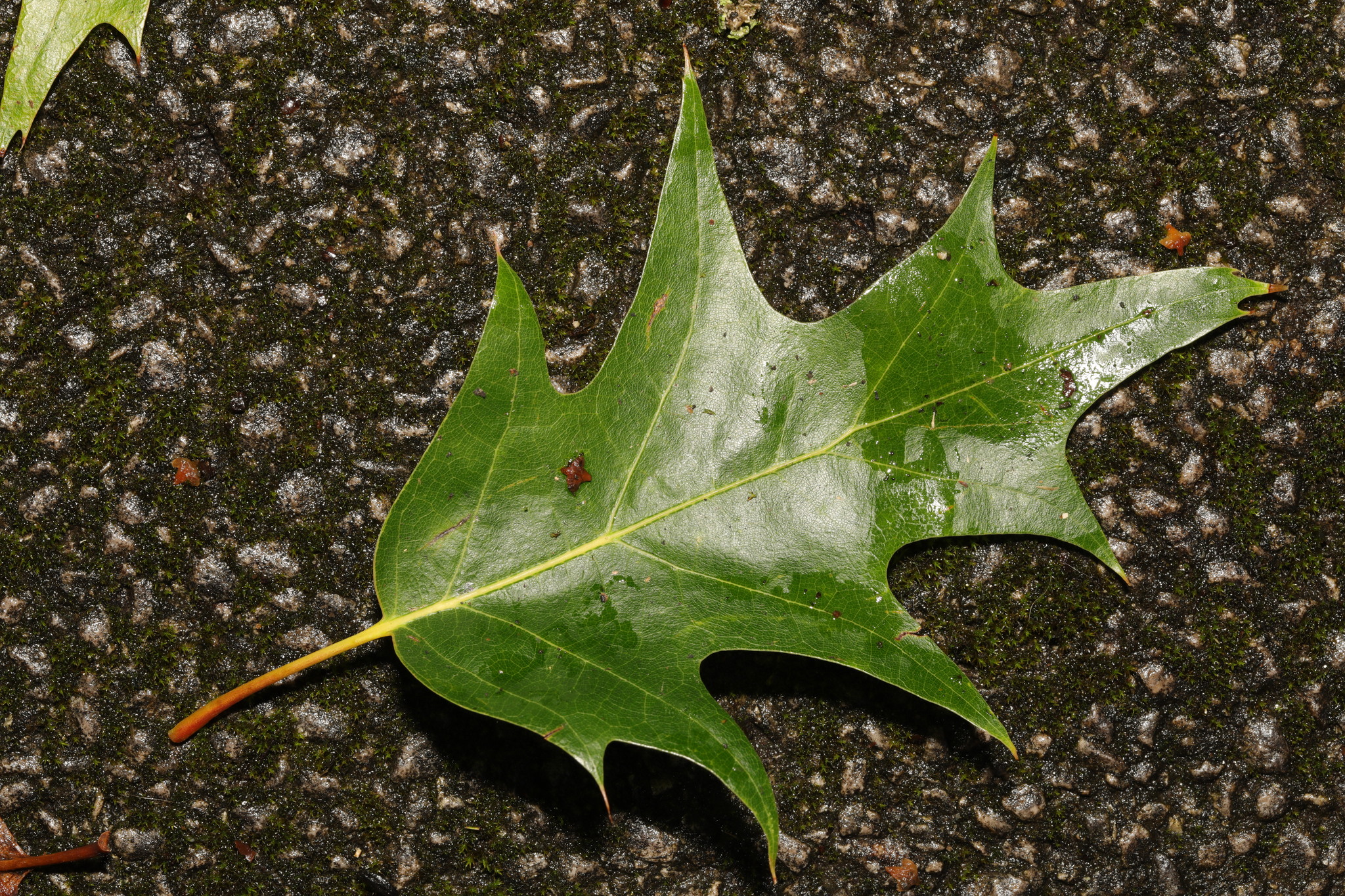


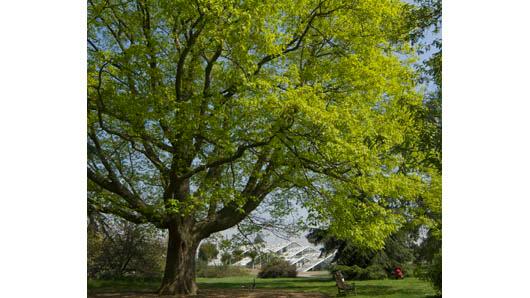
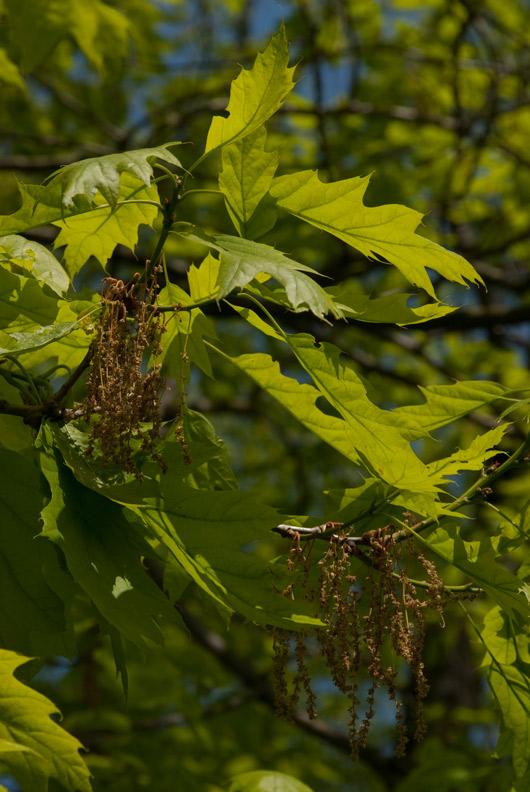
© photo
Joseph Savage · cc0
Kent P. McFarland · cc0
Stephen James McWilliam · cc0
Taken Nov 25, 2011 by Tela Botanica − Annick LARBOUILLAT (cc-by-sa)
Taken Apr 27, 2021 by Samhan182 (cc-by-sa)
© copyright of the Board of Trustees of the Royal Botanic Gardens, Kew.




Global distribution
Quercus rubra is native to southeastern Canada and north-central and eastern parts of the United States, on deep, moist soils. Introduced to Europe in the late 17th century for timber production, it spread widely and is regarded as one of the more problematic introduced woody species in western and central Europe. Several French regions consider it potentially invasive or an emerging invasive species.
- Native2
- Invasive4
- Canada
- United States
- Metropolitan France
- Belgium
- Germany
- Poland
Hexagons: regions where the plant occurs. Green dots: native range.1
Identity
Northern red oak (Quercus rubra L., 1753) is a large deciduous tree in the genus Quercus, family Fagaceae. It is also called red oak or common red oak. The epithet rubra refers to reddish coloring in the inner bark, wood and especially the autumn foliage. 1 7
From southeastern Canada to the northeastern and central United States, its native range lies in eastern and north-central North America. The species reached Europe in the late 17th century, initially as a forestry tree and later as an ornamental. 3 7
The name Northern red oak distinguishes it from southern red oak (Quercus falcata), also called Spanish oak. The similarity of these common names accounts for a familiar source of confusion in older forestry literature. 3
Recognition
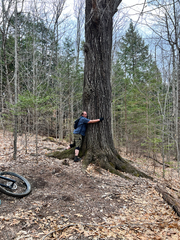
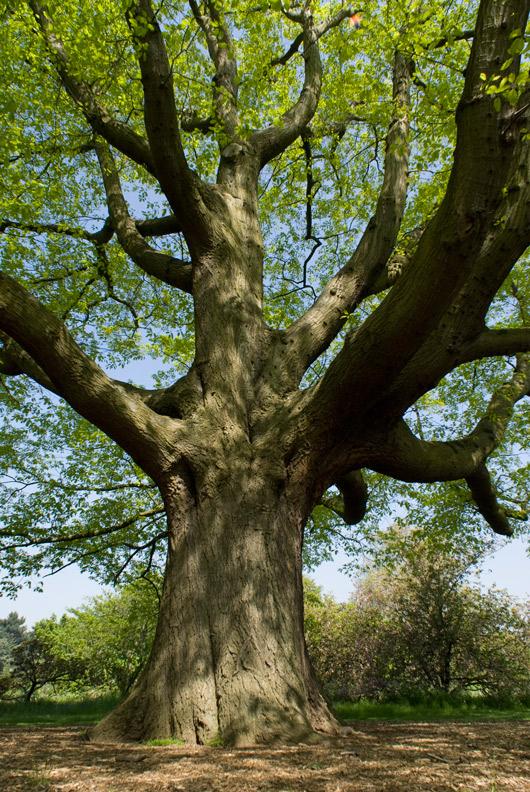
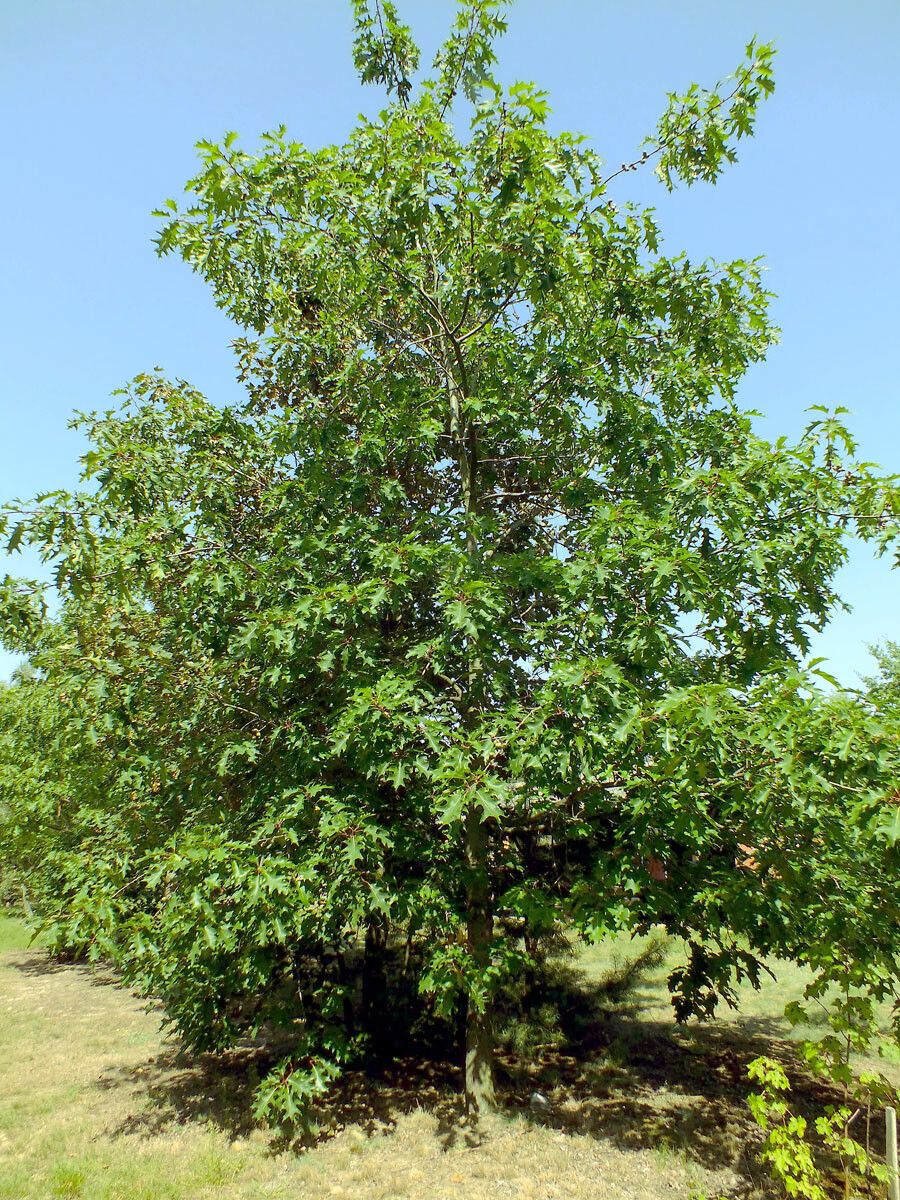
Mature Northern red oak commonly reaches 20–25 m (65–82 ft), with a rounded to spreading crown and a trunk that can exceed 1 m (3.3 ft) in diameter on old trees. Its growth is fast for an oak, helping explain its popularity in timber plantations. 2 4
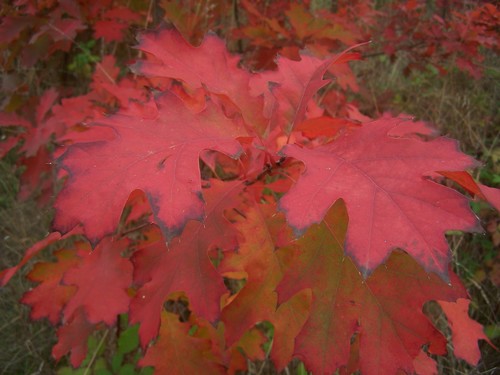
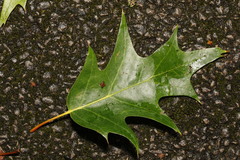
Alternate leaves measure 15–30 cm (6–12 in) long and have 7–11 shallow lobes, each ending in a fine bristle tip, or mucro. White oaks instead have rounded lobes without bristles. Dark green and glossy above and gray-green beneath, the foliage turns red, reddish brown or bronze in autumn, less often a uniform bright red. 3 4
Young bark remains smooth and gray for a long time. Later it develops broad, flat ridges with fine shiny stripes extending along the trunk. These stripes offer a useful winter identification feature when neither leaves nor acorns are available. 3
Useful taxonomy
In Species Plantarum in 1753, Carl Linnaeus described the species as Quercus rubra L. The synonym Quercus borealis F.Michx. remained in use for a long time and still appears in older forestry and horticultural literature. Older catalogs also list two varieties: Quercus rubra var. ambigua (A.Gray) Fernald and Quercus rubra var. borealis (F.Michx.) Farw. 1 7
Within the usual classification of American oaks, Quercus rubra belongs to the red oak group, section Lobatae. Bristle-tipped leaf lobes and acorns ripening over two growing seasons characterize this group. White oaks, section Quercus, instead have rounded lobes and acorns that mature in a single season. 1 3
Habitat and range
Southeastern Canada, especially Quebec and Ontario, together with north-central and eastern areas of the United States, forms the native range. The species grows in temperate deciduous forests on deep, moist, well-drained soils. 1 3
Since its introduction to Europe in the late 17th century, Northern red oak has spread widely through timber planting because of its growth rate and wood quality. In France it is well established in Aquitaine, Limousin, Sologne and several central and northern regions, and is less common elsewhere. 7
Deliberate forestry expansion in Europe has a documented drawback. Northern red oak is considered potentially invasive in Aquitaine and Poitou-Charentes and an emerging invasive species in Limousin, where it competes with native oak regeneration beneath woodland canopies. Across western and central Europe it is among the more problematic introduced woody species. 7
The International Union for Conservation of Nature assesses Quercus rubra as Least Concern within its native range, with no species-wide threat identified. 8
Life cycle and reproduction
Pendant yellow-green male catkins appear in spring, together with small female flowers in the axils of young leaves. Flowering follows the seasonal spring growth of the tree. 5 4
Acorns require two growing seasons to mature, a characteristic red oak trait, compared with one season in English oak. The oval fruits are 2–3 cm (0.8–1.2 in) long, with shallow cups covering only about a quarter of the acorn. An isolated tree starts bearing at 20–25 years, while abundant, regular crops generally begin at 40–50 years. 3 5
Horticultural propagation relies mainly on seed, following several months of cold stratification to overcome dormancy. Grafting is reserved for reproducing a cultivar such as Aurea faithfully, preserving the characteristics that seedlings do not reliably retain. 5
Uses and risks
Northern red oak timber has a more open grain than white oak and is mainly used for flooring, veneer, interior joinery and furniture. Its porosity makes it unsuitable for barrels or demanding outdoor uses. 3 5
Acorns contain bitter tannins and are not eaten raw. After prolonged water leaching to remove tannins, they can be dried, ground into flour and used as a thickener, or roasted as a coffee substitute. These uses are documented among several Indigenous peoples of North America. 5
Young leaves and unleached acorns contain gallotannins that can cause digestive problems after large intakes. The documented risk chiefly concerns horses: abdominal pain, sometimes bloody diarrhea, dark urine and a risk of intestinal blockage when many whole acorns are swallowed. 6
Varieties, look-alikes and related plants
Almost every Northern red oak planted in woodland or urban settings is a representative of the ordinary species. Aurea, with golden young spring leaves, is a rare horticultural selection valued more for ornament than timber production. The old name Quercus borealis identifies the same taxon under an obsolete label. 1
Other large red oaks are the main sources of confusion. Quercus palustris has more finely and deeply divided lobes and a characteristic pyramidal outline with drooping lower branches. Quercus coccinea has still deeper leaf sinuses. Quercus velutina has yellow-orange inner bark and angular, downy buds. 3
Compared with English oak (Quercus robur), a native tree in France, the acorn is a particularly reliable distinction. Northern red oak has almost no acorn stalk and takes two growing seasons to ripen its fruit; English oak carries its acorns on long stalks and ripens them in a single season. These fruit characters complement the contrast between bristle-tipped and rounded leaf lobes.
Main sources
- Plants of the World Online / Kew, Quercus rubra L.
- Royal Horticultural Society, Quercus rubra - red oak
- NC State Extension, Quercus rubra (Northern Red Oak)
- Missouri Botanical Garden, Quercus rubra
- Plants For A Future, Quercus rubra
- ASPCA, Oak toxicity entry
- INPN / MNHN, Quercus rubra L., 1753 (cd_nom 116762)
- IUCN Red List of Threatened Species, Quercus rubra assessment
Frequently asked questions
Is Northern red oak invasive in France?
It is considered potentially invasive in Aquitaine and Poitou-Charentes and an emerging invasive species in Limousin, where it competes with native oak regeneration in woodland. Elsewhere in France, its presence is mainly associated with older forestry plantations.
How can I distinguish Northern red oak from English oak?
Acorns provide the clearest clue: Quercus rubra has almost no acorn stalk and ripens its fruit over two seasons, while Quercus robur has a long stalk and ripens fruit in one season. Bristle-tipped leaf lobes in the former and rounded lobes in the latter confirm the distinction.
Are Quercus rubra acorns edible?
Raw acorns are bitter and rich in irritating tannins. After prolonged leaching in water, they can be dried and ground into flour or roasted as a coffee substitute, uses documented among several Indigenous peoples of North America.
Is Northern red oak poisonous to animals?
The documented risk mainly concerns horses and grazing livestock. Gallotannins in acorns and young leaves can cause digestive problems after substantial intake, with a risk of intestinal blockage if many whole acorns are swallowed.
Why do the leaves not always turn bright red in autumn?
Fall color in Quercus rubra varies with the year, from clear red to reddish brown or bronze. It is generally less spectacular and less uniform than that of some other red oaks.
Are Quercus borealis and Quercus rubra the same species?
Yes. Quercus borealis F.Michx. is an old scientific synonym of Quercus rubra, still present in some forestry and horticultural literature. The accepted name remains Quercus rubra L.
How long does Northern red oak take to produce acorns?
An isolated tree begins producing acorns at about twenty to twenty-five years, but abundant, regular crops generally begin at forty to fifty years, once the crown is well developed.
Similar plants
If you are unsure about a plant’s toxicity, ask a botanist or veterinarian for advice.