
Mexican petunia (Ruellia simplex, )
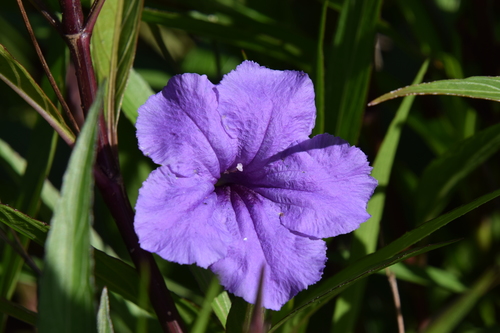
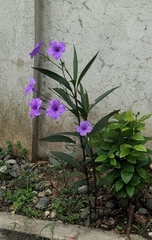
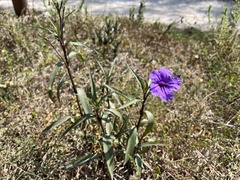
Mexican petunia (Ruellia simplex) is a herbaceous perennial with a woody base in the Acanthaceae family, native to Mexico, the Caribbean and South America. Its violet-blue funnel-shaped flowers last just one day but open continuously from spring through fall. Widely planted for its narrow leaves and generous bloom, it has also naturalized and become invasive in several warm regions.
Read moreMexican petunia, Mexican bluebell and Britton's wild petunia
Allow a few hours of direct sun per day, preferably morning or evening.
Full sun to bright partial shade
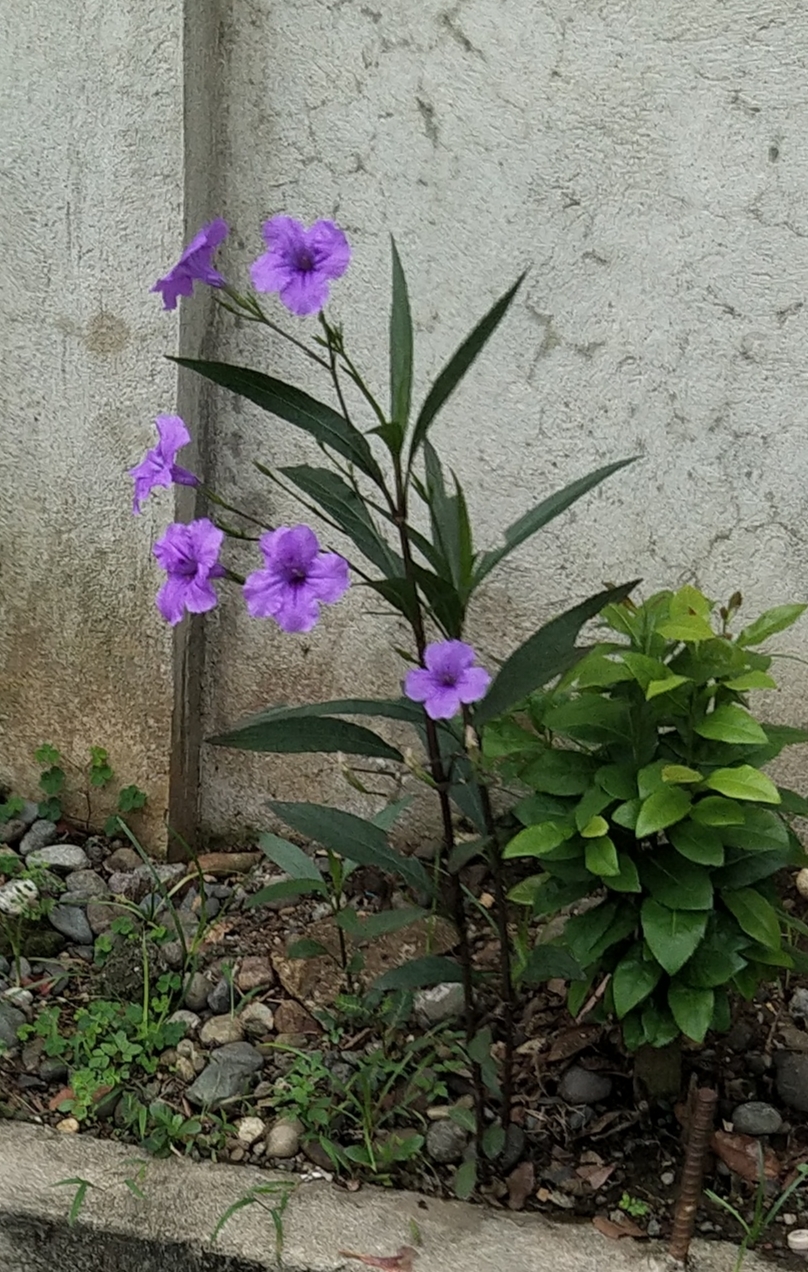
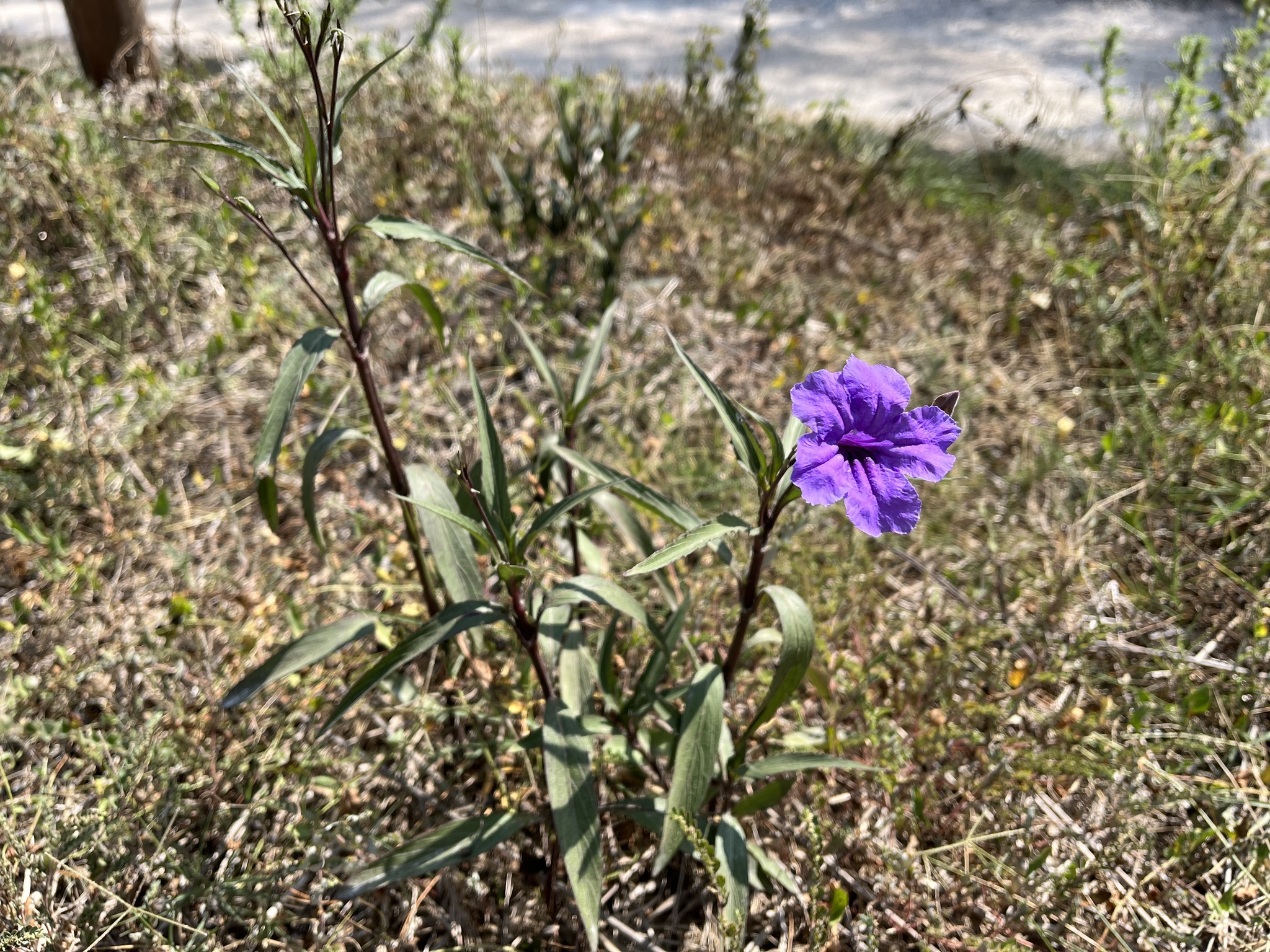


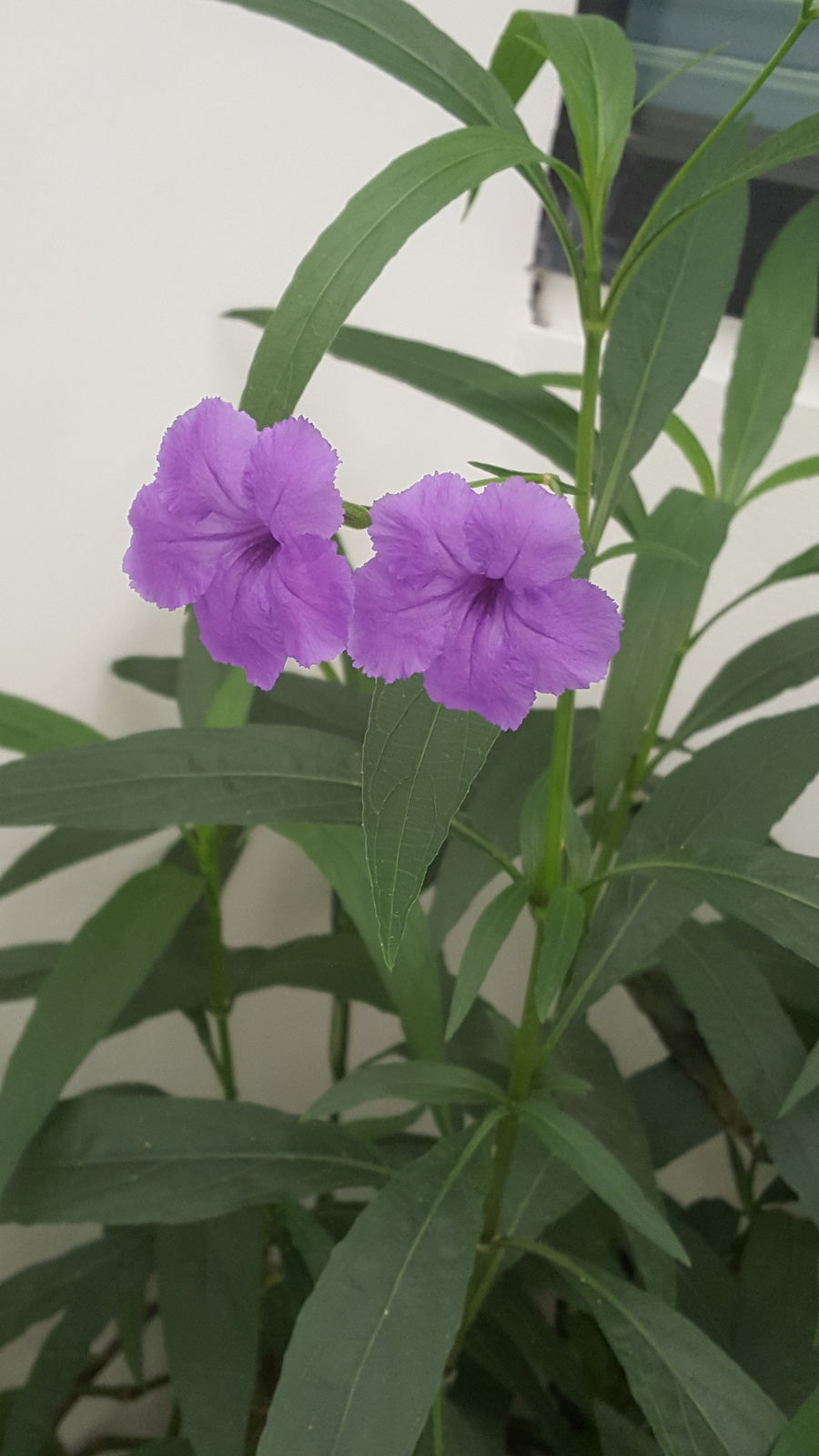
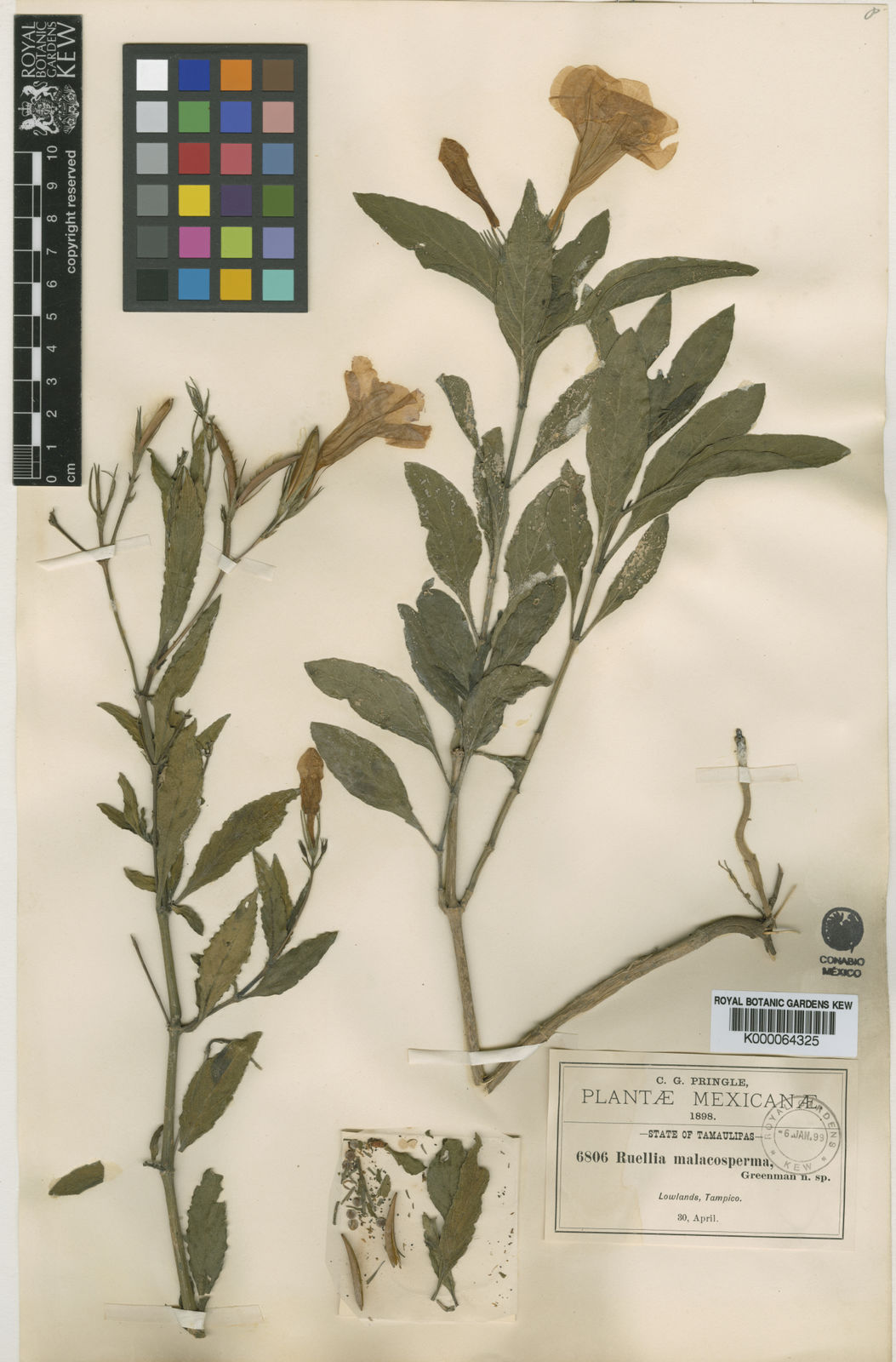
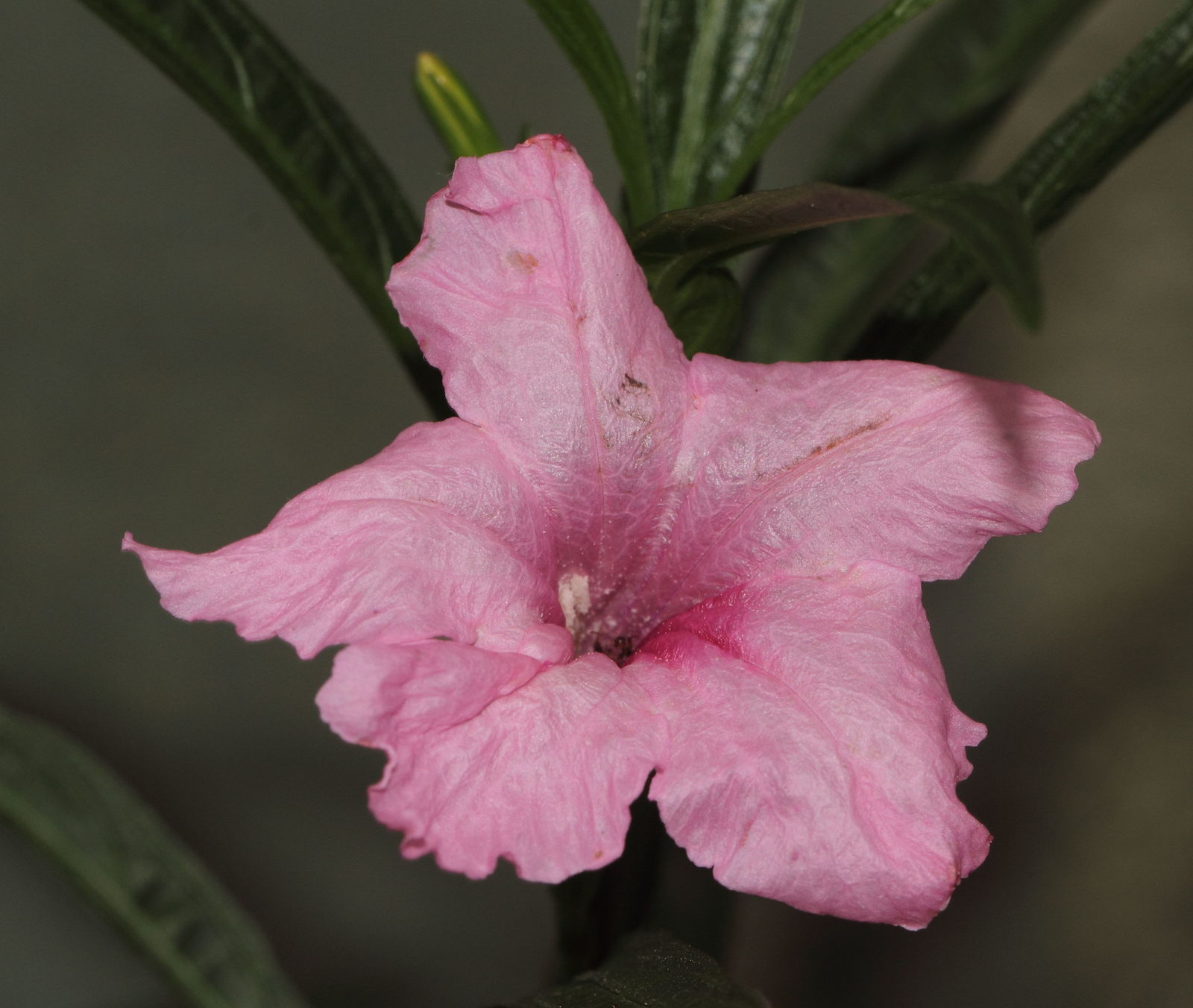
© photo
(c) Te Chang, some rights reserved (CC BY-NC), uploaded by Te Chang · cc-by-nc
Greg III Espera · cc-by
Pavel Kacl · cc-by
Taken Sep 25, 2019 by Virginia (cc-by-sa)
Taken May 30, 2021 by dan hewison (cc-by-sa)
Taken Feb 10, 2022 by Ludwig Omar Julca Salazar (cc-by-sa)
Taken Mar 30, 2021 by Trap Hers (cc-by-sa)
Taken May 24, 2021 by Fernando da Luz Schmidt (cc-by-sa)
© copyright of the Board of Trustees of the Royal Botanic Gardens, Kew.




Global distribution
The native range of Ruellia simplex includes Mexico, the West Indies, western Bolivia, southwestern Brazil, Paraguay, Uruguay and northeastern Argentina. Introduced as an ornamental, it has naturalized widely beyond that range and is classified as invasive in several warm regions.
- Native7
- Invasive3
- Mexico
- Cuba
- Bolivia
- Brazil
- Paraguay
- Uruguay
- Argentina
- United States (Florida)
- Australia (Queensland)
- Japan (Okinawa)
Hexagons: regions where the plant occurs. Green dots: native range.1
Identity
Mexican petunia (Ruellia simplex C.Wright, 1870), also known as Britton's wild petunia, is a herbaceous perennial with a woody base. It belongs to the genus Ruellia in the Acanthaceae family. 1 6 Its common name can mislead gardeners: despite the similar flowers, it is unrelated to the genus Petunia, which belongs to the separate family Solanaceae. 3
The genus Ruellia honors French botanist and physician Jean Ruel. Its epithet simplex refers to simple rather than compound leaves, a useful distinction from other ruellias with more divided foliage. 1
Recognition
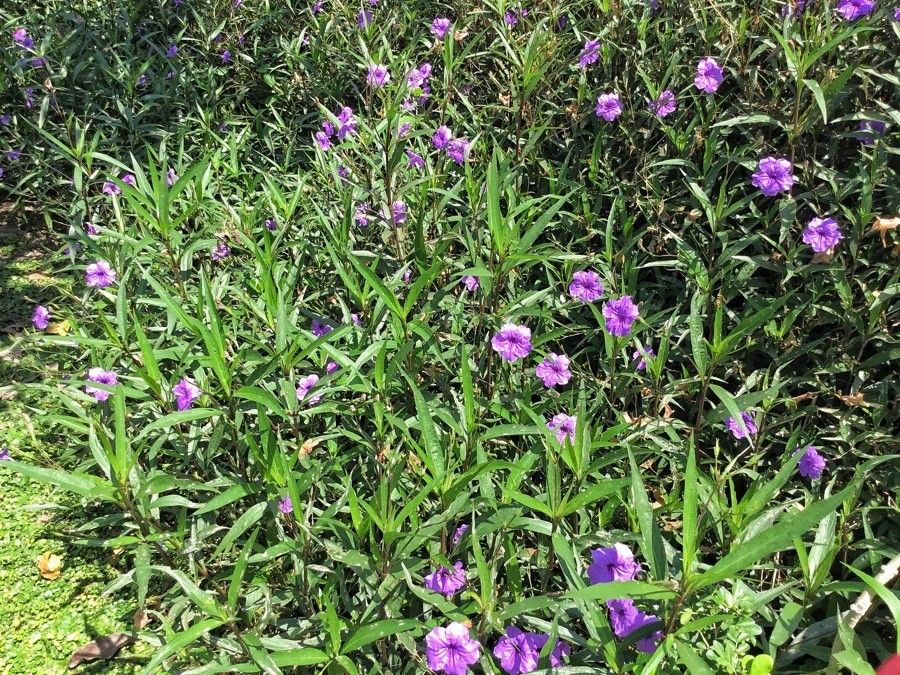
Upright clumps bear stems that become woody at the base and are often tinged purple. In favorable climates and open ground, Mexican petunia reaches 90 cm–1.2 m (3–4 ft), compared with 60–90 cm (2–3 ft) in most gardens. 2 3
Opposite leaves are narrow and lance-shaped, resembling willow leaves. They measure 15–30 cm (6–12 in) long and about 1.5–2 cm (0.6–0.8 in) wide, with smooth, hairless surfaces and untoothed margins. 2
Funnel-shaped, five-lobed flowers measure about 4 cm (1.5 in) across and range from metallic blue to violet; cultivars also offer pink or white flowers. Each flower opens for only one day, but new blooms continue from May through November in warm northern-hemisphere regions, over a somewhat shorter season in cooler areas. 3
An elongated capsule follows flowering. At maturity it bursts open and throws seeds away from the parent plant, a mechanism that explains much of the species' rapid colonization. 3
Useful taxonomy
Charles Wright published the accepted name, Ruellia simplex, in 1870 in Sauvalle's flora of Cuba. The priority of this earlier publication makes it the reference name over later synonyms. 6 7 Horticultural trade has nevertheless long favored a later synonym, still found on many labels. Names encountered for the same plant include:
- Ruellia brittoniana Leonard, a later synonym;
- Ruellia tweediana Griseb., a synonym;
- Ruellia coerulea Morong, a synonym;
- Ruellia angustifolia (Nees) Lindau, a synonym;
- Cryphiacanthus angustifolius Nees, an earlier generic placement.
A 2023 phylogenetic revision of New World Ruellia confirms Ruellia brittoniana as a synonym of Ruellia simplex. The former remains widespread on nursery labels, even when the plants are botanically identical to those sold under the accepted name. 9
Habitat and distribution
Mexico, the West Indies and parts of South America form the native range: western Bolivia, southwestern Brazil, Paraguay, Uruguay and northeastern Argentina. 6 Mexican petunia primarily occupies wet places, including ditches, pond margins and marsh edges, but tolerates drier soil once firmly established. 4
Ornamental planting has led to widespread naturalization beyond that range. It was apparently planted in Florida before 1933 and has also escaped in Australia and Asia. In Okinawa, its introduction dates to the 1970s. 5
Florida lists Ruellia simplex as a category I invasive exotic species. There it can form dense stands that displace local wetland vegetation. That status describes a particular region and should be distinguished from the species' native distribution. 4
Life cycle and reproduction
Repeated flowering extends from May to November in warm northern-hemisphere climates, with a shorter period toward the colder limit of its hardiness range. Every mature capsule releases seeds explosively, spreading the plant several meters beyond its parent. 3
Creeping rhizomes provide a second route of spread alongside seeds. A single established plant can quickly give rise to a dense colony through this underground growth. 3
Cultivated plants are usually propagated by stem cuttings or division of clumps. Seed propagation is possible, but is best avoided where the species is already considered invasive. Some cultivars, including 'Purple Showers', are sterile and do not self-seed. 4
Uses and risks
Sunny beds, moist borders and containers in temperate climates are the main ornamental settings for Mexican petunia. Its long flowering season attracts butterflies and hummingbirds, and the plant withstands browsing by deer well. 3
Hardiness is generally given as USDA zones 8–10. The foliage dies below 0 °C (32 °F), but growth can resume from the crown after mild, brief freezing. Prolonged exposure below that threshold causes lasting damage to the aboveground parts. 2 8
North American horticultural accounts consulted report no documented toxicity to domestic animals or horses, although none examines the subject in depth. This limited information should not be read as a detailed toxicological assessment. 3
Container plants need a very bright position and a growing medium that remains airy despite regular watering. Equal parts garden soil, sand and enriched potting mix are suitable, provided water does not stand around the roots in winter. 8
Where Mexican petunia is already established, its ability to take over a bed or wet area quickly is the principal practical concern. Removing capsules before they open and favoring sterile cultivars helps limit that spread. 4
Varieties and similar plants
Sterility, color and stature vary among the cultivars used in gardens. 'Purple Showers' is sterile and recommended as a less invasive choice. 'Alba' and 'Bonita' provide white and pink flowers, while dwarf forms sold under names such as 'Katie' rarely exceed 30 cm (12 in). 4
Several names and similar-looking plants can cause confusion:
- Ruellia squarrosa has noticeably hairy stems and both leaf surfaces, unlike the smooth foliage of R. simplex;
- the genus Petunia supplies the borrowed common name despite belonging to a different botanical family;
- Ruellia brittoniana is simply a commercial synonym for the same species.
The accepted scientific name, Ruellia simplex, resolves those ambiguities. The plant is an Acanthaceae, regardless of the “petunia” nickname used by a garden center. 1 7
Main sources
- Plants of the World Online / Kew, Ruellia simplex C.Wright
- Missouri Botanical Garden Plant Finder, Ruellia simplex
- NC State Extension Gardener Plant Toolbox, Ruellia simplex
- CABI Compendium, Ruellia simplex (Mexican petunia) invasive species datasheet
- Atlas of Florida Plants, Ruellia simplex
- USDA GRIN Taxonomy, Ruellia simplex
- INPN / MNHN, Ruellia simplex, TAXREF taxonomic account
- Au Jardin, Mexican petunia, Ruellia brittoniana, cultivation and care
- Manzitto-Tripp & Daniel (2023), Taxon, phylogeny and revised classification of New World Ruellia
Frequently asked questions
Is Mexican petunia a true petunia?
No. Ruellia simplex belongs to Acanthaceae, whereas true petunias belong to the genus Petunia in Solanaceae. The common name refers only to the similar funnel-shaped flowers.
Is Mexican petunia invasive?
Yes, in several warm regions. In Florida it is classified as a category I invasive exotic species and can form dense stands that displace local vegetation.
Why do Mexican petunia flowers last only one day?
Each individual flower fades after a single day, but the plant continually opens new buds from spring through fall, creating the impression of uninterrupted flowering.
Is Mexican petunia poisonous to cats and dogs?
The North American horticultural accounts consulted report no documented toxicity to pets or horses, although none discusses the subject in depth.
How can you limit Mexican petunia spreading in a garden?
Remove capsules before they open, prevent self-seeding and favor sterile cultivars such as 'Purple Showers' to substantially reduce the risk of colonization.
What is the difference between Ruellia simplex and Ruellia brittoniana?
There is no botanical difference. Ruellia brittoniana is a later synonym of Ruellia simplex, the oldest accepted name, published in 1870.
Does Mexican petunia survive frost?
Foliage is killed at about 0 °C (32 °F), but the crown often regrows if freezing is mild and brief, particularly in USDA zones 8–10. More severe or prolonged freezing causes lasting damage to aboveground growth.
Similar plants
If you are unsure about a plant’s toxicity, ask a botanist or veterinarian for advice.