
Common rue (Ruta graveolens, )
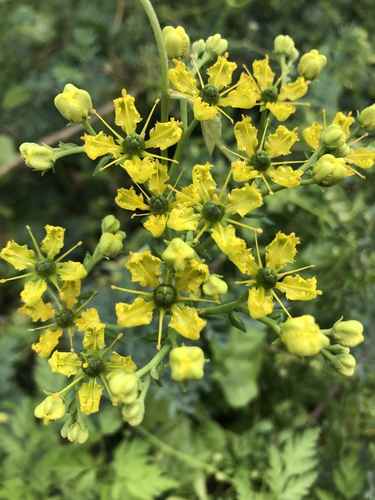
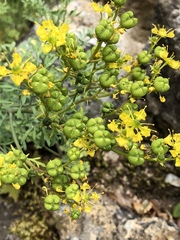

Common rue (Ruta graveolens) is an aromatic subshrub in the Rutaceae family, native from the Balkans to Crimea and widely naturalized around the Mediterranean. Its evergreen blue-gray foliage and tolerance of dry soil make it a familiar ornamental, but contact followed by sunlight can burn the skin, setting it apart from other garden herbs.
Read moreCommon rue, Rue, Herb-of-grace and Garden rue
Allow a few hours of direct sun per day, preferably morning or evening.
Full sun; tolerates light partial shade


© photo
(c) owenmoorhead, some rights reserved (CC BY-NC), uploaded by owenmoorhead · cc-by-nc
iNaturalist User · cc0
Wikimedia Commons · CC BY-SA or Public Domain
Taken Feb 5, 2022 by Giacomo Sellan (cc-by-sa)
Taken Jun 5, 2019 by Visentin Elizabeth (cc-by-sa)
Taken Dec 29, 2013 by Tela Botanica − Pierre CROUZET (cc-by-sa)
Taken Jan 26, 2020 by Pokotilo Olga (cc-by-sa)
Taken Oct 25, 2022 by Erika (cc-by-sa)
© copyright of the Board of Trustees of the Royal Botanic Gardens, Kew.




Global distribution
Ruta graveolens is native from the Balkan Peninsula to Crimea, centered in southeastern Europe. Ornamental, culinary and medicinal cultivation since antiquity has led to widespread naturalization around the Mediterranean and beyond. Records outside the native range therefore mostly concern naturalized or cultivated plants rather than native populations.
Identity
Common rue (Ruta graveolens L., 1753), also called herb-of-grace, is an aromatic subshrub in the genus Ruta and the citrus family, Rutaceae. Plants of the World Online and the International Plant Names Index confirm the accepted name, published in Linnaeus’s Species Plantarum. 1 2
Its sap offers a striking distinction from nearby border herbs: touching it and then exposing the skin to sunlight can cause burns, a reaction not produced by neighboring thyme or lavender. The strong, acrid smell of crushed foliage is unpleasant to some people, yet valued in traditional cooking in the Balkans and northern Italy. The English name herb-of-grace recalls an old liturgical use: sprigs were used to sprinkle holy water in some Catholic rites. 4 6
French botanical records in the INPN list this species as rue odorante, with rue officinale and rue des jardins among its other French vernacular names. 7
Recognition
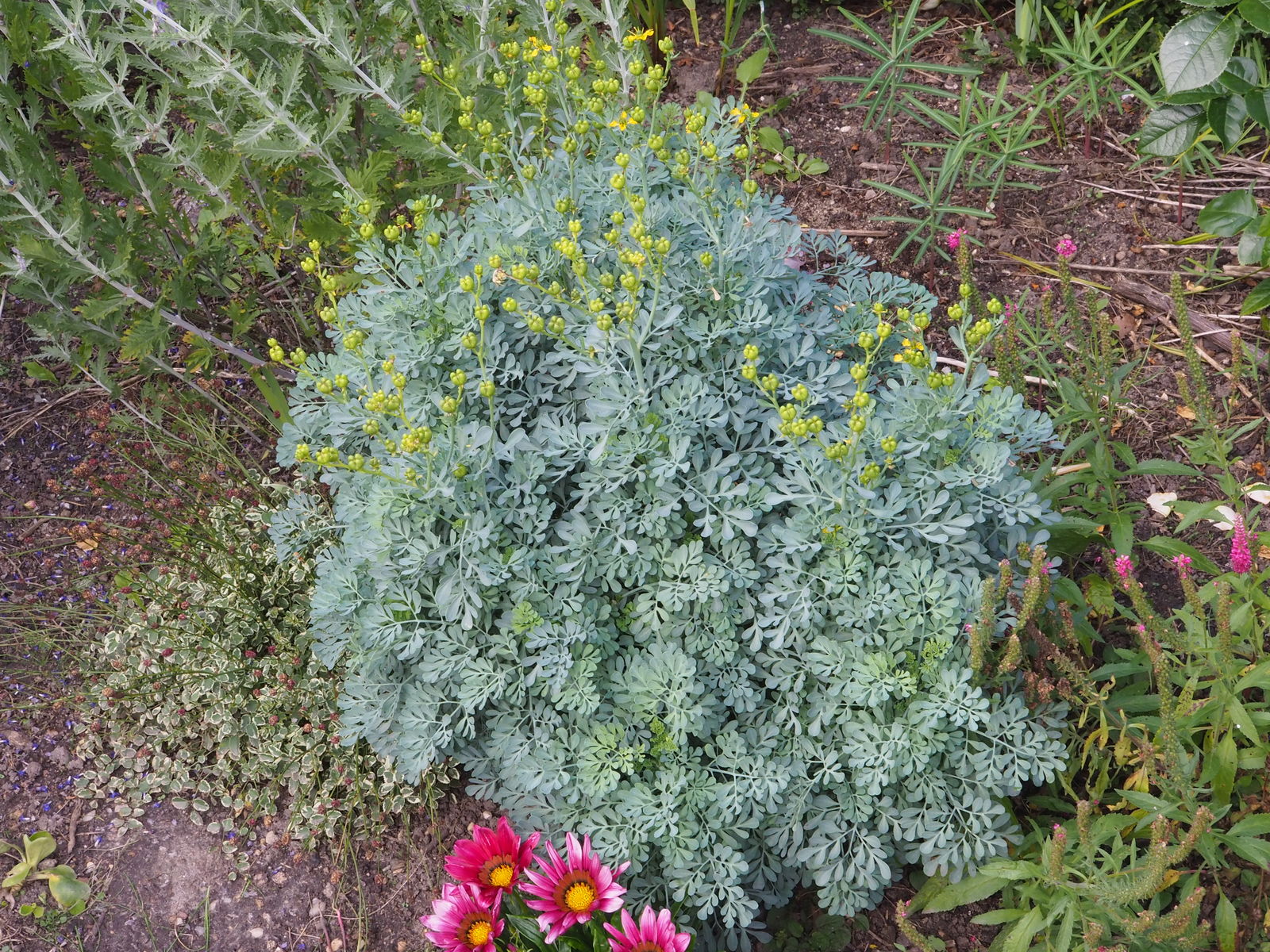
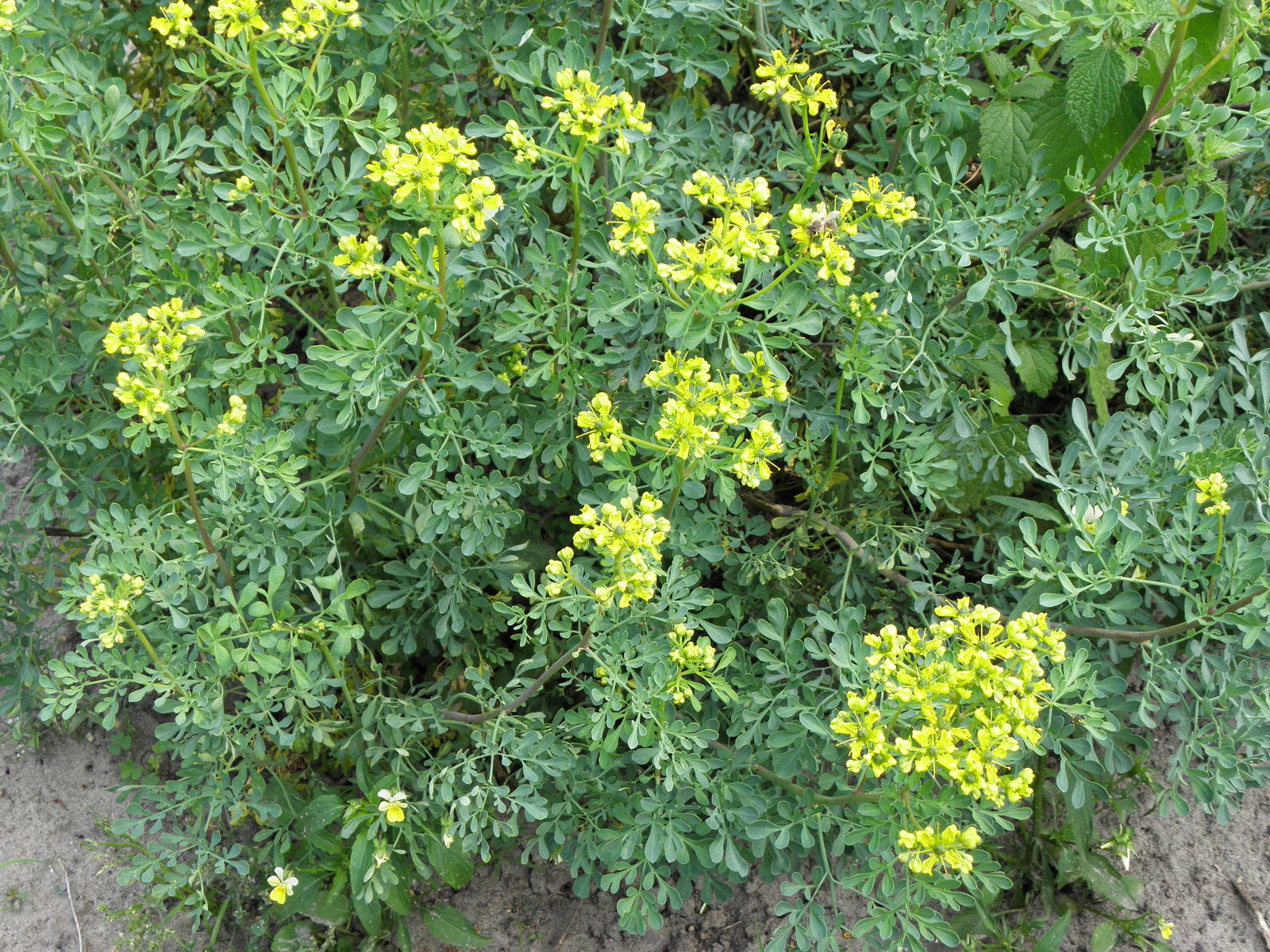
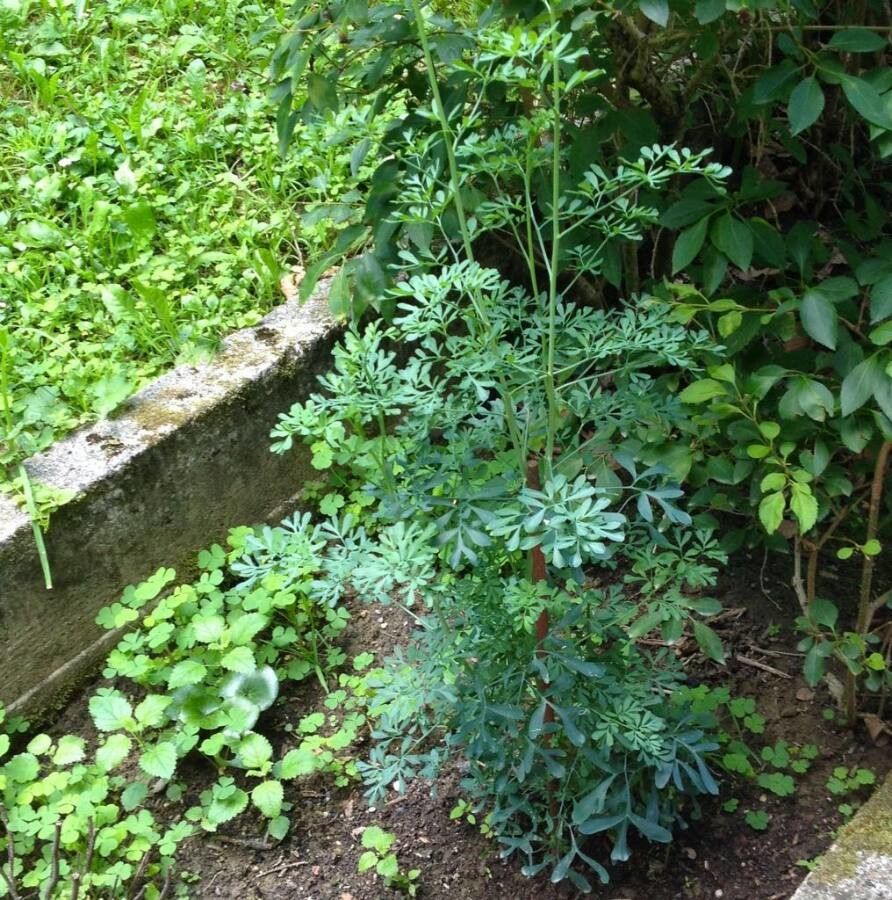
A low, rounded clump reaches 50 cm to 1 m (20–39 in) tall with a similar spread, supported by stems that become woody at the base. Its evergreen, blue-gray to glaucous leaves divide two or three times into small, rounded lobes. This gives it a different appearance from green-leaved Mediterranean herbs such as thyme and oregano. 3 4
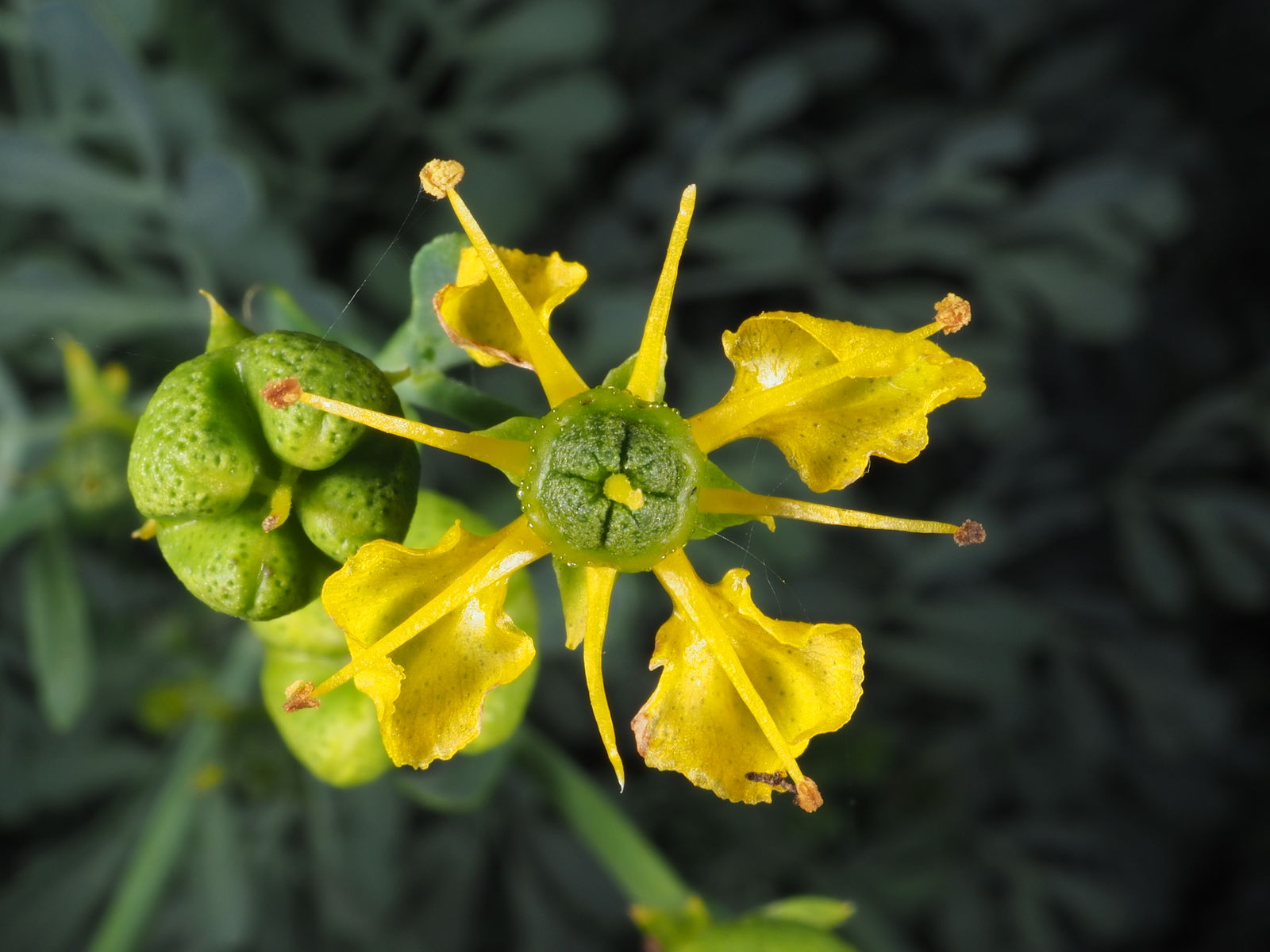
Summer brings cymes of yellow flowers 1.5–2 cm (0.6–0.8 in) across, with four or five petals whose edges are usually entire or only slightly toothed. Petal margins identify Ruta graveolens more reliably than foliage color alone: Ruta chalepensis has conspicuous fringes along the full length of its petals. 3
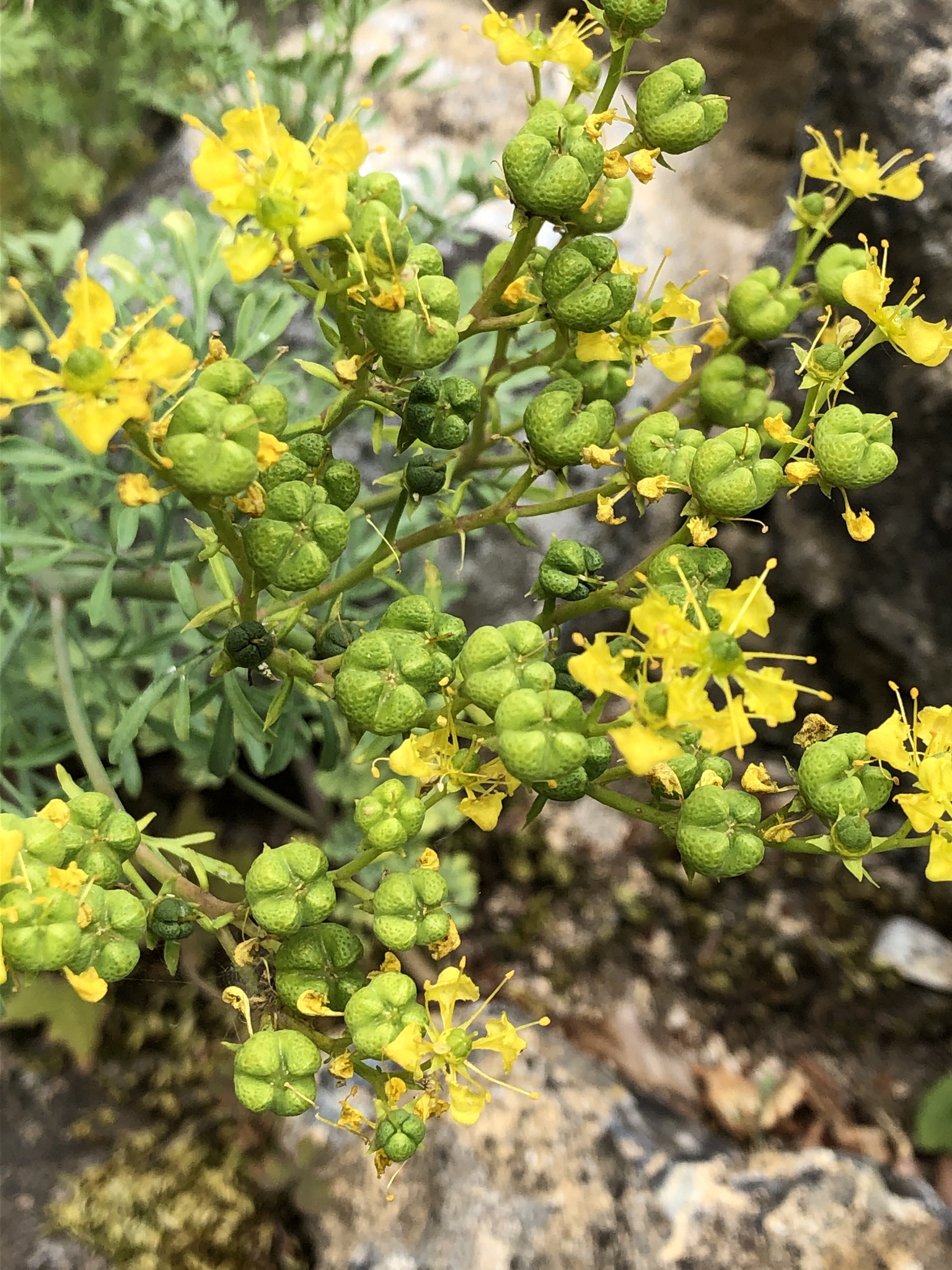
After flowering, each flower develops into a brown capsule with four or five rounded lobes. In Ruta chalepensis, the lobes are pointed and project conspicuously, a useful distinction even after the flowers have faded. 4
Useful taxonomy
Linnaeus published Ruta graveolens L. in 1753 in Species Plantarum, and it remains the accepted name. Several botanical synonyms and historical varieties are now included under it:
- Ruta hortensis Mill., a historical synonym
- Ruta officinalis Pall., a historical synonym
- Ruta divaricata Ten., a historical synonym
- Ruta diversifolia Wender., a historical synonym
- Ruta macrophylla Sol., a historical synonym
- Ruta graveolens f. variegata (Weston) Zabel, a historical variegated form
For everyday identification, the practical issue is the frequent confusion with Ruta chalepensis, fringed rue. It is a close but distinct species, used more often in Ethiopian cooking than common rue. 1 2
Habitat and range
From the Balkan Peninsula to Crimea, the native distribution centers on southeastern Europe. Continuous ornamental, culinary and medicinal cultivation since antiquity subsequently helped the plant naturalize widely around the Mediterranean. 1 7
Ruta graveolens grows on rocky limestone slopes, old walls, dry banks and sunny lowland waste ground, in poor, well-drained soil with a pH of 6–8. Winter waterlogging is far more damaging than dry cold: roots can rot within weeks in soil that stays saturated. 4 3
Beyond its native range, common rue is widely grown in dry herb gardens across temperate regions, including France and the United Kingdom. It is rated hardy to USDA zone 4, depending on winter drainage. 4 3
Life cycle and reproduction
June and July flowering attracts pollinators. Common rue also hosts caterpillars of several swallowtails, including the Old World, anise and giant swallowtails. After pollination, each flower produces a brown seed capsule. 4
Propagation uses spring sowing, semi-ripe cuttings taken in late summer, or division of an established clump. Cuttings root in 3–5 weeks in a free-draining medium, taking considerably longer in heavy, wet soil. 6
A clump remains fully productive for about 3–5 years. After that, its base becomes woody and its center opens up, reducing foliage density and flowering. Cutting back or dividing the clump every three to four years helps prevent this decline in vigor. 6
Uses and risks
Year-round blue-gray foliage gives common rue its main role as an ornamental for low borders, rock gardens and dry beds. It also has a long culinary history around the Mediterranean, notably in grappa alla ruta from Istria and northern Italy, although this use is now marginal. 4 6
The main hazard affects the skin. Sap contains photosensitizing furanocoumarins, including psoralen and chalepensin; sunlight exposure after contact can cause phytophotodermatitis, with blisters resembling true burns. Cases include young children who merely touched the plant in a garden. 8 4
Leaves also contain quinolone alkaloids documented for natural fungicidal properties. Large ingestions can cause digestive pain and vomiting. Common rue has a history as a traditional abortifacient and must be avoided during pregnancy. 9 6
Varieties, look-alikes and related plants
Horticultural selections sold as Ruta graveolens are forms of the same species. ‘Jackman’s Blue’, listed by the Royal Horticultural Society, has deeper blue-gray foliage and a compact habit. ‘Variegata’ has cream-variegated leaves and is less vigorous than the wild type. ‘Blue Beauty’ is grown mainly for its particularly intense glaucous foliage. The name prostrata, used at subspecies rank, denotes a dwarf, trailing form for borders and rock gardens. 3
Fringed rue, Ruta chalepensis, is the most frequent look-alike. Both have bluish foliage and contact toxicity, but fully fringed petals and pointed fruit lobes identify Ruta chalepensis. Common rue instead has entire or slightly toothed petals and rounded fruit lobes. 3 4
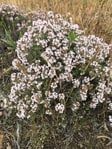
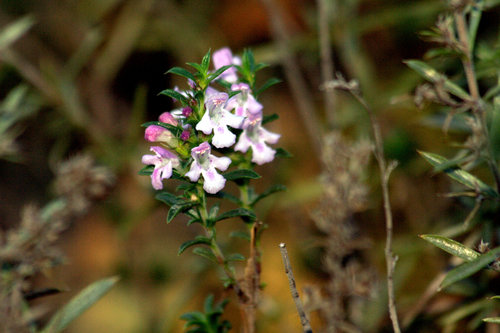
Other silver-leaved Mediterranean herbs, including some lavenders and wormwood, can resemble common rue from a distance. Its strong, distinctive odor when crushed and characteristic blue-gray foliage provide the quickest field clues. 4
Main sources
- Plants of the World Online / Kew, Ruta graveolens L.
- International Plant Names Index, Ruta graveolens L.
- Royal Horticultural Society, Ruta graveolens - common rue
- NC State Extension Gardener Plant Toolbox, Ruta graveolens
- Missouri Botanical Garden Plant Finder, Ruta graveolens
- Plants For A Future, Ruta graveolens
- INPN, Ruta graveolens L. 1753, common rue
- Furniss & Adams, 2007, herb of grace phytophotodermatitis mimicking burn injury
- Oliva et al., 2003, natural fungicides and quinolone alkaloid from Ruta graveolens leaves
Frequently asked questions
Why does common rue burn the skin?
Its sap contains photosensitizing furanocoumarins. With sunlight exposure they trigger phytophotodermatitis, causing burn-like blisters, especially in hot, sunny weather.
Is common rue toxic to cats and dogs?
Yes. It is classed as toxic to cats and dogs through contact and ingestion, with digestive upset after eating it. Its effects on horses remain poorly documented.
How do you tell common rue from Ruta chalepensis?
Flowers are the clearest clue: Ruta graveolens has entire or slightly toothed petals, while Ruta chalepensis has distinctly fringed petals. Fruit lobes are rounded in the former and pointed in the latter.
Is common rue still used in cooking?
It has a long history as a bitter Mediterranean seasoning, notably in Italian grappa alla ruta. Modern culinary use is limited because large doses are toxic and the plant poses a risk during pregnancy.
Why is my common rue losing its blue color?
Overly rich soil, excessive fertilizer or too much shade produces duller foliage. Poor soil and full sun strengthen its characteristic glaucous color.
Does common rue attract beneficial insects?
Yes. It hosts several swallowtail caterpillars, including the Old World swallowtail, and its summer flowers feed pollinators.
Should I wear gloves when pruning common rue?
Yes, always. Sap contact followed by sunlight can cause burns; long sleeves also reduce exposure on the forearms.
Similar plants
If you are unsure about a plant’s toxicity, ask a botanist or veterinarian for advice.