
Silver vine (Actinidia polygama, )
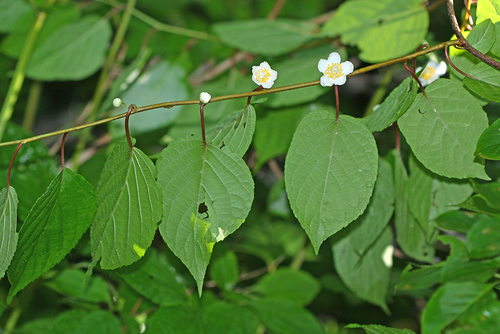

Silver vine (Actinidia polygama) is a deciduous, dioecious climber in the Actinidiaceae family, native to temperate mountain regions of China, Japan, Korea and the Russian Far East. Some leaves turn strongly white just before summer flowering and return to green after the flowers fade. Its powerful effect on domestic cats is well documented and is often stronger than that of ordinary catnip.
Read moreSilver vine and Matatabi
Allow a few hours of direct sun per day, preferably morning or evening.
Full sun to light partial shade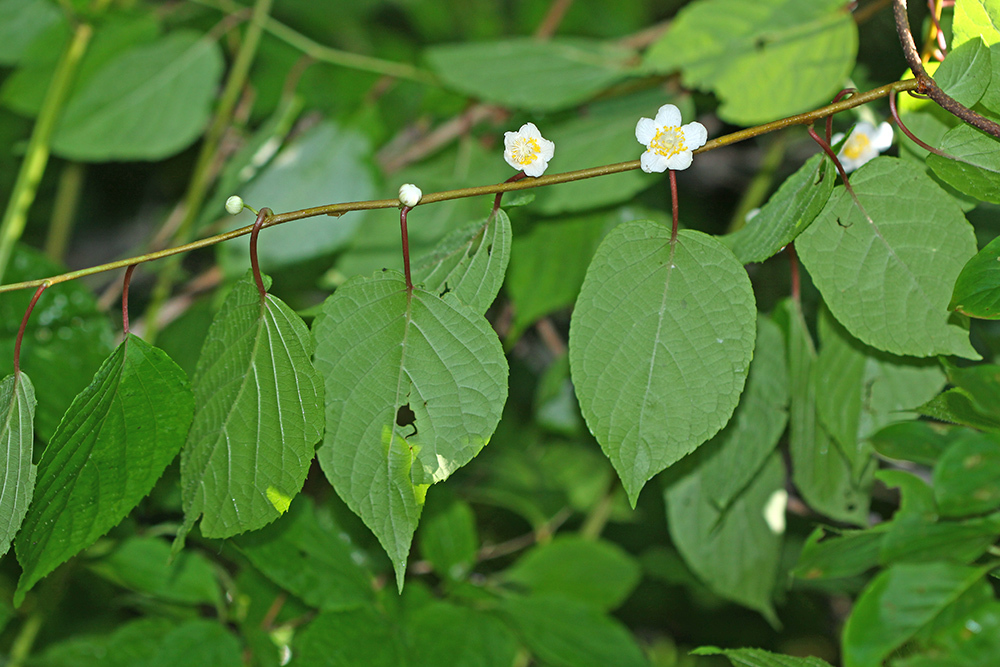


© photo
(c) V.S. Volkotrub, some rights reserved (CC BY-NC), uploaded by V.S. Volkotrub · cc-by-nc
Roman A. Lagazyuk (Роман А. Лагазюк) · cc-by
Wikimedia Commons · CC BY-SA or Public Domain
© copyright of the Board of Trustees of the Royal Botanic Gardens, Kew.


Global distribution
Actinidia polygama is native to temperate East Asia, from eastern and central China to Japan, Korea and the Russian Far East. Elsewhere it is mainly cultivated by collectors, with no documented invasive naturalization reported.
- Native4
- China
- Japan
- South Korea
- Russia (Far East)
Hexagons: regions where the plant occurs. Green dots: native range.1
Identity
Silver vine (Actinidia polygama (Siebold & Zucc.) Planch. ex Maxim., 1859), also known as matatabi, is a deciduous, dioecious climber in Actinidiaceae, the same family as cultivated kiwifruit. Siebold and Zuccarini first described it as Trochostigma polygamum in 1843. Maximowicz transferred it to Actinidia in 1859. 1 2
The Japanese name matatabi is said to recall a legend of exhausted travelers who regained their strength by chewing its fruits along the way. Silver vine describes a more immediate feature: part of the foliage develops a silvery-white patch just before summer flowering. 3
Recognition
Actinidia polygama twines around its support and commonly reaches 5–6 m (16–20 ft) in favorable conditions. Its oval leaves, with heart-shaped bases and finely toothed edges, measure 6–13 cm (2.4–5 in) long. Color is a clearer field mark than leaf shape or vine size: some leaves near the shoot tips turn strongly white in early summer, then return entirely to green once flowering ends. 5 3
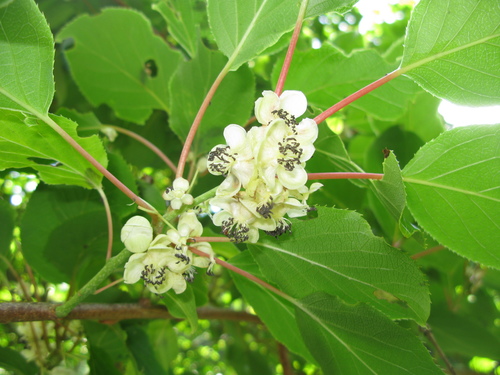
Fragrant white flowers, about 2–3 cm (0.8–1.2 in) across, open in early summer in the native Northern Hemisphere range. Each lasts only two to three days. The species is dioecious, with male and female flowers on separate plants, an important distinction when growing it for fruit. 5
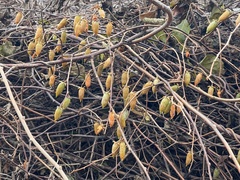
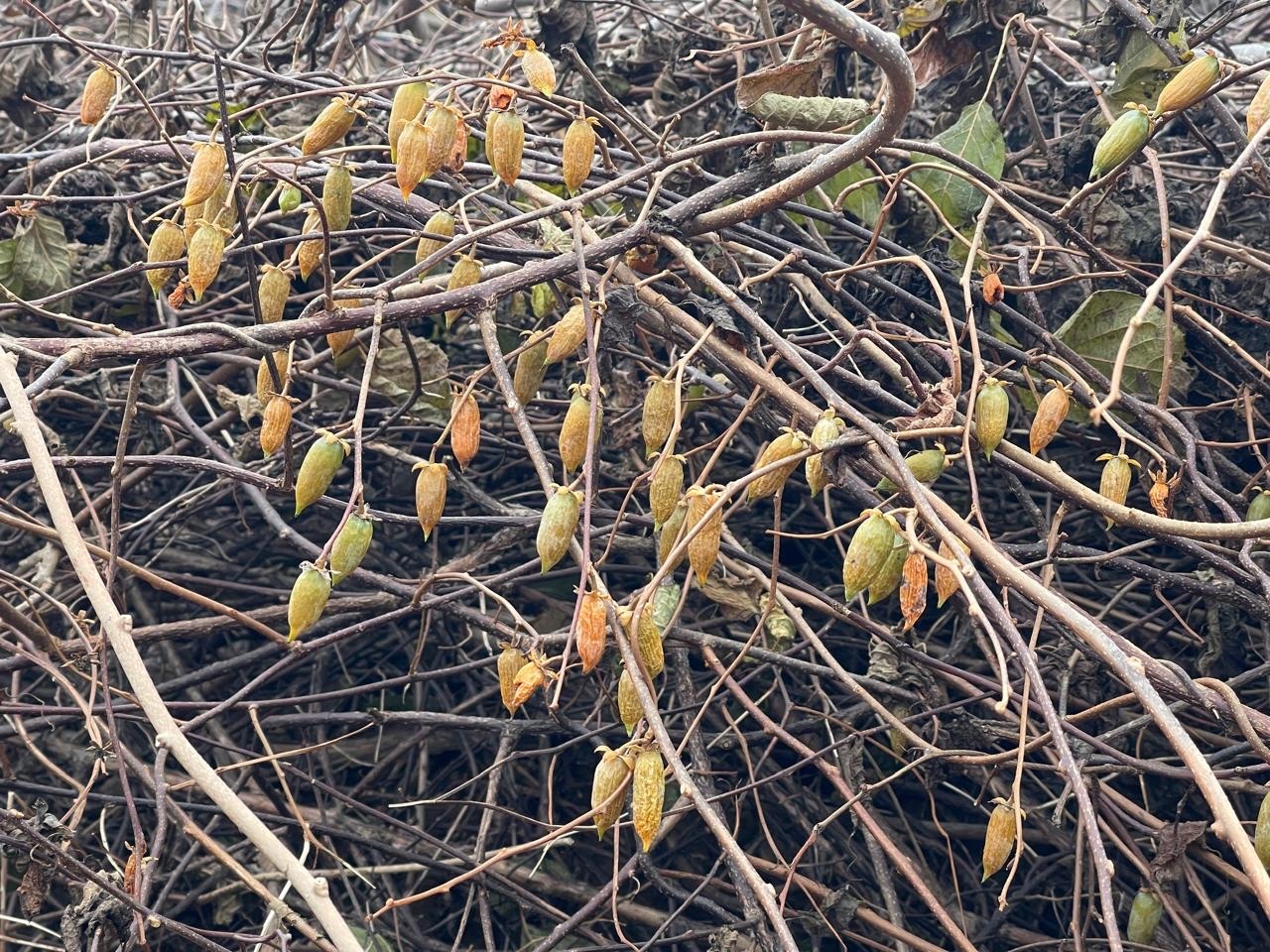
The fruit is an oval berry 3–4 cm (1.2–1.6 in) long, green at first and yellow to orange when fully ripe. Many wild fruits are irregular: a specialized insect’s puncture causes an elongated, lumpy gall quite unlike the healthy fruit. Dried, this galled form is the traditional Japanese mokuten. 4
Useful taxonomy
POWO/WCVP accepts Actinidia polygama, with Trochostigma polygamum Siebold & Zucc. as its basionym. Actinidia includes other hardy fruiting climbers, three of which are often confused with silver vine in nurseries:
- Actinidia arguta (Siebold & Zucc.) Planch. ex Miq., hardy kiwi, with smooth, edible fruit
- Actinidia kolomikta (Rupr. & Maxim.) Maxim., with more extensive, longer-lasting pink and white variegation
- Actinidia deliciosa (A.Chev.) C.F.Liang & A.R.Ferguson, grown for fuzzy kiwifruit
The variety Actinidia polygama var. lecomtei (Nakai) H.L.Li remains included within the species in current classification; it does not represent a separate taxonomic unit in everyday horticulture. 1 2
Habitat and distribution
Native populations extend across temperate East Asia: about fifteen Chinese provinces, from Yunnan to Heilongjiang, Japan, North and South Korea, and the Russian Far East, notably Sakhalin and the Kuril Islands. The vine grows in mountain forests and woodland margins at 500–1,900 m (1,640–6,230 ft). 3 6
Hardy to about −30 °C (−22 °F) and rated for USDA zones 4–8, Actinidia polygama withstands much colder winters than most familiar ornamental climbers. Beyond its native range, it remains mainly a collector’s plant, grown in Europe and North America for changing leaf color and its documented effect on cats. 5
Life cycle and reproduction
Flowering falls in early summer in its native Northern Hemisphere range. Without a nearby male, an isolated female can flower annually without producing a single fruit. Once set, the berries ripen slowly until fall in that range. 5
Propagation is by seed, after about three months of cold stratification, with often irregular germination. Softwood or semi-ripe cuttings taken in early summer are usually faster and more reliable for producing a plant identical to the parent. 5
Uses and risks
As an ornamental, silver vine covers pergolas, fences and trellises. Its partly white foliage contrasts with surrounding green leaves for several weeks. 5
Its effect on domestic cats is more extensively documented than its garden use. A study of 100 cats recorded a positive response in 79%, compared with 68% for ordinary catnip. Nearly 75% of cats that did not respond to catnip nevertheless responded to silver vine. 7
A 2021 study clarified the mechanism: nepetalactol, the principal active leaf compound, raises plasma beta-endorphin in cats through mu-opioid receptors, explaining their face-rubbing behavior. Rubbing transfers the compound to the fur, where it repels mosquitoes. This is a documented chemical-defense function as well as a recreational response. 8
No acute toxicity is recorded in cats. Silver vine is sold as sticks or dried powder for cat toys. Exposure generally causes 5–30 minutes of excitement, followed by a refractory period of about an hour during which the cat shows no interest in renewed contact. 7
Varieties, lookalikes and related plants
No stable, widely distributed garden cultivar is documented for Actinidia polygama. Most plants are propagated from seed or cuttings of wild-type material. 5
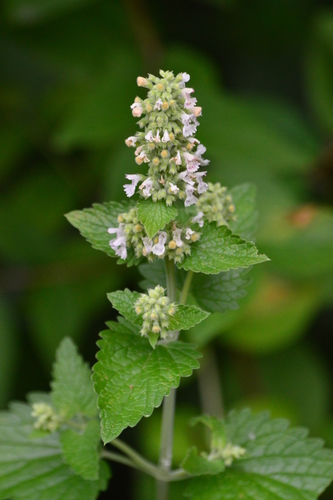
Two plants are often confused with it in the trade in cat-attracting climbers: Actinidia kolomikta, whose pink and white variegation is more extensive and persists longer, and Nepeta cataria, an unrelated herbaceous perennial sharing only the attraction for cats, through a different compound, nepetalactone. The scientific name and twining, climbing habit remain the most reliable distinctions between Actinidia polygama and these two plants. 1
Main sources
- Plants of the World Online / Kew, Actinidia polygama (Siebold & Zucc.) Planch. ex Maxim.
- International Plant Names Index, Actinidia polygama
- USDA GRIN Taxonomy for Plants, Actinidia polygama
- USDA PLANTS Database, Actinidia polygama plant profile (ACPO9)
- Plants For A Future, Actinidia polygama
- Global Biodiversity Information Facility, Actinidia polygama
- Bol et al., 2017, BMC Veterinary Research, cat responsiveness to silver vine, honeysuckle, valerian and catnip
- Uenoyama et al., 2021, Science Advances, nepetalactol and feline chemical defense against mosquitoes
Frequently asked questions
Is silver vine the same plant as kiwifruit?
No, but both belong to Actinidia and the Actinidiaceae family. The species grown for ordinary kiwifruit is Actinidia deliciosa. Silver vine produces edible but less-prized fruit, often distorted into galls.
Is silver vine toxic to cats?
No acute toxicity is recorded. It produces a documented euphoric behavioral response in most exposed cats, with no known harmful effect or reported addictive behavior.
Why are my silver vine leaves turning white?
Partial whitening of leaves near the shoot tips is normal and occurs just before summer flowering. They return entirely to green after the flowers fade.
Why does my silver vine never produce fruit?
The species is dioecious, with male and female flowers on separate plants. A solitary plant can flower every year without fruiting if no plant of the opposite sex is nearby.
Why do silver vine fruits have odd shapes?
A specialized insect’s puncture causes an elongated, lumpy gall on some fruits. This differs from the healthy oval fruit and is the traditional mokuten used in Japanese folk practice.
How does silver vine differ from catnip?
The plants are botanically unrelated. Silver vine (Actinidia polygama, Actinidiaceae) acts mainly through nepetalactol; catnip (Nepeta cataria, Lamiaceae) through nepetalactone. One study measured a more frequent response to silver vine.
Should you protect silver vine from nearby cats?
A light wire guard around young plants prevents repeated rubbing and biting that can damage bark and shoots while the vine establishes.
Similar plants
If you are unsure about a plant’s toxicity, ask a botanist or veterinarian for advice.