
Common asparagus fern (Asparagus setaceus, )
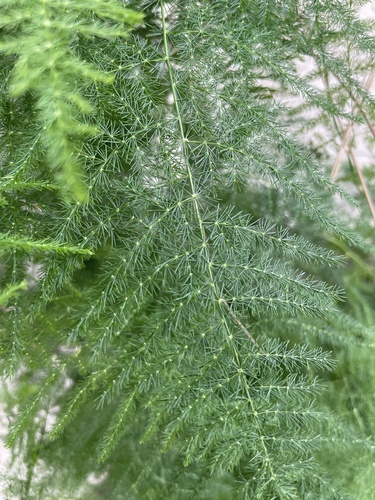
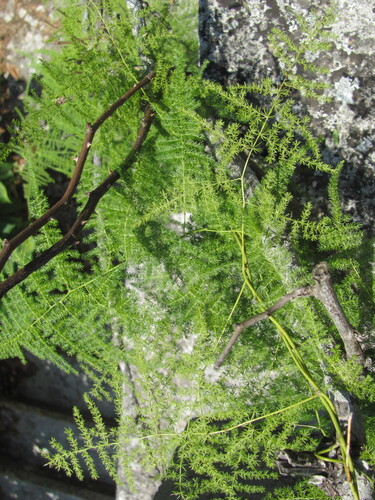
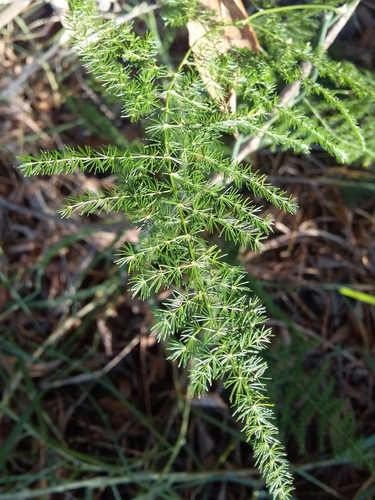
The common asparagus fern (Asparagus setaceus), also called lace fern, is a scrambling subshrub in the asparagus family, Asparagaceae, native to southern and eastern Africa. Despite the name, it is no fern. Its light, feathery foliage is made of cladodes, flattened stems that stand in for true leaves reduced to tiny scales.
Read moreLace fern, Plumosa fern, Asparagus fern and Fern asparagus
Give plenty of ambient light without direct sun on the leaves.
Global distribution
The native range of Asparagus setaceus runs through southern and eastern Africa, from the Cape and Natal in South Africa to central Ethiopia and the Comoros. Grown since the 19th century as an ornamental and for cut foliage, it has spread to warm regions worldwide and has naturalized locally outside its native range.
- Native4
- Introduced1
- Invasive1
- South Africa
- Ethiopia
- Malawi
- Comoros
- United States (Florida)
- Australia (Queensland, New South Wales)
Hexagons: sourced regions. Green dots: native range. Statuses according to POWO (Kew).
Identity
The common asparagus fern (Asparagus setaceus (Kunth) Jessop, 1966), also known as lace fern or plumosa fern, belongs to the genus Asparagus in the family Asparagaceae. It looks like a fern but is not one. Its true leaves are reduced to minute scales, and the light green foliage people know it for consists of cladodes, fine flattened stems 4–7 mm (about ¼ in) long that carry out photosynthesis in place of the missing leaves. 1 2
German botanist Carl Sigismund Kunth described the plant in 1850 as Asparagopsis setacea. Jessop moved it into Asparagus in 1966 under the name accepted today. The epithet setaceus, "bristle-like," refers to the fine, bristly look of the cladodes. 3
Recognition
The plant grows as a scrambling subshrub: slender stems climb by hooking short, recurved spines onto whatever support is available. Without one, the plant stays bushy and trailing in a pot, at 1–3 m (3–10 ft); planted in the ground with a support and a favorable climate, its climbing stems can grow longer than several meters. 4 5
Each node carries 10 to 20 cladodes, 4–7 mm (about ¼ in) long, which give the foliage the feathery texture florists prize. Older stems bear hard, hooked spines that are often missing on young shoots. That is why a newly propagated plant seems harmless while a mature one scratches easily. 1 6
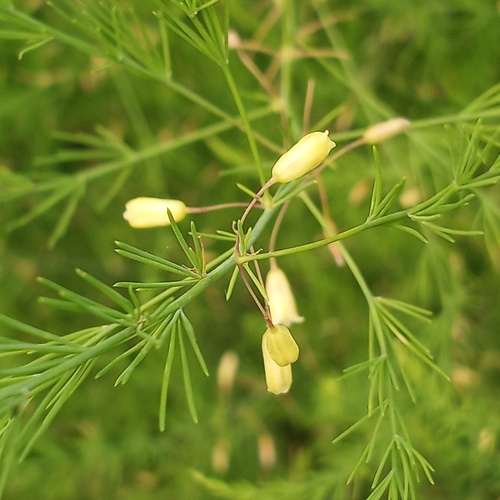
Small bell-shaped flowers, white to greenish white and about 4 mm (⅙ in) long, open in summer, from June to September in cultivation in the Northern Hemisphere. They give way to round berries, green at first, that turn black when ripe. 7
Useful taxonomy
For a long time, the accepted name Asparagus setaceus (Kunth) Jessop has shared the stage with synonyms that still turn up in the horticultural trade. The main ones to know:
- Asparagopsis setacea Kunth, the 1850 basionym
- Asparagus plumosus Baker, long sold under this name by florists
- Asparagus plumosus var. tenuissimus (Van Geert) L.H.Bailey
- Asparagus tenuissimus Van Geert
- Protasparagus setaceus (Kunth) Oberm.
- Asparagus zanzibaricus Baker
At garden centers, the trade name Plumosus is still common on labels. It corresponds to Asparagus plumosus, now treated as a synonym of Asparagus setaceus. Faced with such an outdated label, rely on the accepted scientific name. 2 3
Habitat and range
Native populations stretch across southern and eastern Africa, from the Cape and Natal in South Africa to central Ethiopia and the Comoros. The species grows in humid coastal forests, woodland edges and coastal thickets, in warm climates where frost is rare. 2 8
Grown since the 19th century as an ornamental and for cut foliage, it has spread through warm regions worldwide and is now recorded in nearly 80 countries. In Florida, as in parts of Australia, Asparagus setaceus has naturalized outside its native range. 7 5
Birds spread the berries in Australia, which speeds up naturalization there. The species is listed as invasive on Lord Howe Island and Norfolk Island, in northern New South Wales and in Queensland, where it forms dense mats that smother native vegetation. 1
Life cycle and reproduction
Summer flowering is inconspicuous and precedes fleshy berries that take several weeks to blacken. Birds drawn to the ripe fruit handle most seed dispersal in the wild. 1
Gardeners propagate it mainly by seed or by division. Seeds soaked for 12 hours in lukewarm water and sown in spring germinate in 3 to 6 weeks at around 25 °C (77 °F); dividing a mature plant in early spring gives faster results. 8 7
Growth is fast in the warm season and slower in winter, when the plant slows down without entering true dormancy. Repotting every year or two restores vigor to an established container plant. 6 4
Uses and risks
Ornamental use dominates. Where winters bring frost it is grown as a houseplant; in frost-free regions, roughly USDA zones 9 to 12, it also grows outdoors as a shaded groundcover or a light screen. Its cut stems, valued for their airy texture, remain a floral design staple, which is why florists have used it for so long. 4 7
The berries contain sapogenins, steroidal saponins that are toxic to cats and dogs if eaten, causing vomiting, diarrhea and abdominal pain. The sap and cladodes can also trigger contact dermatitis in sensitive people, especially with repeated skin contact. 1 6
Spines on older stems often cause minor scratches during pruning or repotting, so gloves are advisable when handling a mature plant. 6
Varieties, look-alikes and related plants
Two stable cultivars circulate in horticulture: Nanus, a dwarf form suited to small pots, and Pyramidalis, more upright and branched, sought after in floral design because it holds well in arrangements. 5
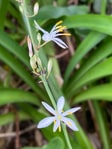
The most frequent mix-up involves Asparagus densiflorus 'Sprengeri', sold under the same "asparagus fern" trade name. The cladodes of Asparagus setaceus sit in very fine, flat fans, while those of Asparagus densiflorus are longer and borne singly along arching, trailing stems, giving a grassier, less feathery look. 6
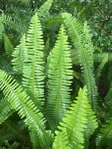
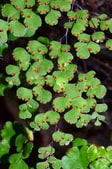
Boston fern (Nephrolepis exaltata) and maidenhair fern (Adiantum raddianum), two true ferns unrelated to the common asparagus fern, are the other usual garden-center confusions. Their fronds carry distinctive sori on the underside, which Asparagus setaceus lacks since it produces neither fronds nor spores.
Main sources
- Plants of the World Online / Kew, Asparagus setaceus (Kunth) Jessop
- International Plant Names Index, Asparagus setaceus (Kunth) Jessop
- Royal Horticultural Society, Asparagus setaceus
- Missouri Botanical Garden PlantFinder, Asparagus setaceus
- NC State Extension, Asparagus setaceus (Fern Asparagus)
- Plants For A Future, Asparagus setaceus
- Wikipedia (EN), Asparagus setaceus
- Conservation Nature, Asparagus setaceus (French-language entry)
Frequently asked questions
Is Asparagus setaceus really a fern?
No. It belongs to the asparagus family, Asparagaceae, not to the ferns. Its true leaves are reduced to tiny scales; the feathery foliage you see is made of cladodes, flattened stems that take over the work of leaves.
Is Asparagus setaceus toxic to cats and dogs?
Its berries contain sapogenins, steroidal saponins that cause vomiting, diarrhea and abdominal pain if eaten. The sap and cladodes can also cause contact dermatitis in sensitive individuals.
Why do some stems have spines and others none?
The curved spines show up mainly on older or climbing stems, which use them to hook onto a support. Young shoots on newly propagated plants are often spineless.
How do you tell Asparagus setaceus from Asparagus densiflorus?
Asparagus setaceus forms very fine cladodes grouped in flat fans. Asparagus densiflorus 'Sprengeri' carries longer cladodes set singly along arching, trailing stems, with a grassier, less feathery look.
What is the easiest way to propagate Asparagus setaceus?
From seed, soaked for 12 hours before sowing in spring, or by dividing a mature clump early in the growing season. Division gives a usable plant sooner.
Why do the cladodes turn yellow and drop?
Most often from too little water or dry air near a heater, or, at the other extreme, from direct sun scorching the fine foliage. A bright spot with filtered light keeps the problem in check.
Why is it popular with florists?
Cut stems of Asparagus setaceus have been used since the 19th century as filler foliage in floral arrangements, valued for their lightness and fine texture.
Similar plants
Botanical data compiled from reference sources (RHS, Kew Gardens, POWO). This profile is for guidance only and is not a substitute for advice from a botanist or veterinarian if you have concerns about toxicity.