
Bird's nest fern (Asplenium nidus, )
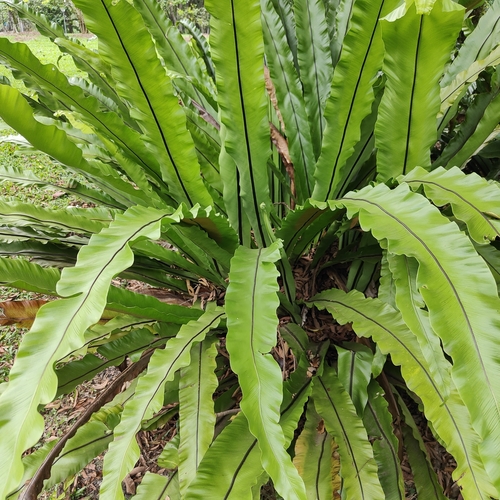
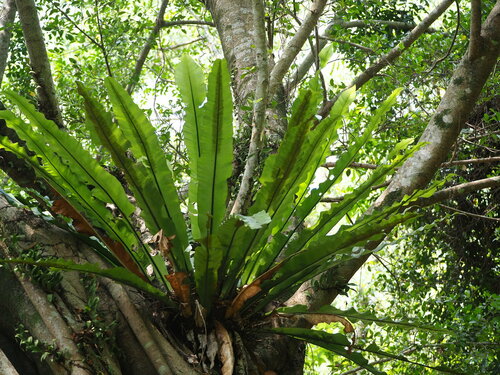
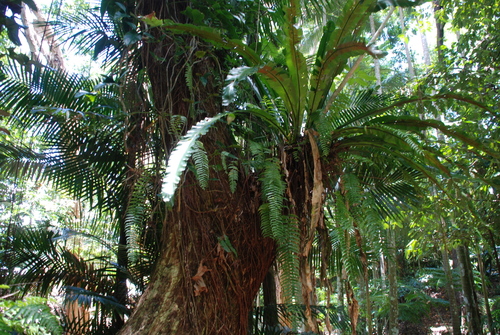
The bird's nest fern (Asplenium nidus L.) is a tropical epiphytic fern grown indoors for its broad, undivided fronds, which rise in a rosette around a nest-shaped crown. It never flowers: it spreads by spores and by division, and the ASPCA lists it as non-toxic to cats, dogs and horses.
Read moreNest fern
Place in indirect light or in a shaded room.
Global distribution
POWO gives the native range of Asplenium nidus as tropical Southeast Asia to northeastern Queensland, in a warm, humid climate. Floras and horticultural lists report a wide presence across the Pacific islands, Hawaii and the Indian Ocean; these records should be kept separate from the Asian native range.
- Native6
- Introduced2
- Malaysia
- Indonesia
- Philippines
- Thailand
- Queensland
- India
- Hawaii
- Polynesia
Hexagons: sourced regions. Green dots: native range. Statuses according to POWO (Kew).
Identity
The bird's nest fern (Asplenium nidus L.) is an epiphytic fern in the family Aspleniaceae, genus Asplenium. Linnaeus published the name in 1753, and it remains the accepted name in the main taxonomic databases. 1 2
Its common name describes the silhouette: undivided fronds rise from a central crown that forms a nest-shaped cup. Outside the tropics it is mostly grown as a large, sturdy houseplant, sold as bird's nest fern or simply nest fern. 3 4
Spleenworts, the genus Asplenium, are ferns often recognized by elongated sori set along the veins. A. nidus stands apart with simple, broad fronds, where many of its relatives carry divided foliage. 5 1
Recognition
Look for a rosette of undivided fronds, broad, arching and glossy, light to bright green. Unlike feathery ferns such as the Boston fern, the blade is not cut into pinnules: it is one continuous sheet with a smooth or slightly wavy edge. 3 6
Down each frond runs a conspicuous dark brown midrib, with fine side veins radiating from it. In cultivation the crown usually stays 40 to 60 cm (16 to 24 in) tall, though exceptional plants in a humid greenhouse can approach 1 m (3 ft). 4 6
Don't mistake the elongated sori for pests. They sit in oblique lines along the midrib on the underside of fertile fronds, are linked to spore production and are perfectly normal on a fern, not scale insects or insect eggs. The center of the rosette collects water and debris, a hallmark of the species. 5 3
Useful taxonomy
Asplenium nidus L. is the working name, treated as an accepted name at species rank in the family Aspleniaceae, order Polypodiales. POWO places the species in a humid tropical climate and describes it as an epiphyte or lithophyte. 1 2
Garden centers use several trade names for this species and its close relatives:
- Asplenium nidus L., the accepted name;
- Asplenium antiquum Makino, a related species often sold under the same bird's nest label;
- the horticultural selections 'Crispy Wave', 'Osaka' and 'Fimbriatum', which describe wavy or fringed frond edges.
These labels refer to habit or leaf texture, not to separate botanical species. The accepted scientific name, Asplenium nidus, stays the dependable reference. 1 6
Habitat and range
POWO gives the native range as tropical Southeast Asia south to northeastern Queensland, where the climate is warm and rainy. There the plant grows as an epiphyte on trunks and branches, or as a lithophyte on shaded rocks rich in organic matter. 1 4
Floras and horticultural lists report a wide presence across the Pacific islands, Hawaii, Polynesia and the Indian Ocean. That spread reflects a long history of cultivation and introduction; it should be kept apart from the Asian native range, and the sources consulted give no basis for calling the plant invasive in temperate Europe. 1 6
Life as an epiphyte explains what the plant asks for in cultivation. The rosette is built for high humidity, light filtered through a canopy and an airy perch that never holds stagnant water. In a pot, that means a free-draining organic mix and moist air, a far cry from what a full-sun plant tolerates. 3 7
Life cycle and reproduction
Flowers and seeds are absent, as in every fern. Generic horticultural datasets that list "flowers" or "fruit" for Asplenium nidus should be set aside for an accurate description. Its reproductive units are spores, borne in elongated sori under the fertile fronds. 5 6
The cycle follows the standard fern pattern: a spore germinates into a small prothallus that bears male and female organs; after fertilization, which needs water, a new leafy fern develops. The process demands constant humidity and moves slowly, which is why few home growers raise this fern from spores. 5 7
In cultivation, vegetative propagation is the easy route: division of a well-rooted crown during the growing season. Sowing spores remains an option for anyone willing to accept a slower method with higher humidity demands, but it rarely delivers results as quickly as division. Either way, avoid burying the center of the rosette and keep the air warm and humid until the plant establishes. 3 6
Uses and risks
Its documented use is ornamental: pots, wide hanging baskets, heated sunrooms, humid greenhouses, shaded frost-free patios or bright, humid rooms such as a bathroom. The references consulted give no grounds for a reliable food use, so no edible or medicinal claim is made here. 3 7
For pets, the ASPCA lists bird's nest fern, that is Asplenium nidus, as non-toxic to cats, dogs and horses. That is useful for a household with animals, as long as the wording stays careful: non-toxic does not mean edible. 8 6
The main household risk is horticultural, not toxicological. Water poured into the center of the rosette encourages crown rot, and air that is too dry browns the frond edges. A large ingestion or any unusual behavior in an animal still calls for a vet's advice, since other plants sold under similar names may have different profiles. 8 3
Varieties, look-alikes and related plants
Trade names mostly play on frond texture. 'Crispy Wave' refers to a form with strongly rippled, crinkled fronds; 'Osaka' and 'Fimbriatum' describe broader, fringed or cut edges. Read them as horticultural labels, not separate species. 6 3
The most frequent mix-up involves neighboring bird's nest ferns:
- Asplenium antiquum, with slightly stiffer, more upright fronds, often sold under the same common name;
- Asplenium australasicum, a close relative from Oceania with a raised midrib;
- feathery ferns such as Nephrolepis exaltata, whose divided fronds look nothing like the undivided blade of A. nidus.
Undivided fronds in a rosette, the nest-like crown, the dark brown midrib and the elongated sori remain the most reliable checks that a plant sold as a bird's nest fern really is Asplenium nidus. 4 1
Main sources
- Plants of the World Online / Kew, Asplenium nidus L.
- International Plant Names Index, Asplenium nidus L.
- Royal Horticultural Society, Asplenium nidus, bird's nest fern
- Missouri Botanical Garden, Asplenium nidus
- NC State Extension Gardener Plant Toolbox, Asplenium nidus
- Encyclopaedia Britannica, spleenwort (Asplenium)
- Plants For A Future, Asplenium nidus
- ASPCA, Bird's Nest Fern (Asplenium nidus) toxicity entry
Frequently asked questions
Is the bird's nest fern toxic to cats?
The ASPCA lists Asplenium nidus, under the name bird's nest fern, as non-toxic to cats, dogs and horses. That does not make it food: watch for any large ingestion or unusual symptoms.
What are the brown lines under the fronds?
On a healthy frond they are usually sori, the structures where spores form, lined up at an angle along the midrib. Scale insects tend to be irregular, mobile or sticky.
Does it have flowers or seeds?
No. Asplenium nidus is a fern: it does not flower, sets no seed and reproduces by spores and by vegetative division.
Where should the plant be watered?
Water the potting mix around the edge, never straight into the center of the rosette. Water pooling in the middle encourages crown rot, one of the most common problems indoors.
Where does Asplenium nidus come from?
POWO gives a native range from tropical Southeast Asia to northeastern Queensland, in a warm, humid climate. The plant has also spread to the Pacific islands and the Indian Ocean.
How is it propagated?
The simplest method indoors is dividing a well-rooted crown. Spores work too, but they are slower, less true to type and need constant humidity.
Similar plants

Botanical data compiled from reference sources (RHS, Kew Gardens, POWO). This profile is for guidance only and is not a substitute for advice from a botanist or veterinarian if you have concerns about toxicity.