
Mediterranean hackberry (Celtis australis, )
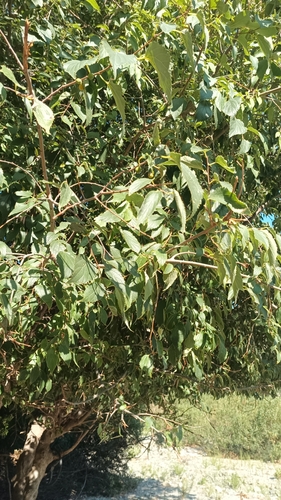
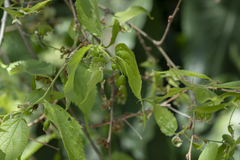
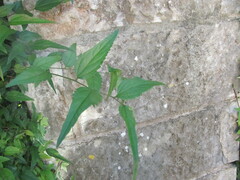
Mediterranean hackberry (Celtis australis) is a large deciduous tree in Cannabaceae, native to the Mediterranean region. Its smooth, beechlike gray bark, rough nettle-shaped leaves and small purple-black fruits distinguish this increasingly popular urban street tree.
Read moreMediterranean hackberry, European nettle tree and Lote tree
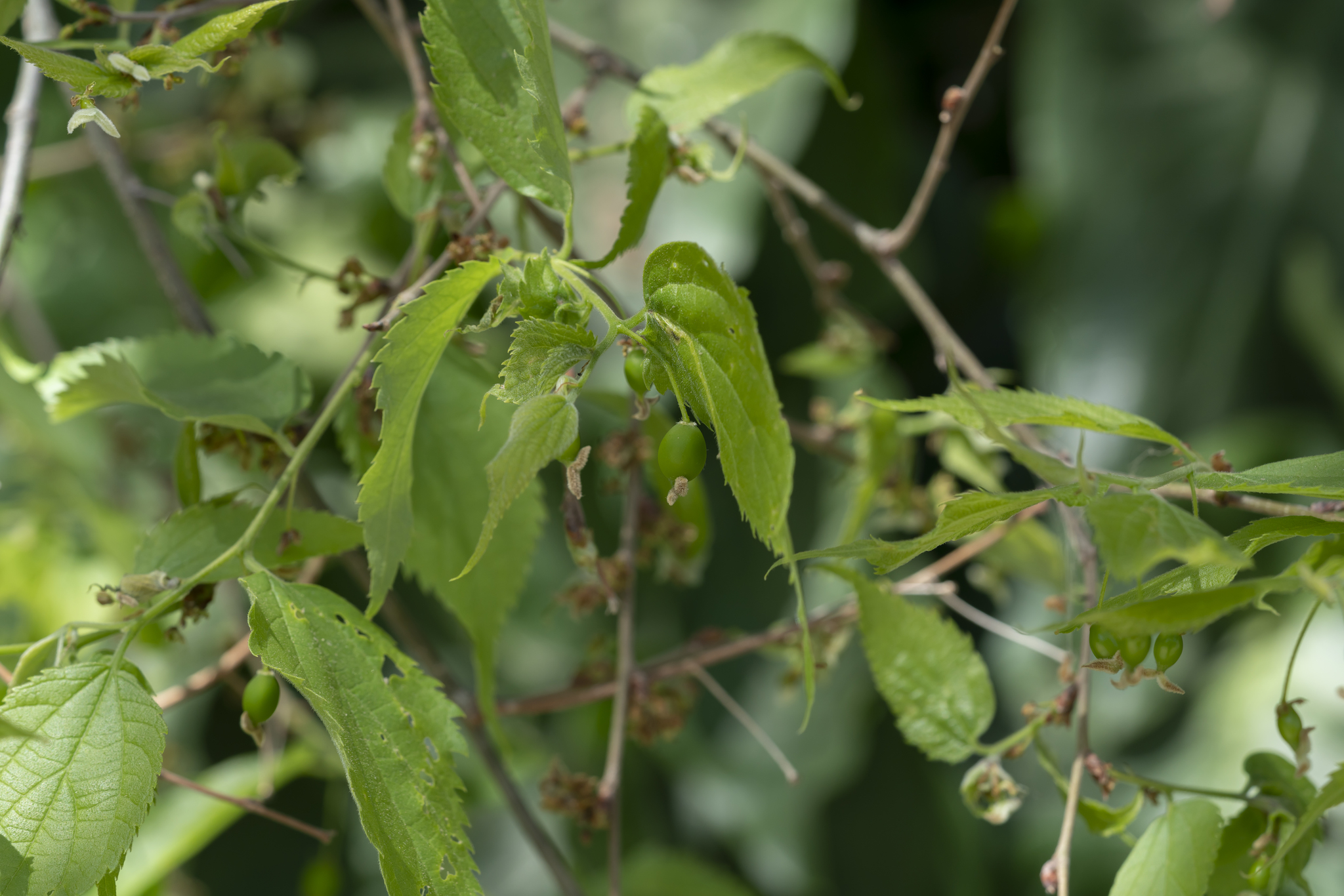
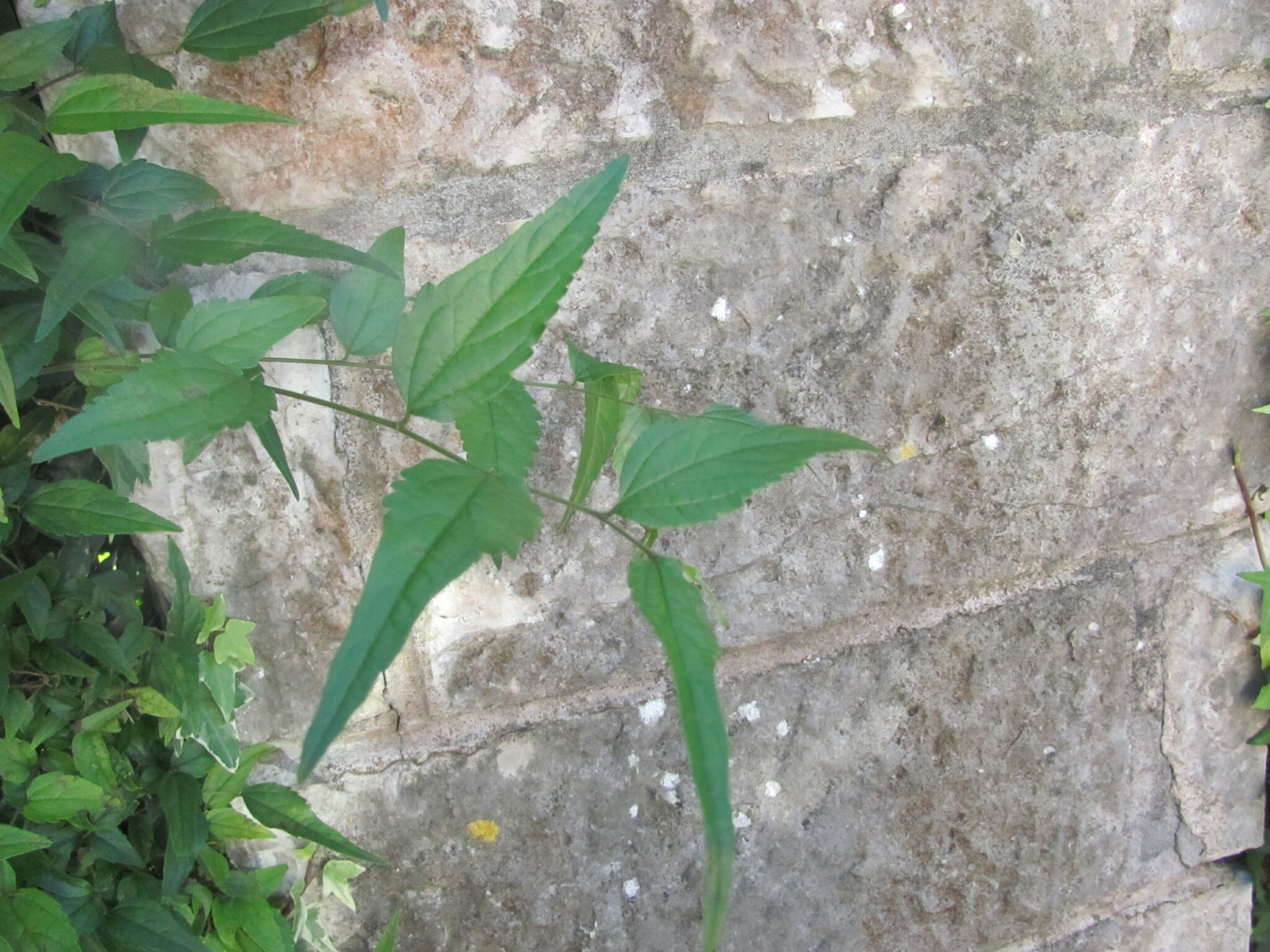


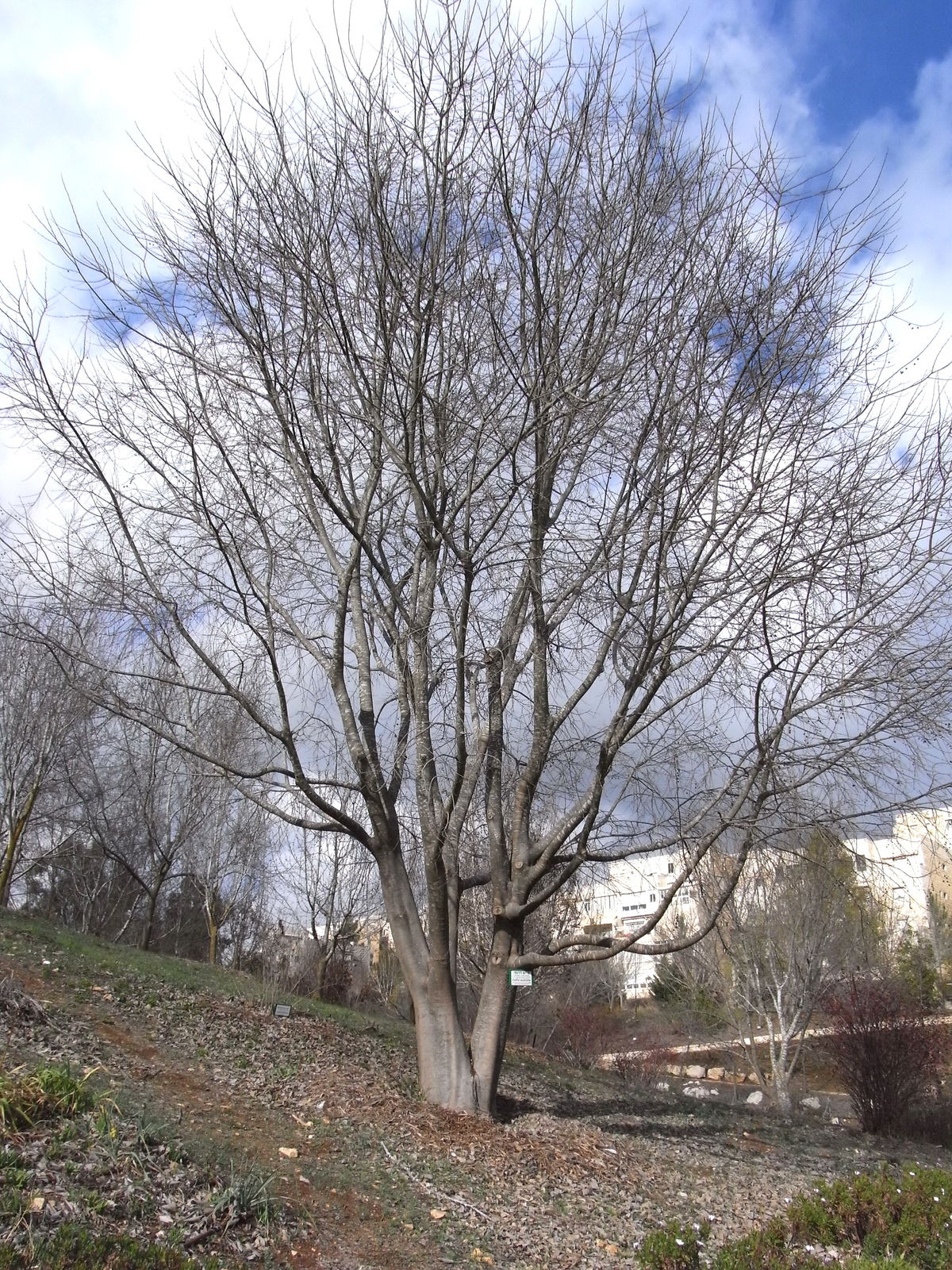
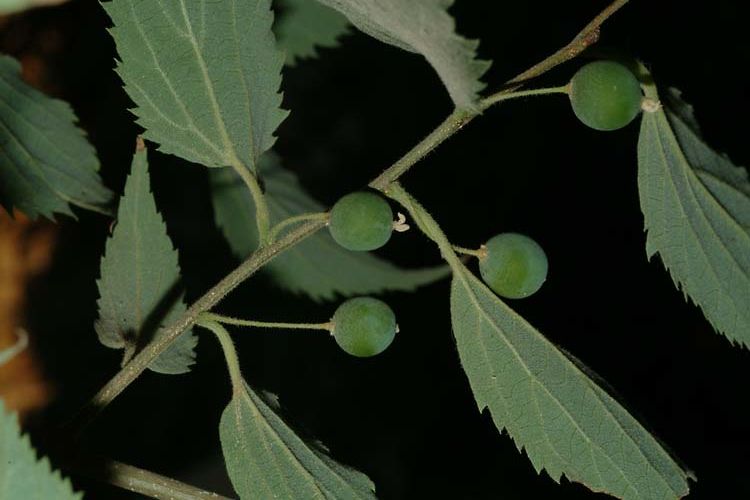
© photo
Lorenzo Emanuele Labate · cc-by
Eleftherios Katsillis · cc-by
zebedeugalinha · cc-by
Taken May 20, 2014 by Tela Botanica − Denis NESPOULOUS (cc-by-sa)
Taken Apr 30, 2015 by Tela Botanica − CONNAULTE Christian (cc-by-sa)
Taken May 22, 2022 by Gomez Jimmy (cc-by-sa)
Taken Aug 8, 2019 by Jean-Daniel BLARD (cc-by-sa)
Taken Oct 4, 2022 by Bastien (cc-by-sa)
© copyright of the Board of Trustees of the Royal Botanic Gardens, Kew.


Global distribution
Celtis australis is native around the Mediterranean, from Spain and North Africa through Italy, the Balkans, Turkey and southern France to northern Iran. It is the only genuinely native Celtis species in metropolitan France. Beyond this range, it has become widely naturalized in sub-Mediterranean and temperate regions and is extensively planted along streets, including in northern France, northern Europe and North America.
- Native7
- France
- Spain
- Italy
- Greece
- Turkey
- Morocco
- Iran
Hexagons: regions where the plant occurs. Green dots: native range.1
Identity
Mediterranean hackberry (Celtis australis L., 1753), also known as European nettle tree or lote tree, is a large deciduous member of Celtis in Cannabaceae. Formerly placed in Ulmaceae, the elm family, it was reassigned to Cannabaceae, the family of hemp and hops, following the adoption of a phylogenetic classification of flowering plants. 1 6
The English name nettle tree describes the foliage: its rough leaves resemble those of a nettle, although the plants are not botanically related. French micocoulier comes from micocoule, the Provençal name for the tree’s small fleshy fruit. 6
Recognition
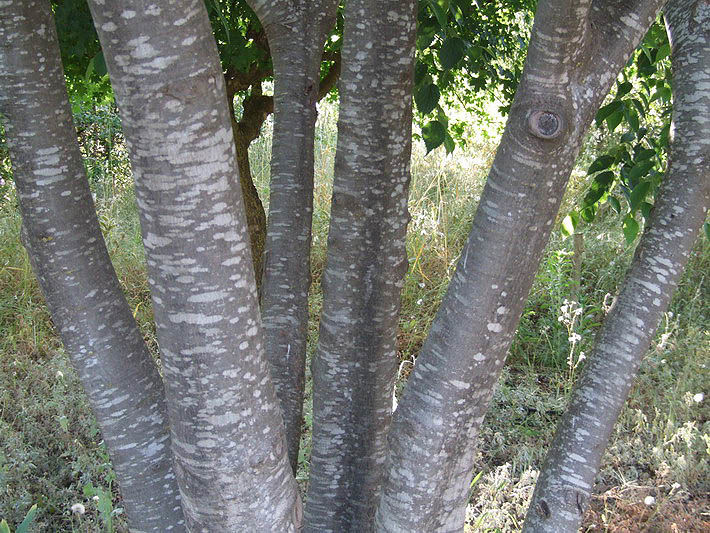
For identification, the trunk provides the most dependable starting point. Its smooth gray bark resembles beech bark, developing fissures only on very old trees, whose trunks may exceed 1 m (3.3 ft) in diameter. Branches end in flexible, drooping, slightly zigzag twigs. 6
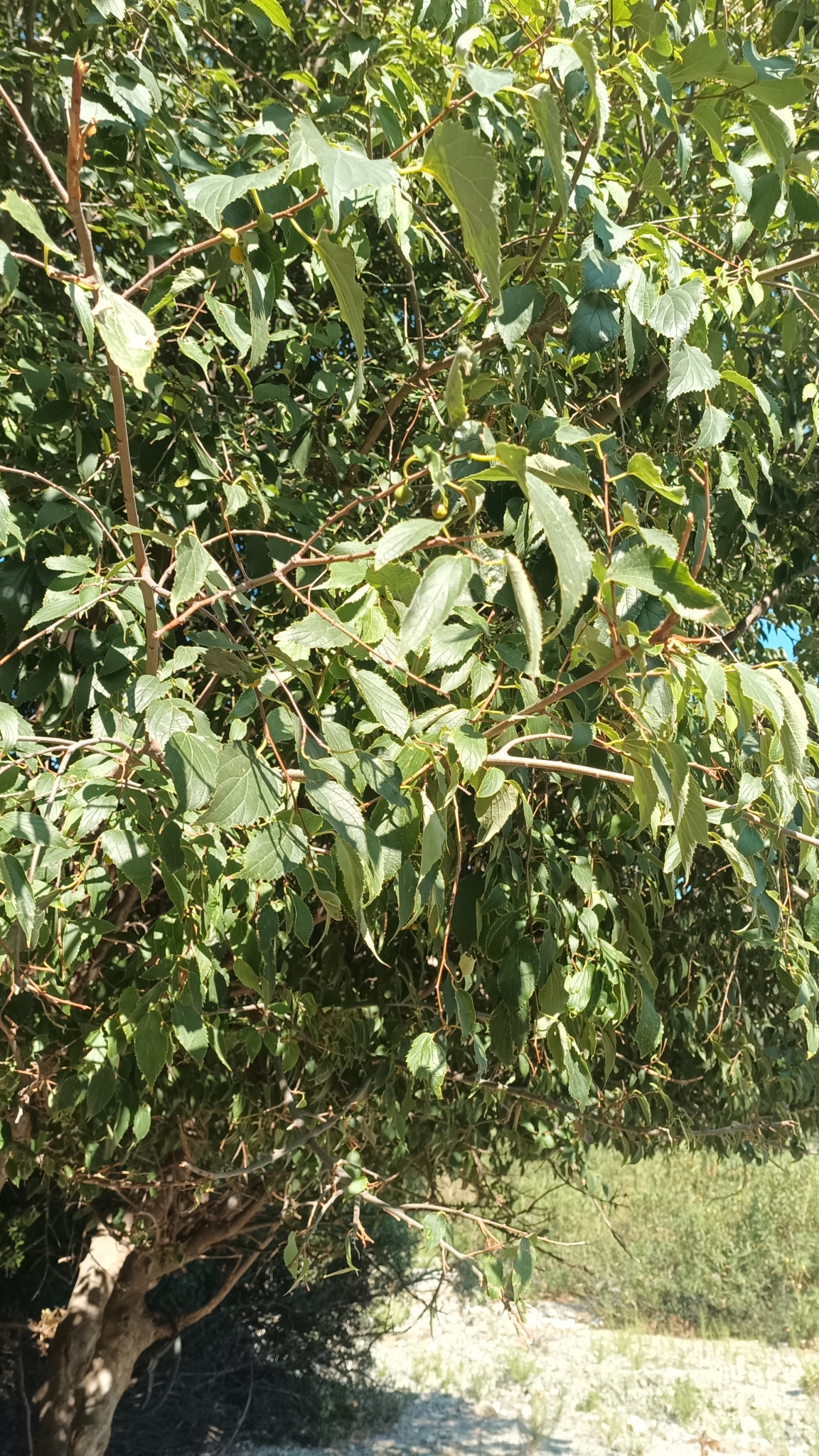
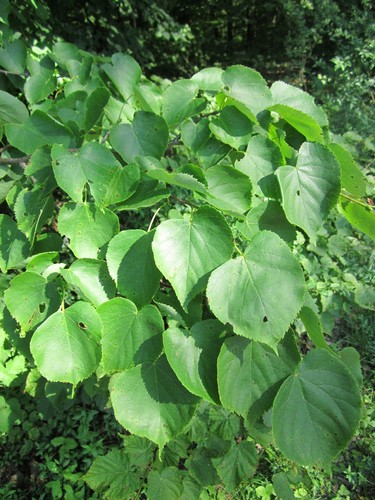
Simple alternate leaves are oval, toothed, asymmetrical at the base and drawn out into a point. Three prominent main veins show beneath the blade, which measures 5–15 cm (2–6 in) long. The upper surface is scabrous, or rough to the touch, unlike the smooth foliage of common hackberry: an immediately useful field distinction. 6 2
Mature trees commonly stand 12–25 m (39–82 ft) tall, with the oldest sometimes exceeding 30 m (98 ft), and spread 8–15 m (26–49 ft). A regular, cylindrical outline and broad, upright crown help explain their popularity in street plantings. 2 3
Useful taxonomy
In 1753, Linnaeus described the species as Celtis australis L., still its accepted name. Several subsequently published forms have been reduced to synonymy: Celtis australis var. eriocarpa (Decne.) Hook.f., Celtis australis var. lutescens Guss., Celtis australis var. panormitana Raimondo & Venturella and Celtis australis f. variegata Schelle ex Geerinck. 1
About a hundred species of Celtis occur across several continents. Celtis australis is the only genuinely native member of the genus in metropolitan France, providing a point of comparison with introduced relatives such as North American Celtis occidentalis. 7 6
Habitat and range
From Spain and North Africa, the native range runs around the Mediterranean through Italy, the Balkans, Turkey and southern France to northern Iran. The European EUNIS habitat classification associates it with warm mixed woodland and white willow gallery forests, on well-drained soils in sunny locations. 1 6
The International Union for Conservation of Nature classifies Celtis australis as Least Concern. It remains widespread, although populations decline locally in urban areas as other tree species replace it in new plantings. 8
Outside its native range, Mediterranean hackberry has become widely naturalized in sub-Mediterranean and temperate regions, where a warming climate favors establishment. It is also widely planted along streets well beyond its origins, notably in northern France, Germany and the United Kingdom. 6 2
Life cycle and reproduction
As new leaves unfold in spring, small, inconspicuous greenish flowers appear and are pollinated by wind. The fruits are fleshy drupes about 1 cm (0.4 in) across, turning from green to purple-black as they ripen in fall. 6 4
Seed is the main means of propagation. Two to three months of cold stratification triggers germination of fresh seed, whereas simply stored seed takes a year; seeds remain viable for about five years. Growth is rapid for the first twenty years and slows as the tree ages. 4
Specimens can live for several centuries. A hackberry growing among the graves of Terre Cabade cemetery in Toulouse received France’s national “remarkable tree” designation in 2016, a tangible example of this longevity. 6
Uses and risks
Hard, flexible and durable wood has traditionally supplied tool handles and walking sticks. It is still shaped into wooden pitchforks in Sauve, in the Gard, while a workshop at Sorède near Perpignan uses it for riding crops and whips, a use documented since the 13th century. 6
Sweet ripe fruits are eaten fresh in small quantities in some regions, and their oil-rich seeds can be pressed. No toxic principle is documented in the species, which is considered non-toxic to humans, cats and dogs. 4
Urban planting brings together two advantages: rapid growth combined with tolerance of air pollution and drought once established, and the dense shade cast by the crown. Paris has more than 4,000 trees, including plantings on boulevard de l’Hôpital and boulevards Jourdan and Kellermann. 6
Caterpillars of the European beak (Libythea celtis) feed on the leaves of Mediterranean hackberry (Celtis australis). 9
Varieties, look-alikes and related plants
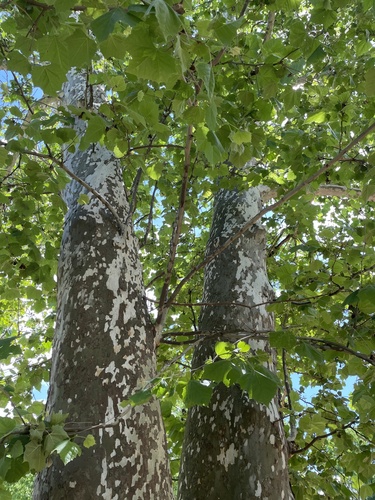
Common hackberry (Celtis occidentalis L.), a North American species increasingly planted in Europe, is the usual source of confusion. Three characters provide a quick distinction: its bark becomes rough and fissured at maturity, while C. australis stays smooth for longer; its leaves are smooth above rather than scabrous; and its ripe fruits are dark purple, redder than the purple-black fruits of C. australis. Habit differs too: Mediterranean hackberry is upright and regular, while its American relative has a broader, more drooping crown better suited to a park than a street planting. 6
Celtis caucasica Willd., native to the Caucasus and Central Asia, was sometimes associated with C. australis in older synonymies but is treated as a separate species by current taxonomic references. Horticultural forms such as f. variegata remain uncommon in cultivation and differ chiefly in their variegated foliage, without other notable differences in habit or growth. 1
Main sources
- Plants of the World Online / Kew, Celtis australis L.
- Royal Horticultural Society, Celtis australis - European nettle tree
- Missouri Botanical Garden, Celtis australis
- Plants For A Future, Celtis australis
- Tela Botanica / eFlore, Celtis australis L.
- Tela Botanica / The Conversation (Serge Muller, MNHN), Mediterranean hackberry
- INPN / MNHN–OFB, Celtis australis L., 1753, CD_NOM 89468: original species notice, archived 27 June 2023
- IUCN Red List of Threatened Species, Celtis australis assessment
- Jurc, M., Csóka, G. and Hrašovec, B. (2016), Potentially important insect pests of Celtis australis in Slovenia, Croatia and Hungary, Šumarski list 140(11–12):577–588
Frequently asked questions
Is Mediterranean hackberry poisonous?
No. No toxic principle is documented in Celtis australis, which is considered non-toxic to humans, cats and dogs. Its ripe fruits are edible.
How can I tell Mediterranean hackberry from common hackberry?
Common hackberry (Celtis occidentalis) develops rough, fissured bark at maturity, while C. australis stays smooth for longer. Its leaves are smooth above rather than rough, and its ripe fruits are dark purple rather than purple-black.
Why is Mediterranean hackberry increasingly planted in cities?
Rapid growth, good tolerance of air pollution and drought once established, and the dense shade of its crown make it a sought-after street tree as urban climates change.
Is Mediterranean hackberry the lotus tree of mythology?
It is one proposed candidate for the lotus eaten by the Lotus-eaters in Homer’s Odyssey, although this hypothesis is considered weaker than the case for the jujube Ziziphus lotus.
Which butterfly depends on Mediterranean hackberry?
The European beak (Libythea celtis), whose caterpillars feed on Mediterranean hackberry leaves.
Is Mediterranean hackberry invasive in France?
No. It is the only native Celtis species in metropolitan France and is classified as Least Concern by the IUCN.
Does Mediterranean hackberry lose its leaves in winter?
Yes. It is deciduous: its leaves turn yellow in fall and drop, leaving the tree bare until the following spring.
Similar plants
If you are unsure about a plant’s toxicity, ask a botanist or veterinarian for advice.