
American sycamore (Platanus occidentalis, )
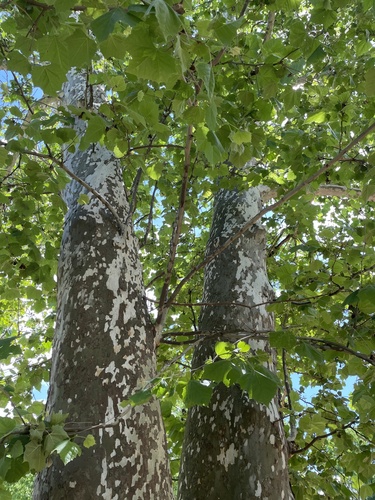
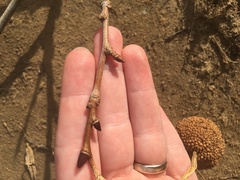
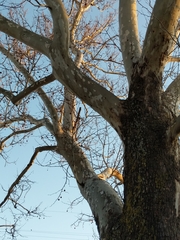
American sycamore (Platanus occidentalis) is a large deciduous tree in the Platanaceae family, native to the eastern and central United States. Its bark peels in broad, irregular plates to reveal a creamy white surface, while its round fruits hang singly on long stalks.
Read moreAmerican sycamore, Sycamore, Western plane, Occidental plane, American planetree and Buttonwood


© photo
no rights reserved, uploaded by Andy Wilson · cc0
Carrie Seltzer · cc0
James Davies · cc0
Taken Aug 10, 2022 by Francisco Javier Inserte (cc-by-sa)
Taken May 23, 2020 by Aaron Harp (cc-by-sa)
Taken Feb 12, 2021 by Eli Small (cc-by-sa)
Taken Jan 7, 2020 by Koen Martens (cc-by-sa)
Taken Jul 13, 2019 by Castillo DrG (cc-by-sa)
© copyright of the Board of Trustees of the Royal Botanic Gardens, Kew.




Global distribution
Platanus occidentalis is native to the eastern and central United States, some mountains of northeastern Mexico, and the southernmost parts of Ontario and Quebec. Introduced to Europe in the 17th century, it has largely been replaced in cities by the London plane hybrid, which tolerates pollution and anthracnose better.
- Native3
- Introduced2
- United States
- Mexico
- Canada
- Argentina
- Australia
Hexagons: regions where the plant occurs. Green dots: native range.1
Identity
American sycamore (Platanus occidentalis L., 1753) is a large deciduous tree in the Platanaceae family. Linnaeus described it in the same publication as its European relative, Platanus orientalis. The epithet occidentalis, meaning western, distinguishes the American species geographically from the tree native to southeastern Europe and western Asia. 1 7
North Americans generally shorten the name to sycamore. In Britain, that word usually means an entirely different tree, sycamore maple. French usage follows the maple meaning too. The same everyday name can therefore refer to unrelated trees on opposite sides of the Atlantic, making the scientific name particularly useful. 4
Another name, buttonwood, describes the small buttonlike fruit balls. Brokers signed the Buttonwood Agreement beneath a tree on Wall Street in 1792, laying the foundations of the future New York Stock Exchange. The historical name remains closely associated with the tree and that agreement. 3
Recognition
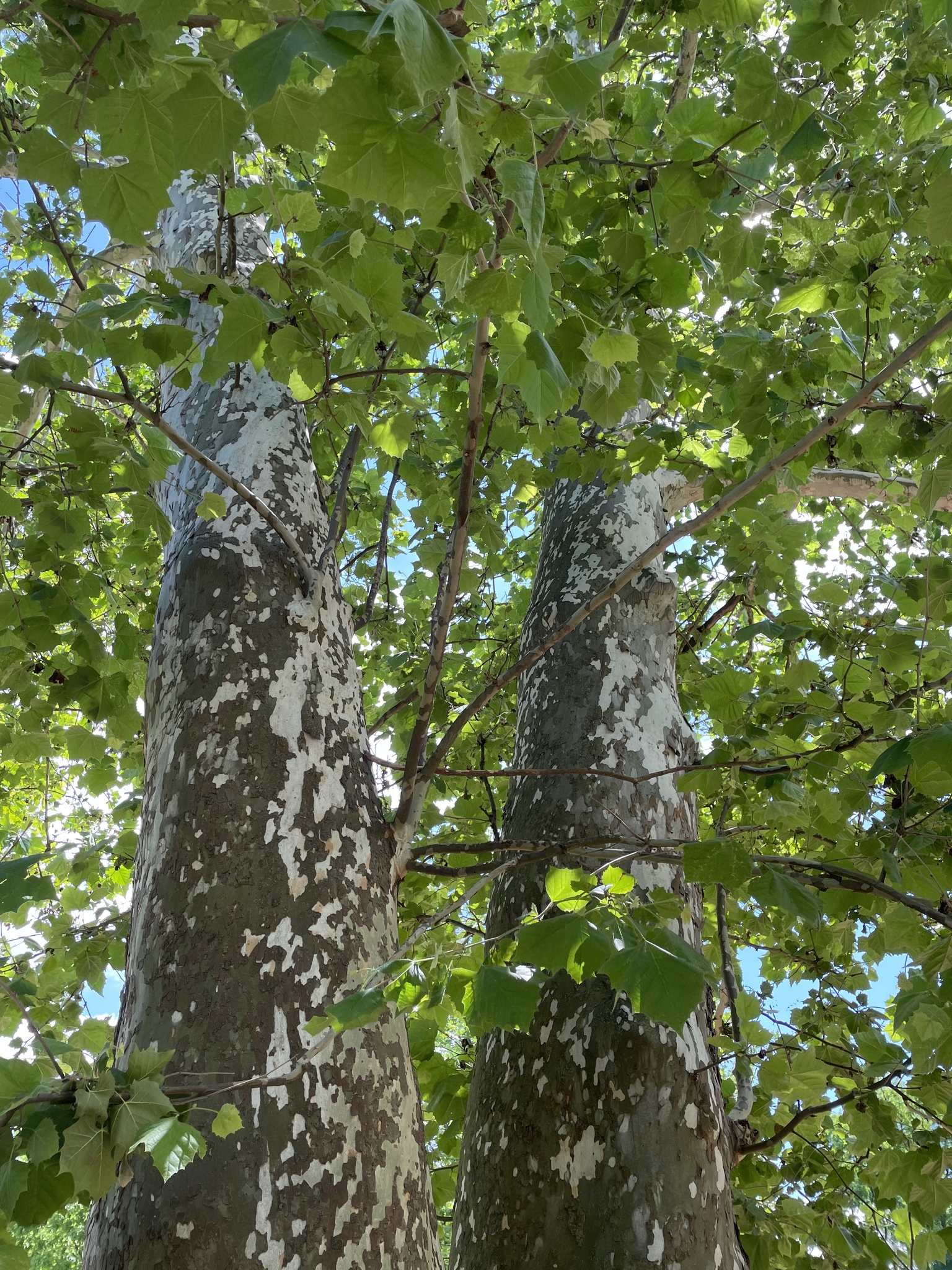
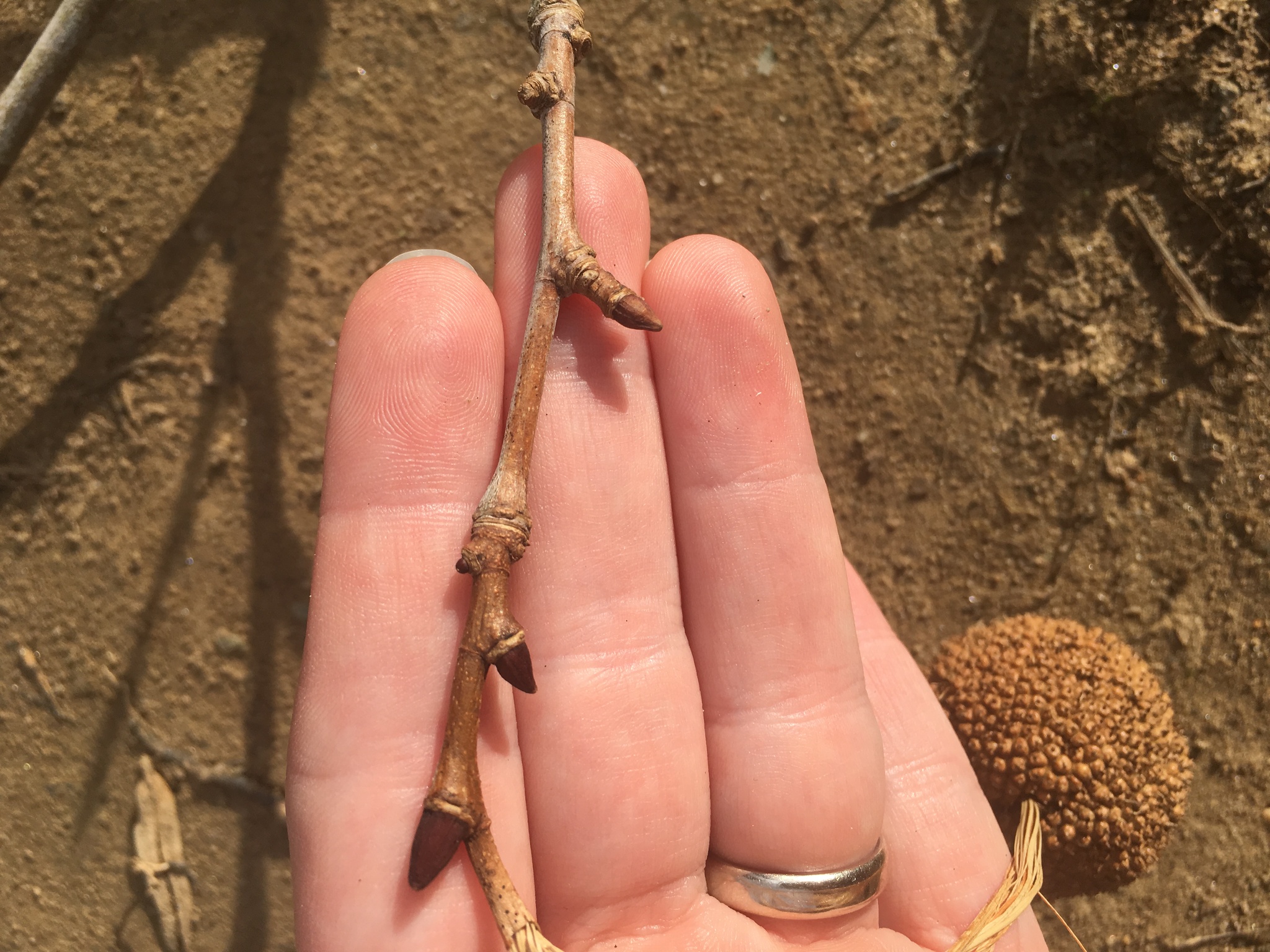
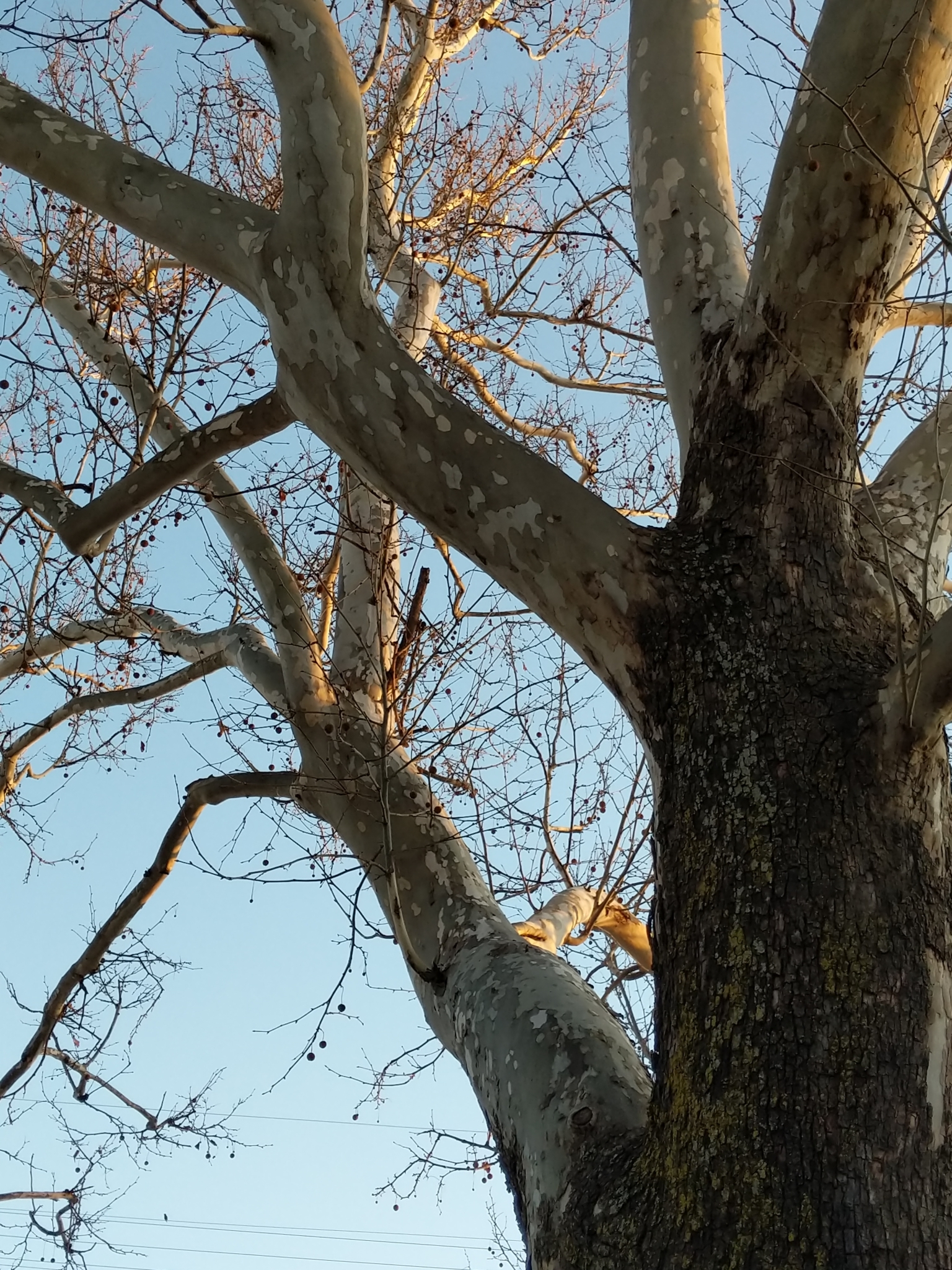
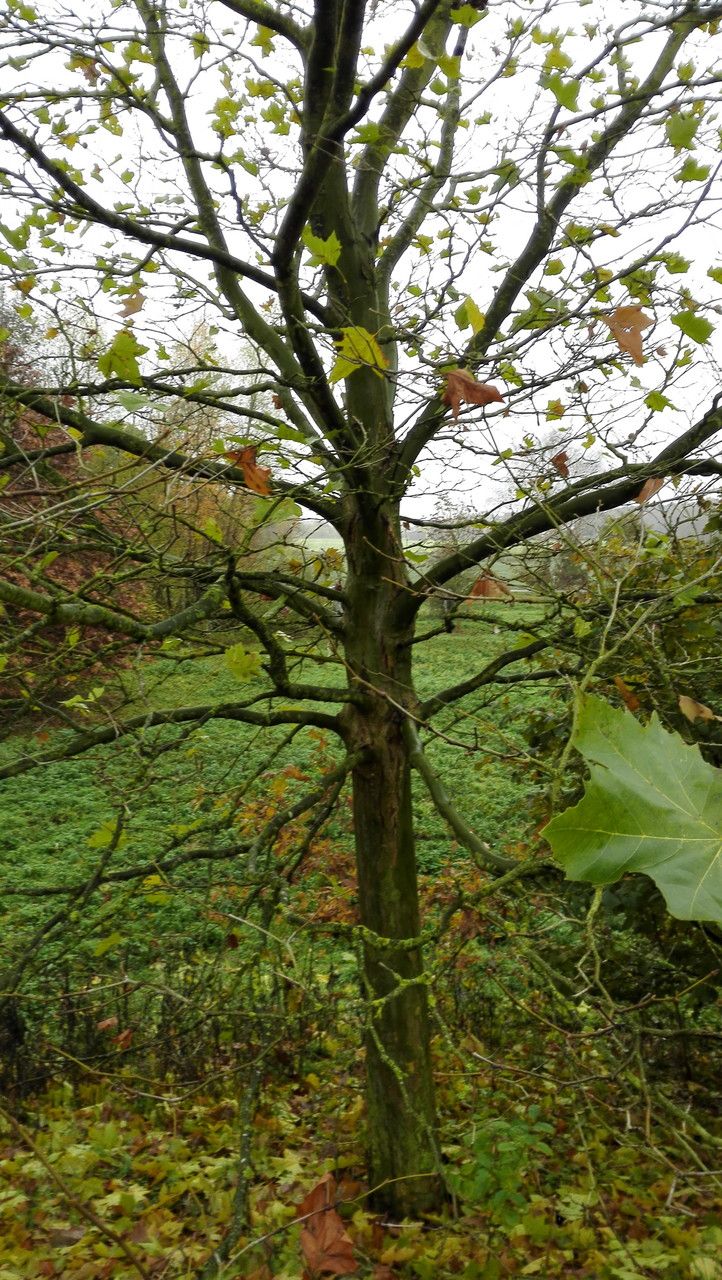
Large patches of mottled, peeling bark often reveal American sycamore before its leaves or fruit are examined. Thin, irregular plates detach to expose a creamy white to gray-green surface. The contrasting patches remain visible at a distance throughout the year, including when the branches are bare. 4 3
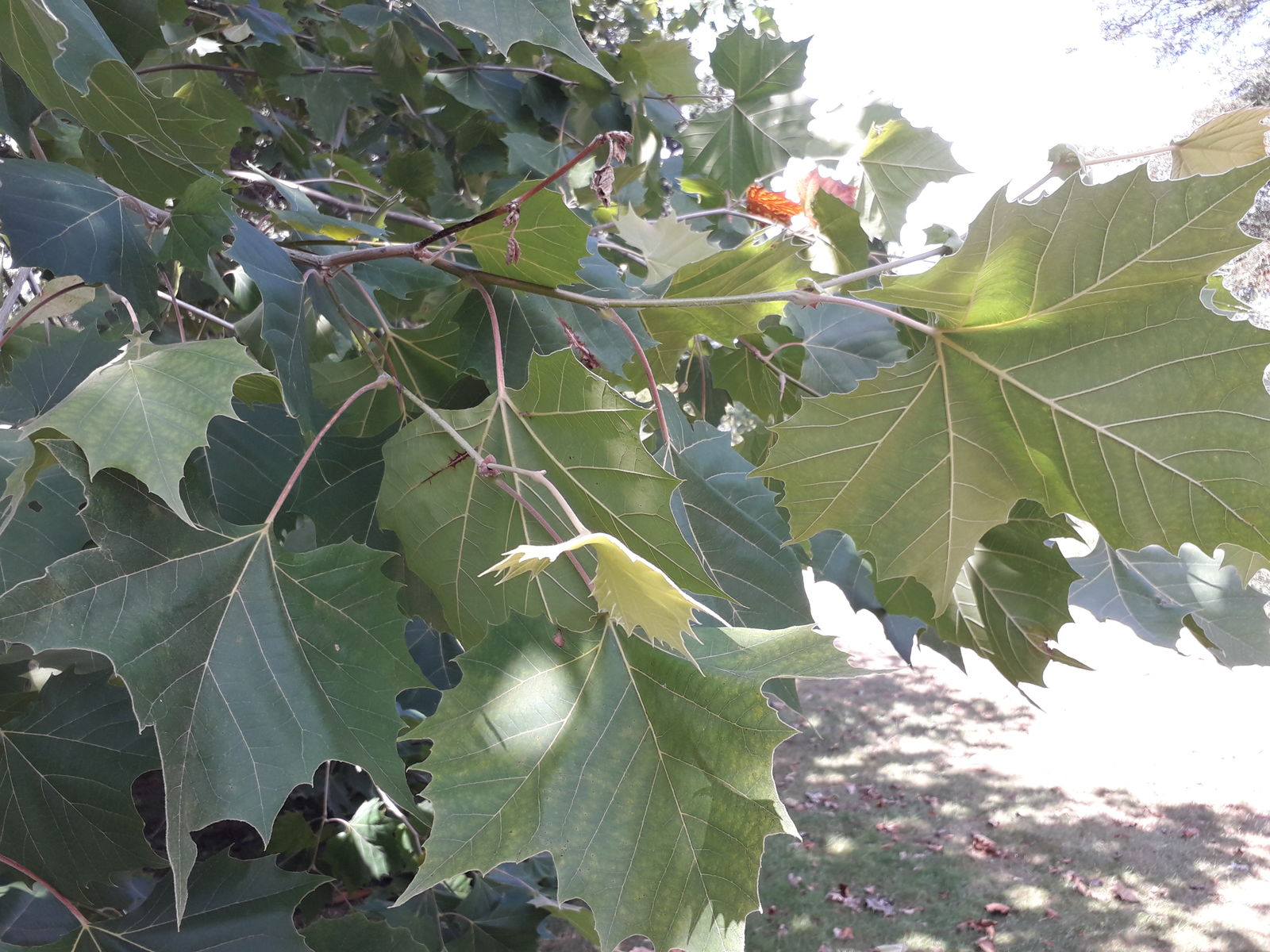
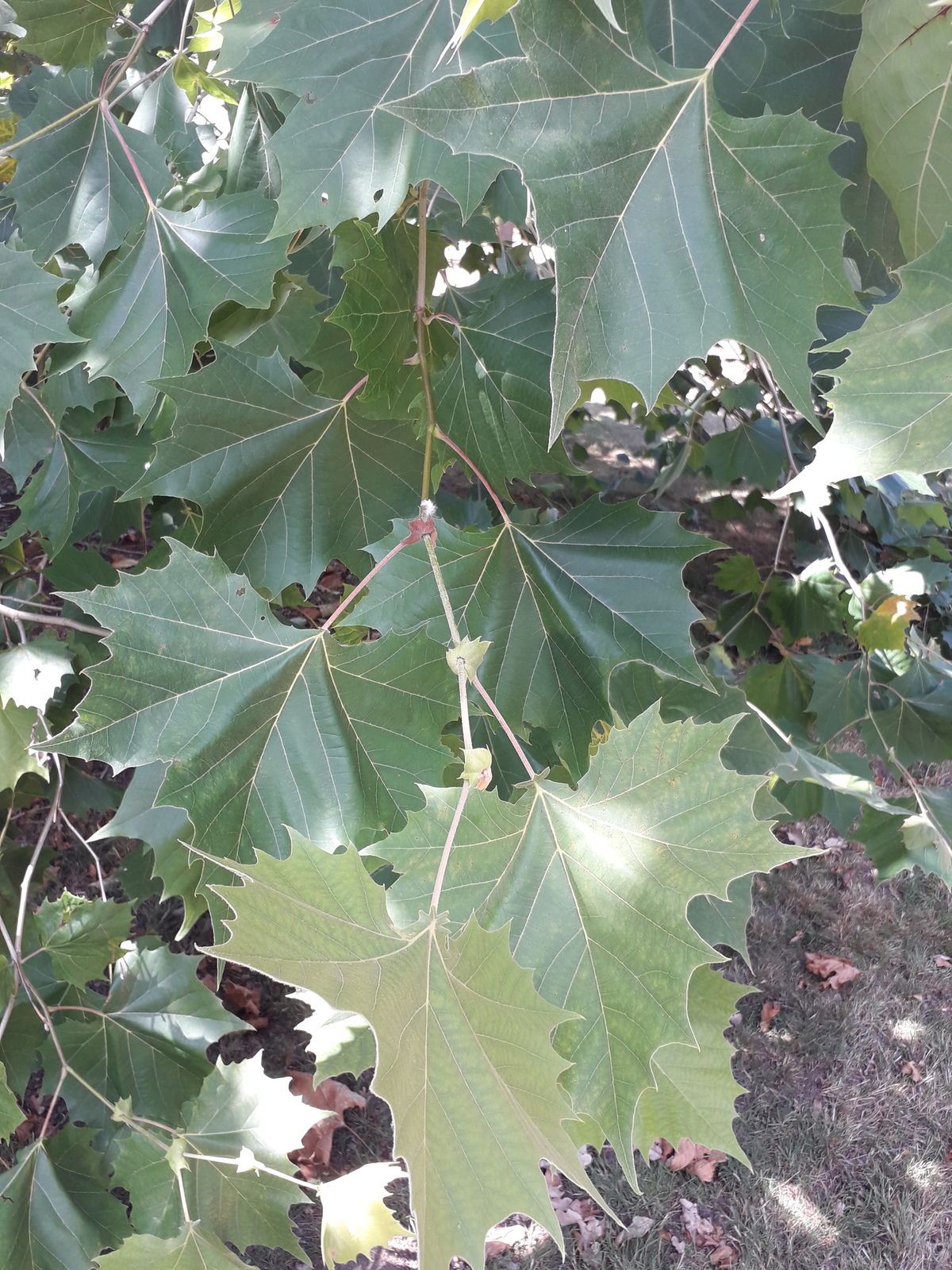
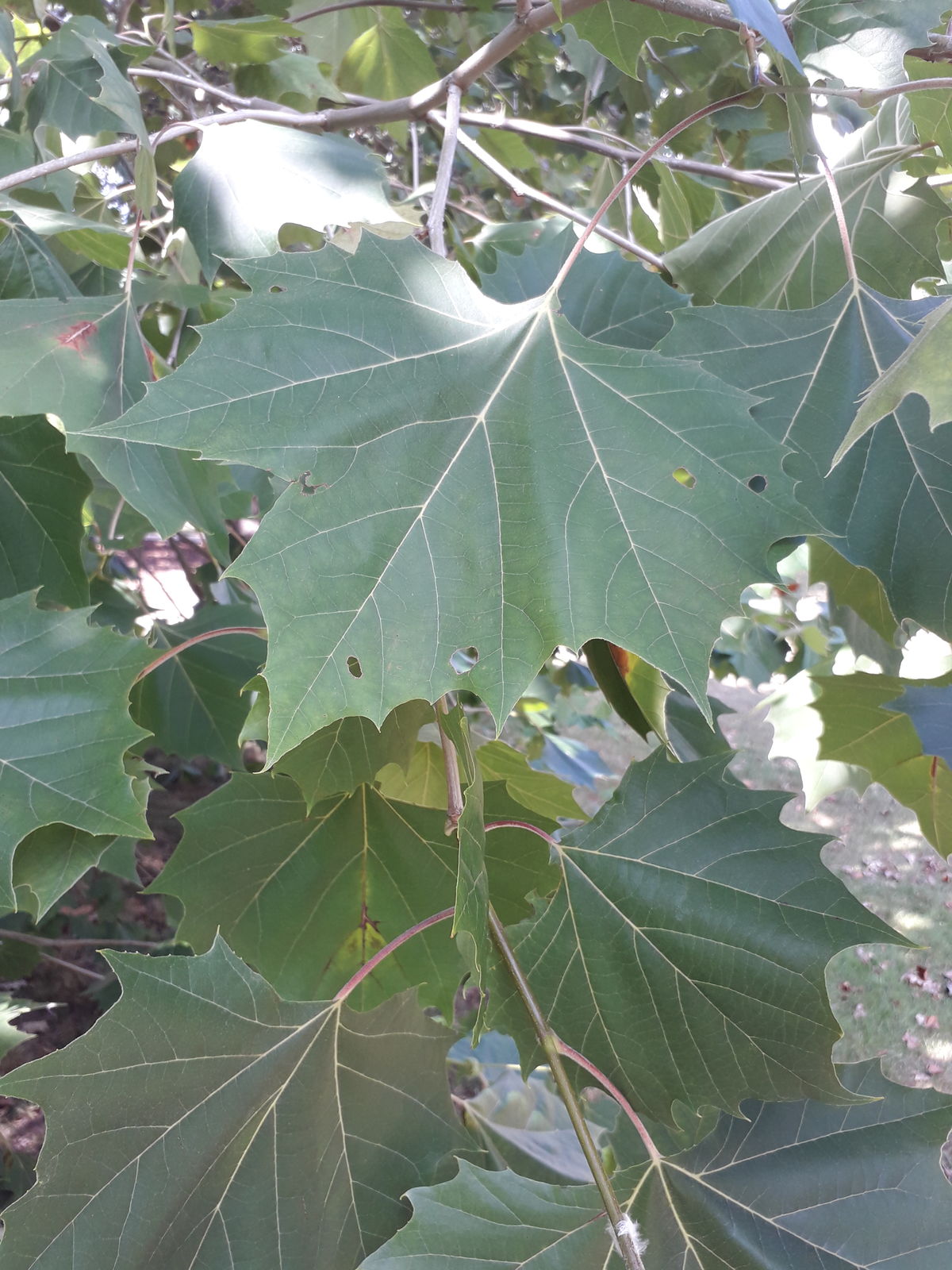
A mature tree commonly reaches 25–35 m (82–115 ft), with a trunk more than 1 m (3.3 ft) across in older specimens. The large, alternate leaves have three or five shallow palmate lobes. Their alternate arrangement immediately helps separate the tree from sycamore maple, whose leaves grow in opposite pairs. 2 3
Small spring flower heads are yellowish in male flowers and reddish in female flowers; both occur on the same tree. The resulting brown, fuzzy fruit ball measures about 2.5–3 cm (1–1.2 in) and hangs singly on a long stalk. This feature helps distinguish American sycamore from Platanus × hispanica, the hybrid widely planted in French streets and parks. 2 4
Useful taxonomy
The accepted name remains Platanus occidentalis L., a species in the family Platanaceae. Several historical varieties now fall within the species itself. Their practical value lies in recognizing older names for the same tree rather than treating them as separate species.
- Platanus occidentalis var. glabrata (Fernald) Sarg., a historical variety now included in the species;
- Platanus occidentalis var. lindeniana (M.Martens & Galeotti) Jaennicke, another historical variety;
- Platanus orientalis var. occidentalis (L.) Kuntze, an older combination;
- Platanus vulgaris proles occidentalis (L.) Cadevall, a historical taxonomic placement.
For identifying planted planes, the hybrid Platanus × hispanica, or London plane, matters more than these synonyms. It arose from Platanus occidentalis and Platanus orientalis. In France, most planes lining streets and canals belong to this hybrid rather than to the American species. 1 4
Habitat and range
The native range of Platanus occidentalis covers the eastern and central United States and mountains of northeastern Mexico, reaching southern Ontario and Quebec at its northern limit. It grows mainly in riverside forests, on stream banks and in floodplains. NC State lists its hardiness range beginning in USDA zone 4. 8 2 9 10
The tree tolerates temporary flooding, but it can die if the entire tree remains submerged for more than two weeks during the growing season. As a floodplain pioneer, it can establish on moist deposits left by floods before other trees become established. 8
European cultivation began in the 17th century. In cities, the species has since largely given way to its hybrid, which better tolerates pollution and anthracnose. The IUCN lists American sycamore as Least Concern, consistent with a native range that remains extensive and relatively little fragmented. 6
Life cycle and reproduction
Flowers open in spring as leaves emerge, with wind transferring pollen between male and female heads on the same tree. By fall, the fruit forms a ball of achenes bearing long hairs. The ball gradually breaks apart through winter, releasing its seeds over time rather than shedding them all at once. 2 3
Each achene retains a tiny style about 1 mm (0.04 in) long in Platanus occidentalis. The London plane hybrid has a much longer residual style, 5–7 mm (0.2–0.3 in). A hand lens makes the difference clear on fallen fruit, even when it would be impossible to judge from a distant fruit ball. 4
More than 200 years is a common lifespan, and exceptional trees may reach 500–600 years. Heartwood in old trunks decays readily, leaving large cavities. One hollow tree in Virginia even sheltered an entire family temporarily during the 18th century, illustrating the size these old trunks can attain. 4
Uses and risks
Shade and avenue planting are the main landscape uses, supported by rapid growth and striking bark. Maintenance is substantial because twigs, bark plates and fruit balls fall each year. The wood has also served historically for crates, butcher blocks and furniture, giving the tree practical uses beyond its ornamental role. 2 3
No chemical toxicity is documented: the ASPCA lists American sycamore as non-toxic to cats, dogs and horses. Fine hairs covering young leaves and fruit can nevertheless irritate skin, eyes or airways after prolonged contact. This is a physical irritation risk rather than poisoning. 5
Two serious diseases affect Platanus. Anthracnose causes early leaf browning in cool, wet springs, generally without threatening the tree's long-term survival. Canker stain is a severe disease regulated in France. There, affected urban plantings chiefly contain London plane and Oriental plane, with American sycamore much less represented at the known outbreak sites. 3
Varieties, look-alikes and related plants
Few named horticultural cultivars belong to the American species, unlike its hybrid. Davis is one of the rare recognized selections, valued for better field resistance to fungal trunk cankers. Its selection reflects disease resistance rather than a purely decorative difference in foliage or bark. 1
London plane, Platanus × hispanica, is the most frequent source of confusion in French city and canal plantings. Count the fruit balls on a stalk: usually one in American sycamore, often two in the hybrid. The residual style length on the individual fruits provides an additional, finer distinction. 4
Sycamore maple, Acer pseudoplatanus, creates a separate confusion through its English name. It is botanically unrelated to the plane trees. Leaf arrangement gives the quickest field check: alternate in American sycamore, opposite in the maple. This can settle the naming problem without waiting for fruit to mature.
Main sources
- Plants of the World Online / Kew, Platanus occidentalis L.
- Missouri Botanical Garden, Platanus occidentalis
- NC State Extension, Platanus occidentalis - American Sycamore
- Trees and Shrubs Online, Platanus occidentalis
- ASPCA, Platanus occidentalis toxicity entry
- IUCN Red List of Threatened Species, Platanus occidentalis assessment
- INPN / MNHN–OFB, Platanus occidentalis L., CD_NOM 717428: original species notice, archived 26 November 2024
- USDA Forest Service, Janet Sullivan (1994), Fire Effects Information System: Platanus occidentalis, American sycamore
- Government of Quebec, Platane occidental (Platanus occidentalis)
- NC State Extension, Platanus occidentalis — USDA hardiness range
Frequently asked questions
Is American sycamore toxic to cats and dogs?
No. The ASPCA lists Platanus occidentalis as non-toxic to cats, dogs and horses. Fine hairs on its fruit and young leaves can still irritate skin, eyes or airways on contact.
How can I distinguish American sycamore from London plane?
Many planes planted in European cities are London plane hybrids. Fruit is the most useful guide: Platanus occidentalis normally has one ball per stalk, while the hybrid often has two, with much longer residual styles on the individual fruits.
Why does sycamore bark peel off in plates?
The outer bark is more rigid and brittle than the growing wood beneath it. Unable to stretch as quickly as the trunk expands, it cracks and flakes off in irregular plates, exposing a younger, paler surface.
Are American sycamore and sycamore maple the same tree?
No. In North American English, sycamore usually means Platanus occidentalis. In Britain and in French usage, the corresponding name generally refers to Acer pseudoplatanus, a maple with opposite leaves in a different botanical family.
Is American sycamore invasive?
It is not classified as invasive in France. It has naturalized locally outside its native range, including in Argentina and Australia, without being regarded there as a documented ecological threat.
How long does an American sycamore live?
The species commonly lives more than 200 years, with exceptional trees reaching 500–600 years under favorable conditions. Old hollow trunks have even provided temporary shelter, as documented in 18th-century Virginia.
Can American sycamore get canker stain?
Platanus is susceptible to this serious fungal disease, which is regulated in France. Known affected plantings there mainly contain London plane and Oriental plane; American sycamore is much less represented in those sites.
Similar plants
If you are unsure about a plant’s toxicity, ask a botanist or veterinarian for advice.