
Greater celandine (Chelidonium majus, )
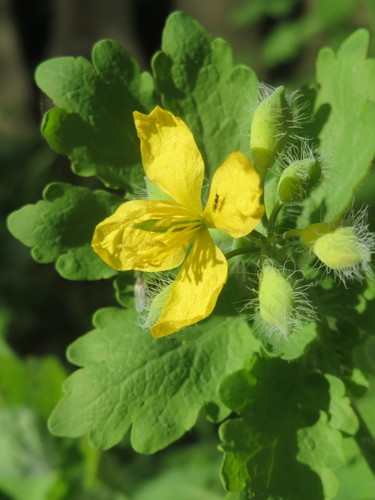
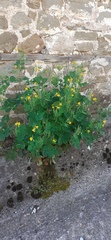
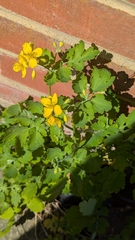
Greater celandine (Chelidonium majus) is a herbaceous perennial in the Papaveraceae, native to Europe, North Africa and western Asia. Colonies grow on disturbed ground beside hedges, walls and banks. Orange latex, released as soon as a stem breaks, is its most conspicuous identifying feature.
Read moreGreater celandine and Celandine
Place in indirect light or in a shaded room.
Partial to light shade
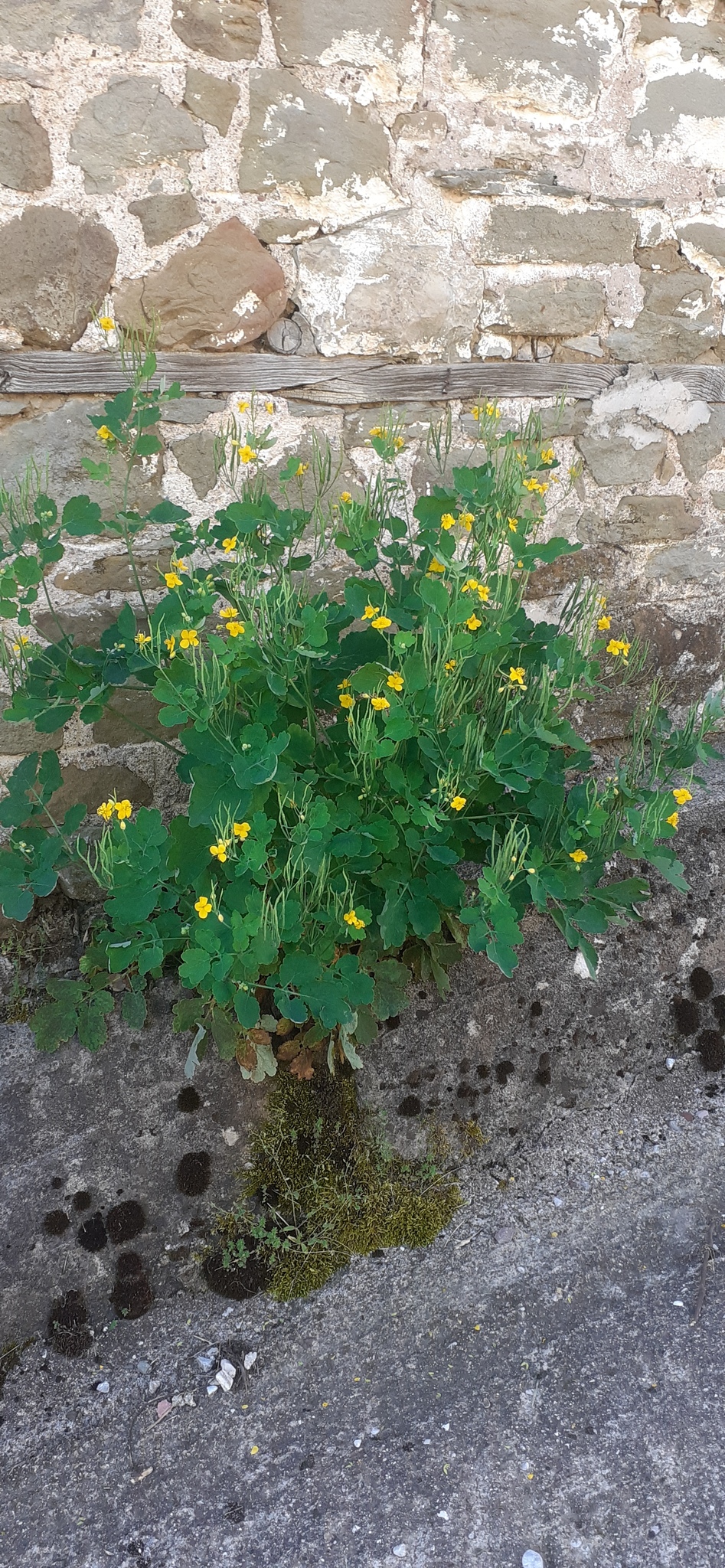


© photo
(c) Andreas Rockstein, some rights reserved (CC BY-SA) · cc-by-sa
Sarah Faulwetter · cc0
Piermario Maculan · cc0
Taken Aug 10, 2022 by Andrzej Konstantynowicz (cc-by-sa)
Taken Mar 24, 2020 by Marie-Claude Deboin (cc-by-sa)
Taken Mar 31, 2022 by Llandrich anna (cc-by-sa)
© copyright of the Board of Trustees of the Royal Botanic Gardens, Kew.




Global distribution
The native range spans Europe, North Africa and western Asia to western Siberia and northern Iran, with populations in Macaronesia. Widely introduced to North America, it has naturalized and is classed as a weed in several Midwestern states.
- Native6
- Introduced1
- Invasive1
- France
- Germany
- United Kingdom
- Russia
- Iran
- Portugal
- Canada
- United States
Hexagons: regions where the plant occurs. Green dots: native range.1
Identity
Greater celandine (Chelidonium majus L., 1753), also called celandine, is a herbaceous perennial in the poppy family, Papaveraceae, and the only widespread European species of Chelidonium. Its genus name comes from the ancient Greek khelidôn, swallow: according to an old belief, flowering coincided with the bird's spring arrival. 6 1
The French name éclaire reflects a later legend that swallows used the plant's latex to treat their nestlings' eyes, supposedly clearing their sight. This is a story about a name, distinct from its documented use. Another French name, herbe aux verrues, describes that use directly: applying latex to the skin to treat warts. 8 5
Recognition
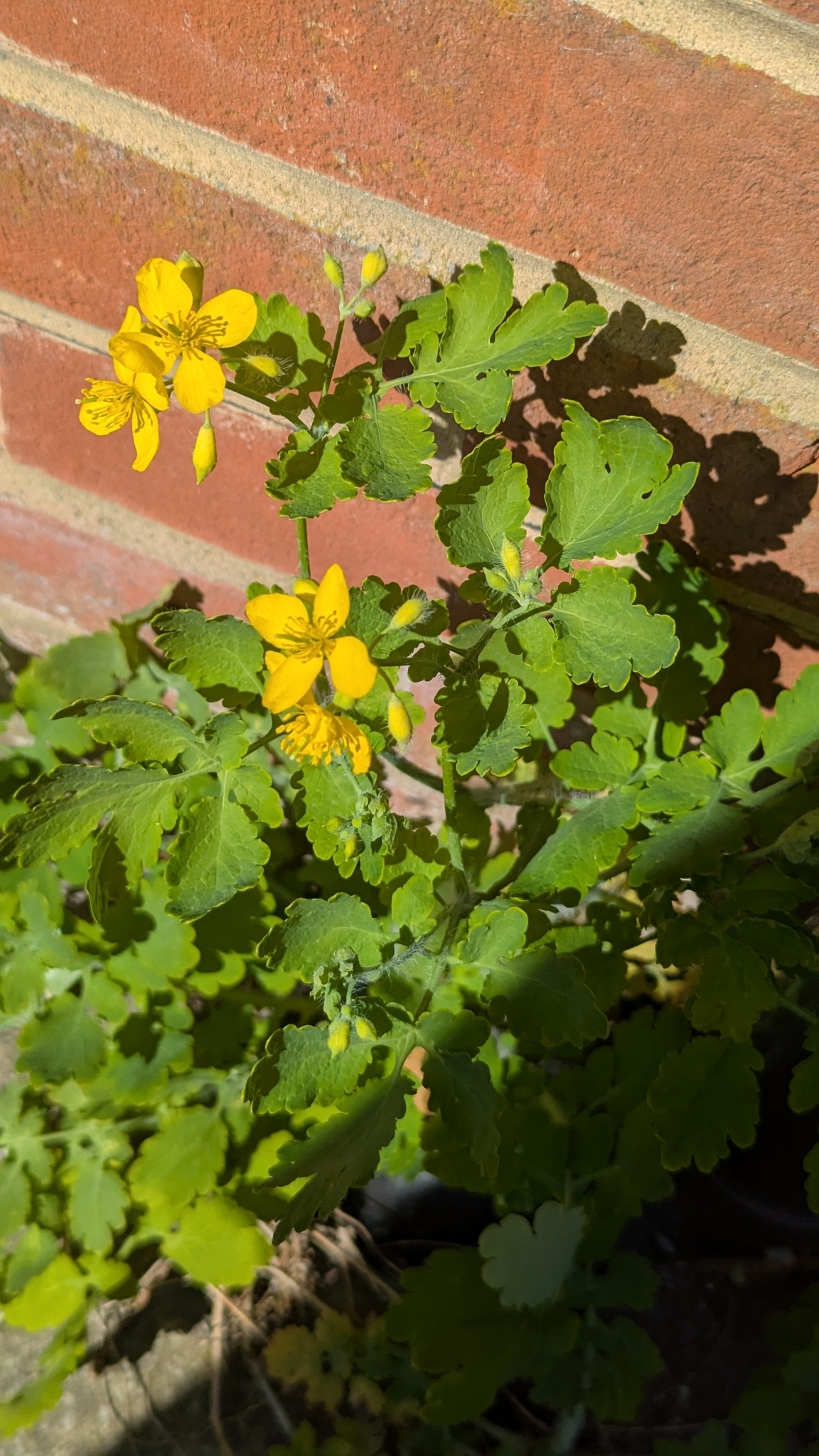
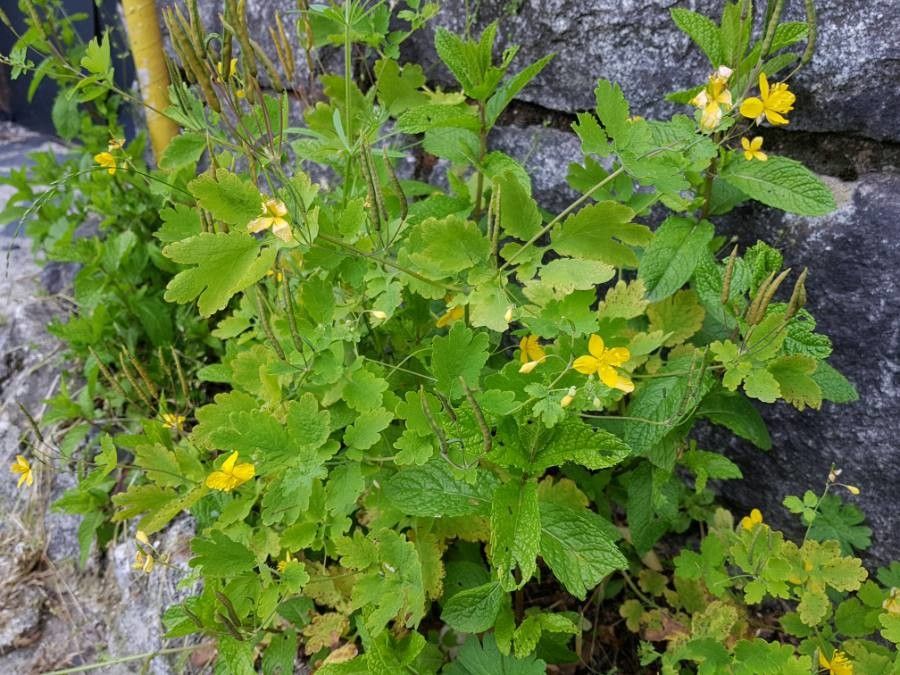
A broken stem or leaf immediately releases orange to bright yellow latex. This is a reliable identifying feature, including against lesser celandine (Ficaria verna), the main look-alike, which produces none. The pinnate, blue-green leaves have lobed leaflets with wavy edges and form a basal rosette before the flowering stems appear. 6 4
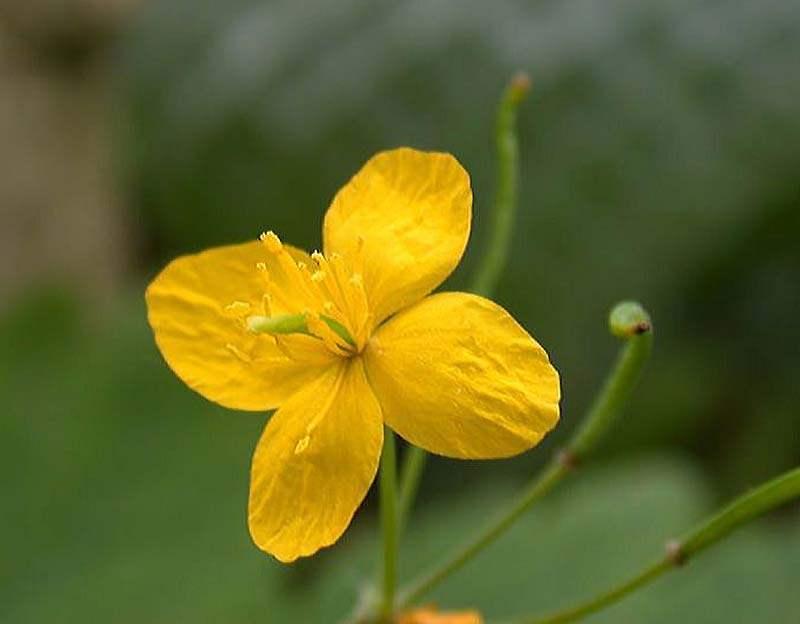
Upright, branching, brittle and slightly hairy stems generally reach 30–60 cm (12–24 in), or 100–120 cm (3.3–4 ft) in moist shade, where the internodes lengthen toward the light. Flowers 1.5–2.5 cm (0.6–1 in) across have four yellow petals and appear in small terminal umbels of two to six flowers, from late spring through summer in the Northern Hemisphere accounts. 4 3
Each flower is followed by a slender, elongated capsule, a dry poppy-family fruit that splits when ripe to release black seeds. A plant with no visible latex, or with five-petalled flowers, is not Chelidonium majus: its flowers always have four petals. 6
Useful taxonomy
Chelidonium majus L., published in Species Plantarum in 1753, remains the accepted name. Besides the typical subspecies, a distinct larger-flowered subspecies is recognized:
- Chelidonium majus subsp. majus, the typical form, ranging from Macaronesia to Iran
- Chelidonium majus subsp. grandiflorum (DC.) Printz, from Siberia, China and Korea, with larger flowers
- Chelidonium majus var. laciniatum (Mill.) Arcang., a fringed-leaved form underlying the horticultural cultivar Laciniatum
The horticultural forms Laciniatum and Flore Pleno are mainly traded under these names; the latter has no separate botanical-variety status. 1 2
Habitat and range
Native populations extend across Europe, North Africa and western Asia to western Siberia and northern Iran, with relict populations in Macaronesia. Native throughout mainland France, greater celandine remains common there and is not a conservation concern. 1 2
Disturbed, moist ground close to human habitation suits this plant, especially in partial shade: rubble, banks, hedges, wall bases and pathsides. Introduced to North America, it occupies similar disturbed soils and has become sufficiently naturalized to be classed as a weed in several Midwestern states, including Wisconsin and Michigan. 5 4
Life cycle and reproduction
Flowering lasts from late spring through summer in its Northern Hemisphere range, sometimes continuing until the first frosts in mild climates. A wide range of generalist insects visit for pollen. The slender capsules contain black seeds about 2 mm (0.08 in) long, each bearing a white, fleshy elaiosome. 3 7
Ants collect seeds for their elaiosomes, carry them to the nest, eat the appendage and discard the intact seed nearby. This dispersal mechanism, myrmecochory, accounts for the patches of plants often found along hedges. 7
Abundant self-seeding on disturbed soil readily sustains spontaneous reproduction. Clumps can also be divided in spring, although cutting them causes copious latex bleeding. 5
Uses and risks
Orange latex has a long history in folk medicine as an external treatment for skin warts, a use still documented today, and for eye conditions, an application now discouraged. Celandine preparations also occur in some modern herbal formulations for digestive complaints. 5 6
The whole plant contains numerous isoquinoline alkaloids, including coptisine, chelidonine and sanguinarine, concentrated particularly in the latex and rhizome. Sap contact irritates skin and eyes and sometimes causes allergic reactions. Even moderate ingestion can cause digestive problems, while liver toxicity has been documented in several clinical cases involving celandine preparations. 6 4
In cats and dogs, accidental ingestion of latex or foliage causes the same digestive problems as in humans. As a precaution, fresh plants should be kept away from children and pets; uncontrolled internal use is discouraged. 4
Varieties, look-alikes and related plants
Laciniatum, with deeply fringed leaves, and Flore Pleno, with double golden-yellow flowers, are grown in shady beds, prolonging summer flowering where few plants bloom on poor soil. Neither changes the toxicity or ecology of the typical species. 1 2
The most frequent and misleading confusion is with lesser celandine, Ficaria verna, which belongs to a completely different family, Ranunculaceae. Despite sharing the name celandine, the two plants differ in their pinnate foliage, orange latex and toxicity. 6
In North America, greater celandine can also be confused with Stylophorum diphyllum, a native poppy-family plant with superficially similar foliage and yellow latex, but larger flowers and a hairy capsule. Common names alone cannot distinguish these three plants; their full scientific names do so unambiguously. 4
Main sources
- Plants of the World Online / Kew, Chelidonium majus L.
- Tela Botanica / eFlore BDTFX, Chelidonium majus
- Missouri Botanical Garden, PlantFinder Chelidonium majus
- NC State Extension, Chelidonium majus - Greater Celandine
- Plants For A Future, Chelidonium majus
- Wikipedia (en), Chelidonium majus
- PMC, Transcriptome analysis of Chelidonium majus elaiosomes and seeds
- LPO, Grande Chélidoine
Frequently asked questions
Is greater celandine latex dangerous?
Yes, both on contact and if swallowed. The orange latex irritates skin and eyes, and the whole plant contains poisonous isoquinoline alkaloids, with a documented risk of liver injury after ingestion.
Why is greater celandine called éclaire in French?
The name reflects a folk belief that swallows used the plant's latex to treat their nestlings' eyes. Traditional use in the eyes is no longer recommended.
Can greater celandine be confused with lesser celandine?
The name celandine is used for both Chelidonium majus and Ficaria verna, lesser celandine. These unrelated plants belong to different botanical families, Papaveraceae and Ranunculaceae respectively.
How are greater celandine seeds dispersed?
Each black seed has a white, fleshy elaiosome that ants carry to their nest. They eat the appendage and discard the intact seed nearby, encouraging patchy colonies.
Is greater celandine invasive?
In France, where it is native, it remains a common ruderal plant without invasive status. Introduced to North America, it has naturalized sufficiently to be classed as a weed in several Midwestern states.
Are there garden forms of greater celandine?
Yes. Laciniatum, with deeply fringed leaves, and double-flowered Flore Pleno are grown in shady beds. Neither is a separate species from the wild form.
Similar plants

If you are unsure about a plant’s toxicity, ask a botanist or veterinarian for advice.