
Bull thistle (Cirsium vulgare, )
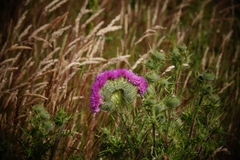
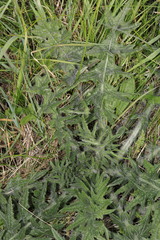
Bull thistle (Cirsium vulgare (Savi) Ten., 1836) is a biennial in the Asteraceae, native to temperate Europe, western Asia and northwestern Africa, and now naturalized on almost every continent. Its upright stems have continuous spiny wings and a solitary pink-purple head. A single fleshy taproot replaces the creeping root system of its close relative Cirsium arvense.
Read moreBull thistle and Spear thistle
Place in full sun, with intense direct light all day long.
Full sun; dense shade strongly inhibits establishment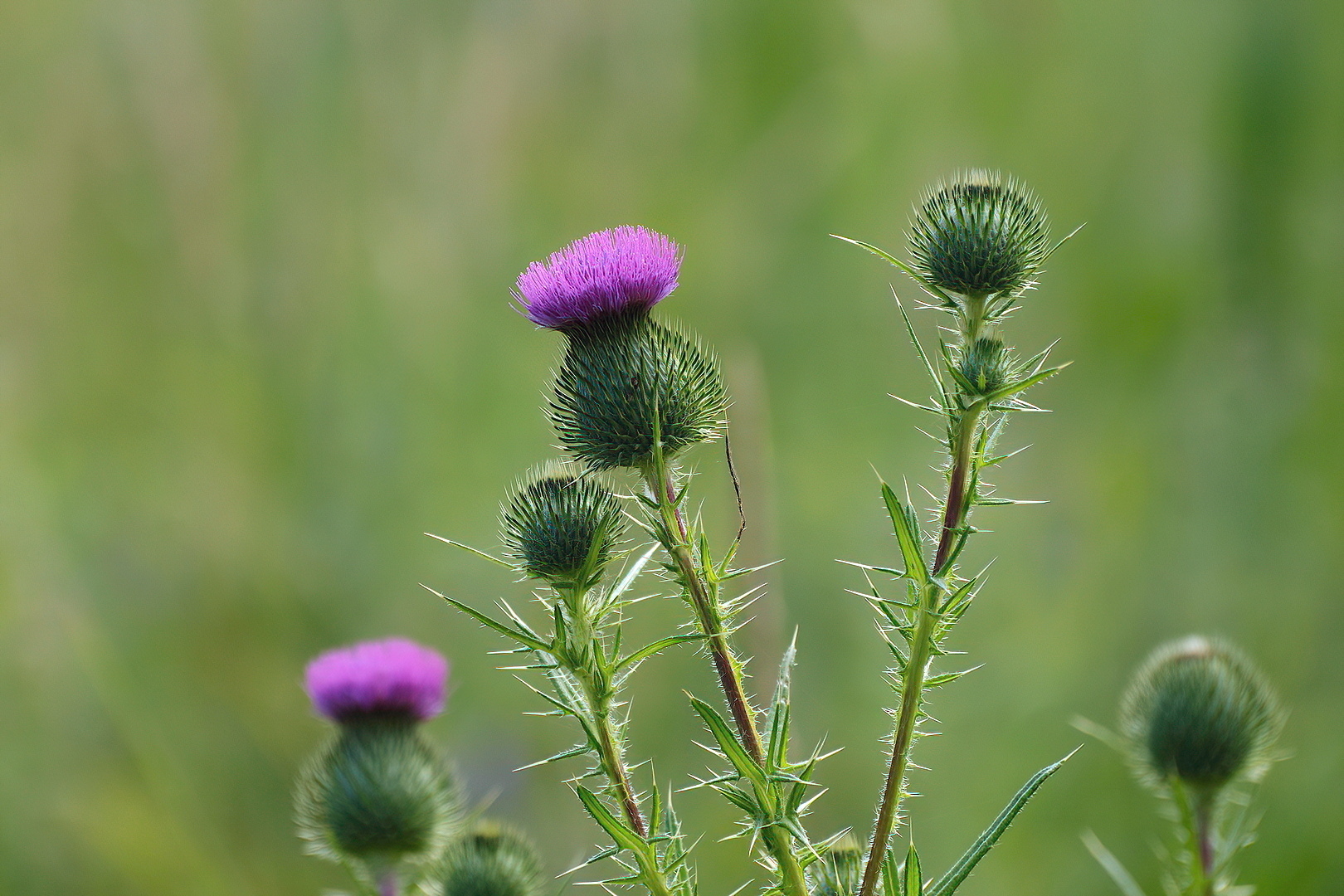
© photo
(c) Sabine Atteln, some rights reserved (CC BY-NC), uploaded by Sabine Atteln · cc-by-nc
Margit Kildevang · cc0
Stephen James McWilliam · cc0
no rights reserved · cc0
(c) Tom Norton, some rights reserved (CC BY) · cc-by
Global distribution
The WCVP places the native range of Cirsium vulgare in temperate Europe east to Siberia, western Asia and northwestern Africa, including mainland France. Introduced from Europe, it is now North America's most widespread pasture weed, a noxious weed in Australia and a localized invasive species in New Caledonia.
- Native5
- Introduced3
- Invasive2
- Metropolitan France
- United Kingdom
- Spain
- Iran
- Russia
- United States
- Canada
- South Africa
- Australia
- New Caledonia
Hexagons: regions where the plant occurs. Green dots: native range.1
Identity
Bull thistle (Cirsium vulgare (Savi) Ten., 1836) is a biennial in the genus Cirsium, family Asteraceae. The genus takes its name from the Greek kirsos, a varicose vein, recalling historical medicinal use of the roots of several thistles for venous complaints. 4 1
The Latin epithet vulgare simply means common. The Italian naturalist Gaetano Savi first described the plant in 1798 as Carduus vulgaris. Michele Tenore transferred it to Cirsium in 1836, producing the name now accepted by the WCVP. 1
The English names spear thistle and bull thistle refer respectively to its sharply pointed leaves and imposing stature among British thistles. The continuous spiny wings along its stem distinguish it from creeping thistle, whose stem is unwinged; this single feature is usually enough to tell them apart. 3
Recognition
According to the INPN, Cirsium vulgare commonly reaches 30 cm–2.5 m (1–8 ft) tall. A single fleshy taproot may descend 70 cm (28 in), without the horizontal creeping root network of Cirsium arvense. 2 6
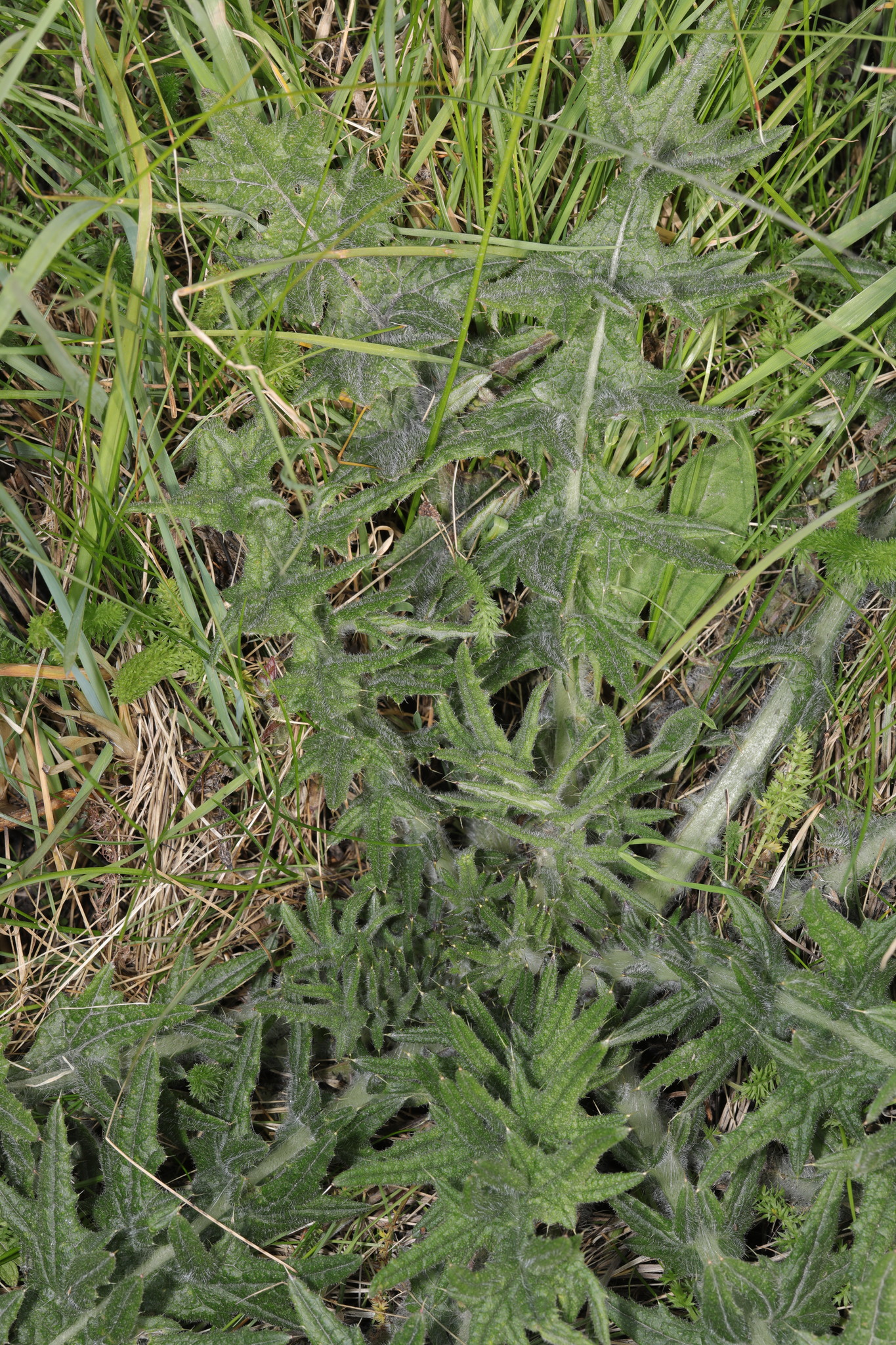
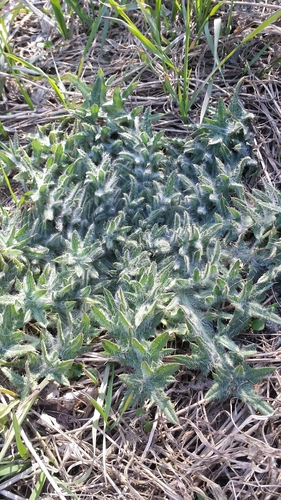
Leaves are dark green and rough above, white and woolly beneath, with rigidly spined lobes; basal leaves can exceed 20 cm (8 in) long. Their bases run down the stem to form continuous spiny wings along its entire height, the most reliable recognition feature. 5 3
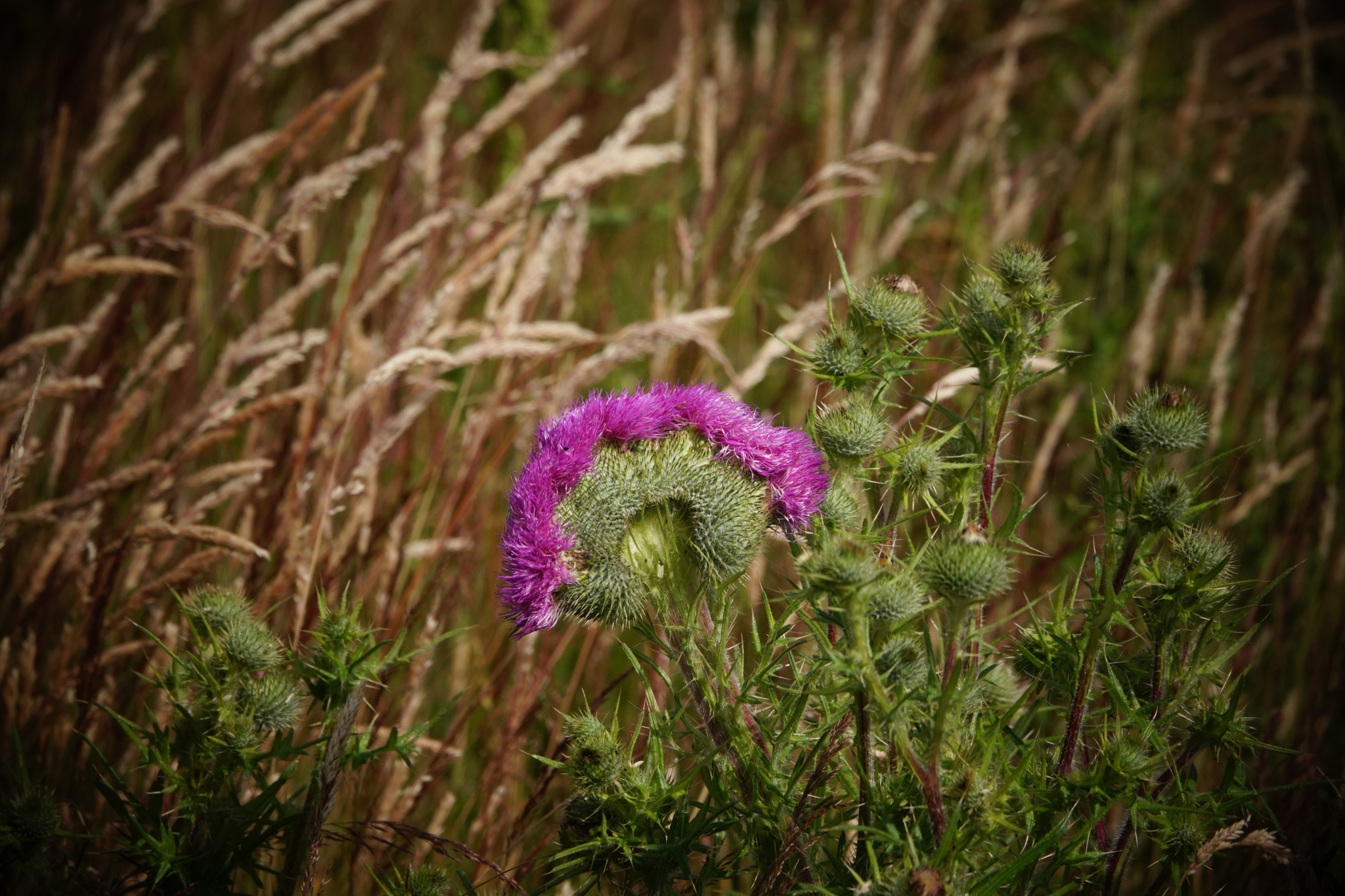
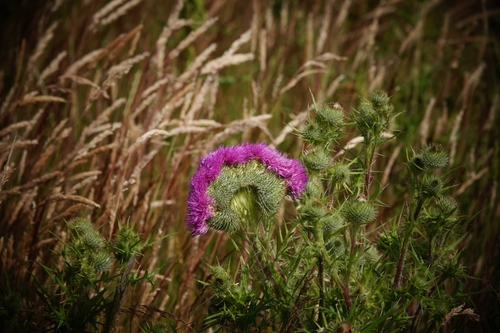
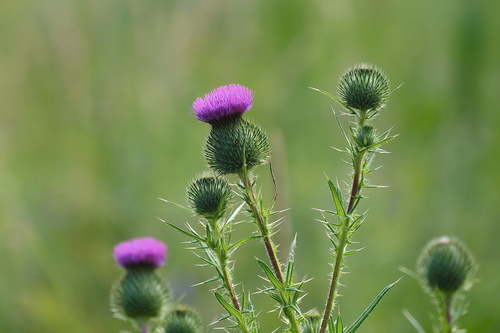
A solitary head tops each stem, measuring 2.5–5 cm (1–2 in) across. It is ovoid to globose, with involucral bracts ending in spines. Flowers are pink-purple, rarely white. Flowering runs from late spring into early autumn, peaking in summer in the cited temperate accounts. 2 8
Useful taxonomy
The combination Cirsium vulgare (Savi) Ten., accepted by Plants of the World Online, resulted from a change of genus: Gaetano Savi first described it as Carduus vulgaris in 1798, and Michele Tenore transferred it to Cirsium in 1836. 1
Several names appear in its botanical synonymy and are useful when identifying a plant or consulting an older flora:
- Carduus vulgaris Savi, the basionym published in 1798
- Cirsium lanceolatum (L.) Scop., an illegitimate name long used in European floras
- Cirsium lanceolatum var. vulgare Nägeli ex W.D.J.Koch
- Cirsium eriophorum subsp. vulgare Petr.
- Cirsium vulgare subsp. crinitum (Boiss. ex DC.) Arènes, a western and central Mediterranean subspecies
The genus Cirsium contains more than 200 species, several sharing bull thistle's disturbed habitats without being the same plant. A scientific name is more reliable than the shape or color of a plant, both of which vary considerably with growing conditions. 1
Habitat and range
The WCVP places its native range in temperate Europe east to Siberia, western Asia and northwestern Africa, including mainland France. There it is a common nitrogen-loving plant of moderately moist pastures, meadows, waste ground and woodland edges. 1 2
It has also been widely introduced beyond its native range, notably to North America, where it is now the most widespread pasture weed, and to South Africa and Australia, where it is treated as a noxious weed. 6 8
In New Caledonia, bull thistle arrived accidentally in imported fodder in 1969. It has since behaved as a localized invasive plant on the west coast, a situation distinct from its native presence in France. 8
Life cycle and reproduction
The life cycle is biennial and strictly monocarpic. Seed germinates in spring or autumn at 10–30 °C (50–86 °F), forming a first-year leaf rosette and a deep taproot. 6 4
After overwintering as a rosette, the plant produces a winged stem the following spring that can exceed 2 m (6.5 ft). It flowers from late spring into early autumn in the cited temperate accounts. One plant may bear from one to more than 400 heads, each with 100–300 or more seeds, of which 60–90% may be viable. 6
Each achene has an easily detached feathery pappus and disperses by wind, water, mud or animal fur. The plant then dies, unlike the perennial creeping thistle, whose roots continue to spread. 6 5
Uses and risks
PFAF records several historical food uses: the peeled taproot, with a flavor resembling Jerusalem artichoke, and young flowering stems cooked as vegetables. The receptacle, prepared like an artichoke heart, is also edible. These uses do not amount to intentional cultivation. 4
No ingestion toxicity is documented in humans or domestic animals. The principal risk is mechanical: rigid spines on stems, leaves and bracts irritate skin, mouths and livestock muzzles. Grazing animals avoid the plant, giving it an advantage in overgrazed pastures where competitors have been removed. 5 7
Bull thistle is a major nectar source, ranking sixth among British plants for nectar production and third for sugar production per floral unit. Bees and butterflies visit its heads, while goldfinches eat the oily seeds and use the pappus in their nests. 8
Control and look-alikes
In managed pastures and meadows, mowing or pulling before the heads open remains the most effective intervention, before seed blows away. The gall fly Urophora stylata has also been introduced for biological control and can reduce seed production by up to 60%. 7
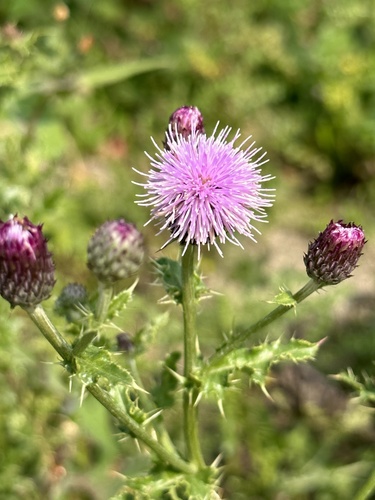
Creeping thistle (Cirsium arvense) is the main look-alike. Its stem is unwinged and unarmed, whereas bull thistle has continuous spiny wings and solitary, much larger heads. Cirsium eriophorum has woollier heads, and Onopordum acanthium a more silvery, robust rosette. 3
Bull thistle is sometimes identified as the source of Scotland's thistle emblem, although heraldic tradition more often favors Onopordum acanthium. The legend of a Viking invader betrayed by stepping on a thistle belongs to folklore rather than establishing a botanical identification. 8
Main sources
- Plants of the World Online / Kew, Cirsium vulgare (Savi) Ten.
- INPN / MNHN, Cirsium vulgare (Savi) Ten., 1838
- Royal Horticultural Society, Cirsium vulgare - spear thistle
- Plants For A Future, Cirsium vulgare
- North Carolina State University Extension, Cirsium vulgare (Bull Thistle)
- USDA Forest Service, Fire Effects Information System, Cirsium vulgare
- Washington State Noxious Weed Control Board, Bull thistle
- Wikipedia EN, Cirsium vulgare
Frequently asked questions
Is bull thistle poisonous to dogs and cats?
No ingestion toxicity is documented in dogs, cats or humans. The practical risk remains mechanical: spines on stems, leaves and bracts irritate skin, mouths and livestock muzzles.
Why does bull thistle spread in overgrazed pastures?
Livestock avoid its spines, reducing competition around it. Overgrazing removes neighboring grasses and leaves disturbed soil, both ideal conditions for germination.
Is bull thistle really Scotland's emblem?
This is debated. Heraldry often favors Onopordum acanthium, although bull thistle is also cited because of its similar shape and abundance in open habitats.
Can bull thistle be eaten?
PFAF records the peeled taproot, with a flavor resembling Jerusalem artichoke, young stems cooked as vegetables and receptacles prepared like artichoke hearts. These uses do not amount to intentional cultivation.
How does it differ from creeping thistle?
Bull thistle has continuous spiny wings along its stem; Cirsium arvense has an unwinged stem. Its heads are also solitary and much larger, unlike creeping thistle's small corymbs.
When is the best time to control bull thistle?
Before the heads open. Mowing or pulling after flowering begins may already leave viable seeds behind.
Does bull thistle benefit biodiversity?
Yes. It ranks sixth among British plants for nectar production, feeds many butterflies and bees, and its oily seeds attract seed-eating birds such as goldfinches.
Similar plants

If you are unsure about a plant’s toxicity, ask a botanist or veterinarian for advice.